
769,008 development applications. 358 councils. 26 live trade categories. 26 registered users. 2 paying subscribers.
That is where DA Leads stood on 10 April 2026.
If you want the polished startup version, this is not it. The honest version is slower and messier: council portals that all behave differently, a dataset that keeps getting harder to normalise, and a revenue line that is still tiny. But the signal is finally real enough that I can stop pretending this is just an experiment.
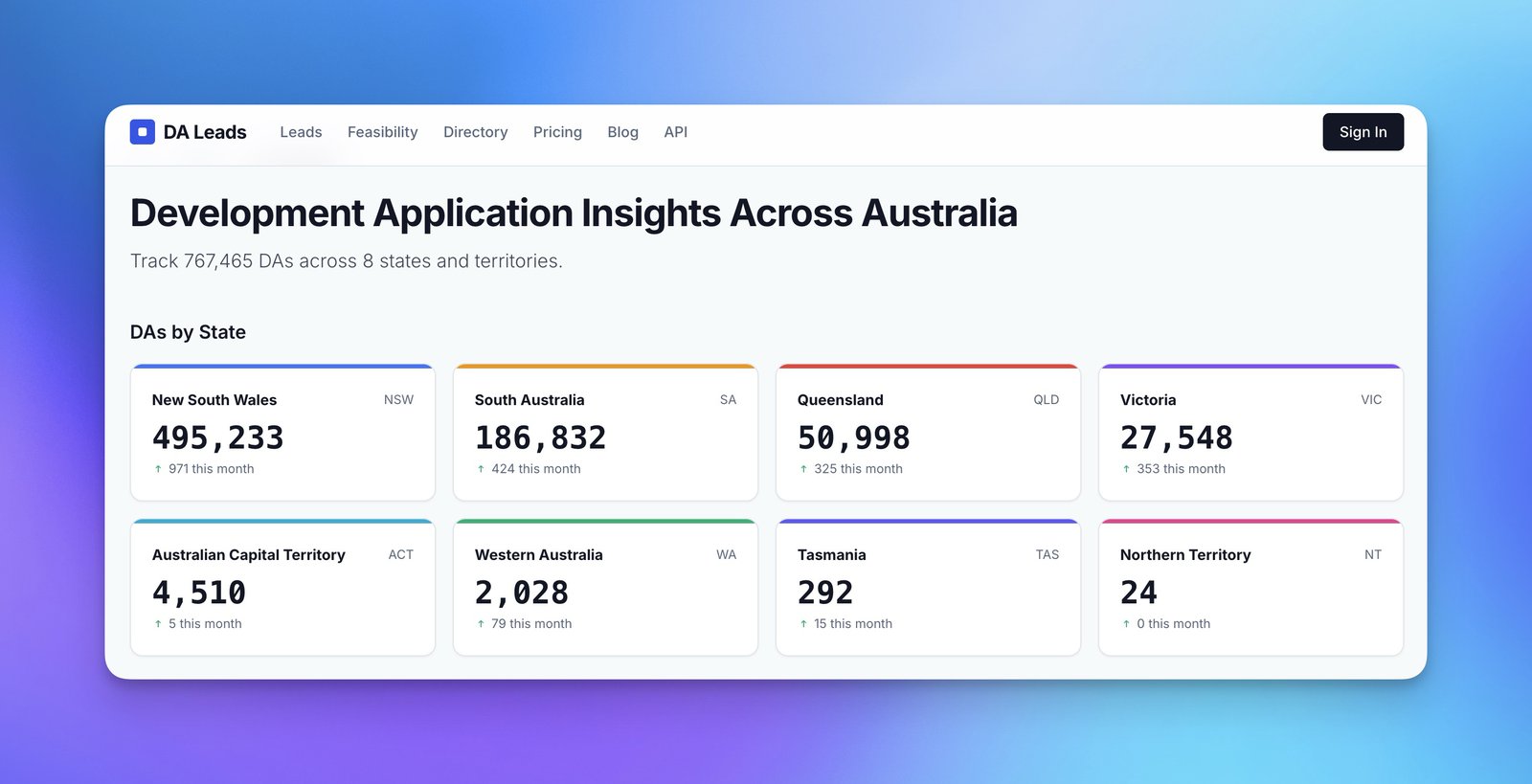
DA Leads insights dashboard, showing the national dataset and recent activity snapshot used to monitor the pipeline. Source: DA Leads product dashboard, checked 2026-04-10.
| Metric | Snapshot | Why it matters |
|---|---|---|
| Total DAs tracked | 769,008 | This is the core asset. Everything else sits on top of it. |
| 2026 DAs only | 44,343 | The pipeline is not just historical archive, it is current activity. |
| Councils covered | 358 | National enough to be useful, still uneven enough to need caveats. |
| Distinct trade categories | 26 | Useful only if the classification layer stays accurate. |
| Registered users | 26 | Real people are using it, but the market has not been won. |
| Paying subscribers | 2 | Brutal but clear. There is willingness to pay, not scale. |
| Core plan MRR | $98 | Inferred from 2 active Pro subscriptions at $49/month. |
| Published blog posts | 66 | Content has become part of the distribution engine, not a side project. |
The Problem Started With One Tradie
The first useful signal did not come from a grand market map. It came from a friend running a fencing business.
He was checking council websites by hand to find work. Not all of them. Just the handful he had time for. One council used a decent portal, another had a broken search, another posted PDFs, another buried everything three clicks deep. If he checked five or six councils in a week, that was already a lot. The rest just went dark.
That stuck with me because it was such a waste. The information was public. The demand was real. But the workflow was ridiculous.
So version one of DA Leads was exactly what you'd expect from a solo founder trying to prove a point fast: a Python script, a few Victorian councils, a rough SQLite database, and a daily CSV emailed to one person. Ugly. Useful. Good enough.
That was the correct place to start.
What The Product Actually Became
DA Leads is no longer just a lead list for tradies. It has turned into four different surfaces that all depend on the same underlying dataset.
| Product surface | What it does | Who it is for |
|---|---|---|
| Leads dashboard | Filters recent DAs by trade, suburb and council | Tradies, builders, subcontractors |
| Councils directory | Shows council-by-council volume and recent applications | Sales teams, operators, researchers |
| Feasibility tools | Pulls zoning, parcel and planning data into one workflow | Small developers and site assessors |
| API | Exposes structured DA data for downstream products | Proptech teams and data platforms |
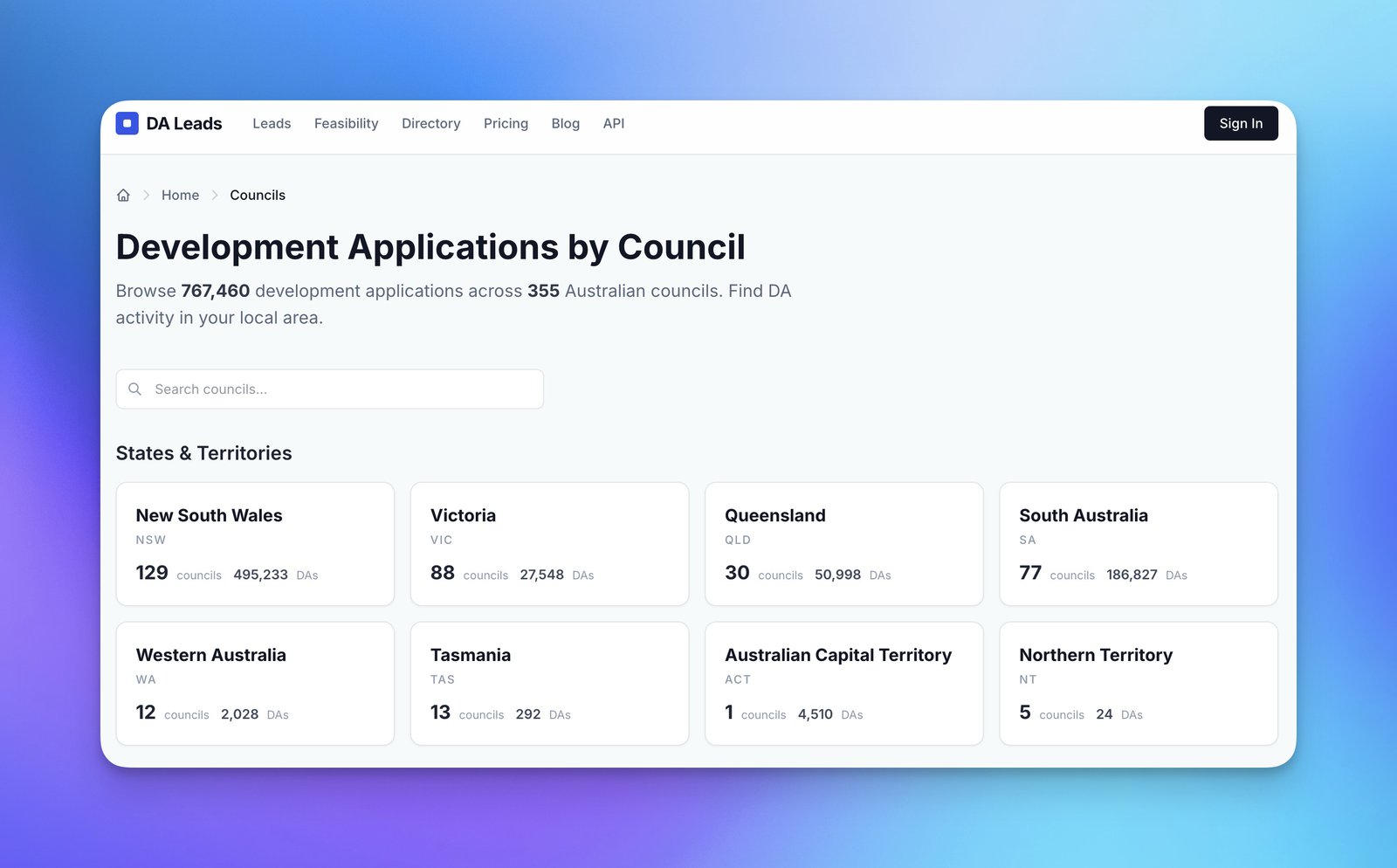
The councils directory turned the raw pipeline into something a normal user can scan quickly. Source: DA Leads councils directory, checked 2026-04-10.
The important part is not that there are four surfaces. The important part is that the same dataset powers all four. Once the data model got better, the product options multiplied.
That was the first real lesson. Build the asset first. The interfaces come later.
The Moat Was Not Scraping. It Was Normalisation
People hear "planning data" and assume the hard part is getting access. That is not the hard part.
The hard part is dealing with dozens of portal patterns, inconsistent council naming, partial fields, weird date formats, duplicated records, missing categories, and descriptions written like they were designed to confuse both humans and machines.
Getting one scraper working is engineering. Keeping 358 councils usable inside one schema is operations.
That is where the defensibility sits.
Current DA record counts by state and territory in the live database. Source: DA Leads internal database snapshot, queried 2026-04-10.
This unevenness matters. NSW alone holds 496,090 records. SA adds another 187,163. Victoria is broad in council count, 88 councils, but still much thinner in raw DA volume. WA, TAS and NT are usable in parts, not complete.
That sounds like a weakness. It is. But it is also useful honesty.
Users do not need fake certainty. They need to know where the data is strong, where it is thin, and whether the product is still worth using for their workflow. In NSW and SA, the answer is clearly yes. In WA or NT, the answer is often "sometimes, check before you rely on it."
What Worked Better Than I Expected
| Lever | What happened | Why it mattered |
|---|---|---|
| Raw DA coverage | Users tolerated a rougher interface than I expected | Good data buys you time to improve UX later |
| Database-backed content | Data-led posts felt stronger than generic SEO articles | The content became harder to copy |
| API surface | The product stopped looking like a single-use lead tool | The market got wider without rebuilding the core asset |
Useful data beat polished UX
Early on, the product looked nowhere near as good as it does now. But the people who cared did not complain about rounded corners. They cared that the dataset saved them time.
That was a relief because solo founders do not get to perfect everything at once. If you can remove two hours of repetitive work from someone's week, they forgive a lot of rough edges.
In hindsight, that sounds obvious. It wasn't. I still wasted time polishing things users barely noticed, when what really mattered was coverage, freshness, and category accuracy.
The best content came from the database, not from generic SEO ideas
I used to think content was a separate lane. Product over here, SEO over there.
Wrong.
The content that feels strongest now is the content only this dataset can produce: council rankings, trade hotspots, state comparisons, suburb patterns, and founder updates that use real operating numbers instead of startup theatre. As of 10 April 2026, DA Leads has 66 published blog posts. The useful ones are not the generic explainers. They are the ones backed by live data.
That changed how I think about blogging. I do not want to win by sounding generic. I want to win by showing something a competitor without this dataset cannot show.
Tradies were the wedge, but the API broadened the opportunity
I started from a tradie use case because it was concrete: show me new work near me.
That wedge still matters. It made the problem small enough to ship.
But the longer I worked on the data model, the more obvious the second market became. The same pipeline that helps a fence contractor find likely jobs can also help a proptech team track development activity, enrich suburb models, or plug DA signals into a product they already sell.
That is a much better business than "just another list of leads."
What Has Not Worked
| Constraint | Current reality | Consequence |
|---|---|---|
| Revenue | 2 active Pro subscribers, $98 inferred MRR | Useful signal, nowhere near PMF |
| Coverage mix | NSW and SA dominate the dataset | National messaging needs caveats |
| AI reliability | Drafting is fast, verification is not optional | Human review stays in the loop |
Revenue is still tiny
This is the part founders usually blur. I do not think that helps anyone.
DA Leads has 2 active Pro subscribers. On the current $49/month core plan, that implies $98 MRR. Not thousands. Not even hundreds beyond the first line. Just $98.
That is not product-market fit. It is not even close.
But it is not nothing either. Two people paying for a rough product is stronger evidence than a hundred polite compliments. I would take two payments over two thousand "interesting idea" comments every time.
Coverage is still lopsided
The state chart above is the truth, not a temporary presentation issue.
If you are a user in NSW, the product already feels much richer. If you are in SA, there is serious value too. If you are in Queensland, it depends on the council. If you are in Tasmania or the Northern Territory, I would not tell you to rely on the product blindly yet.
That creates a strange founder problem. The product can be very good for one user and not ready for the next person who lands on the homepage. Which means the marketing has to stay disciplined. Broad claims are tempting. Broad claims also backfire.
AI is helpful, but only inside a system that assumes it will be wrong
I learned this the hard way in both classification and content.
Keyword rules were too brittle. Pure model output was too loose. And AI-written copy looked fine until it got factual. Then the errors started stacking up.
So my current view is simple: AI is a force multiplier for the boring middle of the workflow, not a substitute for truth. Let it draft, classify, cluster, summarise, and suggest. Then verify the parts that can hurt trust, especially numbers, labels, and claims about planning rules.
That is slower than the fully automated dream. It is also how you avoid shipping nonsense.
What I Would Do Again
If I had to restart tomorrow, I would keep three decisions.
- Start with a painful workflow, not a giant market story. One tradie manually checking council portals was enough of a problem to begin.
- Build the dataset before the brand narrative. The asset compounds. Slogans do not.
- Tell the truth about the scoreboard. 26 users and 2 paying subscribers is not impressive. It is still more useful than pretending the business is further along than it is.
I would also keep the bias toward messy public data. Government systems are annoying. That is exactly why normalising them creates value.
Where This Goes Next
The next phase is not "scale everything." That would be lazy.
The next phase is narrower:
| Focus | Why now | What I am not doing |
|---|---|---|
| Deepen strong states | Better density beats shallow national claims | Pretending every state is equally mature |
| Productise the dataset | Pages, tools and API endpoints compound off the same asset | Building disconnected side projects |
| Fix conversion after value is obvious | The biggest leak is after users see the data, not before | Hiding weak retention behind more top-of-funnel activity |
- deepen the strongest states before pretending every state is equally ready
- keep turning raw records into pages, tools and API endpoints that solve a real workflow
- improve the parts of the funnel that happen after someone sees the value
Right now, DA Leads already has the beginnings of a real asset: 769,008 structured DA records, 44,343 from 2026 alone, 358 councils in the live database, and a product surface that is finally coherent enough to compound.
Still early. Very early.
But early with signal beats early with vibes.
If you work in Australian proptech, local construction lead generation, or site assessment, the best places to see what DA Leads is becoming are the API overview, the councils directory, and the national insights pages.
Sources and Further Reading
- DA Leads internal database snapshot, queried 2026-04-10
- DA Leads pricing
- DA Leads blog
- DA Leads councils directory
- DA Leads API overview
- DA Leads national insights


