
Residential still owns the visible DA pipeline in 2026. In the DA Leads database snapshot taken on 10 April 2026, a seven-category residential core accounts for 25,718 tracked applications. The commercial signal set I care about here, Commercial / Industrial + Change of Use + Signage / Advertising, accounts for 5,471.
That is not close on raw count.
But raw count is not the whole story either.
This article is not a dollar ledger. DA Leads tracks applications, not final contract value. So the better question is not "where is more money?" It is: where is the visible pipeline, and what kind of work does each side of that pipeline imply?
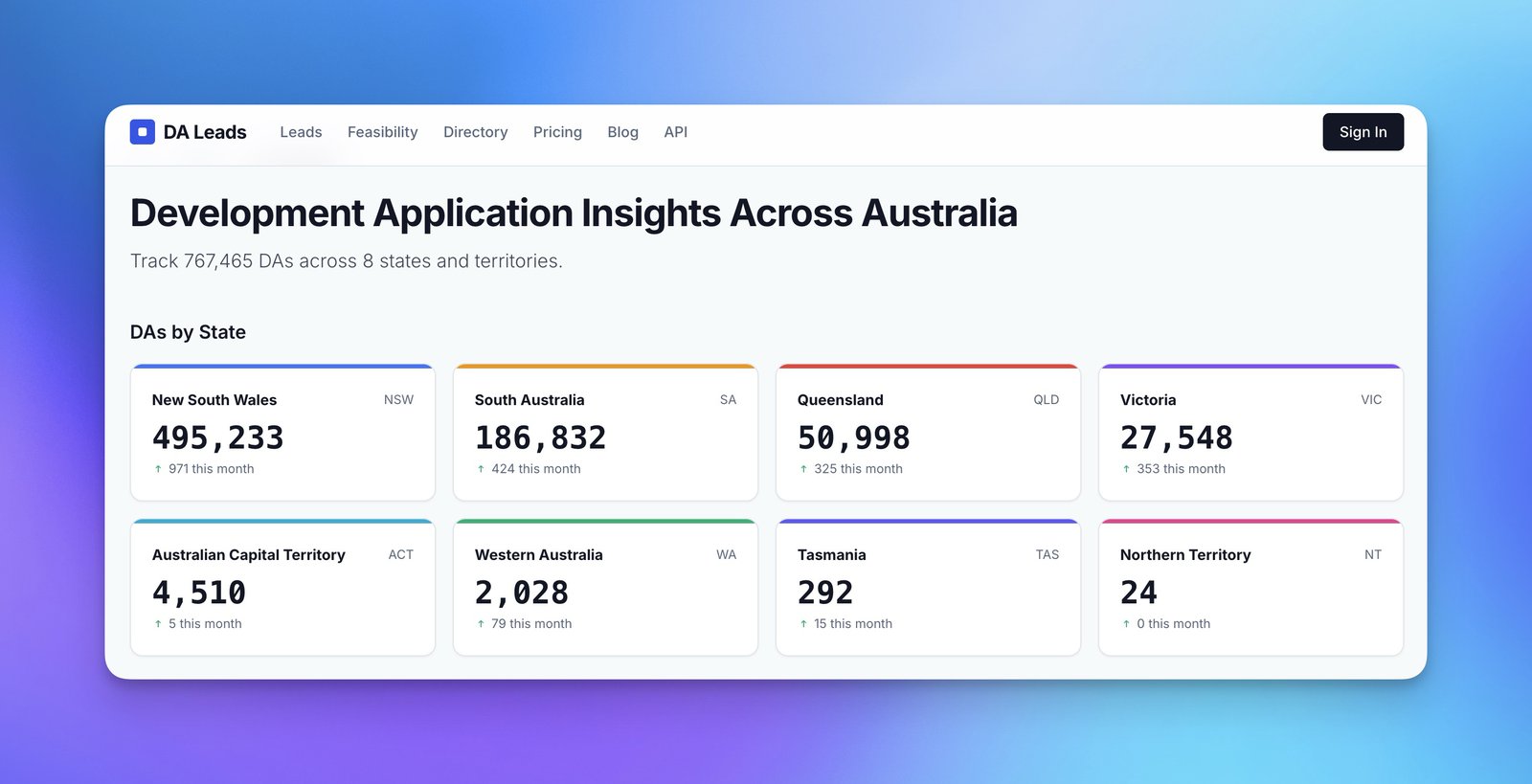
DA Leads insights dashboard used to monitor national application volume and category trends. Source: DA Leads product dashboard, checked 2026-04-10.
The Fast Answer
| Bucket | 2026 DAs | What it suggests |
|---|---|---|
| Residential core | 25,718 | Broader, more frequent, geographically repeated work |
| Commercial / Industrial | 3,211 | Fewer jobs, but often heavier and more specialist |
| Change of Use | 1,702 | Strong leading signal for tenancy repositioning and compliance work |
| Signage / Advertising | 558 | Small count, but often early evidence of business movement |
2026 DA counts by comparison bucket. Source: DA Leads internal database snapshot, queried 2026-04-10.
Three things jump out immediately:
- Residential dominates the count.
- Commercial signals are smaller, but not tiny.
- Change of use is big enough to track as its own market, not just a footnote inside commercial.
What "Residential" Means In This Comparison
I am not using "residential" as a vibe. I am using it as a practical cluster of categories that usually translate into homeowner-led or housing-led work.
The biggest 2026 categories inside that cluster are:
| Category | 2026 DAs |
|---|---|
| Renovation / Extension | 8,849 |
| New Dwelling | 5,201 |
| Garage / Carport / Shed | 4,005 |
| Swimming Pool / Spa | 2,919 |
| Granny Flat / Secondary Dwelling | 1,857 |
| Deck / Pergola / Patio | 1,646 |
| Multi-Dwelling / Townhouse | 1,241 |
That list explains why residential keeps winning on visible volume. It is not one giant category. It is multiple repeatable categories stacked on top of each other.
For many trades, that matters more than abstract market size. A renovation-heavy pipeline means more quote opportunities, more suburb repetition, and more work types that smaller operators can actually service.
Residential Still Owns The Broad Surface Area
At state level, the residential-core split looks like this:
| State | 2026 residential-core DAs |
|---|---|
| NSW | 15,459 |
| SA | 5,697 |
| QLD | 2,489 |
| VIC | 1,278 |
| WA | 508 |
| ACT | 242 |
| TAS | 39 |
| NT | 6 |
And the busiest residential-core councils in the current 2026 snapshot are:
| Rank | Council | State | Residential-core DAs |
|---|---|---|---|
| 1 | Logan City Council | QLD | 1,323 |
| 2 | Central Coast Council | NSW | 664 |
| 3 | Council of the City of Sydney | NSW | 536 |
| 4 | Onkaparinga Council | SA | 520 |
| 5 | Blacktown City Council | NSW | 512 |
| 6 | Lake Macquarie City Council | NSW | 477 |
| 7 | Northern Beaches Council | NSW | 427 |
| 8 | Canterbury-Bankstown Council | NSW | 407 |
| 9 | Camden Council | NSW | 390 |
| 10 | Liverpool City Council | NSW | 389 |
That is what residential volume looks like in practice: broad state coverage, lots of repeatable suburban work, and several councils where the pipeline is thick enough to support specialists.
Commercial Is Smaller, But It Has Different Signal Quality
Commercial and industrial work behaves differently in the database.
The count is lower. The signal density is not.
In 2026, the commercial-signal bucket, commercial / industrial + change of use + signage, totals 5,471 DAs. That is only about 12.3% of the full 2026 dataset, but it is still large enough to matter operationally.
Why? Because these applications often imply one or more of the following:
- more consultant input
- more compliance and services coordination
- larger scopes per job
- longer decision cycles, but stronger downstream packages
That is a different market, not merely a smaller one.
Change Of Use Is The Commercial Signal People Underestimate
Commercial / Industrial by itself has 3,211 DAs in 2026. That is useful, but the more interesting companion category is Change of Use at 1,702.
That matters because change-of-use jobs often reveal business movement before a full build-out lands. A tenancy repositioning, a food upgrade, a showroom conversion, or a medical-to-other-use shift can all show up there before the bigger package becomes obvious.
Signage is even smaller at 558, but I would not ignore it. Signage can be noisy. It can also be an early flag that a business is opening, moving, or rebranding.
For some contractors, especially fit-out, signage, electrical, HVAC, shopfitting, and hybrid builder teams, those signals are more commercially useful than asking "is commercial bigger than residential?"
Top councils by 2026 commercial-signal DAs, where commercial signals = Commercial / Industrial + Change of Use + Signage / Advertising. Source: DA Leads internal database snapshot, queried 2026-04-10.
Where Commercial Signals Cluster
At state level, the commercial-signal split is more concentrated than the residential one:
| State | 2026 commercial-signal DAs |
|---|---|
| NSW | 3,287 |
| QLD | 1,018 |
| SA | 590 |
| VIC | 451 |
| WA | 79 |
| ACT | 24 |
| NT | 13 |
| TAS | 9 |
And the top councils look different too:
| Rank | Council | State | 2026 commercial-signal DAs |
|---|---|---|---|
| 1 | Brisbane City Council | QLD | 440 |
| 2 | Camden Council | NSW | 195 |
| 3 | Blacktown City Council | NSW | 179 |
| 4 | Melbourne City Council | VIC | 156 |
| 5 | Liverpool City Council | NSW | 148 |
| 6 | Council of the City of Sydney | NSW | 144 |
| 7 | Moreton Bay Regional Council | QLD | 137 |
| 8 | The Hills Shire Council | NSW | 125 |
| 9 | Wollondilly Shire Council | NSW | 118 |
| 10 | Campbelltown City Council | NSW | 113 |
That tells a different story from the residential list. Commercial signals are not spread as evenly. They cluster harder in specific growth and business corridors.
What This Means For Different Trades
| Trade posture | Better market to prioritise | Reason |
|---|---|---|
| Residential-first trades | Residential core | Higher frequency, easier geographic repetition, lower friction jobs |
| Commercial-capable specialists | Commercial signals | Smaller count, but better fit for compliance-heavy and higher-scope work |
| Hybrid trades | Both | Painters, tilers, plasterers, electrical, and some builders can move across both clusters |
| Lead-generation teams | Commercial signals first, then residential volume | Commercial signals often identify higher-value conversations earlier |
This is the operational lens I would use:
- if your business needs frequent quoting opportunities, follow residential first
- if your edge is compliance, coordination, or bigger scopes, follow commercial signals
- if you can serve both, use residential for pipeline stability and commercial for upside
That is a much better framing than arguing over which side is "bigger."
How To Read This Inside DA Leads
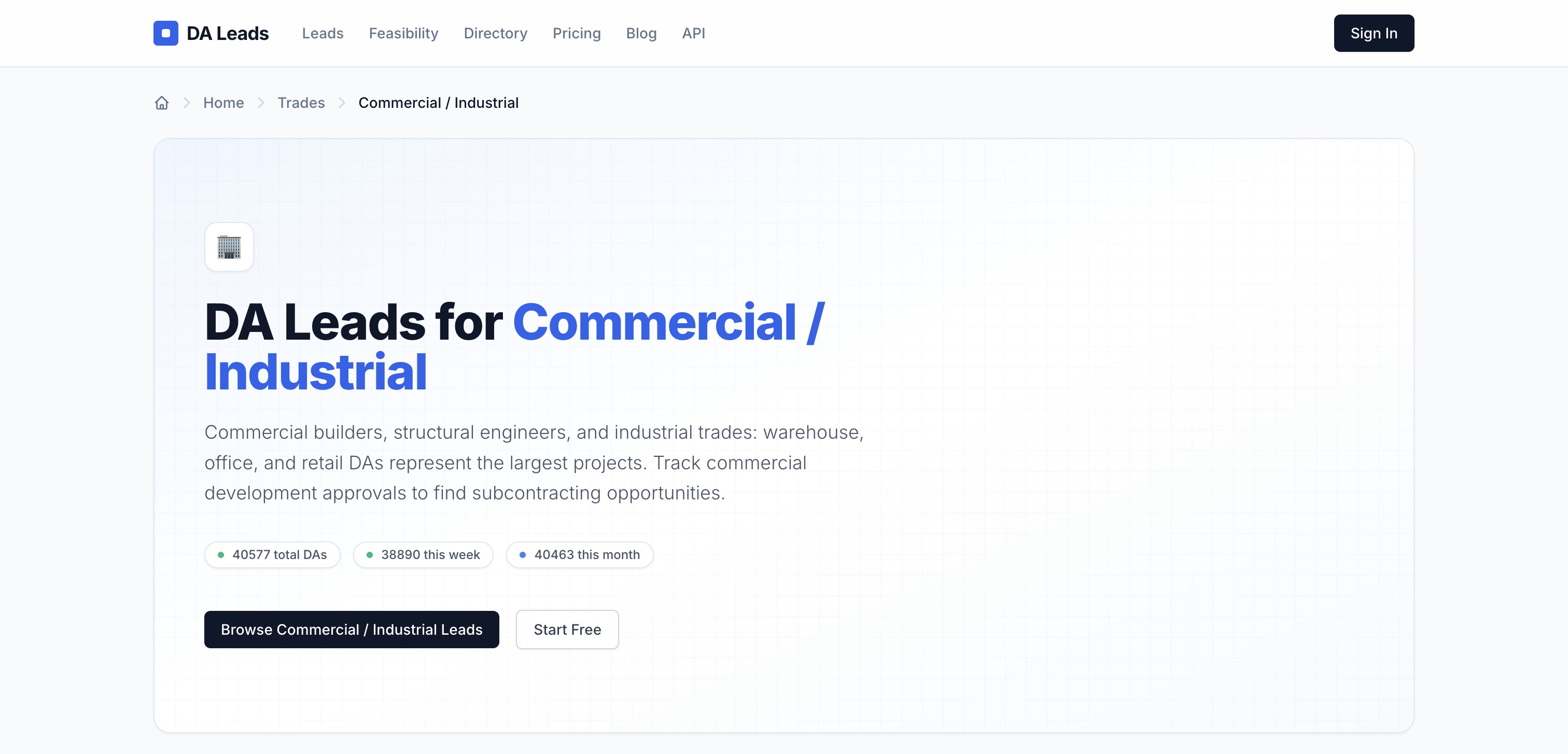
DA Leads trade page for commercial and industrial work, showing live applications and top councils. Source: DA Leads commercial / industrial category page, captured 2026-04-10.
If you want to use this comparison properly inside DA Leads:
- Start with the leads browser and filter by your actual service type.
- Check commercial and industrial leads if you want heavier, slower-moving opportunities.
- Check change-of-use leads if you care about tenancy movement and approval friction.
- Use the national insights pages and councils directory to see whether your region behaves more like a residential volume market or a commercial signal market.
The Bottom Line
In the current 2026 snapshot, residential core categories outnumber commercial signals by about 4.7 to 1. So if you only care about raw visible volume, residential wins comfortably.
But if your business makes money from more complex scopes, compliance-heavy jobs, or early tenancy-movement signals, then commercial categories still deserve attention well beyond their count.
That is the real comparison.
Not which side sounds bigger, but which side produces the work your team can actually win.
Sources and Further Reading
- DA Leads internal database snapshot, queried 2026-04-10
- DA Leads national insights
- DA Leads commercial and industrial leads
- DA Leads change-of-use leads
- DA Leads councils directory
- DA Leads leads browser


