
Multi-dwelling and townhouse developments are one of the most trade-intensive categories in Australia's DA pipeline. Our database currently tracks 121 applications in this category. Each one represents not a single home but a cluster of 2 to 6 or more dwellings being built on a single site.
So 121 DAs translates to an estimated 300 to 600+ individual dwellings. For tradies, the multiplier effect is real: every multi-dwelling project needs the same trades as a single house, but repeated across every unit on the site, so a single DA notification from one of these councils can represent three, four, or even six separate kitchens, bathrooms, driveways, and electrical fit-offs waiting to be quoted.
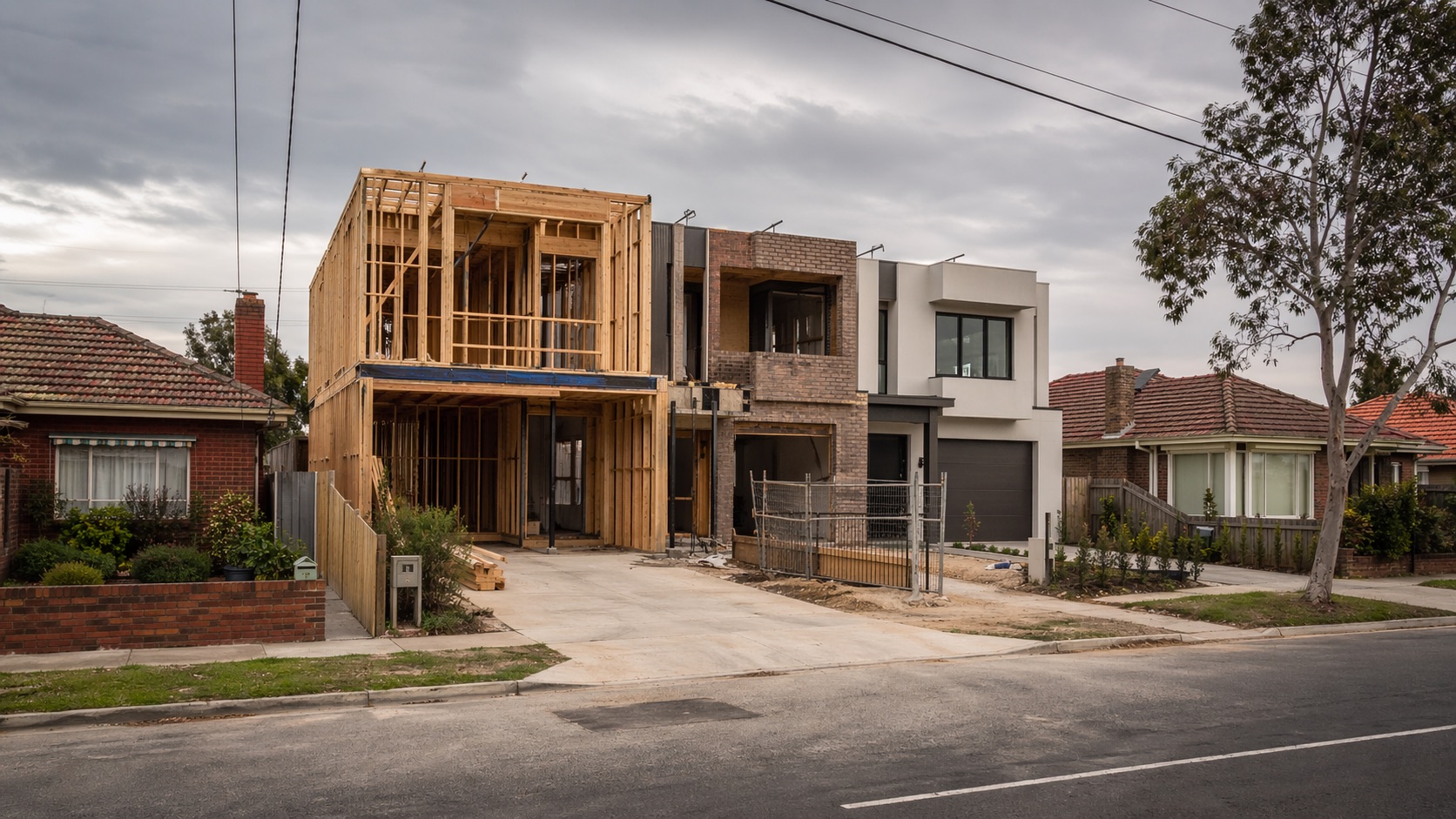
A typical Melbourne townhouse development: three units at different construction stages on a single lot, with older houses visible on the neighbouring properties.
The Scale of Multi-Dwelling Activity
| Metric | Number |
|---|---|
| Multi-dwelling / townhouse DAs | 121 |
| Estimated total dwellings | 300 to 600+ |
| Share of all DAs | 0.7% |
| Typical project size | 2 to 6 dwellings |
At 0.7% of total DA volume, multi-dwelling might look like a niche category. It is not. In terms of construction output, it punches well above its weight. A 4-unit townhouse development generates roughly 4x the trade work of a single house build, on trades like plumbing, electrical, plastering, and tiling.
Geography matters too. The projects cluster in specific suburbs and council areas, creating pockets of intensive building activity.
Where Multi-Dwelling Projects Are Concentrated
Multi-dwelling development clusters in two types of locations, and the drivers behind each are quite different.
Established middle suburbs with good transport access are the first. These are the areas where planning policy actively encourages medium-density housing. A single house on a 700sqm block gets knocked down and replaced with 3 townhouses. Or a corner block gets redeveloped into a 4-unit complex.
In Victoria, councils like Monash (188 total DAs), Boroondara (213), and Bayside (181) process a significant share of multi-dwelling applications. These are established suburbs with land values high enough to make townhouse development financially viable. The maths is simple: when a single lot is worth $1.5 million, replacing one house with three townhouses at $900,000 each makes the development margin hard to ignore, which is exactly why these inner-ring councils keep generating applications year after year.
Growth area fringe suburbs are the second hotspot. Here, multi-dwelling projects appear as part of mixed-density master-planned estates. The bulk of growth corridor DAs are still subdivision and single dwellings. But developers are increasingly slotting townhouse clusters into new estates to meet planning scheme requirements for housing diversity, and these medium-density pockets within larger master plans create concentrated work opportunities that trades can pick up without chasing projects across a wide area.
In NSW, Western Sydney councils like Canterbury-Bankstown, Liverpool, and Campbelltown are processing multi-dwelling DAs alongside their high-volume single dwelling pipelines.
| Trade | Why multi-dwelling pays more | Typical scope per 4-unit project |
|---|---|---|
| Plumbers | 4 sets of water/sewer connections plus shared drainage | 4 kitchens, 8+ bathrooms, shared stormwater |
| Electricians | Scale efficiency on one site plus common area work | 4 meter boards, intercom, common lighting |
| Concreters | Slabs, retaining walls, shared driveways all multiply | 4 slabs + shared driveway + boundary walls |
| Painters | Interior and matching exteriors across all units | 2-3 weeks continuous work per project |
| Landscapers | Council-mandated landscape plans for medium density | Common areas + individual courtyards |
| Fencers | Dividing fences, boundary fences, front streetscape | 3-4x the linear metres of a single house |
Why Multi-Dwelling Projects Matter More Per DA
A single multi-dwelling DA is worth significantly more in trade work than a single new dwelling DA.
Repetition on one site. A 3-townhouse project needs 3 kitchens, 3 sets of bathrooms, 3 electrical fit-offs, 3 driveways. But all the work is on the same site. Less travel time, more efficient scheduling, and better material buying power for the trades doing the work.
Shared infrastructure. Many multi-dwelling projects have common driveways, shared fencing, common landscaping, and joint stormwater systems. These shared elements are additional scope beyond what the individual units need.
Higher construction standards. Townhouses and multi-dwelling projects often require higher fire ratings, acoustic separation, and accessibility features compared to standalone houses. More specialised work for trades like fire services, acoustic installers, and access consultants follows directly from those requirements.
Longer project timelines. A single house might take 6 to 9 months from slab to handover. A 4-unit townhouse project typically runs 12 to 18 months. Longer timelines. More predictable cash flow.
The Trades That Benefit Most
Every trade involved in residential construction benefits from multi-dwelling activity. Some benefit disproportionately.
Plumbers sit at the top. Each dwelling needs its own water and sewer connections, hot water system, and bathroom/kitchen rough-ins. A 4-unit project means 4 sets of plumbing work, often with the added complexity of shared sewer lines and stormwater management. See plumbing leads.
Electricians benefit from scale. Wiring 4 townhouses on one site beats chasing 4 separate houses scattered across different suburbs. Add in common area lighting, intercom systems, and shared meter boards, and the electrical scope on a multi-dwelling project is substantial.
Concreters and bricklayers do the structural work. Slabs. Retaining walls. Driveways. Boundary walls. All multiply with unit count. Shared driveways and retaining walls between units add further scope.
Painters and plasterers finish every unit. Interior painting alone on a 4-unit project can keep a crew busy for 2 to 3 weeks. Exteriors need to match across all units, which means larger paint orders and more consistent scheduling.
Landscapers handle the common areas and individual courtyards. Multi-dwelling projects typically have more detailed landscaping plans than single houses, driven by council requirements for medium-density developments.
Fencing contractors install dividing fences between units, boundary fences, and often front fencing as part of the streetscape design. The linear metres of fencing per multi-dwelling project are significantly higher than for a single house. See fencing leads.
The Developer Perspective
For property developers, townhouse and multi-dwelling projects sit in a sweet spot. They're complex enough to require professional development management, but small enough to avoid the financing and regulatory hurdles of apartment towers.
A typical 3 to 4 unit townhouse project in Melbourne's middle suburbs might look like this:
- Site purchase: $1.2M to $1.8M for a single lot
- Construction: $1.5M to $2.4M for 3 to 4 units (roughly $400K to $600K per unit at project scale)
- End value: $2.7M to $3.6M across all units (at $900K each)
- Timeline: 18 to 24 months from purchase to settlement
These numbers explain why multi-dwelling DAs concentrate in suburbs where land values justify the development margin. For a walkthrough on checking the maths, see our property development feasibility guide. If you're seeing multi-dwelling DAs in a suburb, it's because the economics work there. And where the economics work, more projects will follow.
What to Watch
Multi-dwelling development is likely to grow as a share of total DAs. State governments across Australia are actively promoting medium-density housing as part of their housing supply strategies. Victoria's Housing Statement and NSW's housing targets both emphasise "missing middle" housing types, which includes townhouses and small multi-dwelling projects.
For tradies, the practical advice is simple: multi-dwelling DAs are worth tracking because each one represents a disproportionate amount of work. Our townhouse vs duplex profitability analysis compares the two most common formats. A suburb with 10 multi-dwelling DAs could generate as much trade work as a suburb with 30 or 40 single dwelling DAs.
Find Multi-Dwelling Leads in Your Area
We track multi-dwelling and townhouse DAs daily across all states. Filter by your council area to see what's in the pipeline.
Browse multi-dwelling leads or set up alerts to get notified when new townhouse projects land near you.
Sources and Further Reading
- Victoria's Housing Statement - state government policy on medium-density "missing middle" housing
- NSW Housing Targets - NSW government housing supply targets
- DA Leads internal database snapshot, queried 2026-02-07
- DA Leads council directory


