
Adelaide's CBD sits inside a single council area, the City of Adelaide, which covers the square mile grid plus North Adelaide and the surrounding parklands. Forty-three development applications are on the books. The inner city is experiencing a concentrated burst of building activity that reflects South Australia's broader economic momentum.
Unlike the greenfield subdivisions dominating Logan or Western Sydney, Adelaide's DA pipeline is all about infill, adaptive reuse, and vertical growth where heritage overlays and compact sites add layers of complexity you simply don't see on an outer-suburban subdivision. Different work. Different opportunities.
| Metric | Value |
|---|---|
| Total DAs | 43 |
| Top category | Mixed-use and apartment developments |
| Development type | Infill, adaptive reuse, vertical growth |
| Council | City of Adelaide |
| Key trades in demand | Fitout specialists, facade and heritage trades, MEP services |
| Key advantage | CBD commercial and mixed-use pipeline with higher project values than suburban residential |
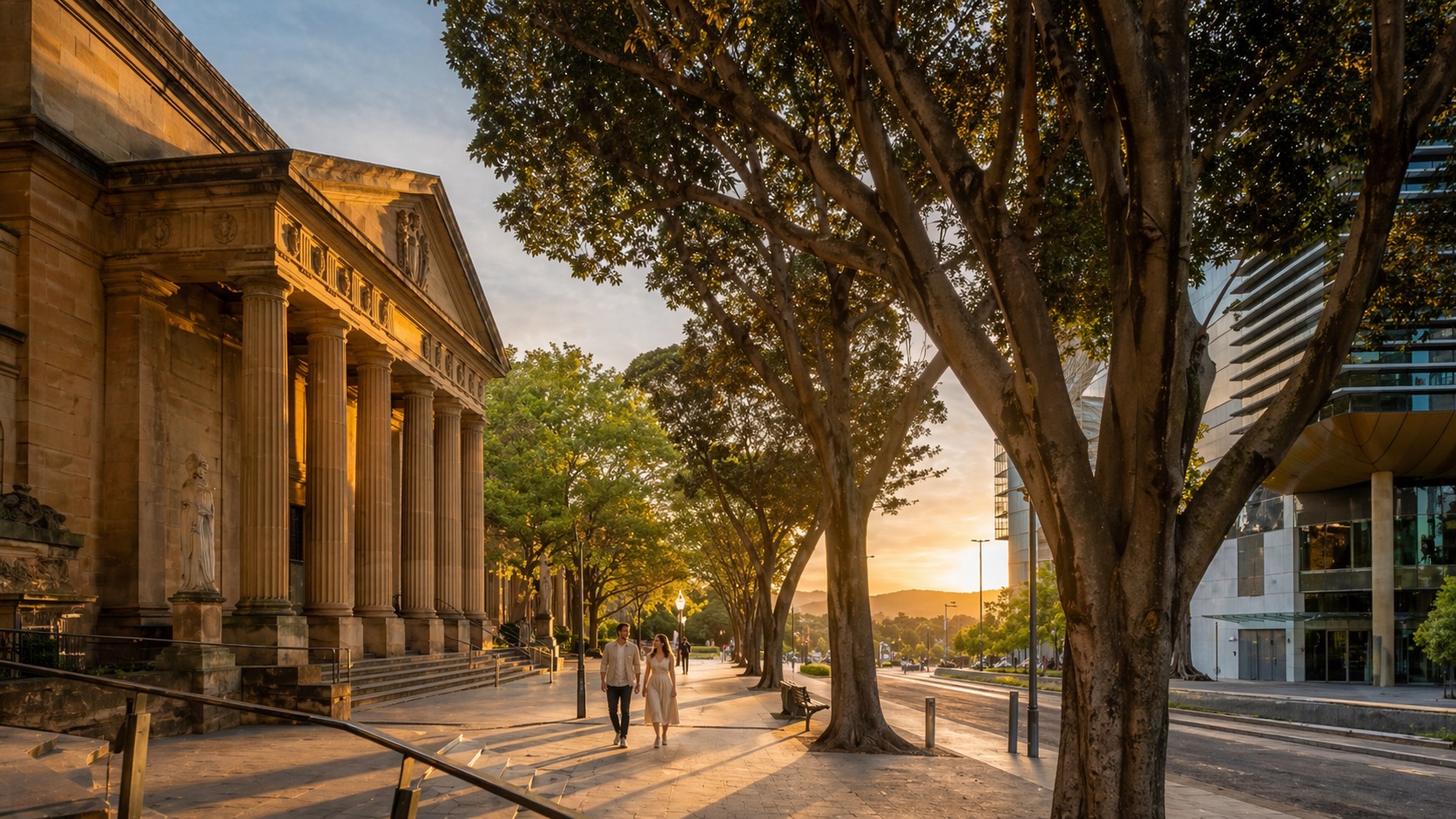
Adelaide's North Terrace: the Art Gallery, universities, and Moreton Bay figs. Development activity here skews commercial and heritage-sensitive, unlike the greenfield growth corridors.
What the DA Data Shows
Adelaide Council's 43 DAs skew heavily toward commercial and mixed-use development. This is a CBD, so the application mix looks nothing like a suburban growth area.
Mixed-use and apartment developments lead the pipeline. Adelaide has embraced medium-density living in the CBD more successfully than most Australian capitals. Purpose-built apartment projects, often with ground-floor retail or hospitality, are a consistent presence in the DA data.
Commercial fitouts and upgrades form the second major category. Office refurbishments, retail tenancy modifications, and hospitality venue builds reflect a CBD that's actively being reinvested in. The commercial core is compact. A single block can contain multiple active DAs.
Heritage-affected alterations are a notable segment. Adelaide's CBD has a significant stock of heritage-listed and contributory buildings, particularly along North Terrace, Rundle Street, and Hutt Street. Development on these sites requires careful navigation of heritage overlays, which adds complexity but also creates opportunities for specialist trades.
Why Adelaide's CBD Is Active
Several factors are converging to drive development in Adelaide's inner city.
State government investment. South Australia has poured money into CBD infrastructure, including the Adelaide Oval precinct, the new Royal Adelaide Hospital (now well established), and ongoing upgrades to the tram network that runs through the heart of the city and connects key development corridors. Public investment creates private confidence.
Defence industry growth. The Osborne shipyard (continuous naval shipbuilding program) and the broader defence precinct have attracted thousands of skilled workers to Adelaide. Many choose to live in or near the CBD, driving demand for apartments and townhouses.
Education and health precincts. The University of Adelaide, UniSA, and major hospitals within the CBD generate student accommodation, staff housing, and research facility development.
Relative affordability. Adelaide remains significantly cheaper than Sydney and Melbourne for both property purchase and commercial leasing. That affordability attracts developers who can make the numbers work on projects that wouldn't stack up in other capitals.
Planning reform. South Australia shifted to the Planning and Design Code. Red tape dropped. Compliant projects now move through assessment faster than they did under the old regime, and that speed matters when you are modelling holding costs.
What's Being Built
Apartments and residential towers in the southern and western CBD range from boutique 20-unit buildings to larger tower projects. Most include ground-floor commercial space.
Hotel and short-stay accommodation projects have repurposed several former office buildings as hotels or serviced apartments, driven by tourism and business travel.
Retail and hospitality fitouts continue to transform Adelaide's laneways and side streets with small bars, restaurants, and specialty retail. Every new venue means a fitout DA. And each fitout DA means a package of trade work for joiners, electricians, plumbers, and finishers.
Office conversions reflect the post-pandemic shift in commercial space demand. These projects are complex, involving structural modification, services upgrades, and facade work.
Tradies Working in the CBD
CBD construction work demands a different skill set and approach compared to suburban residential.
Fitout specialists are in constant demand. Commercial and hospitality fitouts cycle frequently, with tenancies turning over and being rebuilt every few years. If you do shopfitting, joinery, or commercial plastering, Adelaide's CBD has a reliable pipeline.
Facade and heritage trades command premium rates. Stonework restoration, heritage carpentry, and specialist rendering are needed on heritage-affected buildings where standard approaches don't meet planning requirements.
Services trades (mechanical, electrical, plumbing) are essential on every project. CBD sites typically involve complex services routing, working around existing infrastructure, and meeting higher standards for fire safety and accessibility.
Demolition and asbestos removal feature on conversion and redevelopment projects. Older commercial buildings often contain asbestos. Licensed removal is required before any structural work begins, and the remediation process on a multi-storey CBD building can run for weeks before the actual build starts.
CBD site logistics mean trades need to plan more carefully than on a suburban site: restricted access, limited laydown areas, noise regulations, and tight coordination with neighbouring tenants who are still operating during the build. But the project values are higher. And the work is often more technically interesting.
Developer Perspective
Adelaide's CBD offers development opportunities that have been priced out of Sydney and Melbourne. Lower land values. A relatively clear planning framework. Genuine end-user demand, particularly for apartments and mixed-use, driven by defence workers, university students, and hospital staff who want to live close to where they work.
The key considerations for developers are heritage overlays, parking requirements (which are being relaxed in parts of the CBD), and the competitive landscape of other projects in the pipeline. If you are buying into a development site, understanding stamp duty implications for SA developers is worth doing early in your feasibility work.
For feasibility analysis on specific CBD sites, our feasibility calculator supports South Australian zones and planning parameters. The SA provider pulls data from PlanSA to give you accurate zoning and overlay information.
Tracking Adelaide's Pipeline
Adelaide Council's 43 DAs represent a concentrated pocket of development activity in South Australia's most important economic centre. It is one of several growth suburbs where development is happening across the country. The mix of commercial, residential, and mixed-use projects creates opportunities across a wide range of trades and development types.
Browse all Adelaide Council DAs to see the current pipeline, or visit our SA insights page for statewide development trends. South Australia's 1,539 total DAs show that development activity extends well beyond the CBD.


