
South Australia often looks attractive to developers because Adelaide site prices are lower than Sydney or Melbourne. But the useful question is not whether South Australia is "cheap". It is whether RevenueSA's current duty and relief settings still support the kind of product you are trying to build and sell.
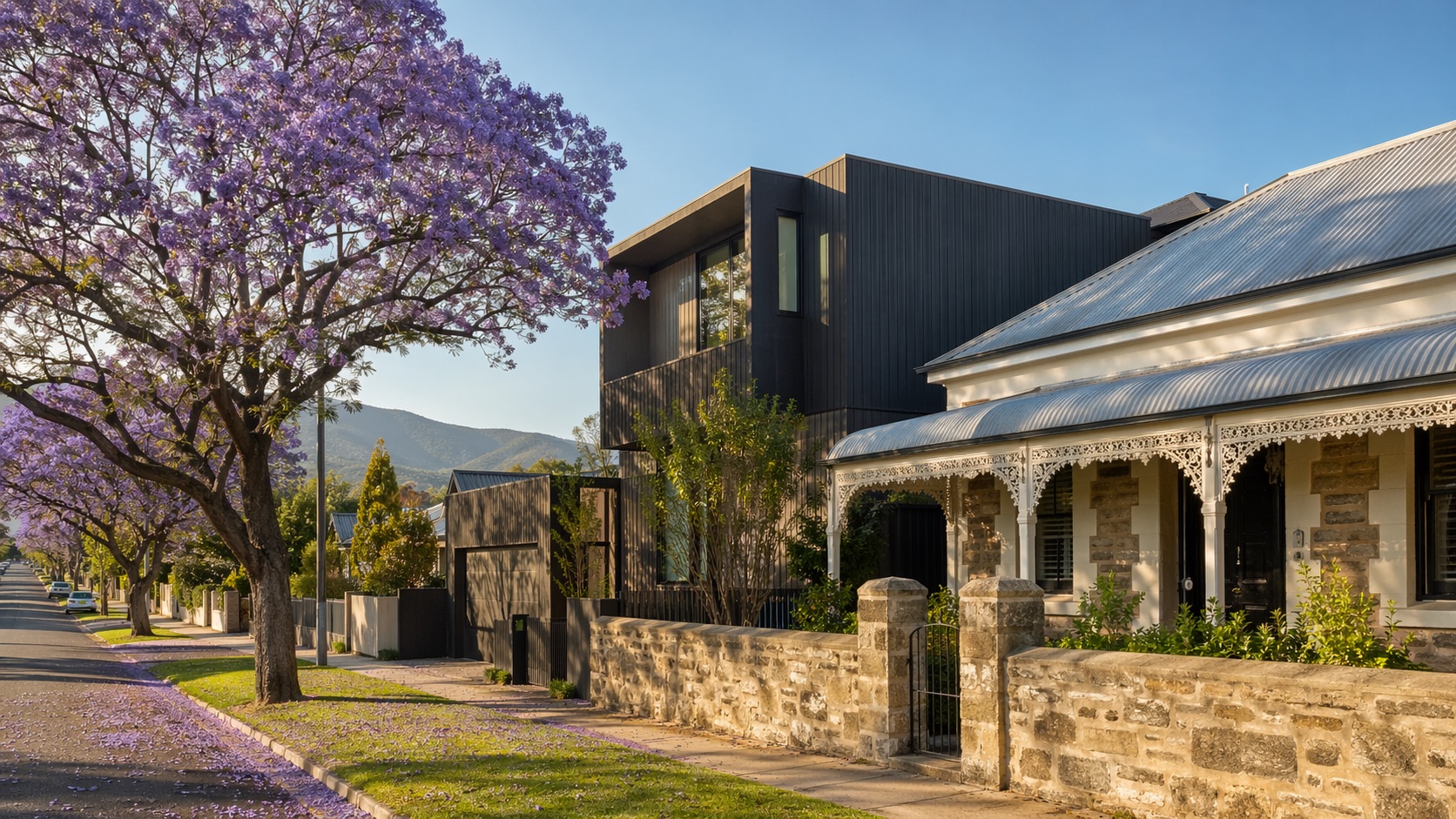
Adelaide development: Edwardian bungalows alongside modern infill. The site prices are lower, but RevenueSA's duty brackets, land tax thresholds, and trust structures still shape the feasibility.
The Fast Answer
SA transfer duty runs from 1.0% on the first $12,000 up to a top marginal rate of 5.5% above $500,000. On a $750,000 site acquisition, that works out to roughly $35,080 in duty before any relief is applied.
The most commercially relevant SA questions are:
- what duty applies on acquisition (nine graduated brackets, top rate 5.5%)
- whether the 7% foreign ownership surcharge is in play
- whether the end buyer qualifies for the new-home stamp duty abolition or the $15,000 First Home Owner Grant
- what land tax looks like if the site is held in a trust ($25,000 threshold) versus personally ($833,000 threshold)
| Setting | Current Figure |
|---|---|
| Transfer duty top rate | 5.5% on value above $500,000 (base $21,330) |
| First home buyer relief (new homes) | Full stamp duty abolition, no property price cap |
| First home buyer relief (vacant land) | Full stamp duty abolition for eligible vacant land to build on |
| First Home Owner Grant | $15,000 cash grant for new homes, no price cap |
| Foreign ownership surcharge | 7% surcharge on top of standard duty |
| Land tax threshold (general) | $833,000 tax-free; 0.5% to 2.4% above that |
| Land tax threshold (trusts) | $25,000 tax-free; 0.5% to 2.4% above that |
| GST margin scheme | Available if acquisition and sale qualify; must be documented at contract |
SA Transfer Duty Brackets at a Glance
SA uses nine graduated brackets. Here is the full rate table:
| Property Value | Duty Calculation |
|---|---|
| Up to $12,000 | $1.00 per $100 |
| $12,001 to $30,000 | $120 + $2.00 per $100 above $12,000 |
| $30,001 to $50,000 | $480 + $3.00 per $100 above $30,000 |
| $50,001 to $100,000 | $1,080 + $3.50 per $100 above $50,000 |
| $100,001 to $200,000 | $2,830 + $4.00 per $100 above $100,000 |
| $200,001 to $250,000 | $6,830 + $4.25 per $100 above $200,000 |
| $250,001 to $300,000 | $8,955 + $4.75 per $100 above $250,000 |
| $300,001 to $500,000 | $11,330 + $5.00 per $100 above $300,000 |
| Over $500,000 | $21,330 + $5.50 per $100 above $500,000 |
For context: duty on a $600,000 acquisition is $26,830. On $1,000,000 it is $48,830. There is no premium property surcharge in SA, unlike NSW or VIC, so the 5.5% top rate is the ceiling regardless of price.
Why SA Still Matters for Developers
SA can still work for smaller and mid-market developers because:
- entry prices can be more manageable than eastern-state capitals
- the full stamp duty abolition for first home buyers of new homes directly supports demand for your end product
- the $15,000 First Home Owner Grant stacks on top of that relief, giving buyers up to $15,000 plus the full duty saving
- the broader Adelaide market still offers projects that do not require Sydney-scale margins just to survive acquisition cost
That said, the tax structure still matters, especially when projects are held or staged over time.
First Home Buyer Relief Is a Real Exit-Side Lever
Since June 2023, SA has abolished stamp duty entirely for first home buyers purchasing a new home. There is no property price cap on this relief, which makes it one of the most generous first home buyer settings in Australia.
On top of that, the $15,000 First Home Owner Grant applies to new residential properties with no price cap either. The grant was expanded from $10,000 to $15,000 and the previous property value limits were removed.
What this means in practice:
- a first home buyer purchasing a $550,000 new townhouse saves roughly $24,080 in stamp duty and receives $15,000 cash, for a combined benefit of about $39,080
- relief also extends to eligible vacant land purchases where the buyer intends to build their home on it
- the buyer must be a natural person, at least 18, and at least one applicant must be an Australian citizen or permanent resident
In practice, developers selling new homes or eligible vacant-land product into the first home buyer cohort can benefit from significantly stronger demand than the raw purchase price alone would suggest. A $550,000 new townhouse effectively competes with a $510,000 existing home once the buyer accounts for the combined relief.
Foreign Ownership Surcharge: 7% on Top
SA imposes a 7% foreign ownership surcharge on top of the standard transfer duty for residential property purchases by foreign persons or entities. On a $600,000 purchase, that is $42,000 in surcharge alone, plus the $26,830 standard duty, for a total of $68,830.
The practical consequence for developers:
- if you are marketing to any offshore or foreign-entity buyers, the combined duty burden is roughly 11.5% of purchase price at the $600,000 mark
- entity and trust structure can trigger the surcharge even when the human buyer is Australian. A company or trust with a foreign person as a beneficiary, director, or substantial shareholder can be classified as a "foreign person" under the Act
- discretionary trusts are especially exposed because RevenueSA can treat all potential beneficiaries as relevant
This should be resolved before exchange, not during settlement prep.
Holding Structure Matters in SA
Land tax in SA can look very different depending on who holds the site. The gap between the general threshold and the trust threshold is enormous:
General land tax (individual owners, 2025-26):
| Total Taxable Site Value | Tax Payable |
|---|---|
| Up to $833,000 | Nil |
| $833,001 to $1,338,000 | 0.5% of value above $833,000 |
| $1,338,001 to $1,946,000 | $2,525 + 1.0% above $1,338,000 |
| $1,946,001 to $3,116,000 | $8,605 + 2.0% above $1,946,000 |
| Over $3,116,000 | $32,005 + 2.4% above $3,116,000 |
Trust land tax (discretionary, fixed, unit trusts, 2025-26):
| Total Taxable Site Value | Tax Payable |
|---|---|
| Up to $25,000 | Nil |
| $25,001 to $833,000 | $125 + 0.5% above $25,000 |
| $833,001 to $1,338,000 | $4,165 + 1.0% above $833,000 |
| $1,338,001 to $1,946,000 | $9,215 + 1.5% above $1,338,000 |
| $1,946,001 to $3,116,000 | $18,335 + 2.4% above $1,946,000 |
| Over $3,116,000 | $46,415 + 2.4% above $3,116,000 |
The practical gap: on a development site with a taxable site value of $1,000,000, an individual owner pays $835 per year in land tax. The same site held in a discretionary trust pays $5,000 per year. Over a two-year approval and construction period, that is an $8,330 difference in holding cost.
The structure choice can materially change the holding-cost line while the project moves through approvals.
GST and the Margin Scheme
Like every other state, SA developers still need to separate transfer duty from GST while modelling them together.
If the acquisition and later sale qualify, the margin scheme can materially change the GST outcome. That should be structured and documented properly, not assumed from a rough blog example.
Practical Advice for SA Developers
- Run the actual duty number on your acquisition price. On a $750,000 site, you are looking at roughly $35,080 in transfer duty. That is real money in your feasibility, not a rounding error.
- Check whether first home buyer relief on the end product strengthens your pricing strategy. If you are building new homes or townhouses for first home buyers, the full stamp duty abolition plus the $15,000 grant is a genuine demand lever.
- Model foreign surcharge exposure early. The 7% surcharge can add $42,000 to a $600,000 purchase. If any part of your buyer pool includes foreign entities, this needs to be in the feasibility from day one.
- Model land tax under the actual holding structure. A trust-held $1M site costs roughly $5,000/year in land tax versus $835/year for an individual. Over a multi-year project, that compounds.
- Treat SA affordability as an advantage only after the tax settings are confirmed. Lower site prices mean nothing if the duty, surcharge, and holding costs erode the margin.
The Bottom Line
SA can still be one of the more workable states for smaller developers. The top transfer duty rate of 5.5% is lower than VIC or NSW, there is no premium property surcharge, and the first home buyer settings are genuinely strong for new-home product. But those advantages only hold if you combine the lower entry price with realistic modelling of your actual duty bill, your holding structure's land tax exposure, and any foreign buyer risk in your sales mix.
Run these numbers through our feasibility calculator before you commit to a site. For a national comparison of how SA stacks up against other states, see our stamp duty guide for property developers. And if your SA project involves subdivision, our subdivision process guide covers the steps from lot creation to title.


