
If you want better demolition leads in Victoria, stop treating every demo record as a knockdown-rebuild. The current DA Leads MySQL snapshot shows a much narrower reality: 86 Victorian demolition records lodged in 2026, 281 since 1 January 2025, and 306 all-time across 22 councils. The visible pipeline is real, but it is not broad. It is concentrated.
Even more important, the category is mixed. Some records are full redevelopment signals. Some are partial demolition tied to an addition. Some are internal strip-outs, balcony removals, front fences, or heritage-controlled facade work. If you do not separate those, you will waste time pricing the wrong jobs.
That is the real takeaway. Demolition is not a high-volume bucket in Victoria. It is a high-context bucket. The money is usually in reading what comes after the demo, not in chasing every address with the word "demolition" in it.
Why Demolition Leads Are Better Than They Look
The best demolition leads are rarely "just demo." They are usually the first visible step in a longer approval chain.
- A building permit application for demolition puts the owner inside a formal process.
- Report and consent can add delay, paperwork, and more council visibility.
- Heritage or planning controls can turn a simple removal into a staged redevelopment job.
That stacked path is exactly why demolition can be a better lead source than a generic quote request. By the time the work appears in the approval system, the owner is already spending money and making commitments.
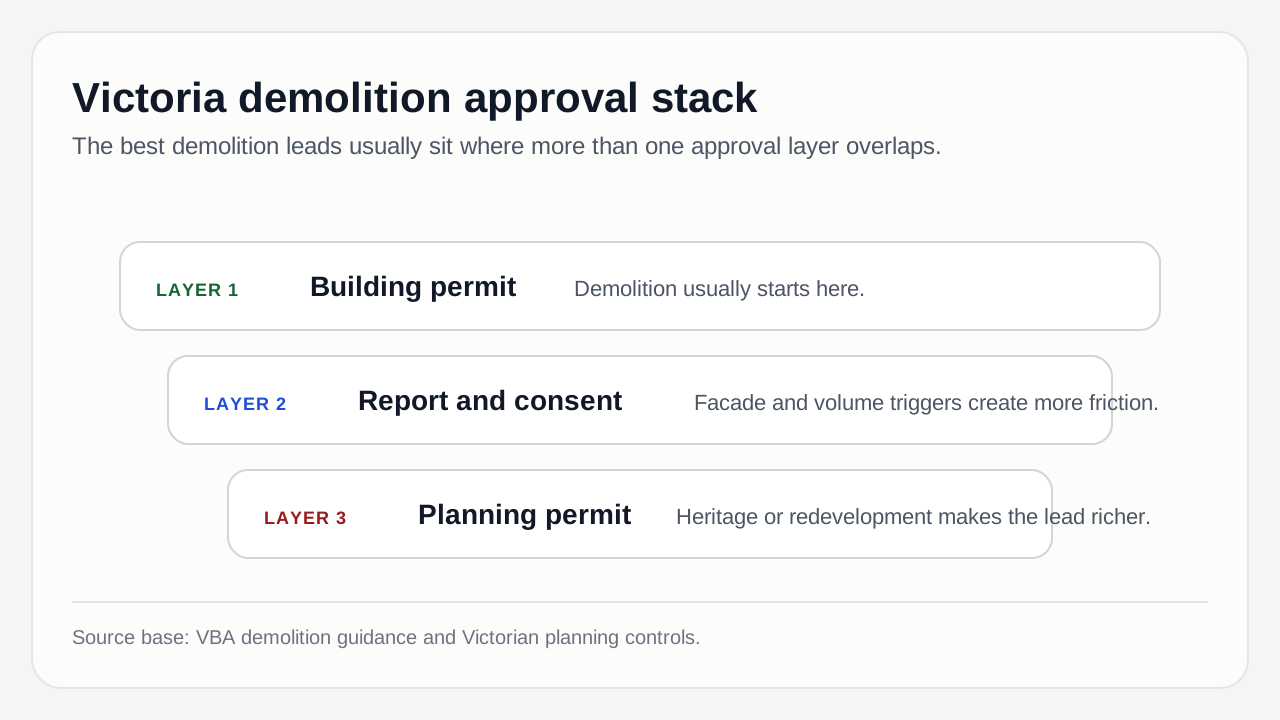
Victoria demolition approval stack: demolition jobs often move through building permit controls first, with extra planning or report-and-consent layers depending on the site. Source: DA Leads synthesis of Victoria demolition approval requirements.
Where the Visible Pipeline Actually Sits
This market is not spread evenly across Victoria. It is heavily concentrated in inner-metro councils where redevelopment pressure and heritage friction overlap.
Visible demolition work is highly concentrated in Melbourne City and Stonnington rather than evenly spread across the state. Source: DA Leads internal MySQL snapshot, queried 2026-04-12.
| Council | Records since 2025-01-01 | Why it matters |
|---|---|---|
| Melbourne City Council | 175 | By far the biggest visible signal, with balcony removals, internal demolition, facade-sensitive work, and heritage-linked approvals |
| City of Stonnington | 57 | Strong for heritage and part-demolition jobs tied to higher-value residential redevelopment |
| Darebin City Council | 8 | Lower volume, but useful if you want established-suburb redevelopment signals outside the CBD core |
| City of Yarra | 7 | Small but active, with outbuildings, fences, and part-demolition jobs that often sit inside broader works |
| Boroondara City Council | 6 | Fewer records, but better odds of planning friction and serious clients |
If you only build one Victorian demolition watchlist, start with Melbourne City and Stonnington. Everything else is secondary until the volume changes.
Not Every Demolition Record Is a Teardown
This is the mistake most contractors make. They see "demolition" and assume a clean knockdown. The descriptions say otherwise.
| Recent description | What it usually means |
|---|---|
Partial demolition and construction of an outbuilding |
Partial works, likely tied to a rear addition or secondary structure, not a full-site clearance |
Demolition of a rear outbuilding |
Small scope, useful only if you profit on tight, quick jobs |
Internal demolition works at Level 5 |
Commercial strip-out, not a residential house demo lead |
Demolition of an existing balcony within a Heritage Overlay |
Small scope but high compliance friction, often better for specialist operators than volume crews |
Proposed Demolition, Construction of 7 New Cabins and Removal of Native Vegetation |
Strong redevelopment signal, multi-stage, likely worth more follow-up than a simple removal |
That last line is the money line. You are not just looking for demolition. You are looking for demolition that proves a second budget is already forming behind it.
The Rule Stack That Makes a Lead More Valuable
Victoria demolition jobs get more valuable when the permit path gets more complicated.
| Rule | Official position | Why it matters commercially |
|---|---|---|
| Building permit pathway | VBA DE-01 says the RBS must consider an application for a building permit to demolish or remove a building, and Regulation 26 sets the required documentation | Good lead signal because the owner is already inside a formal approval process |
| Report and consent: volume test | Section 29A requires report and consent if demolition, together with demo completed or permitted in the previous 3 years, amounts to more than half the building's volume | Bigger or staged demolition jobs become more visible and slower to move, which usually means better-qualified leads |
| Report and consent: facade test | Section 29A also requires report and consent where demolition affects any part of a street-facing facade that is at least partly visible from the street | Facade-sensitive jobs are often more planning-heavy and less price-driven |
| Partial demolition still counts | VBA DE-01 says demolition includes permanent removal of all or part of an existing building, including work to make way for an addition | Do not ignore partial demolition. It can be the first signal of a larger extension or redevelopment |
| Heritage Overlay planning trigger | VBA DE-01 says a Heritage Overlay in the planning scheme generally provides that a planning permit is also required for demolition | These jobs are slower, but usually stronger, because the owner cannot solve them with a quick handyman call |
This is why simple volume filtering is not enough. The best leads are the ones where demo sits next to facade controls, heritage language, or obvious redevelopment wording.
The Description Markers Worth Prioritising
Some phrases show up again and again in the tracked data. They do not all mean the same thing.
These markers are not exclusive categories. They are wording signals inside demolition descriptions that help separate better leads from low-value cleanup work. Source: DA Leads internal MySQL snapshot, queried 2026-04-12.
How to read them:
- Heritage Overlay often means the job is slower, more documented, and less likely to be a race-to-the-bottom price enquiry.
- Partial demolition often points to additions, extensions, and staged redevelopment rather than bare-site clearing.
- Construction mentioned is the clearest clue that the demolition is only phase one.
- Internal demolition can still be valuable, but it is often commercial strip-out rather than structural teardown.
- Fence / balcony / outbuilding records can be fine filler work, but they are not the highest-value signal by default.
If you only have time to follow up ten records this week, pick heritage-linked, partial-demolition, and construction-linked jobs first. Leave the isolated fence or balcony removals until later.
Timing Matters More Than Seasonality
Demolition does not need a fake "spring rush" story. What matters is when the job becomes visible and what still has to happen after it.
Recent visibility lifted through late 2025 and again in February to March 2026. The better takeaway is not a neat seasonality rule. It is that active monitoring catches jobs before site mobilisation. Source: DA Leads internal MySQL snapshot, queried 2026-04-12.
Once a demolition job is visible, the clock starts. If the description already shows partial demolition, heritage constraints, facade issues, or linked construction, you are early enough to be useful. If you wait until the builder stack is fully assembled, you are late.
How Demo Contractors Should Work This List
- Start with the demolition trade page, then watch Melbourne City Council and City of Stonnington first.
- Do not filter for the word
demolitionalone. The better signal is demolition plusconstruction,partial demolition,Heritage Overlay, or a street-facing facade issue. - Treat partial demolition as a serious lead, not a weak one. The official VBA guidance treats removal of part of a building as demolition when it is permanent.
- Split your workflow into two buckets: redevelopment-linked jobs first, low-scope removals second.
- Cross-check related categories like multi-dwelling / townhouse, renovation hotspots, and commercial fit-out approvals if the description hints at what comes next.
The demolition job is rarely the whole opportunity. In Victoria, it is usually the earliest visible sign that the real project has already started.
See demolition DAs across Victorian councils on DA Leads. If you want better-quality work, read past the word demolition and chase the records that already show friction, approvals, and phase-two intent.
Sources and Further Reading
- Victorian Building Authority, DE-01 Demolition of buildings - Report and Consent
- DA Leads internal MySQL snapshot, Victoria
Demolition, queried 2026-04-12


