
Most commercial fit-outs do not start with the walls or the joinery. They start with one question: is this still the same lawful use, or are you changing the use of the premises?
That answer usually tells you whether the job stays in the building-compliance lane, or whether planning approval is about to enter the picture as well.
The Fast Answer
| Scenario | Likely planning impact | Building impact |
|---|---|---|
| Same use, cosmetic fit-out | Often no planning approval | Still check fire systems, exits, certifier triggers, and lease conditions |
| Same use, structural changes | Planning may still stay limited | Building surveyor and NCC compliance become critical fast |
| Change of use | Planning approval risk rises quickly | NCC class, fire, access, parking, and services may all shift |
| Food, medical, assembly, fitness | Usually higher-friction than a standard office or retail refresh | Extra standards, inspections, or operating controls often apply |
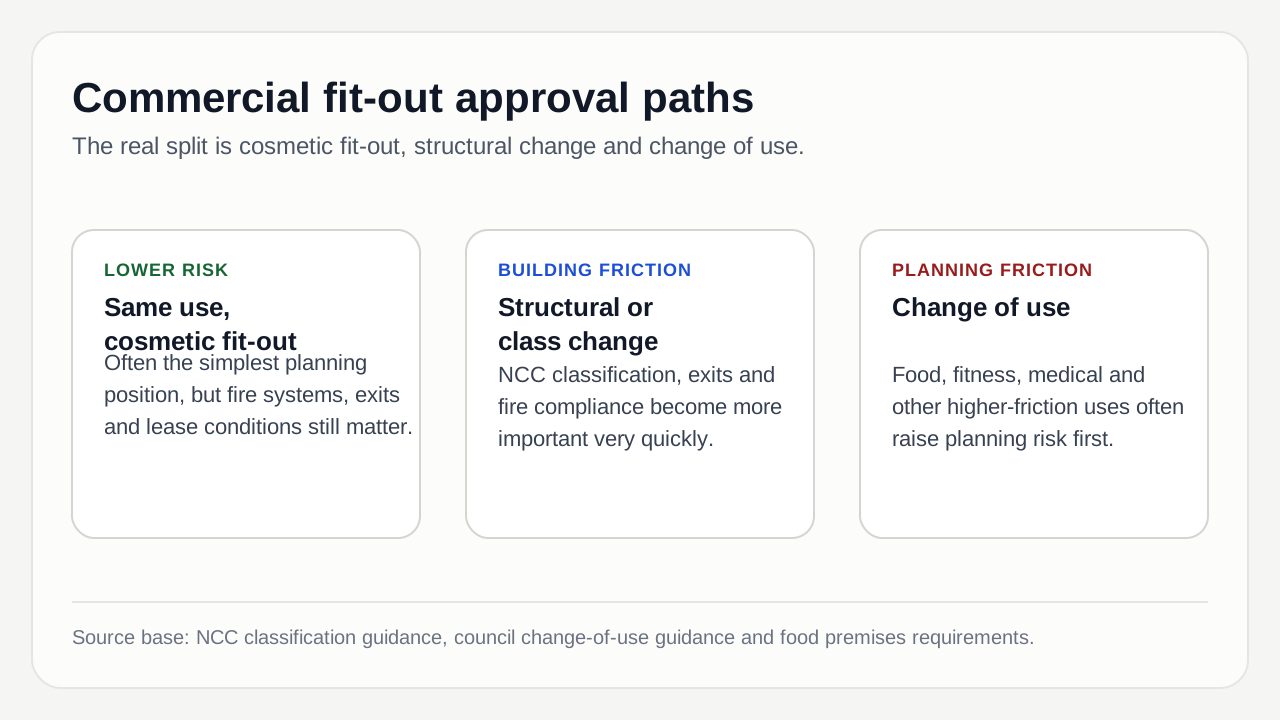
Commercial fit-out approval paths: same-use cosmetic work usually stays in the building-compliance lane, while structural or class changes and change of use raise approval friction quickly. Source: DA Leads synthesis of ABCB building classification guidance, NSW Planning guidance, and NSW Food Authority requirements.
If you only remember one thing, remember this: planning use, NCC class, and sector-specific regulation are three separate checks. A job can clear one and fail the other two.
The Three Approval Lanes
| Approval lane | What it asks | Typical trigger |
|---|---|---|
| Planning | Is the proposed use permitted here, and is this still the approved use? | Change of use, new hours, parking, loading, heritage, waste, signage |
| Building | Does the work or use change trigger a different NCC outcome? | Class change, fire upgrades, access, exits, ventilation, structural work |
| Sector overlays | Does this use attract extra operating rules? | Food premises, health care, childcare, fitness, licensed venues |
This is why so many commercial jobs go wrong at quoting stage. The tenant thinks they are "just doing a fit-out." The contractor hears "minor internal works." The planner or certifier arrives later and says, no, this is actually a use change with compliance consequences.
That is expensive rework.
The Key Trigger: Same Use or Change of Use?
Planning systems care about what the tenancy is used for, not just how it looks inside.
So before you price anything, ask for the current approved use, not just the new tenant brief.
In NSW, the business and industry pocket guide says a change of use may not need planning approval if it falls within exempt development, usually where the new use is similar to the current approved use. It gives examples like a shop becoming a business premises, or a warehouse becoming a light industry use. If it is not exempt, approval usually moves to either a complying development certificate or a full DA.
Shoalhaven City Council makes the same logic even clearer: start by proving the current use is lawful, then test whether the new use changes NCC classification, involves non-exempt building alterations, or falls outside the exempt or complying pathways. Their wording is blunt, and correct: assume some form of approval is needed until you can prove that it is not.
That means:
- a cosmetic refresh of an existing office is usually a very different approval problem from an office turning into a gym
- a shop staying retail may be simpler than a shop becoming a food and drink premises
- a warehouse with a bit of office admin is different from a warehouse becoming a public showroom
Building Classification Is The Second Gate, Not The First
The NCC class does not replace planning. But it changes the cost and risk profile of the job so much that contractors should treat it as an early gate.
The ABCB's building classification guide is the cleanest starting point:
| NCC class | Typical commercial example | Why fit-out teams care |
|---|---|---|
| Class 5 | Offices for professional or commercial purposes | Office refreshes can stay simpler if the use remains office |
| Class 6 | Shops, restaurants, cafes, showrooms, hairdressers | Retail and hospitality fit-outs often sit here |
| Class 7b | Warehouses and wholesale display/storage buildings | A warehouse with only ancillary office space may still stay 7b |
| Class 8 | Factories, workshops, repair or process spaces | Industrial services and workshop jobs often land here |
| Class 9a | Health-care buildings where treatment may leave patients non-ambulatory | Medical use can step up sharply in compliance burden |
| Class 9b | Assembly buildings such as sporting facilities | Gyms and similar occupancies can push the job into a higher-friction class |
Two practical ABCB details matter a lot for fit-outs:
- A building can have multiple classifications at once. A tenancy or part of a floor can be classified separately.
- A small office inside a warehouse can stay ancillary to the main use if it is not more than 10% of the floor area of that storey. Once it grows past that threshold, separate classification becomes more likely.
That is why "we are only adding offices inside the warehouse" is not enough information. You need to know how much office space, what the public will use, and whether the tenancy is changing from wholesale or storage to direct-to-public activity.
The Jobs That Look Small But Escalate Fast
| Proposed shift | Planning risk | Building risk | Why it escalates |
|---|---|---|---|
| Office to office refresh | Low to medium | Medium | Usually a building-compliance job unless structural or access issues appear |
| Shop to another retail tenant | Low to medium | Medium | Tenant change is not always a use change, but check the approved use anyway |
| Shop to cafe or restaurant | High | High | Planning use may change even if the building stays Class 6 |
| Office to medical suites | High | Medium to high | Planning use may change, and some treatment settings can push toward Class 9a |
| Warehouse to showroom | High | High | Moving toward direct-to-public activity can change both planning logic and class mix |
| Warehouse to workshop or process use | Medium to high | High | Class 7b to Class 8 issues can drive ventilation, fire and service upgrades |
| Office or retail to gym | High | High | Assembly-style occupancy brings different access, fire, and operational expectations |
This is the real pattern behind fit-out blowouts. The expensive part is rarely the plasterboard. It is the moment someone realises the approval pathway was misread.
Food Premises Add Their Own Layer
Food is one of the most common reasons a "simple" fit-out stops being simple.
In NSW, the business and industry pocket guide says that a change of use to a food and drink premises can use the complying pathway only if the patron capacity stays at 100 or less, among other conditions. For alterations, it also points to AS 4674:2004 for the design, construction and fit-out of food premises.
The NSW Food Authority adds the operating side. Retail food businesses are overseen by local councils and must notify their council before operating. If the business is higher-risk or sits in licensed categories, the Food Authority itself can come into play.
For fit-out contractors, the practical checklist is:
- food handling layout
- finishes and cleanability
- exhaust and ventilation
- grease, waste and drainage
- patron capacity
- whether the premises is being developed under exempt or complying planning provisions
If food is involved, price for friction early. Do not wait for the certifier or environmental health officer to explain it after the joinery order has gone in.
Heritage, Parking, Waste, And Frontage Checks Still Matter
This is where many tenants get caught.
The pocket guide says complying development for business and industry can be excluded by heritage items, certain bushfire settings, designated development, environmental protection licence triggers, and some other site conditions. It also notes that car parking may need to be provided if the premises does not meet the listed exemptions, and that building works like ventilation systems, shopfront upgrades, or floor area changes each come with separate standards.
Shoalhaven's DA checklist is useful because it shows what lands on the table once the job misses the exempt or complying path. Even a change-of-use application with no building works can still need a statement of environmental effects explaining how the use will operate, hours of operation, loading, vehicle access, and waste management.
That is a good reality check for contractors: the planning issue is often operational, not just physical.
What Fit-out Contractors Should Ask Before Quoting
| Question | Why it matters |
|---|---|
| What is the current approved use of the tenancy? | You cannot assess change of use without the existing lawful use |
| Is the new use permitted in the zone? | If not, the job may be dead before fit-out design starts |
| Will the NCC class stay the same? | Class shifts can change fire, access, and services requirements |
| Is food, medical, fitness, or another higher-friction use involved? | These uses attract extra compliance and operating rules |
| Are there heritage, frontage, parking, or waste constraints? | These often decide whether CDC or DA is possible |
| Are we changing floor area, structure, or exits? | A "same use" job can still become a serious building job |
Ask those questions before you sharpen the pencil on price.
Not after.
Why This Is A Good Lead Category
This is where DA Leads has an advantage over generic "commercial construction leads" lists.
As of 10 April 2026, the live DA Leads database contains:
| Category | Live records | What it tells you |
|---|---|---|
| Commercial / Industrial | 40,577 | This is a large, ongoing commercial pipeline, not a niche edge case |
| Change of Use | 25,841 | Tenancy repositioning is a real volume category on its own |
For commercial and industrial work, the top councils in the current database are:
| Rank | Council | State | Commercial / Industrial DAs |
|---|---|---|---|
| 1 | Melbourne City Council | VIC | 1,809 |
| 2 | Liverpool City Council | NSW | 1,414 |
| 3 | Camden Council | NSW | 1,267 |
| 4 | Blacktown City Council | NSW | 1,199 |
| 5 | The Hills Shire Council | NSW | 1,159 |
And for pure change-of-use activity, Queensland jumps harder than many people would expect:
| Rank | Council | State | Change of Use DAs |
|---|---|---|---|
| 1 | Brisbane City Council | QLD | 5,558 |
| 2 | Logan City Council | QLD | 1,673 |
| 3 | Toowoomba Regional Council | QLD | 1,151 |
| 4 | Moreton Bay Regional Council | QLD | 936 |
| 5 | Council of the City of Sydney | NSW | 792 |
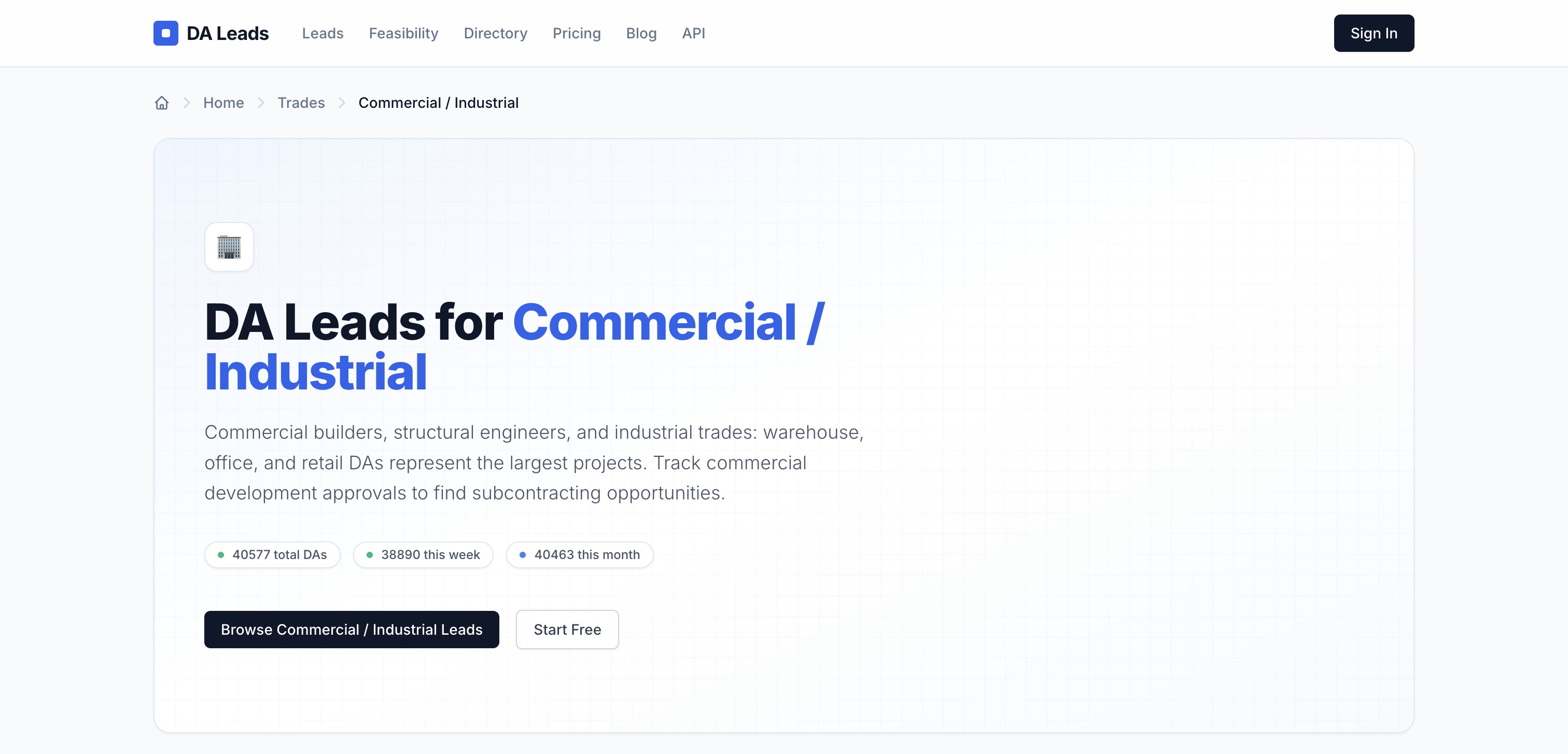
DA Leads trade page for commercial and industrial work, showing recent live applications and top councils. Source: DA Leads commercial / industrial category page, captured 2026-04-10.
That is why this category matters. Once a tenant is already committed to a site and moving through a harder approval path, the job is usually larger, more consultant-heavy, and more urgent once the green light lands.
For contractors who understand the rules well enough to ask the right questions early, those are better leads than a generic cold list.
Browse change-of-use leads, commercial and industrial leads, or the wider councils directory to see where these jobs are clustering.
Sources and Further Reading
- DA Leads internal database snapshot, queried 2026-04-10
- ABCB, Building classifications
- NSW Department of Planning, Complying Development for Business and Industry: A Pocket Guide
- Shoalhaven City Council, Change of Use (Commercial or Industrial)
- NSW Food Authority, Starting a food business
- NSW Food Authority, Cafes, restaurants and retail outlets
- What Is a Development Application?
- DA Leads for Commercial / Industrial


