
In Corio, a working-class suburb between Geelong and Melbourne, there's a government primary school with an ICSEA score of 877. Less than two kilometres away, an independent school scores 1,149. Same suburb. Same streets. Same kids walking past the same shops. A 272-point gap.
If ICSEA measured teaching quality, this would mean one school is dramatically better than the other. But ICSEA was never designed to measure teaching quality. Understanding what it does measure, and what it doesn't, matters if you're using school data for property decisions.
We analysed 2,290 Victorian schools across three sectors, cross-referenced ICSEA scores with childcare NQS ratings, teacher-student ratios, and catchment boundaries. The findings challenge the way most property buyers evaluate school zones.
What ICSEA Actually Measures (and Doesn't)
ICSEA stands for the Index of Community Socio-Educational Advantage. ACARA calculates it for every school in Australia using four inputs:
- Parental occupation (the biggest weight)
- Parental education level
- School remoteness
- Proportion of Indigenous students
Notice what's missing from that list: test scores, teaching quality, curriculum, facilities, student outcomes, graduation rates, or anything that happens inside a classroom.
ICSEA measures the socio-economic profile of the community that sends children to a school. A school in Toorak will typically score higher than a school in Moe, primarily because Toorak parents tend to have higher incomes and education levels. The score reflects the community's characteristics, not the school's teaching practices.
ACARA is explicit about this. Their official documentation states: "An ICSEA value is not a rating of the school institution — of its staff performance, quality of teaching programs or nature of facilities. Additionally, ICSEA is not a measure of student academic performance." (ACARA Fact Sheet — About ICSEA)
ICSEA was designed to enable fair comparison: "ICSEA is not a measurement of school performance. Rather, this measure enables fair and meaningful comparisons of the performance in literacy and numeracy of students in a given school with that of students with similar backgrounds." (About ICSEA)
In other words, a school with an ICSEA of 900 that achieves above-average NAPLAN scores is outperforming expectations. A school with an ICSEA of 1,200 that achieves average NAPLAN scores is performing in line with what its demographics would predict.
The distinction matters for property decisions because ICSEA is often used as a proxy for school quality. Understanding that it measures community profile rather than educational outcomes gives buyers a more complete picture when comparing schools across suburbs.
Same Suburb, Different Scores: The Government-Independent Gap
If ICSEA reflected anything about the schools themselves, government and independent schools in the same suburb should score similarly. They serve the same area. Their students live on the same streets.
They don't score similarly. Across 145 Victorian suburbs that have both government and independent schools, the average ICSEA gap between them is 37 points. The independent school scores higher in 108 of those suburbs.
The largest gaps:
| Suburb | Government Avg | Independent Avg | Gap |
|---|---|---|---|
| Corio | 877 | 1,149 | +272 |
| Wendouree | 904 | 1,120 | +216 |
| Mildura | 902 | 1,077 | +175 |
| West Wodonga | 906 | 1,070 | +164 |
| Broadmeadows | 931 | 1,088 | +157 |
| Ballarat | 1,018 | 1,172 | +154 |
| Shepparton | 883 | 1,031 | +148 |
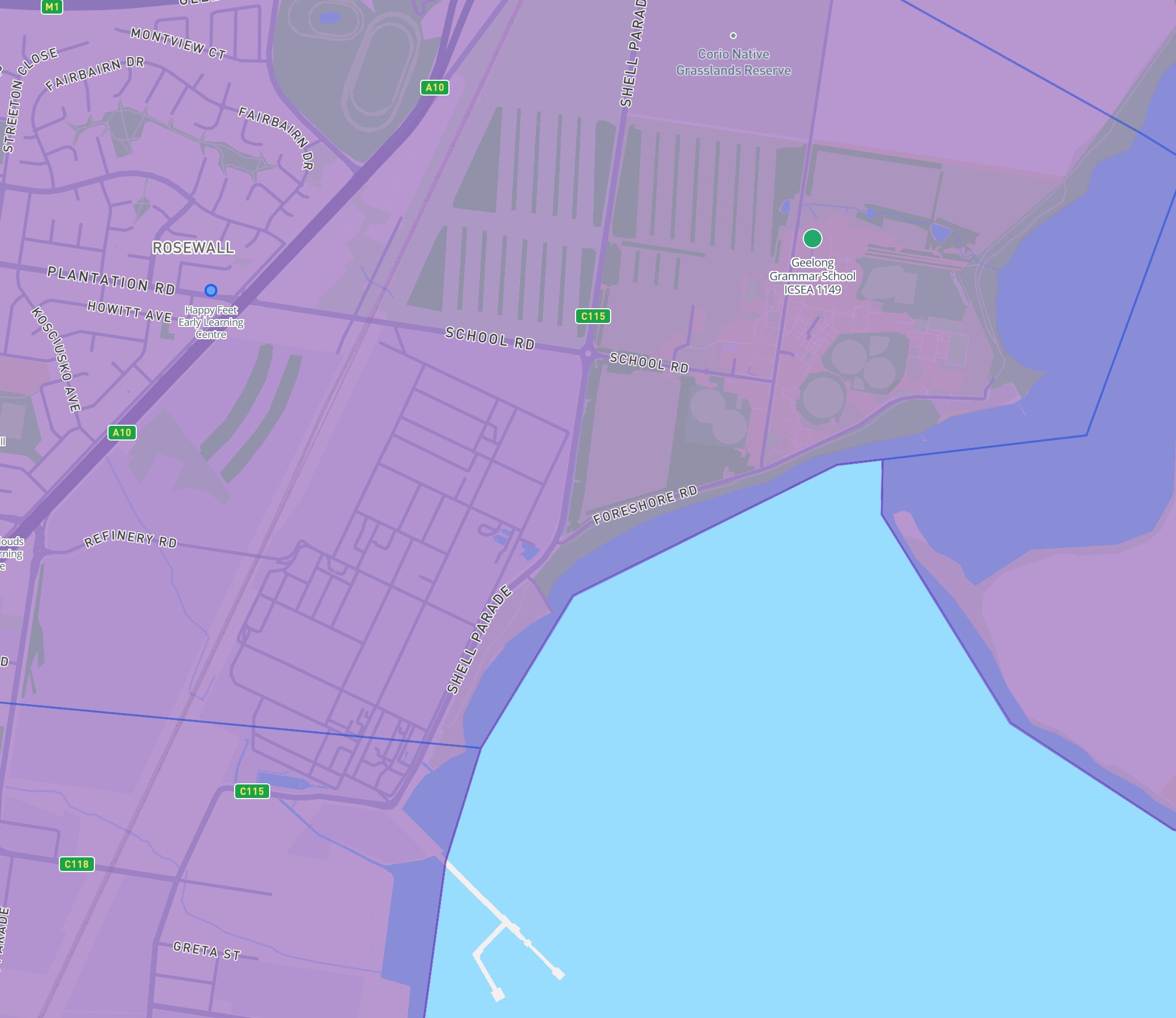
The pattern reflects enrolment selection rather than school quality. Independent schools charge fees, which means families who enrol tend to have higher incomes and education levels. ICSEA captures these demographic differences between the two school populations.
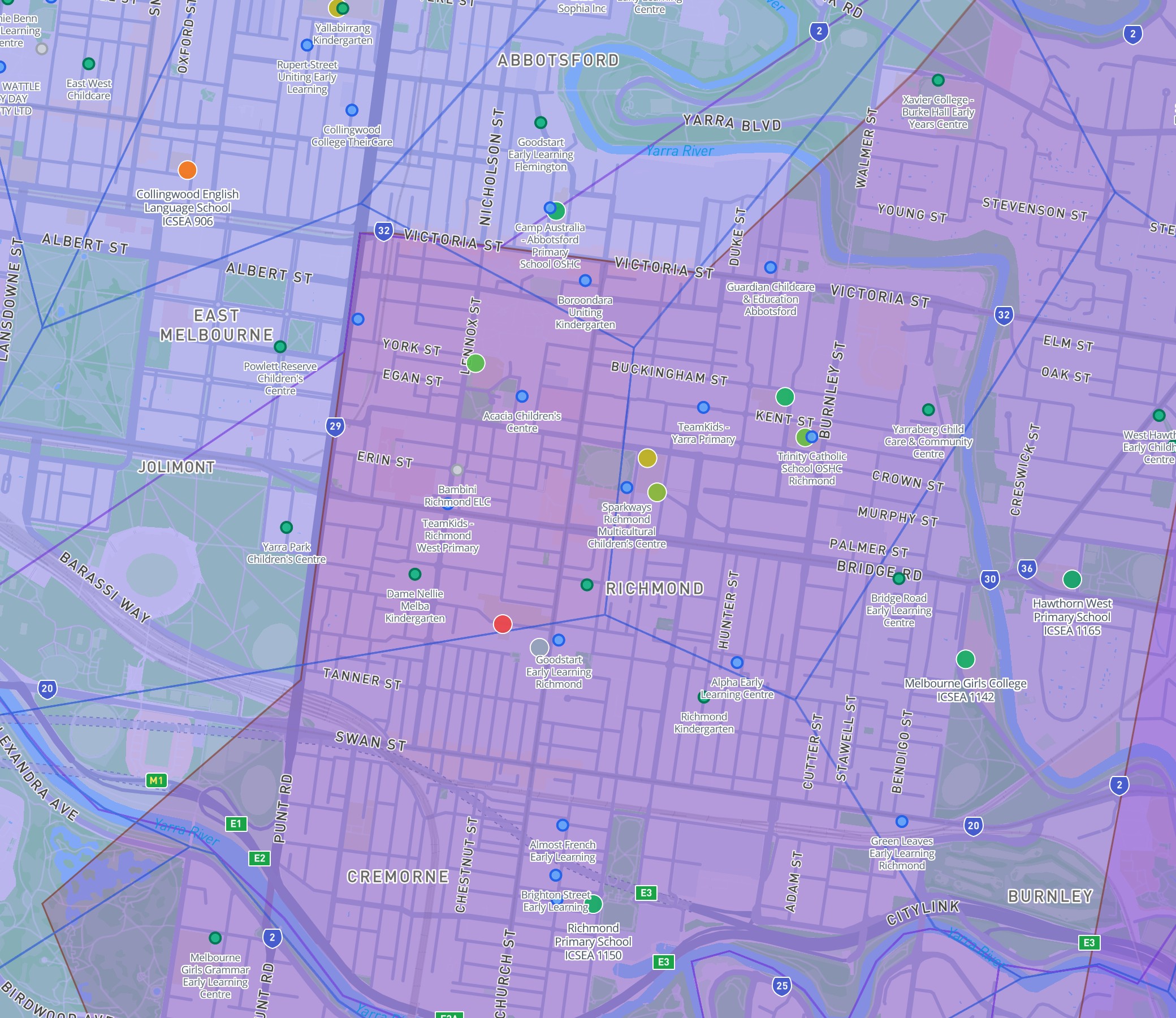
The reverse cases are equally telling. In 37 suburbs, government schools actually score higher than independent schools. Richmond is the most extreme: government schools average 1,095 while the local independent school scores 761. Camberwell's government schools average 1,192 versus 1,036 for the independent school. In these inner suburbs, the government schools attract high-SES families, and the ICSEA scores reflect that enrolment pattern.
Teacher-Student Ratios: A Counterintuitive Pattern
One assumption worth testing is whether high-ICSEA schools have smaller class sizes. The data shows an unexpected pattern.
| ICSEA Range | Schools | Avg Students per Teacher |
|---|---|---|
| Below 950 | 274 | 8.0 |
| 950-1,000 | 521 | 9.1 |
| 1,000-1,050 | 592 | 10.2 |
| 1,050-1,100 | 443 | 10.6 |
| 1,100-1,150 | 313 | 11.1 |
| 1,150+ | 144 | 10.8 |
Schools with the lowest ICSEA scores have the best teacher-student ratios. A school scoring below 950 averages 8 students per teacher. A school above 1,100 averages 11.1.
The pattern makes sense once you factor in Australia's Schooling Resource Standard (SRS). Lower-ICSEA schools receive additional government funding, which translates into more support staff, specialist teachers, and integration aides. The students may face greater challenges, but they often have access to more adults per student than their higher-ICSEA counterparts.
This is worth knowing: ICSEA and resourcing levels don't move in the same direction. The funding model is designed to provide more support where it's most needed.
The Three Sectors: A Statewide Picture
The ICSEA gap between sectors is structural, not qualitative.
| Sector | Schools | Mean ICSEA | Median | Below 1,000 | Above 1,100 |
|---|---|---|---|---|---|
| Government | 1,568 | 1,017 | 1,007 | 45% | 15% |
| Catholic | 491 | 1,058 | 1,055 | 10% | 21% |
| Independent | 231 | 1,082 | 1,088 | 13% | 42% |
42% of independent schools score above 1,100. Only 15% of government schools do. But this tells you about the families who enrol, not the schools themselves. Catholic schools sit between the two, as you'd expect from a sector with moderate fees and broad catchments.
A useful next step is checking whether a school outperforms its ICSEA prediction. ACARA publishes this comparison for NAPLAN results, providing a measure of how a school performs relative to schools with similar demographics.
How Childcare Quality Relates to ICSEA
We cross-referenced suburb-level ICSEA scores with ACECQA's National Quality Standard (NQS) ratings across 433 Victorian suburbs to test how strongly socio-economic profile predicts childcare quality.
The correlation is r = 0.378 (R² = 0.143). That means ICSEA explains only 14% of the variation in childcare quality. The other 86% is driven by factors independent of suburb-level socio-economics: management practices, staffing decisions, governance quality, and each service's approach to the seven NQS quality areas.
The scatter plot above shows the weak relationship visually. The red dots (bottom-right) are wealthy suburbs with poor childcare; the green dots (top-left) are lower-ICSEA suburbs with excellent childcare. The grey dots in the middle show the broad spread at every ICSEA level — high NQS services exist at every socio-economic tier.
The outliers are the most revealing:
Wealthy suburbs with poor childcare:
| Suburb | Avg ICSEA | Avg NQS | Services |
|---|---|---|---|
| Kew East | 1,148 | 2.75 | 4 |
| Narre Warren North | 1,101 | 2.88 | 8 |
| Templestowe | 1,140 | 3.00 | 9 |
| Rosanna | 1,130 | 3.09 | 11 |
| Box Hill North | 1,102 | 3.09 | 11 |
Lower-income suburbs with excellent childcare:
| Suburb | Avg ICSEA | Avg NQS | Services |
|---|---|---|---|
| Collingwood | 952 | 3.60 | 5 |
| Healesville | 924 | 3.50 | 6 |
| Hastings | 944 | 3.43 | 7 |
| Dallas | 958 | 3.43 | 7 |
| Broadmeadows | 959 | 3.40 | 5 |
| Hoppers Crossing | 993 | 3.38 | 32 |
Kew East has an average ICSEA of 1,148 (top 5% statewide) but its four childcare services average 2.75 on the NQS scale, meaning most are rated Working Towards. Meanwhile, Collingwood (ICSEA 952, bottom 40%) has five childcare services averaging 3.60 with three rated Exceeding.
Hoppers Crossing is especially notable: 32 childcare services with a 3.38 average, despite an ICSEA of 993. The volume and quality of childcare in this growth corridor suburb outperforms many inner-east suburbs that cost three times as much to buy into.
The data suggests that childcare quality is best assessed directly through NQS ratings rather than inferred from the suburb's ICSEA profile. Checking individual service ratings provides a much clearer picture than relying on area-level socio-economic indicators.
The Suburbs That Don't Fit the Narrative
Some suburbs have enormous internal ICSEA variation, meaning the "suburb average" is misleading.
| Suburb | Avg ICSEA | Min | Max | Spread | Schools |
|---|---|---|---|---|---|
| Richmond | 1,050 | 761 | 1,150 | 389 | 8 |
| Healesville | 924 | 649 | 1,029 | 380 | 5 |
| Shepparton | 948 | 811 | 1,128 | 317 | 13 |
| North Melbourne | 1,023 | 820 | 1,136 | 316 | 5 |
| Bendigo | 1,008 | 858 | 1,148 | 290 | 13 |
| Mildura | 957 | 797 | 1,077 | 280 | 10 |
Richmond's average ICSEA is 1,050, which sounds solid. But the spread is 389 points: from 761 (bottom 3% nationally) to 1,150 (top 5%). That's not one community. That's two completely different socio-economic worlds sharing the same postcode. A suburb average of 1,050 can mask a reality where individual schools range from 761 to 1,150, making the average less informative than the spread.
Compare that to Glen Iris, where six schools span a range of just 17 points (1,166 to 1,183). Or Ringwood North, where three schools sit within a 5-point band. These are genuinely uniform educational environments. Richmond is not.
Is This a Victorian Pattern or a National One?
This analysis focuses on Victoria, but the underlying dynamics are national. ACARA calculates ICSEA using the same methodology for all 9,755 Australian schools. The government-independent gap, the SRS funding model, and the demographic basis of ICSEA all operate identically across states.
What may differ is the magnitude. Sydney's property market is more stratified than Melbourne's, which could produce even larger intra-suburb ICSEA spreads. Queensland's more dispersed urban form may reduce the sharp boundary effects seen in Melbourne's inner suburbs. We're extending this analysis to Sydney and Brisbane in upcoming articles.
NSW's Centre for Education Statistics and Evaluation (CESE) has developed an alternative measure called FOEI (Family Occupation and Education Index), which they describe as having greater predictive power for school performance than ICSEA. This suggests the limitations we've identified aren't unique to our analysis — they're recognised within the education system itself.
What This Means for Property Decisions
School zones matter for property decisions. But ICSEA is one data point among several, and knowing what it captures helps you use it more effectively.
What a high ICSEA tells you: - Your neighbours will be wealthier and more educated - The school's NAPLAN benchmark is set higher (so "average" performance is actually impressive for a low-ICSEA school) - The school has less additional government funding per student - Your property value is supported by other families who also value the zone
What it doesn't tell you: - Whether the teaching is good - Whether your child will learn more - Whether the school is well-managed - Whether the childcare in the area is any good
What to actually look at: - NAPLAN results relative to ICSEA (does the school outperform its prediction?) - The NQS rating of specific childcare services, not the suburb average - Teacher-student ratios (lower ICSEA schools often have better ratios due to funding) - The intra-suburb spread (is this a genuinely uniform area, or an average that hides extremes?)
ICSEA is a valuable metric when read in context. Combining it with NAPLAN-relative-to-ICSEA performance, NQS ratings for nearby childcare, teacher-student ratios, and intra-suburb variation gives a more complete picture of what a school zone offers.
Explore the Data Yourself
All of the school and childcare data referenced in this analysis is available on the DA Leads interactive map. Toggle on the Schools & Childcare layer to see every school colour-coded by ICSEA percentile and every childcare service by NQS rating. Click any school to see its ICSEA score, sector, enrolment, teacher count, and catchment zone.
Open the interactive map with Schools & Childcare layer →
Methodology
School data: ACARA School Profile 2025, covering 2,290 Victorian schools with ICSEA scores. 1,568 Government, 491 Catholic, 231 Independent. Special schools were excluded.
Childcare data: ACECQA National Register, covering 5,027 Victorian services with NQS ratings. Quality area scores (QA1-QA7) available for services assessed under the current framework.
Correlation: Pearson correlation coefficient calculated between suburb-level average ICSEA and average NQS rating for 433 suburbs with at least 3 rated childcare services and at least one school with ICSEA data.
Teacher-student ratio: Calculated as total enrolment divided by teaching staff count, per school. Averaged by ICSEA band.
Same-suburb comparison: Required at least one government and one independent school in the same suburb. 145 suburbs met this criterion.
Limitations:
- ICSEA currency: ICSEA is updated annually by ACARA, using the most recent census and enrolment data available. The 2025 values used here reflect 2024 enrolment demographics. Schools with rapidly changing catchment populations (e.g., new housing estates) may have ICSEA scores that lag demographic reality by 1-2 years.
- NQS assessment cycle: NQS ratings are point-in-time assessments. ACECQA uses a risk-based schedule: lower-rated services are reassessed more frequently, while higher-rated services may go several years between assessments. Some ratings in this analysis may be 3-5 years old. Individual services may have improved or declined since their last assessment.
- No NAPLAN data: This analysis does not include NAPLAN results. Comparing NAPLAN performance relative to ICSEA prediction would provide a direct measure of educational value-add, but NAPLAN data requires separate access through My School. We reference this comparison as a recommended next step for readers.
- Property price inference: The correlation between ICSEA and property prices is inferred from ICSEA's SES inputs (parental occupation and education correlate with income), not measured directly. We did not include median house price data in this analysis.
- Victorian scope: All analysis is based on Victorian schools and childcare services. National patterns may differ in magnitude, though the methodology (ICSEA calculation, NQS assessment, SRS funding) is consistent across states.
Sources
- ACARA — About ICSEA
- ACARA Data Access Program — School Profile 2025
- ACECQA National Register — Service Ratings
- Australian Government — Schooling Resource Standard
- ACARA — Fact Sheet: About ICSEA
- ACARA — Guide to Understanding ICSEA Values 2024
- NSW CESE — Getting the Funding Right (FOEI)
- DA Leads Interactive Map — Schools & Childcare Layer
- Best School Zones in Melbourne (2026)
- Best Childcare in Melbourne: NQS Ratings (2026)


