
Of all the development application categories we track, subdivision is the biggest. As of February 2026, it accounts for 672 DAs out of 17,929 total applications in our database (3.7%), more than renovations, new dwellings, or any other single category.
That number represents the front end of Australia's housing pipeline. Every subdivision DA is land being cut up into smaller lots, and each of those lots will eventually need a house, a driveway, a fence, and a connection to services. For tradies, this is where the work starts.
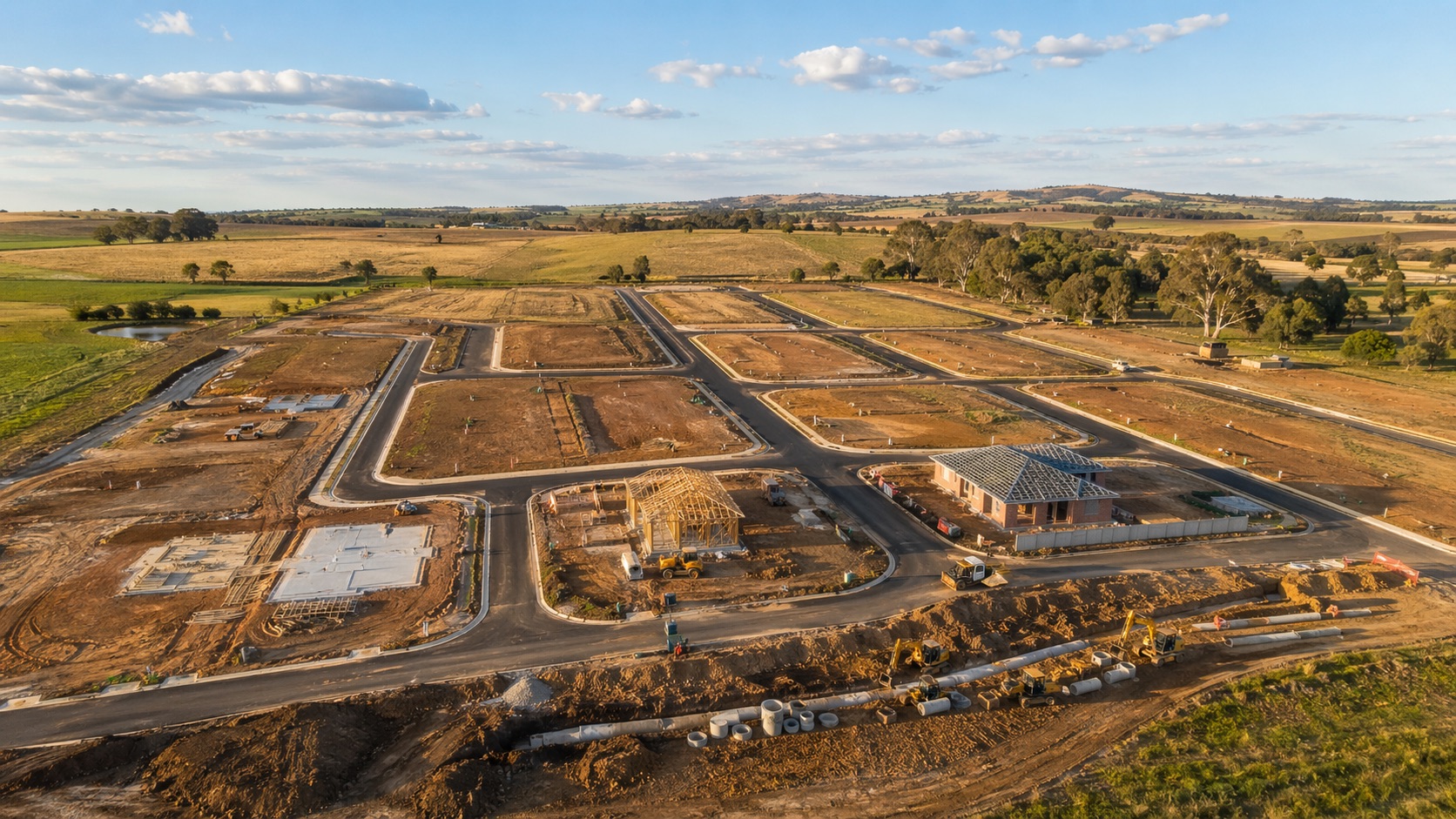
A new subdivision taking shape: fresh roads, graded lots, houses at various construction stages, and farmland transitioning at the edges. This is what the front end of Australia's housing pipeline looks like from above.
Why Subdivision Leads Every Category
| Category | DAs | Share |
|---|---|---|
| Subdivision | 672 | 3.7% |
| Renovation / Extension | 577 | 3.2% |
| New Dwelling | 449 | 2.5% |
| Tree Removal | 208 | 1.2% |
| Commercial / Industrial | 156 | 0.9% |
| Multi-Dwelling / Townhouse | 121 | 0.7% |
Subdivision being the top category makes sense when you look at where Australia's development is concentrated. The busiest suburbs in the country (Cornubia with 199 DAs, Greenbank with 128, Yarrabilba with 121) are all greenfield areas where large parcels are being divided into residential lots.
This is the classic Australian growth model: farmland and semi-rural lots get rezoned, subdivided, serviced, and sold to builders. The subdivision DA is the first domino.
Where Subdivisions Are Concentrated
Subdivision activity clusters in the growth corridors that dominate our overall DA rankings.
| Region | Key suburbs | Driver |
|---|---|---|
| SE Queensland (Logan) | Cornubia, Greenbank, Yarrabilba, Bahrs Scrub | Master-planned communities, active land release |
| SW Sydney | Austral, Leppington, Menangle Park | Aerotropolis, 17,000+ homes planned |
| Melbourne corridors | Casey, Cardinia, Wyndham, Melton | Population growth pushing outward |
| Adelaide fringe | Onkaparinga and surrounds | Steady infill and fringe expansion |
South East Queensland is the epicentre. The Logan corridor is generating subdivision DAs at a pace that no other region in Australia matches. Master-planned communities like Yarrabilba are still in active land release phases with Stage 10 and 11 registering lots through 2026, meaning the subdivision pipeline has years of runway left.
South-Western Sydney is the second hotspot. The Western Sydney Aerotropolis precinct is accelerating land releases, and councils like Camden and Campbelltown are processing subdivision applications alongside the resulting new dwelling DAs.
Melbourne's growth corridors (particularly Casey, Cardinia, Wyndham, and Melton) contribute VIC's share. Activity remains strong as Melbourne's population continues to push outward.
South Australia also contributes, with Onkaparinga and other Adelaide fringe councils processing a steady stream of subdivision applications.
The Trades That Benefit First
Subdivision isn't just one job. It's a chain. Here's how the work flows.
| Trade | When they enter | What they do |
|---|---|---|
| Civil contractors | First on site | Earthmoving, roads, drainage, stormwater |
| Surveyors | Day one | Plan of subdivision, certification |
| Fencing | Mid-construction + post-sale | Temporary hoarding, then permanent boundary fences |
| Service providers | During civil works | Plumbing, electrical, gas connections to each lot |
| Landscapers | Tail end | Driveways, paths, retaining walls, gardens |
Civil contractors are first on site. Always. Earthmoving, road construction, drainage, and stormwater infrastructure all have to be completed before a single house lot is ready for sale, which means civil contractors who track subdivision DAs have months of advance notice before their competitors even know a project exists.
Fencing contractors pick up work at two stages: temporary fencing during construction, then permanent fencing once lots are sold and houses go up. In a suburb like Yarrabilba with 121 DAs, that could translate to hundreds of individual fencing jobs over the following 12 to 18 months. Not a bad pipeline from one data point.
From DA to Contracts: The Timeline
A subdivision DA lodged today doesn't mean work starts tomorrow. Here's the typical sequence:
| Stage | Duration | Who's working |
|---|---|---|
| DA assessment | 2–6 months | Surveyors, planners |
| Civil works | 6–12 months | Civil contractors, earthmovers |
| Lot registration | 2–4 months | Surveyors, conveyancers |
| House construction | 12–18 months per lot | Builders, then all finishing trades |
For tradies, a subdivision DA is a 6 to 18 month forward indicator. That's valuable planning time. Knowing which suburbs are lodging subdivision DAs now tells you where the house construction and finishing trades work will be in a year.
What to Watch For
Not all subdivisions are equal. A 2-lot subdivision of a suburban backyard is very different from a 200-lot estate.
Lot count matters. Large subdivisions in growth areas generate the most downstream work. Look for applications in master-planned communities and greenfield release areas.
Sequential stages. Big estates subdivide in stages. If you see Stage 3 being lodged, Stages 1 and 2 are already under construction, which means there are builders on site right now who need subcontractors, and Stage 4 is probably being designed, giving you a forward pipeline that extends well beyond the immediate opportunity sitting in front of you. Start quoting.
Council activity trends. A council that's processing a lot of subdivision DAs now will be processing a lot of new dwelling DAs in 12 months. Track both categories to build your pipeline.
For a deeper understanding of how the subdivision process works across Australia, including state-by-state requirements, see our full guide.
Get Subdivision Leads in Your Area
We track subdivision DAs daily across all states. Filter by your council area or state to see what's coming through the pipeline.
Browse subdivision leads or set up alerts to get notified when new subdivision applications land near you.
Sources and Further Reading
- Yarrabilba community - Lendlease - master-planned community in the Logan corridor
- Western Sydney Aerotropolis - NSW Planning - land release and planning precinct information
- DA Leads internal database snapshot (17,929 total DAs), queried 2026-02-09
- DA Leads council directory


