
Greenbank recorded 128 development applications. Second in Queensland. Among the top suburbs nationally for building activity. This semi-rural suburb south of Brisbane is undergoing a transformation that's creating significant opportunities for builders, tradies, and developers.
| Metric | Value |
|---|---|
| Total DAs | 128 |
| Top category | Residential subdivision |
| Typical lot size | 400 to 600 sqm (new lots from 4,000 to 20,000 sqm parcels) |
| Council | Logan City Council |
| Ranking | Second-busiest suburb in Queensland |
| Key advantage | Significant stock of lots over 2,000 sqm still zoned for subdivision, with undulating terrain creating strong demand for civil works |
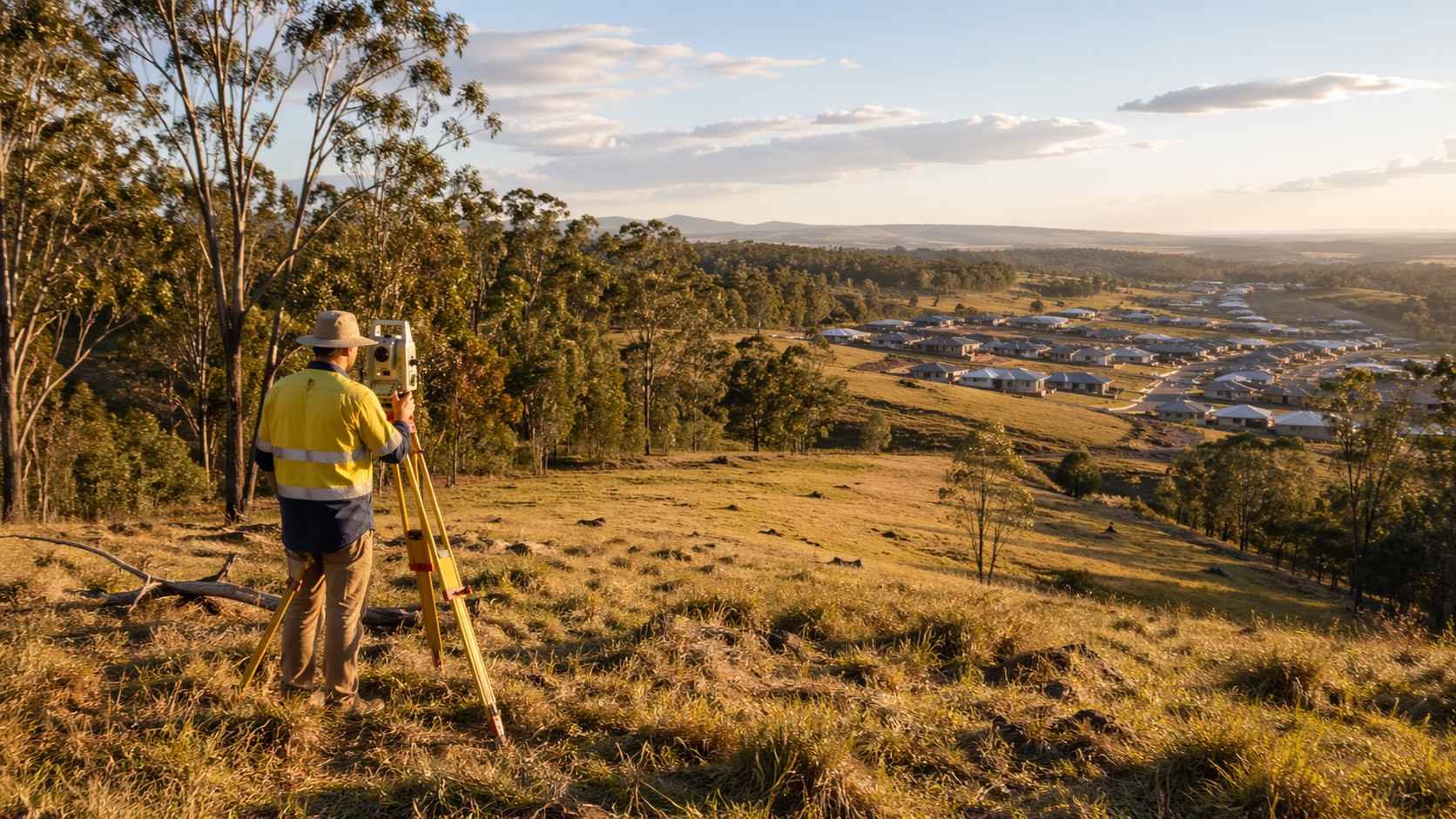
Greenbank from the ridge: a surveyor measuring the next stage while new houses fill the valley below. Undulating terrain means strong demand for retaining walls and earthworks.
Why Greenbank Is Growing
Greenbank is located approximately 35 kilometres south of the Brisbane CBD, within Logan City Council. It covers a large geographic area, much of it previously used for rural residential living and small-scale farming.
Three factors are driving its growth.
Population pressure. South East Queensland is one of Australia's fastest-growing regions. Closer suburbs fill up. Development pushes outward. Greenbank, with its stock of larger lots, is exactly the type of area that absorbs the next wave of population growth by converting acreage into residential allotments at a pace that would have been unimaginable a decade ago.
Transport infrastructure. The Mount Lindesay Highway runs through the western edge of the suburb, connecting it to both Brisbane and the broader Logan corridor. Improvements to this highway, along with the planned Beaudesert rail line, are increasing Greenbank's accessibility and appeal.
Land availability. Greenbank still has a significant stock of lots over 2,000 square metres. Many of these are zoned to allow subdivision, creating a steady supply of development sites at price points below inner suburban Brisbane.
The suburb sits between Cornubia to the east (199 DAs) and the newer estates further south. It occupies a middle ground: more established than a greenfield site, but with plenty of undeveloped potential remaining.
What's Being Built
Greenbank's 128 DAs reflect a suburb in active transition from rural to suburban character.
Residential subdivision dominates the application list. Property owners with lots between 4,000 and 20,000 square metres are carving them into smaller residential allotments. Some are simple two-lot splits. Others are larger estate-scale subdivisions producing 10 or more lots. Our subdivision process guide covers the steps from DA lodgement through to lot registration.
New houses follow subdivision approvals. The typical build is a single-storey, four-bedroom family home on a 400 to 600 square metre lot. Two-storey designs are becoming more common as lot sizes shrink and buyers seek more floor area.
Ancillary structures make up a notable portion of applications. Sheds, carports, pools, and retaining walls are common in an area where the terrain is undulating and residents expect outdoor living spaces.
Small-scale multi-dwelling projects are emerging. Dual occupancies. Triplexes. These are appearing on lots near the local centres as builders respond to Logan City Council's density targets for the corridor, and the trend will accelerate as remaining acreage lots become harder to find.
For Tradies
Greenbank offers consistent work across a broad range of trades. The suburb's transition from acreage to residential lots means the full construction cycle is playing out simultaneously in different pockets of the area.
Site preparation trades are in high demand. The undulating terrain means retaining walls, cut-and-fill earthworks, and drainage solutions are needed on many sites. If you specialise in civil works or retaining wall construction, this is productive ground.
Residential builders and framers have a deep pipeline. The volume of new dwelling approvals means there are always houses going up. Many are project-home builds on standard lots, but custom builds on larger remaining sites also provide work.
Landscapers and outdoor living specialists benefit from the estate completion cycle. As subdivisions finish and houses are occupied, the demand for turf, fencing, driveways, patios, and pools follows within 6 to 12 months.
Plumbers and electricians are needed for both new builds and the infrastructure connections that come with subdivision. Service runs to new lots require licensed trades. No shortcuts.
The geographic spread of Greenbank means jobs can be further apart than in a compact urban suburb. Plan your scheduling accordingly. See all active QLD leads.
For Developers
Greenbank's appeal to developers lies in its combination of available land and proven demand.
Site acquisition opportunities. Acreage properties listed for sale in Greenbank frequently have subdivision potential. Match the lot's zoning and frontage to a viable lot yield. Corner positions? Dual road access? Those deliver the best returns.
Council familiarity. Logan City Council has processed thousands of subdivision applications across the corridor. This means the planning team is experienced with the application type, reducing the risk of unexpected objections or drawn-out assessment periods.
Market demand is strong. Completed lots sell. Project-home builders and owner-occupiers compete for them because Greenbank's relative affordability compared to Brisbane inner suburbs makes it one of the few places where first-home buyers and young families can enter the market without stretching beyond what the bank will lend.
Watch the infrastructure charges. Greenbank's semi-rural origins mean that some areas still require significant infrastructure contributions for sewer and water connections. These costs, along with QLD stamp duty, can materially affect feasibility. Run your numbers with a feasibility calculator before committing.
Review Logan City Council's development pipeline to identify where activity is concentrated and where gaps might exist.
The Bottom Line
Greenbank is in the middle of its growth arc. Not greenfield. Not fully built out. It offers a rolling pipeline of subdivision and construction work that sits between those two extremes, and for tradies and developers operating in the Logan corridor, it belongs on the shortlist.
Explore Greenbank visually on the DA Leads interactive map — see live DAs, subdivision activity, zoning overlays, and planning controls for any address.
Explore QLD development data or search Greenbank leads to track what's coming through.


