
Fifteen years ago, Oran Park was farmland. Today it has a town centre, multiple schools, medical facilities, and a population growing faster than almost anywhere else in Sydney. And it shows. With 60 development applications in our database under Camden Council, it is one of the most active development suburbs in NSW.
| Metric | Value |
|---|---|
| Total DAs | 60 |
| Top category | New dwelling construction |
| Typical lot size | 300 to 500 sqm |
| Council | Camden Council |
| Remaining stages | 20 to 40 new lots per release |
| Key advantage | Master-planned community with its own town centre, creating commercial fitout opportunities not found in purely residential growth suburbs |
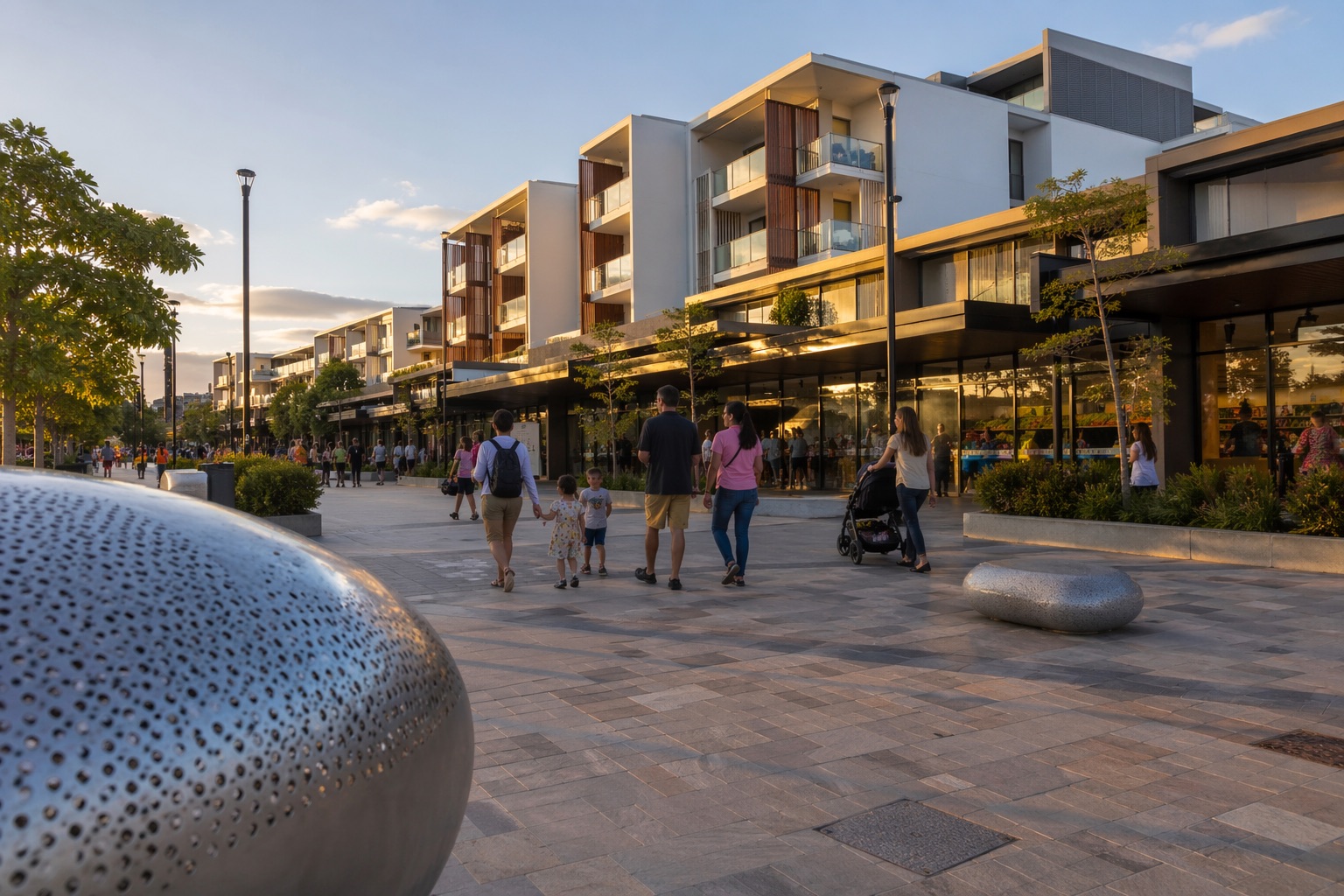
Oran Park's town centre: retail, apartments, public art, young families. What was farmland fifteen years ago is now a functioning suburban centre with 60 active DAs.
What the DA Data Shows
Oran Park's 60 DAs reflect a suburb that has moved past the pure subdivision phase and into a mature development cycle.
New dwelling construction is the dominant DA type. Unlike suburbs earlier in the growth cycle where subdivision DAs lead, Oran Park's land has largely been divided and registered. What is happening now is building. House construction DAs are flowing at a consistent rate as buyers settle on their lots and engage builders.
Subdivision DAs still appear but at a lower rate. Remaining land parcels on the suburb's edges are being released in final stages. Each stage brings 20 to 40 new lots to market.
Commercial and community facility DAs are notable here. Oran Park's town centre is still being built out, with retail, medical, and mixed-use applications adding to the non-residential pipeline. This is unusual for a growth suburb and reflects the master-planned approach. Worth noting.
The Master Plan Advantage
Oran Park was planned from the outset as a self-contained community, not just a collection of housing estates. Roads, drainage, parks, and services were designed before the first lot was sold. Planning first, building second. The Oran Park Town Centre provides retail, dining, and services that keep spending local. For commercial tradies, the town centre's ongoing expansion creates fitout opportunities that do not exist in purely residential growth suburbs.
Why It Keeps Growing
Several factors sustain Oran Park's development momentum.
Sydney's south-west growth corridor. The NSW Government's strategic plan channels population growth into the south-west, with supporting infrastructure investment. Oran Park sits squarely within this corridor, benefiting from road upgrades and future rail connections. The combination of state government growth designation, master-planned infrastructure delivery, proximity to the future Western Sydney Airport employment zone, and a proven track record of lot sales and population growth makes Oran Park one of the lowest-risk growth suburb investments in the corridor.
Affordability relative to Sydney. A new 4-bedroom home in Oran Park costs significantly less than the Sydney median. For families willing to live 55 km from the CBD, the value proposition is strong: a new home, local schools, a town centre, and a growing community.
Western Sydney Airport effect. The new airport at Badgerys Creek, approximately 20 km north of Oran Park, will generate employment in logistics, aviation, and services. Nearby suburbs will capture residential demand from workers who want to live close to their jobs.
What Is Being Built
The residential product in Oran Park is predominantly detached houses on lots of 300 to 500 square metres. Two-storey homes are increasingly common as lot widths narrow. The typical new build is a 4-bedroom, 2-bathroom home with a double garage.
Medium density is emerging. Townhouse and terrace-style DAs are appearing, particularly on lots closer to the town centre where the planning controls support higher density. The town centre itself is delivering mixed-use development: retail on the ground floor with residential or commercial above.
Opportunities for Tradies
Oran Park's mature development cycle means opportunities exist across all construction phases simultaneously.
Residential construction is the volume play. Multiple builders are active, and the rate of new dwelling DAs suggests consistent demand for concreters, framers, roofers, plumbers, electricians, and plasterers for at least the next 2 to 3 years.
Commercial fitout is the emerging opportunity. As the town centre expands and new retail tenants sign leases, fitout work follows. This is higher-margin work that requires different skills than residential construction. Better margins too.
Track NSW development applications in real time to find opportunities in Oran Park and surrounding suburbs.
Opportunities for Developers
The greenfield subdivision opportunity in Oran Park itself is largely captured by the master developer. However, several adjacent plays remain.
Townhouse and medium density on appropriately zoned lots near the town centre. As the suburb matures, council and the community are more receptive to higher-density housing. Developers who can deliver quality townhouse products at the right price point will find demand. Our property development feasibility guide covers how to assess whether a medium-density project stacks up.
Use the feasibility calculator to run the numbers on any property in the Camden LGA.
What Comes Next
Oran Park's story is not finished. Final land release stages will continue generating DAs for another 2 to 3 years, and the town centre has room to grow. It is one of several growth suburbs where development is happening at scale across NSW. For anyone in the construction industry, Oran Park is both an active opportunity and a template for how master-planned communities develop. Worth studying closely. The lessons from Oran Park's staged development approach, particularly how the town centre delivery attracted commercial tenants alongside residential growth rather than years after it, are being watched by developers and councils planning the next generation of Sydney's growth area communities.
Explore NSW insights to see how Oran Park compares to other growth suburbs across the state.


