
You've found a site that looks promising. The agent says there's interest from multiple parties. You need to decide by Friday. How do you know if the numbers actually work?
This is where feasibility analysis separates the developers who make money from the ones who lose their shirts. With construction costs sitting between $2,800 and $4,500 per square metre and interest rates still elevated, getting the feasibility right isn't optional. It's survival.
There are three core frameworks professional developers use. Each answers a different question, and the best developers run all three before committing to a site.
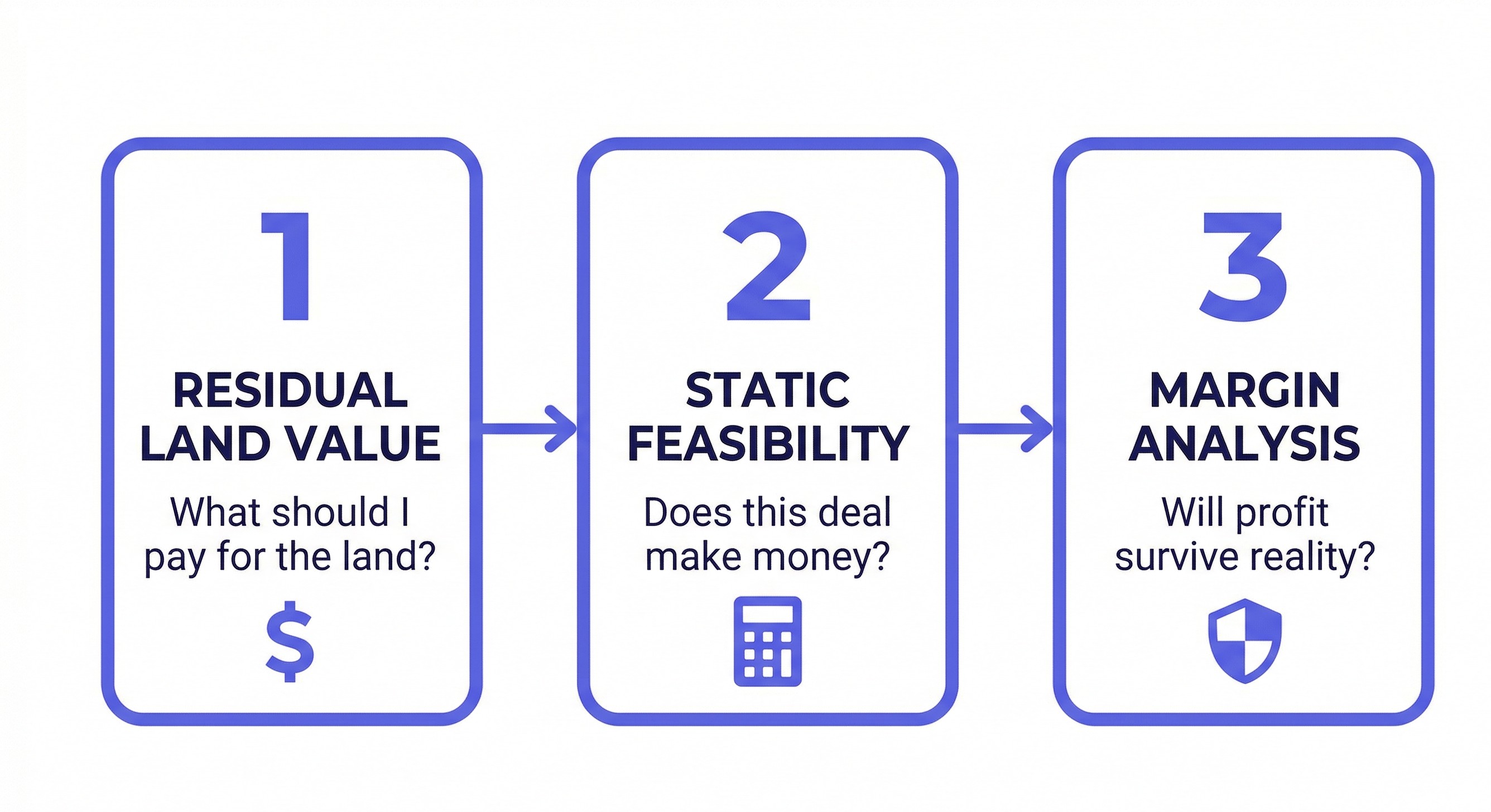
The three feasibility frameworks: residual land value, static feasibility, and margin analysis each answer a different commercial question. Source: DA Leads visual summary of core development feasibility frameworks.
| Framework | Question | When to use |
|---|---|---|
| Residual Land Value | "What should I pay for the land?" | Bidding on a site |
| Static Feasibility | "Does this deal make money?" | Evaluating a specific deal |
| Development Margin Analysis | "Will the profit survive reality?" | After static feasibility shows positive |
Framework 1: Residual Land Value Method
Start with what the finished product will sell for. Work backwards.
The logic: if you know the end value, the construction costs, all the soft costs, and the profit margin you need, whatever's left over is what the land is worth to you.
How it works
Start with Gross Realisation (what the completed project sells for), then subtract everything:
- Construction costs (hard costs including builder margin)
- Professional fees (architect, engineer, surveyor, town planner; typically 8–12% of construction)
- Council contributions (development contributions, open space levies, infrastructure charges)
- Statutory costs (stamp duty, legal fees, planning permit fees)
- Finance costs (interest on land acquisition and construction debt)
- Selling costs (agent commissions 1.5–2.5%, marketing, legal)
- GST (remember the margin scheme if buying from a non-developer)
- Developer's margin (your required profit, typically 15–20% of total development cost)
Whatever is left after all those deductions is the residual land value, the maximum you should pay.
Real example
A 700m² site in Melbourne's middle ring. You reckon you can build three townhouses that will sell for $850,000 each.
| Item | Amount |
|---|---|
| Gross Realisation (3 × $850,000) | $2,550,000 |
| Less construction (3 × 185m² × $2,900/m²) | -$1,609,500 |
| Less professional fees (10%) | -$160,950 |
| Less council contributions | -$45,000 |
| Less stamp duty (on land purchase) | -$55,000 |
| Less finance costs (12 months) | -$95,000 |
| Less selling costs (2%) | -$51,000 |
| Less developer margin (20% on cost) | -$380,000 |
| Residual land value | $153,550 |
Tight. At best you can pay around $150,000 for the land, but similar sites in the middle ring sell for $800,000+. This deal doesn't work. The residual method just saved you from a bad purchase.
If the numbers had produced a higher residual (say $900,000+ for a site listed at $850,000), you'd know the deal has room to move.
When to use it
Use residual land value when you're bidding on a site and need to know your maximum price. It's the default method for acquisitions.
Framework 2: Static Feasibility Analysis
Unlike the residual method, here you already know the land price (or have a target) and you're testing whether the project stacks up.
How it works
Lay out every cost and every revenue line item. No discounting, no time value of money, just a snapshot of total costs versus total revenue.
The key output is your development margin:
Development Margin = (Profit ÷ Total Development Cost) × 100
Most lenders and equity partners want to see 15–20% minimum, because below 15% you're essentially working for free the moment something goes wrong, and on a construction project involving council approvals, subcontractor coordination, weather delays, and material price fluctuations over 18+ months, something always goes wrong.
Real example
A 900m² corner site in Reservoir listed at $1,050,000. You believe you can get approval for four townhouses under GRZ zoning.
Revenue: - 4 townhouses × $780,000 = $3,120,000
Costs:
| Cost item | Amount |
|---|---|
| Land acquisition | $1,050,000 |
| Stamp duty (VIC, general rate) | ~$56,000 |
| Legal (acquisition) | $5,000 |
| Design and planning | $85,000 |
| Council permit fees | $12,000 |
| Construction (4 × 160m² × $2,900/m²) | $1,856,000 |
| Council development contributions | $52,000 |
| Site works and demolition | $45,000 |
| Finance, land (18 months, 7.5%) | $70,875 |
| Finance, construction (12 months, 8%) | $74,240 |
| Selling costs (agents + legal) | $68,640 |
| Contingency (5% of construction) | $92,800 |
| Total development cost | $3,467,555 |
Profit: $3,120,000 - $3,467,555 = -$347,555
A loss. Four units at $780,000 each doesn't cover the costs. You'd need end values of at least $870,000 per townhouse to hit a 15% margin, or you need to negotiate the land price down to around $750,000.
When to use it
Use static feasibility when you're evaluating a specific deal with a known or estimated land price. This is the workhorse of day-to-day deal screening.
Framework 3: Development Margin Analysis
This takes the static feasibility result and stress-tests it.
How it works
Calculate your expected margin, then ask: what happens when things go wrong?
The three variables that kill most projects:
- Construction cost blowouts (what if costs come in 10% over?)
- Sale price drops (what if the market softens 5–10%?)
- Time delays (what if the project takes 6 months longer?)
Professional developers build a sensitivity table:
| Scenario | Margin impact |
|---|---|
| Base case | 18.5% |
| Construction +10% | 12.1% |
| Sales -5% | 11.8% |
| 6-month delay | 14.2% |
| Construction +10% AND sales -5% | 5.4% |
If your margin drops below 10% in a single-variable stress test, the deal is too tight. If it goes negative in a two-variable test, walk away.
The holding cost trap
The most commonly underestimated cost in Australian development is holding costs during delays. On a $1 million land purchase at 7.5% interest, every month of delay costs you $6,250 in interest alone, before rates, insurance, and land tax.
A six-month council delay on a $3.5 million total project can eat $75,000+ in extra holding costs. That's real margin disappearing while you wait for a planner to assess your application.
When to use it
Use development margin analysis after your static feasibility shows a positive result. It tells you whether your profit can survive the real world.
How the Three Frameworks Work Together
Think of them as a sequence:
- Residual land value tells you what to pay (or whether to bother at all)
- Static feasibility tells you if a specific deal makes money
- Development margin analysis tells you if the profit will survive reality
Most developers who lose money skip step 3. Their static feasibility showed 18% margin, so they went ahead. Then construction costs blew out 8%, the market dipped 3%, and council took an extra four months. Suddenly that 18% is 4%, and they've spent two years to make what they could have earned in a salaried job.
For a deeper look at the costs that catch people off guard, see our guide on hidden costs of property development.
Quick Rules of Thumb
These aren't substitutes for proper analysis, but they'll help you screen sites quickly:
- Minimum margin: 15% on total development cost (20% for anything complex)
- Land-to-GR ratio: Land cost should be 30–40% of gross realisation for townhouses, 20–30% for apartments
- Construction cost check: $2,800–$3,500/m² for standard townhouses in Melbourne (2026), $3,500–$4,500/m² for apartments
- Professional fees: Budget 10–12% of construction costs
- Contingency: 5% minimum on construction, 10% if you're new to development
- Selling costs: 2–3% of gross realisation
Wondering whether a duplex or townhouse is more profitable for your situation? Run both scenarios through Framework 2 and compare.
Your Next Step
Running these frameworks by hand gets tedious fast, especially when you're screening multiple sites per week. The DA Leads feasibility calculator automates the residual land value and static feasibility calculations with real zone data, construction cost benchmarks, and market comparables for any Australian address. Plug in a site, get a result in seconds, and spend your time on the deals that actually work.
Sources and Further Reading
- Victorian Planning Provisions - Residential zones - GRZ, NRZ, and RGZ zone specifications and garden area requirements
- State Revenue Office Victoria - Stamp duty calculator - current stamp duty rates for land purchases
- DA Leads internal database snapshot, queried 2026-03-09
- DA Leads feasibility calculator


