
Leppington recorded 76 development applications, placing it among the top 10 busiest suburbs in Australia. Located at the southern edge of Sydney's sprawling growth frontier, it is one of the suburbs most directly affected by the infrastructure investment flowing into Western Sydney.
A decade ago, Leppington was paddocks and market gardens. Today, it is a construction zone with a train station, a growing population, and a pipeline of residential work that stretches years into the future. The scale of transformation is remarkable when you consider that many of the streets, parks, schools, and shopping precincts that will eventually serve a population of tens of thousands simply did not exist in any form five years ago.
| Metric | Value |
|---|---|
| Total DAs | 76 |
| Top category | Residential subdivision |
| Typical lot size | 250 to 400 sqm |
| Council | Liverpool City Council (partially Camden Council) |
| Infrastructure contributions | Can exceed $40,000 per lot |
| Key advantage | Top 10 busiest suburb in Australia, with train station and Western Sydney Airport roughly 10 km north |
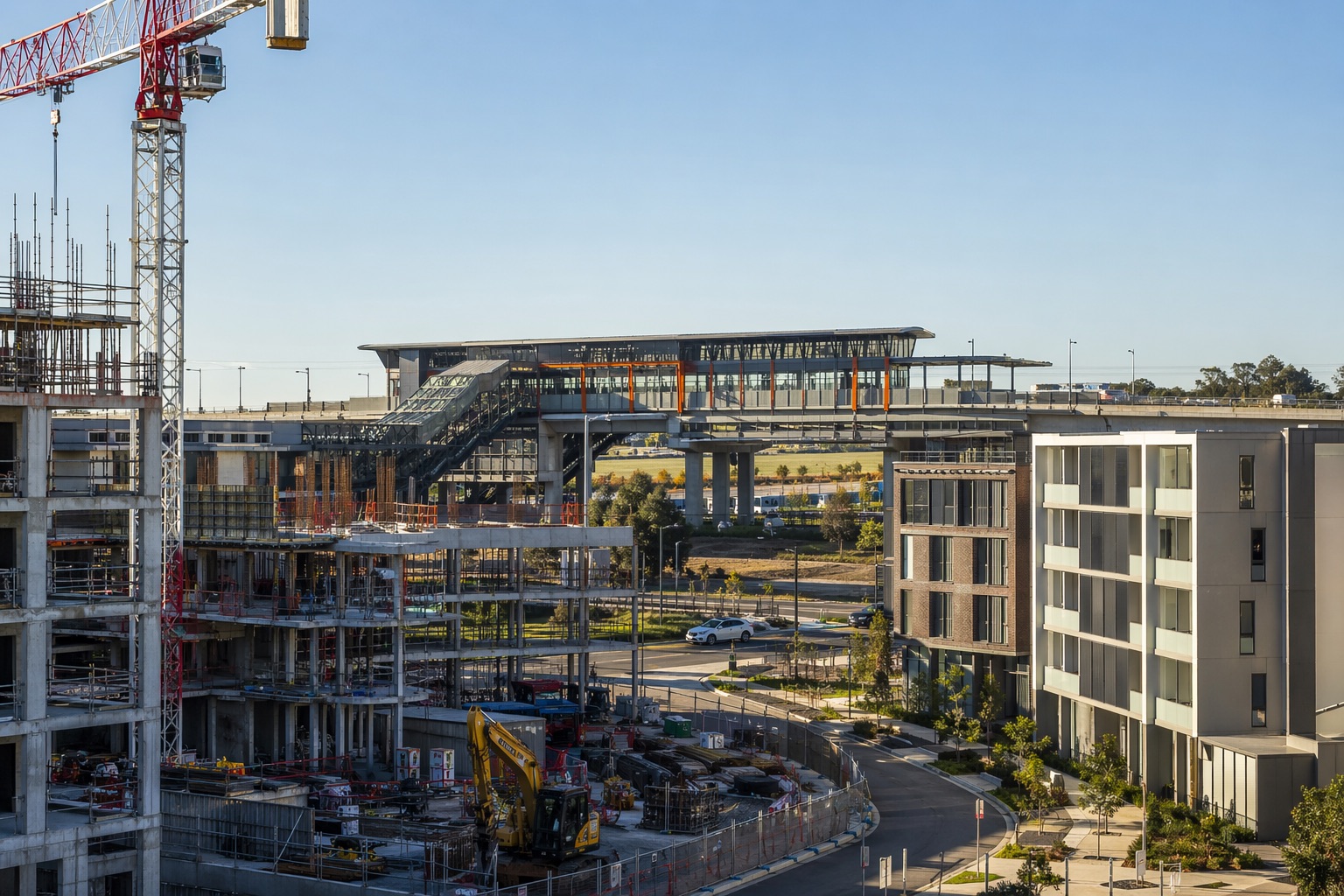
Leppington's station precinct: elevated rail, a crane on a multi-storey build, completed apartments alongside. The airport 10 km north is accelerating medium-density demand.
Why Leppington Is Growing
Leppington sits approximately 50 kilometres south-west of the Sydney CBD, within Liverpool City Council and partially within Camden Council. It is part of the South West Growth Area and sits within the influence zone of the Western Sydney Aerotropolis.
The train station changed the game. Leppington Station opened in 2015 as the terminus of the T2/T8 South West rail line. That single piece of infrastructure transformed Leppington from a rural backwater into a transit-connected growth suburb overnight. Land values responded accordingly, and development proposals followed. And they kept coming. The opening of Leppington Station created a self-reinforcing cycle where improved transport access lifted land values, which attracted developers, whose subdivision and construction activity then justified further government investment in roads, schools, and community facilities that in turn made the suburb more attractive to buyers and developers alike.
Airport proximity. The Western Sydney International Airport at Badgerys Creek is located roughly 10 kilometres to the north. When it opens, Leppington will be one of the closest established residential suburbs to the airport, with direct rail connectivity. This proximity is already influencing development activity and land pricing. Timing matters.
Government-backed growth. The NSW Government has designated the South West Growth Area as a priority for housing supply. Precinct plans for Leppington and the surrounding area set out the lot layout, road network, open space, and density targets. The planning framework is in place for large-scale residential delivery. Our NSW DA approval process guide explains how these precinct plans translate into individual approvals.
Affordable entry point. Compared to suburbs closer to the Sydney CBD, Leppington offers significantly lower land prices. House-and-land packages attract first-home buyers, downsizers, and investors looking for growth potential near major infrastructure.
What's Being Built
Leppington's 76 DAs are concentrated in residential development, with the character shifting as different precincts reach different stages of the development cycle.
Residential subdivision remains the most common application type. Former rural lots of 2 to 10 hectares are being converted into residential estates. Lot sizes typically range from 250 to 400 square metres in new releases, reflecting the trend toward compact urban lots that maximise yield.
New dwelling construction is accelerating as titled lots become available. The housing stock is predominantly detached single and two-storey homes, though the proportion of attached and semi-detached housing is increasing in precincts closer to the train station.
Medium-density development is emerging around the station precinct. The Leppington Town Centre plans call for higher-density residential and mixed-use buildings. Townhouse projects of 10 to 30 dwellings are starting to appear in DAs.
Civil and infrastructure works are a constant. Each new precinct requires roads, drainage, utilities, and open space improvements before building can commence. These civil packages are often large-scale and require specialist contractors. Not small jobs. The civil infrastructure packages in Leppington's newer precincts routinely involve coordinated delivery of trunk drainage, arterial road construction, water and sewer main extensions, electrical substation connections, and public domain landscaping works that must all be completed before the first residential building application can even be lodged on the serviced lots.
Commercial and retail applications are beginning to appear as the residential population reaches the threshold needed to support local services. Small retail centres, childcare facilities, and medical centres are in the pipeline.
For Tradies
Leppington is a suburb where every stage of the construction cycle is happening at once. Some precincts are still in the civil works phase. Others have houses going up. Early-stage estates are already seeing residents move in.
Earthworks and civil contractors have the most immediate pipeline. Leppington's terrain includes some flood-prone areas and varying soil conditions. Site preparation often involves significant fill importation, compaction, and drainage infrastructure. These are large packages that suit established civil contractors.
Concreters and formworkers are servicing both subdivision infrastructure and individual house slabs. The demand is consistent across multiple active stages.
Bricklayers and framers are needed for the volume of new houses. The south-west Sydney market has a strong preference for brick veneer construction, which keeps bricklaying demand high in these growth suburbs.
Roofers, plumbers, and electricians follow the structural trades. The clustered nature of estate development means these trades can often service multiple houses on the same street in the same week.
Landscapers, fencers, and driveway contractors are picking up work in the earlier-completed stages where residents are settling in and completing their outdoor spaces. Estate covenants often require landscaping within 6 to 12 months of occupancy, creating a guaranteed demand cycle.
Track new applications as they are lodged. Browse NSW development leads to see what is coming through in Leppington and surrounding suburbs.
For Developers
Leppington offers strong fundamentals for residential development, but the opportunity set is shifting as the suburb matures.
Large-lot subdivision opportunities are diminishing. The first wave of rural-to-residential conversions has already occurred or is underway. Remaining large sites may have more complex constraints, such as flood affectation, fragmented ownership, or biodiversity considerations. Due diligence is essential. Check everything twice.
Medium-density around the station is the emerging play. The Leppington Town Centre precinct plan supports higher densities near the train station. Townhouse, terrace, and apartment projects in this zone benefit from the transit-oriented development premium. Competition for sites in this precinct is increasing. Move early. Developers who secured sites in this precinct before the density uplift was formally adopted into the planning controls have a significant cost advantage over those now competing for the remaining parcels at prices that already reflect the higher-density development potential.
Infrastructure costs must be modelled carefully. Like neighbouring Austral, Leppington is subject to Special Infrastructure Contributions and local Section 7.11 contributions. Combined, these can exceed $40,000 per lot. Underestimating these costs is one of the most common feasibility errors in growth area projects. Our guide to hidden costs in property development covers the charges that catch developers off guard.
Airport completion will be a catalyst. When Western Sydney Airport opens, the flow-on effects for Leppington will include increased housing demand, commercial activity, and potentially land value uplift. Projects that complete around this timing may benefit from the sentiment shift.
Use a feasibility calculator to model your site-specific numbers, including lot yield, infrastructure contributions, construction costs, and realistic sale prices.
Compare your target site against the broader pipeline in Liverpool City Council to understand the competitive landscape.
The Bottom Line
Leppington is a suburb in rapid transition, backed by rail infrastructure, airport proximity, and government growth planning. The 76 DAs represent a suburb moving through its most intensive period of construction. For tradies, the work is diverse and concentrated. For developers, the strongest opportunities are shifting from broad-acre subdivision toward medium-density and transit-oriented projects.
Explore Leppington visually on the DA Leads interactive map — see live DAs, zoning overlays, school zones, and infrastructure near any address.
Explore NSW development insights or search Leppington leads to monitor the pipeline.


