
Queensland does not run one neat DA queue. A small backyard job can stay invisible inside accepted development, while a flood-affected fitout on a state-controlled road can go from council lodgement to referral, public notice, conditions, and a separate building approval step. If you want the short answer, it is this: the category controls the timeline, not the suburb name or the project budget.
For trades, consultants, and suppliers, that matters more than the textbook planning definition. Code-assessable jobs are the faster, quieter path. Impact-assessable jobs are the public path. The best DA Leads signal usually appears where referral, notice, or conditions make the project too visible to hide.
That concentration changes how you should read the market. You do not need to watch the whole state equally. You need to know where the visible volume sits, which category makes a job public, and where the project still has another approval gate after council says yes.
This guide is about the statewide framework, not every council-specific overlay, local fee schedule, or neighbourhood code. If you are pricing a live job, you still need the local planning scheme and the current council fees in front of you.
Where the Visible Queensland Pipeline Sits in 2026
The first useful thing to know is where the work is clustering right now.
Tracked Queensland DA volume is heavily concentrated in the SEQ corridor rather than spread evenly across the state. Source: DA Leads internal MySQL snapshot, queried 2026-04-10.
| Council | 2026 DAs | Why it matters |
|---|---|---|
| Logan City Council | 1,766 | The heaviest visible pipeline in Queensland, strong for subdivision, new housing, and corridor growth work |
| Brisbane City Council | 1,623 | Better mix of renovation, change-of-use, infill, and commercial planning friction |
| Moreton Bay Regional Council | 567 | Useful for housing-led work and the north side growth belt |
| Gold Coast City Council | 477 | Less raw volume than Logan or Brisbane, but strong for overlay-heavy and consultant-driven jobs |
If you work South East Queensland, this is the real map. The top four councils already hold nearly three-quarters of the visible state pipeline in our 2026 snapshot. That means a statewide strategy with no Logan or Brisbane watchlist is not a statewide strategy at all.
The trade mix tells a second story. Queensland is not only about greenfield housing. Renovation and change-of-use both sit near the top, which matters if you care more about approval friction than raw dwelling counts.
Queensland's visible DA mix is not just detached housing. Renovation, change-of-use, subdivision, and shed-related work all show up at scale. Source: DA Leads internal MySQL snapshot, queried 2026-04-10.
That is why Queensland DA data is not just a developer tool. If you are a builder, certifier, hydraulic consultant, shopfitter, or planning consultant, the visible pipeline sits exactly where the project is too complex to stay off-market.
The Four Development Categories That Control the Timeline
Queensland's planning framework splits development into accepted development, accepted development subject to requirements, and assessable development. For practical lead timing, the important split is simpler: accepted means invisible, code means bounded, impact means public.
| Category | What it means | Public notice | What it means for lead timing |
|---|---|---|---|
| Accepted development | No development approval, if the work fits the applicable rules | No | Usually weak DA signal because many jobs never enter the public planning stream |
| Accepted development subject to requirements | Still approval-free, but only while the proposal stays inside the stated requirements | No | Can look simple at first, then tip into assessable development once a requirement is missed |
| Code assessment | Assessed against the planning scheme codes, with bounded code assessment and no public consultation | No | Faster and quieter, but still visible once plans are formally lodged |
| Impact assessment | Broader merits-based assessment with public notification | Yes | Slower, more exposed, and better for early consultant and contractor targeting |
Code assessment is the path most builders wish every job would take. The official guidance describes it as bounded code assessment, which means the assessment is constrained by the applicable codes and public consultation is not required. Impact assessment is the opposite type of signal. It is broader, publicly notified, and more likely to involve submissions, redesign, and timing drift.
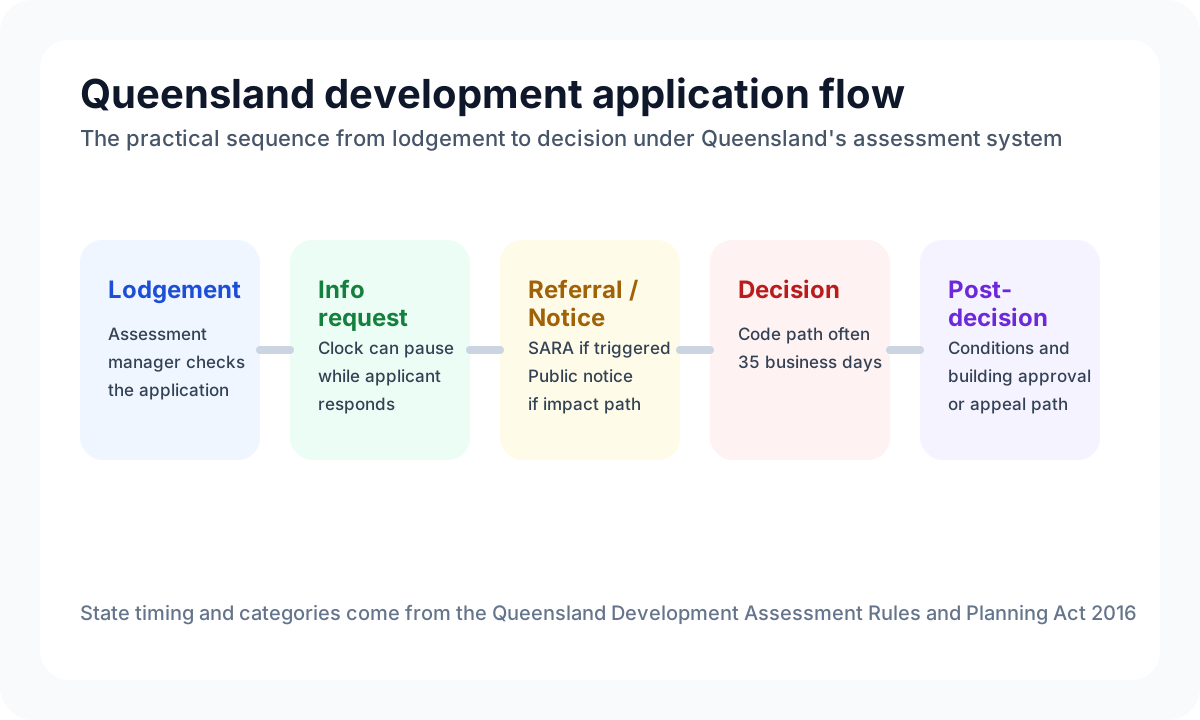
Queensland development application flow: lodgement, information requests, referral, decision, and post-approval steps each affect when a job becomes commercially actionable. Source: DA Leads synthesis of Queensland development assessment steps.
Where the Real Delay Comes From
Most people ask the wrong timing question. They ask, "How long does a Queensland DA take?" The better question is, "What makes this application stop moving?"
The official Development Assessment Guide says an application is not properly made until the right form, the right information, owner consent where required, and the fees are in. That matters because an incomplete lodgement does not behave like a live, cleanly running application. It behaves like a project that is already slipping before the assessment really gets going.
| Stage | Official rule | What usually stretches the job |
|---|---|---|
| Properly made lodgement | Form, information, owner consent, and fees need to be correct | Missing documents, wrong fee assumptions, and weak first lodgement packages |
| Information request | Early requests for more information happen near the front of the process | Poorly scoped reports, incomplete plans, and consultant gaps |
| Referral | Relevant applications must be referred to agencies such as SARA within the early part of the process | State road, flood, coastal, heritage, and environmental triggers |
| Public notice | Impact-assessable applications require at least 15 business days of public notification | Objections, redesign pressure, and longer stakeholder management |
| Decision notice and conditions | Approval can come with conditions, not just a yes | Stormwater, access, landscaping, servicing, and staging conditions that reshape procurement |
This is why Queensland jobs can feel deceptively fast on paper and still drag in real life. The statutory framework matters, but the commercial reality sits in the handoffs: the quality of the first lodgement, whether a referral is triggered, whether notice is required, and how ugly the conditions are when the decision notice lands.
SARA Is Often the Signal That a Job Just Got More Valuable
Some applications trigger referral to SARA, the State Assessment and Referral Agency. That is usually where Queensland stops being a simple council-only story.
SARA gets involved when a project touches a state interest, for example:
- state-controlled roads
- flood, bushfire, coastal, or environmental triggers
- state heritage places
- other referral matters in the state framework
When SARA is in the path, the application usually becomes more consultant-heavy, more document-heavy, and more expensive to unwind. That is frustrating for the applicant. It is useful for anyone selling expertise.
Queensland's best lead window usually appears after plans are lodged and referral or assessment risk becomes visible, but before the full builder and subcontractor stack is locked in. Source: DA Leads synthesis of Queensland DA process and SARA referral triggers.
If you do fitout, stormwater, access, civil, certifier coordination, acoustic, fire, or specialist building work, these are usually better leads than the simplest backyard projects. The budget is larger, the consultant stack is already forming, and the owner has usually crossed the point where they are still spending money to make the project happen.
What Actually Costs Money Before a Shovel Goes In
Queensland does not have one neat statewide DA fee you can memorise. The useful question is which cost line appears at which step.
| Cost line | Who sets it | When it appears | Practical note |
|---|---|---|---|
| Pre-lodgement advice | Local council | Before formal lodgement | Many councils offer pre-lodgement advice or services, and they may charge for it |
| DA application fee | Assessment manager, usually council | At lodgement | If the fee and required material are not right, the application is not properly made |
| Public notice cost | Applicant-managed, under the impact assessment rules | Impact-assessable projects only | Site notice, neighbour notice, and publication all add time and money |
| Referral and specialist reports | Depends on the trigger and consultant team | When state interests or technical constraints are in play | Flood, traffic, heritage, servicing, and environmental issues can reshape the whole budget |
| Building approval / certification | Local government or building certifier | After planning approval and before construction starts | Separate from planning approval, and easy to underestimate in sales timing |
This is why a Queensland job can look cheap at lodgement and still become expensive before site start. The planning fee is only one line item. Public notice, redesign, referral responses, and the building approval handoff are usually where the commercial reality shows up.
Planning Approval Is Not a Shovel-on-Site Date
A Queensland planning approval is a buying signal, not a start-on-site date.
The decision notice can approve the development and still leave a lot of work between "yes" and "build." Conditions can force additional engineering, access changes, landscape revisions, servicing responses, or staged sign-offs. On top of that, Business Queensland says a building development approval is needed before construction can start on most domestic building work, and that approval can come from local government or a building certifier.
That matters for lead timing. If you wait for site commencement, you are late. If you move as soon as the decision notice and next approval steps become visible, you are much closer to the real procurement window.
Appeals Still Matter, Even If They Slow the Sale
Queensland's Planning and Environment Court handles development application appeals. Commercially, that does not always mean the project is dead.
Sometimes an appeal means the owner has enough conviction, capital, and sunk consultant cost to keep pushing. That can still be a live lead for planners, lawyers, certifiers, engineers, and specialist contractors. The mistake is treating it like a normal fast-conversion lead. It is usually a slower, consultant-led opportunity with a longer sales cycle.
What Tradies, Consultants, and Suppliers Should Do Next
- Start with Queensland insights, then watch Logan City Council, Brisbane City Council, Moreton Bay Regional Council, and Gold Coast City Council.
- If you want visible volume, focus first on renovation and extension, change-of-use, subdivision, and garage/carport/shed work.
- If you want higher-value leads, pay extra attention to impact-assessable and referral-heavy projects.
- Once a decision notice lands, move quickly on the second-step work: building approval, certifier coordination, and condition response.
Browse Queensland development applications if you want the statewide picture, or go straight to the leads dashboard to filter by trade category and council.
Sources and Further Reading
- Queensland Development Assessment Rules Overview
- Queensland Development Assessment Guide
- Queensland Categories of Development
- State Assessment and Referral Agency (SARA)
- Building approvals and inspections, Business Queensland
- Starting proceedings in the Planning and Environment Court
- DA Leads internal MySQL snapshot, Queensland 2026, queried 2026-04-10


