
Queensland secondary dwelling applications surged 330% in the past 12 months, with 886 DAs lodged across the state compared to 206 the year before. Logan City Council alone accounts for two-thirds of all activity.
But Queensland does not have one clean statewide granny-flat rule like NSW. The development assessment system is state-based, while the detailed settings for a secondary dwelling come from each local planning scheme. A design that is straightforward in one council area may need a different size, setback or assessment path in the next.
For builders and owners, the first question is not "can Queensland do granny flats?" It can. The real question is which council rules apply to your lot, and whether the project stays in code assessment or gets pushed into impact assessment.
What Queensland Calls a Granny Flat
Queensland planning schemes usually use the term secondary dwelling or, in some councils, auxiliary unit rather than "granny flat." The exact wording varies, but the practical idea is the same: a self-contained dwelling on the same lot as a primary home.
Some older planning schemes still reference "dual occupancy" for two dwellings on one lot. A secondary dwelling is a specific subset: it's smaller than the primary dwelling and is typically subordinate to it in scale and function.
The distinction matters for approvals. If your project crosses from secondary dwelling into dual occupancy territory, the assessment category, infrastructure charges, and parking requirements all change. In most councils, a secondary dwelling must remain subordinate in both scale and function to the primary house.
Code Assessment vs Impact Assessment
In most Queensland councils, a standard secondary dwelling that fits the local code is code assessable. This is the faster path.
- 35 business days statutory decision timeframe
- No public notification
- Standards-based assessment against the planning scheme benchmarks
If the proposal does not fit the code settings, it can move into impact assessment instead. That path is slower, publicly notified, and more discretionary.
| Path | Timeline | Public notice | Risk level |
|---|---|---|---|
| Code assessment | 35 business days | None | Low, if benchmarks are met |
| Impact assessment | 15+ business days public notice, then decision period | Yes, neighbours can submit | Higher, discretionary |
Most secondary dwelling DAs that end up in our tracking data are the ones that triggered impact assessment or had extra planning complexity. The straightforward code-assessable projects often move quickly without public visibility.
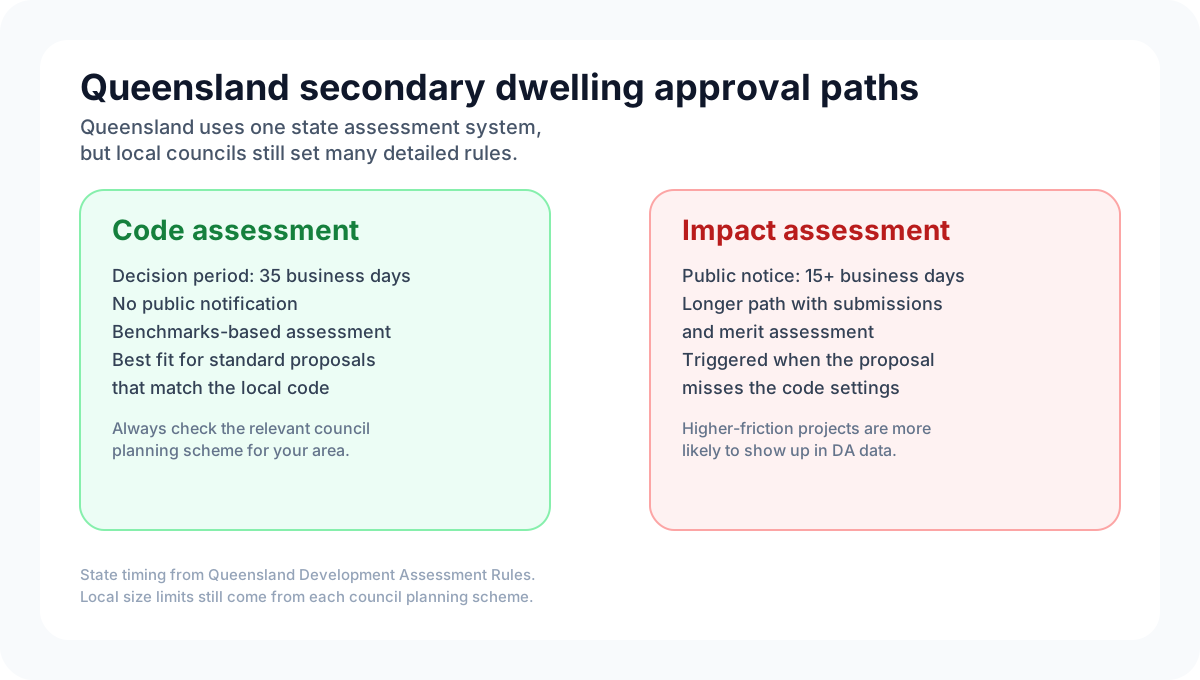
Queensland secondary dwelling approval paths: same-use residential sites can still face planning friction when overlays, lot conditions, or local controls change the path. Source: DA Leads synthesis of Queensland secondary dwelling approval guidance.
Queensland Secondary Dwelling DA Data by Council
We track development applications across 325+ Australian councils. Here is where secondary dwelling activity is concentrated in Queensland, based on 1,542 DAs in our database:
| Council | Total DAs | Last 12 months | Trend |
|---|---|---|---|
| Logan City Council | 1,040 | 709 | Dominant, 67% of all QLD |
| Moreton Bay Regional Council | 238 | 143 | Strong growth corridor |
| Brisbane City Council | 131 | 42 | Steady, urban infill driven |
| Maranoa Regional Council | 34 | 4 | Regional, slowing |
| Somerset Regional Council | 18 | 18 | All recent, emerging |
| Mareeba Shire Council | 17 | 4 | Regional, low volume |
| Fraser Coast Regional Council | 9 | 3 | Low |
| Sunshine Coast Regional Council | 7 | 3 | Surprisingly low given population |
| Ipswich City Council | 7 | 7 | All recent, watch this one |
| Townsville City Council | 5 | 5 | All recent, emerging |
Data: DA Leads tracking of publicly listed development applications. Code-assessable projects without public notification may not appear. Last updated May 2026.
The Logan dominance is striking. This is not just about population. Logan's planning scheme, land availability, and lot sizes make secondary dwellings more feasible there than in many other SEQ councils. More on Logan below.
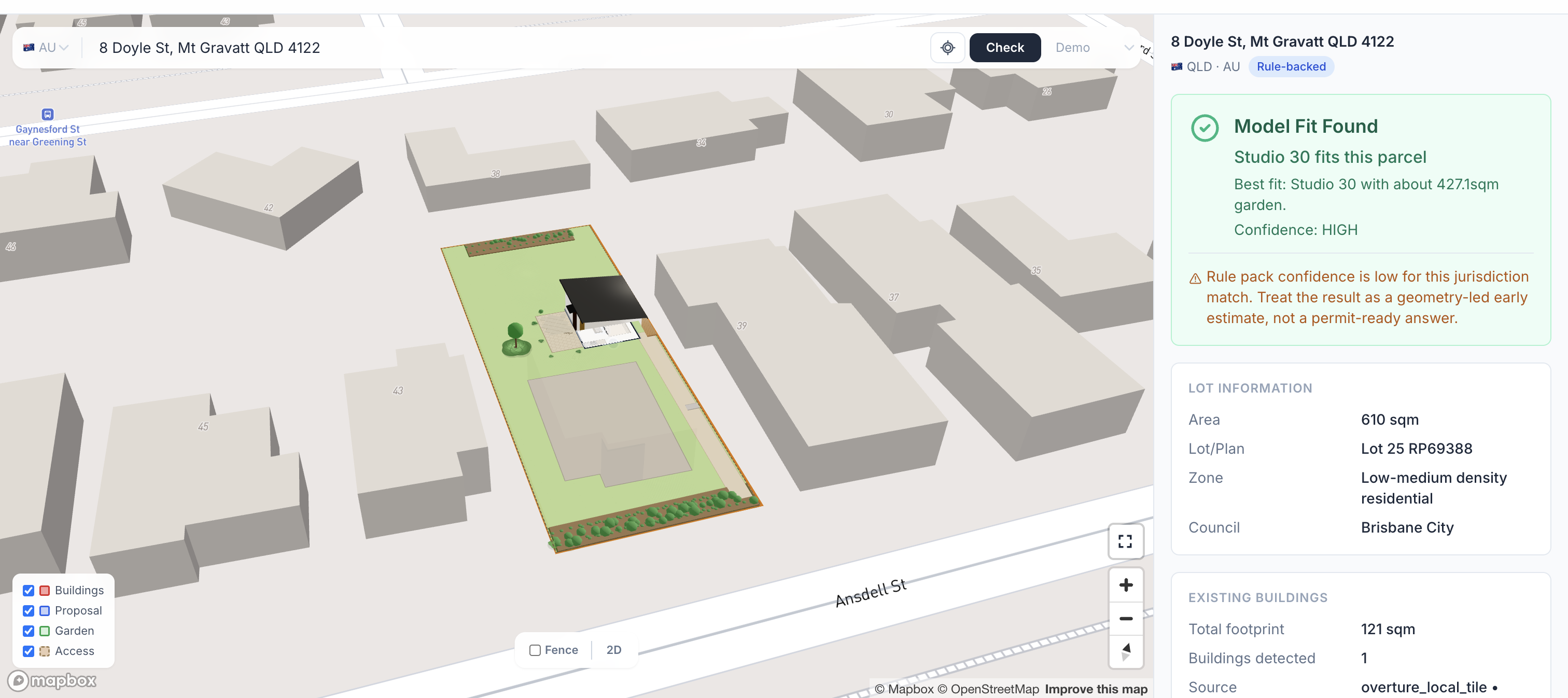
The Granny Flat Feasibility Checker in action on a Mt Gravatt, Brisbane property. Shows parcel boundary, existing building footprint, proposed granny flat placement and garden plan.
Council-Specific Rules: What You Need to Know
Queensland secondary dwelling friction often comes from council-specific overlays, slope, servicing, and lot conditions rather than one statewide size rule.
Logan City Council
Logan is Queensland's granny flat capital. With 1,040 tracked secondary dwelling DAs, it processes more than the rest of the state combined.
Key rules: - Secondary dwelling generally limited to 70m² GFA in residential zones and 100m² in other zones - Must be on the same lot as the primary dwelling - Must remain subordinate in scale to the primary house - Minimum lot size applies (check your zone's lot requirements)
Where in Logan? The top suburbs for secondary dwelling DAs in the past 12 months:
| Suburb | DAs (12 months) |
|---|---|
| Logan Reserve | 126 |
| Park Ridge | 101 |
| Chambers Flat | 60 |
| Greenbank | 35 |
| Logan Village | 28 |
| Woodridge | 21 |
| Kingston | 18 |
| Crestmead | 17 |
Logan Reserve and Park Ridge together account for more secondary dwelling DAs than any other Queensland council outside Logan. These are growth-corridor suburbs with larger lots and new subdivisions where secondary dwellings are part of the investment strategy from day one.
Browse Logan City Council DAs to see current applications.
Brisbane City Council
Brisbane processes secondary dwellings under its City Plan. The rules differ from Logan:
- Generally code assessable if the site is in a residential zone and the design meets the acceptable outcomes
- The secondary dwelling must be within the building envelope
- Flood overlays in low-lying suburbs (e.g., Rocklea, Graceville) can push the project into a harder assessment category
- Infrastructure charges apply
Brisbane's 131 tracked DAs over the period suggest steady but lower activity than the outer growth corridors. Urban infill sites tend to be more constrained, which means more projects end up needing additional approvals.
Moreton Bay Regional Council
Moreton Bay sits north of Brisbane and is the second-most-active council for secondary dwellings. The growth corridor includes suburbs like North Lakes, Caboolture, and Burpengary where lot sizes are large enough for secondary dwellings.
- Planning scheme aligns with the state framework
- Code assessment for standard proposals
- The rapid population growth in the corridor is driving both new builds and secondary dwelling additions
Sunshine Coast and Gold Coast
Both councils have their own scheme settings. Sunshine Coast's 7 tracked DAs is surprisingly low given its population, which may reflect stricter local controls or a planning scheme that channels more projects through code assessment (making them invisible in public DA data).
Gold Coast secondary dwelling rules depend heavily on the zone and overlay maps. Flood and coastal hazard overlays along the coast can complicate otherwise straightforward proposals.
What Usually Pushes a Project Out of the Fast Path
These are the issues that commonly turn a straightforward proposal into a harder one:
- Flood overlays and floor-level requirements (the most common friction point in SEQ)
- Steep sites, retaining walls, and access problems
- Infrastructure servicing constraints (sewer, stormwater, water supply)
- Short-stay accommodation assumptions that do not match the approved land use
- Trying to transplant another council's size cap or setback expectations onto the wrong lot
- Exceeding the GFA limit, even by a small amount, which shifts the assessment category
- Insufficient setbacks to boundaries, triggering relaxation requests
Building Approval Requirements
Regardless of which council you're in, every secondary dwelling still needs building approval. Queensland's building approval sits alongside the planning approval path, not instead of it.
Key building requirements include:
- NCC (National Construction Code) compliance for structural, fire, and energy performance
- Structural compliance for the site's wind or cyclone region
- Fire separation between primary and secondary dwelling where required
- Plumbing and drainage approvals (separate connection or shared, depending on the design)
- Access and siting compliance including setbacks and private open space
In cyclone-prone parts of Queensland (north of the Tropic of Capricorn), the structural requirements can be materially different from South East Queensland. Wind classification, fixing details, and roof tie-down specifications all change. That is one reason copied plan sets from SEQ can go wrong fast when used further north.
Private Certifier vs Council
Queensland allows private building certifiers to issue building approvals. In practice, most secondary dwelling projects use a private certifier for speed:
- Private certifier: Typically faster turnaround, competitive on price, available across SEQ
- Council building approval: Available but often slower, some councils have backlogs
Either path produces a valid building approval. The planning approval (DA) is separate and handled by the council regardless.
Costs and Financial Considerations
Queensland councils do not consistently report construction costs in DA data, so we cannot provide a reliable average from our database. However, based on industry sources and project descriptions in our tracked DAs:
- Kit and modular secondary dwellings: $80,000 to $150,000 for a basic 1-2 bedroom design
- Custom-built on site: $150,000 to $280,000+ depending on size, finishes, and site conditions
- Infrastructure charges: Vary by council. Logan's infrastructure charges for a secondary dwelling can add $15,000 to $30,000+
- Professional fees: Town planner ($3,000-$8,000 for impact assessment), building certifier ($2,000-$5,000), surveyor, engineer
For context, a secondary dwelling in Logan that meets code assessment can avoid the town planner cost entirely. That difference alone makes the code-assessable path significantly cheaper.
Rental return context: A 2-bedroom granny flat in Logan's growth corridor suburbs (Logan Reserve, Park Ridge) typically rents for $350 to $500 per week based on current listings. At the lower construction cost end, that represents a gross yield that makes the numbers work for many investors.
Common Pitfalls in Queensland
- Assuming one council's rules apply everywhere. Queensland is not NSW. Logan's 70m² cap does not apply in Brisbane, and Brisbane's flood mapping does not apply in Logan.
- Overlooking flood and hazard mapping. This is the fastest way to blow up a simple concept. Check the council's overlay maps before you commit to a design.
- Ignoring servicing and access. Sewer, drainage and site access often shape the real cost more than the building itself.
- Treating short-stay use as automatic. The approved land use and the business model are not always the same thing. Airbnb use of a secondary dwelling may require a separate material change of use approval.
- Underestimating infrastructure charges. These can add $15,000-$30,000+ on top of construction costs in growth areas.
- Not checking the lot's existing approvals. Some lots in new subdivisions have conditions that restrict or complicate additional dwellings.
Where Queensland Granny Flat DAs Are Happening
These councils have the highest secondary dwelling DA activity in Queensland right now:
Finding Secondary Dwelling Projects
Secondary dwellings that stay in code assessment move quickly and do not involve public notification. The ones that appear in DA tracking systems like ours are more often impact-assessable or otherwise more complex jobs.
Browse Queensland development applications on DA Leads to find active projects, or check out the granny flat and secondary dwelling category for opportunities across all states. If you're assessing a site for secondary dwelling potential, the feasibility calculator can help you understand the numbers before you commit.
Track Granny Flat DAs on the Map
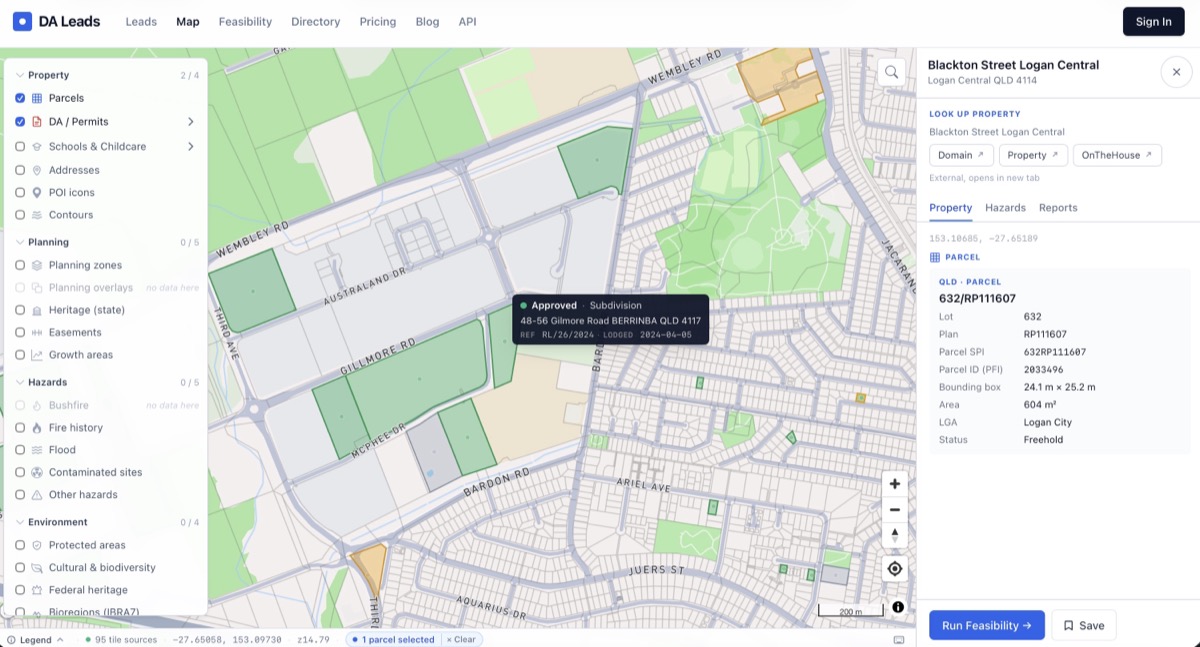
Want to see which granny flat projects are being lodged near a specific site? The DA Leads interactive map shows every development application across 325+ councils in real time. Search any Queensland address to see nearby secondary dwelling DAs, zoning overlays, and planning controls.
Frequently Asked Questions
Can I build a granny flat in Queensland without council approval?
No. Every secondary dwelling in Queensland needs at minimum a building approval. Whether you also need a planning approval (DA) depends on the assessment category in your council's planning scheme. Many standard projects are code assessable, meaning the council must approve them if they meet the benchmarks, but you still need to lodge the paperwork.
What is the maximum size for a granny flat in QLD?
It varies by council. Logan City Council limits secondary dwellings to 70m² GFA in residential zones and 100m² in other zones. Other councils have different limits. The state framework does not set a single statewide cap. Always check your specific council's planning scheme.
How much does it cost to build a granny flat in Queensland?
Typical ranges are $80,000 to $150,000 for kit or modular builds, and $150,000 to $280,000+ for custom on-site construction. Infrastructure charges ($15,000-$30,000+ in growth areas like Logan), professional fees, and site preparation costs add to the total. Code-assessable projects avoid town planner fees ($3,000-$8,000), which reduces the cost.
Which QLD council approves the most granny flats?
Logan City Council, by a wide margin. With over 1,000 tracked secondary dwelling DAs, Logan processes more than the rest of Queensland combined. Moreton Bay Regional Council (238 DAs) and Brisbane City Council (131 DAs) are the next largest.
Can I Airbnb my granny flat in Queensland?
Not automatically. A secondary dwelling is approved for residential use. Using it for short-stay accommodation (like Airbnb) may require a separate material change of use approval, depending on the council. Some councils actively enforce this distinction.
How long does granny flat approval take in QLD?
For code-assessable projects, the statutory decision period is 35 business days. In practice, council turnaround varies. Impact-assessable projects take longer because they require a minimum 15-business-day public notification period plus the decision period. Using a private building certifier for the building approval component can speed up the overall timeline.
Do I need a separate driveway for a granny flat in QLD?
Not necessarily. Most councils require that the secondary dwelling has adequate access, but this can be shared with the primary dwelling. Specific requirements for car parking spaces (usually one additional space) and driveway dimensions depend on the council's planning scheme.
Sources and Further Reading
- Queensland Planning: Secondary Dwellings
- Queensland Planning: Changes to Secondary Dwellings
- Queensland Development Assessment Rules Overview
- Logan City Council: Assessment Criteria and Categories of Development
- Logan City Council: Domestic Housing Fact Sheet
- DA Leads: Queensland Development Applications
- DA Leads: Granny Flat & Secondary Dwelling Category
- DA Leads: 8,092 granny flat DAs in 12 months, the national data


