
NSW does not run every project through one full council DA. Depending on the job, you may be dealing with exempt development, a complying development certificate, a local DA, or a state-significant pathway. If you're trying to time outreach or work out what happens after lodgement, that distinction matters more than anything else.
Four Approval Pathways: Not Every Job Needs a Full DA
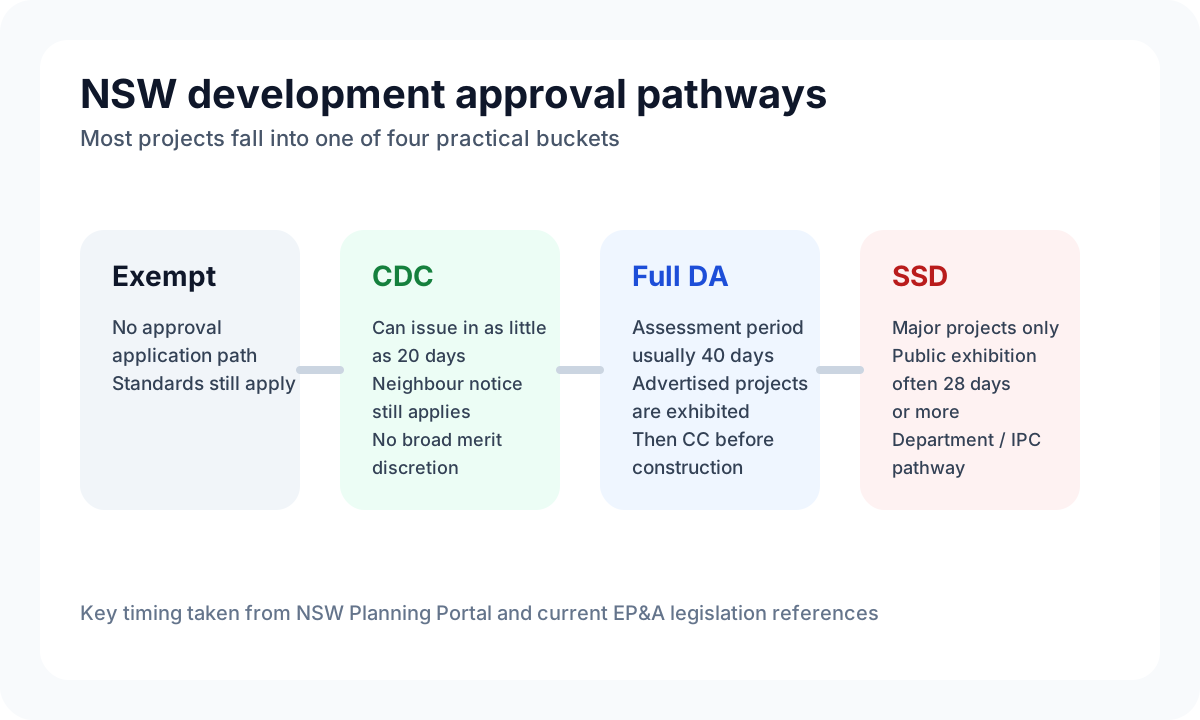
NSW uses a tiered system. The practical question is simple: which pathway are you actually in? That tells you who decides, how visible the project is, and how long you may wait.
Exempt Development
Small, low-impact works that do not need an approval application at all. Think minor internal renovations, some sheds, some fences, and other low-risk jobs that stay inside the exempt development standards. No application. No assessment. But the work still needs to comply with the relevant standards in the State Environmental Planning Policies (SEPPs).
Complying Development (CDC)
This is the fast-track pathway. A Complying Development Certificate (CDC) is assessed by council or a certifier against a fixed set of standards. If the project fits the code, it can move much faster than a full DA.
The NSW Planning Portal says approvals can be issued in as little as 20 days.
CDC does not mean invisible. Neighbour notification still applies, but the path is more prescribed and there is far less merit-based discretion than a full DA.
Full Development Application (DA)
This is the standard pathway for anything that doesn't qualify as exempt or complying development. A DA is lodged with the local council (or, for larger projects, a regional or state planning panel) and assessed on its merits against the local environmental plan (LEP), development control plan (DCP), and any relevant SEPPs.
The 40 days figure matters, but it needs the right label. For ordinary development, 40 days is the key deemed-refusal benchmark used in appeal rights. For designated or integrated development, that moves to 60 days. For state significant development, it stretches to 90 days. Advertised development has its own public-notice settings, commonly 14 days or 28 days for integrated and threatened-species matters.
State Significant Development (SSD)
Large-scale projects are assessed by the NSW Department of Planning under the state-significant pathway. These are not backyard or standard suburban jobs, but they matter if you work on major packages and want to read the pipeline early.
| Path | Typical approval logic |
|---|---|
| Exempt | No approval application, but standards still apply |
| CDC | As little as 20 days, prescribed standards, neighbour notice still applies |
| Full DA | Council or panel merits assessment, with 40/60 day deemed-refusal clocks depending on the development type |
| SSD | State-level pathway for major projects |
The DA Timeline: What Actually Happens
1. Pre-Lodgement
Many councils offer pre-DA meetings where applicants can test a concept before paying for full documentation. If someone tells you they have already done that, the project is usually real, not just a weekend idea.
2. Lodgement via the NSW Planning Portal
Most planning applications in NSW are now lodged through the NSW Planning Portal. That centralised flow is one of the reasons NSW is easier to track at scale than most other states.
Your opportunity: Once a DA appears on the portal, the applicant has committed real money. They've paid for architectural drawings, consultant reports, and application fees. This is a strong signal of intent.
NSW DA lead window: portal lodgement and assessment are usually the best outreach moments, while post-CC approaches are later and harder. Source: DA Leads synthesis of NSW Planning Portal process and post-consent steps.
3. Notification / Exhibition
If the project is an advertised application, the public notice period is commonly 14 days, or 28 days for some integrated or threatened-species development. This is where objections, support submissions and public scrutiny start affecting the clock.
4. Assessment
Council planners assess the DA against the LEP, DCP and any relevant state planning instruments. They look at height, setbacks, heritage, flooding, landscaping, traffic and environmental impacts.
If the application is incomplete, council will issue a request for information (RFI). This pauses the assessment clock and is the single biggest cause of delays. Some applications bounce back and forth multiple times.
This is also the stage where a lot of applicants quietly start lining up trades. They know the project is real. They just do not know exactly when consent will land.
5. Decision
The DA is either approved (with or without conditions), refused, or deferred for more information. For straightforward applications assessed by council staff under delegation, the decision happens relatively quickly. Applications that go to a council meeting or a planning panel take longer. Sometimes much longer.
Conditions of consent are worth reading carefully. They often specify materials, hours of construction, landscaping requirements, stormwater management, and other details that directly affect the scope and cost of building work.
6. Post-Approval
After DA approval, the applicant still needs a Construction Certificate (CC) before building work can start. That certificate confirms the detailed construction plans comply with the building rules and other consent requirements.
NSW development approval flow: lodgement, notice, assessment, determination, and post-approval building compliance each create their own timing risk. Source: DA Leads synthesis of NSW planning and approval guidance.
And the sequence does not stop there. The NSW Planning Portal's post-consent guidance says:
- a CC must be obtained before building or construction work starts
- an Occupation Certificate (OC) is needed to occupy and use a new building, part of a building, or change the use of an existing building
That matters for tradies because a project can be "approved" in the planning sense and still not be ready to build or occupy.
Section 4.55 Modifications
Plans change. When a project needs to be altered after DA approval, the applicant lodges a modification under Section 4.55 of the Environmental Planning and Assessment Act.
There are three types:
- s4.55(1): Minor error, misdescription, miscalculation, or a change with no environmental impact.
- s4.55(1A): Modifications with minimal environmental impact, where the development remains the same or substantially the same development.
- s4.55(2): Other modifications that still remain the same or substantially the same development, but usually involve a heavier assessment and notification path.
Modifications are common and often signal that a project is actively progressing. A homeowner modifying their approved plans is likely in detailed discussions with their builder about construction details.
Appeals: The Land and Environment Court
If a DA is refused, or if council does not make a decision within the statutory deemed-refusal period, the applicant can appeal to the NSW Land and Environment Court.
The Court's own development appeal guidance says:
- appeals under
s 8.7ors 8.9are generally to be made within 6 months - ordinary development is deemed refused after 40 days
- designated or integrated development is deemed refused after 60 days
- state significant development is deemed refused after 90 days
- modification applications are generally deemed refused after 40 days
For tradies, a DA under appeal isn't dead. If the applicant is spending money on legal representation, they're committed to the project. These can be good leads once the appeal is resolved.
What This Means for Finding Work
NSW's centralised Planning Portal makes it possible to track the state more consistently than almost any other Australian market. In the current DA Leads snapshot, NSW contributes 23,935 DAs lodged in 2026 across 129 councils, and 496,090 NSW records in the wider database.
That scale matters because it lets you compare not just one suburb or one council, but the whole NSW pipeline.
| Stage | What it means operationally | Outreach value |
|---|---|---|
| Pre-lodgement | Project may still change or die | Low |
| Lodgement | Real money already spent on plans and reports | High |
| Exhibition / notice | Public visibility increases, but objections may change timing | Medium to high |
| Assessment | Applicant is often collecting quotes while waiting | High |
| Post-consent, pre-CC | Scope is real, but detailed compliance still underway | Medium |
| Post-CC / pre-OC | Build readiness rises sharply | High, but competition is higher too |
The key stages where tradies can add value:
- At lodgement: The homeowner has committed but may not have locked in all their trades yet.
- During assessment: The homeowner is waiting and gathering quotes. This is the sweet spot for outreach.
- After approval: The project is confirmed, but CC and other post-consent steps may still shape timing.
- After CC: The project is build-ready. This is often the most urgent stage, but also the most competitive.
For NSW specifically, I would not treat all four pathways the same from a lead perspective:
- Exempt development is often invisible in public DA datasets, so do not assume "no record" means "no work"
- CDC is fast and can move before slower competitors notice it
- Full DA offers the clearest public lead window
- SSD matters less for small tradies, but very early visibility matters if you work on major subcontract packages
Browse the latest NSW development applications or go straight to the NSW insights page on DA Leads to see where the current pipeline is thickest. For the cost side of buying or building in NSW, see the companion NSW transfer duty rates 2025-26 guide.
Sources and Further Reading
- DA Leads internal database snapshot, queried 2026-04-10
- NSW Planning Portal Overview
- NSW Planning Portal: Local Development
- NSW Planning Portal: Complying Development
- NSW Planning Portal: Post-Consent Certificates
- Environmental Planning and Assessment Act 1979 (NSW)
- NSW Land and Environment Court: Development appeals


