
Since 14 December 2023, Victoria has allowed many small second dwellings, what most people still call granny flats, to proceed without a planning permit. Since 8 September 2025, lots under 300m² in residential zones have also had an updated 10 business day VicSmart path if they meet the standards. A building permit is still always required.
If you're still telling clients every granny flat needs a council planning permit, you're out of date. Here's what actually changed, what still triggers a permit, and where DA Leads still matters.
The Big Change: Many Granny Flats Skip Planning Permits
This is the headline: a small second dwelling of 60m² or less on the same lot as an existing home can be built on many residential and rural lots without a planning permit.
That does not mean "no approval". It means the planning-permit step can disappear, while the building-permit step stays.
| Site setup | Approval path |
|---|---|
| Lot over 300m², standard site, no special controls | No planning permit, building permit still required |
| Lot under 300m² in a residential zone, standards met | VicSmart planning permit, 10 business day review point |
| Over 60m², special controls, or non-standard proposal | Full planning permit, then building permit |
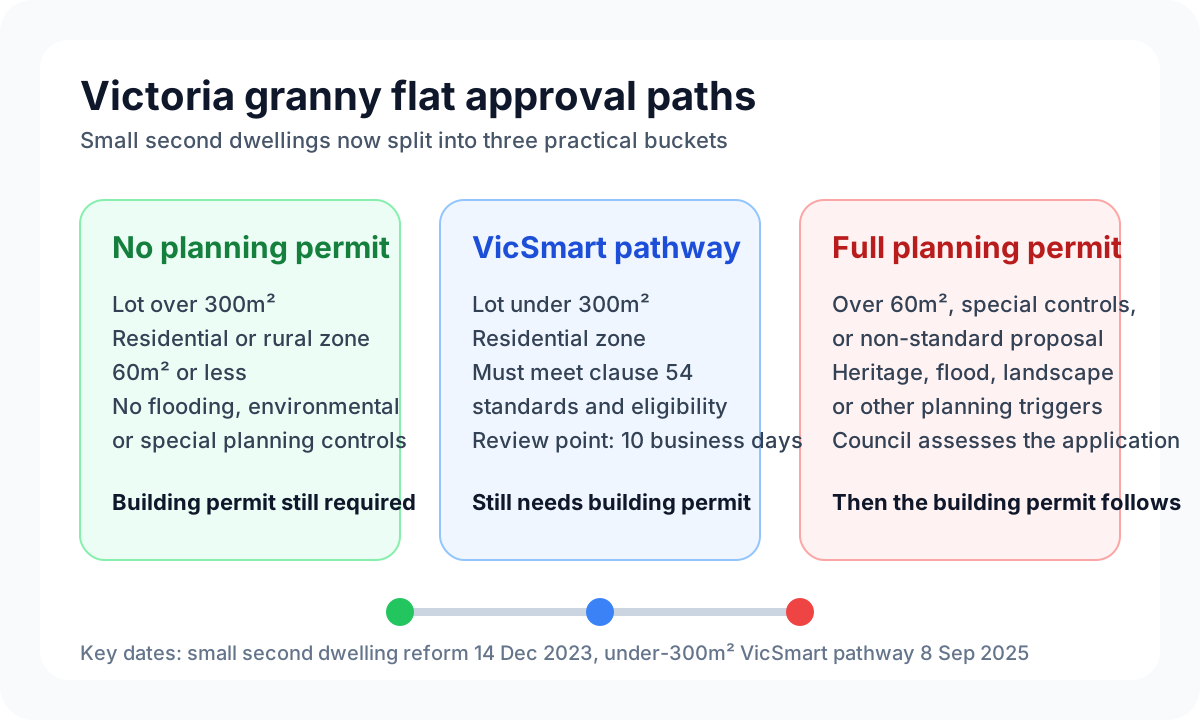
Victoria granny flat approval paths: planning, building, and site constraints combine differently depending on lot size, overlays, and dwelling setup. Source: DA Leads synthesis of Victoria granny flat approval pathways.
You still need a building permit, but cutting out the planning-permit stage can mean:
- Faster approvals. The project can move straight into building-permit documentation.
- Lower soft costs. No standard planning application and fewer planning-consultant fees.
- Less discretion. A standard compliant proposal avoids the full council planning assessment.
When You Still Need a Planning Permit
The exemption does not apply everywhere. You'll still need a planning permit if:
- The lot is under 300m² and the proposal does not qualify for the VicSmart pathway
- The site is affected by flooding, environmental, heritage, landscape or other special planning controls
- The second dwelling exceeds 60m²
- It is not on the same lot as an existing home
- The proposal falls outside the small second dwelling rules, for example if it is connected to reticulated natural gas while trying to rely on the planning-permit exemption
For lots under 300m² in residential zones, the picture changed again on 8 September 2025. These proposals can use a VicSmart planning permit application if they meet the clause 54 standards and eligibility rules. That is faster than a normal planning permit, but it is still a planning permit.
When a planning permit is required, the application shows up in council records and can appear on DA Leads. These are the higher-friction projects, and they are usually the better-qualified leads.
What About "Dependent Person's Units"?
Here's the detail many builders miss: the old dependent person's unit category has effectively aged out.
The land-use term was removed in late 2023, then the transitional window was extended a few times. The current expiry date is 28 March 2027. As of 6 April 2026, the DPU pathway still exists in transition, but it should be explained carefully because the long-term framework is now the small second dwelling rules.
Building Permit Requirements Still Apply
Even when no planning permit is needed, every granny flat still needs a building permit.
- The building permit is still mandatory
- The dwelling still has to satisfy siting, setback, site coverage, garden area, privacy and access rules under Victoria's building framework
- From 1 May 2024, Victoria's NCC 2022 energy-efficiency and livable-housing provisions became mandatory for relevant residential building work
- Small second dwellings also have specific access-path requirements in the Victorian building rules
For builders, this is an advantage. The planning side is lighter, but the technical documentation still matters. The better you explain siting, service connections, access and compliance, the easier it is to win work.
Why Granny Flats Are Booming
The demand is real, and it comes from multiple angles:
- Housing pressure. Families are using backyard dwellings to create extra space without moving.
- Ageing parents. People want independent living close to family support.
- Rental income. Owners like the idea of a second income stream on land they already hold.
- Smaller infill projects. Builders can deliver a repeatable product without taking on a multi-townhouse site.
For builders, this means a steady pipeline of work that is relatively standardised but still requires licensed, skilled trades to deliver properly.
How to Find Granny Flat Leads
The granny flats that show up in DA data are the ones that do need a planning permit: small lots, special controls, more complex sites and larger proposals. These tend to be in established suburbs where the project complexity, and often the budget, is higher.
For the permit-exempt projects in standard suburban backyards, you'll need other lead-generation strategies. But the DA-sourced leads are still worth watching because the homeowner has already invested in plans, consultants or both.
Where Victorian Granny Flat DAs Are Being Lodged
The granny flats that still need planning permits tend to cluster in inner and middle-ring suburbs with smaller lots, heritage overlays, or special controls:
If you want the broader planning context first, read how council planning permits work in Victoria. For national trends and how Victoria compares with other states, see the rise of granny flats across Australia. Then browse granny flat DAs on DA Leads to see current opportunities.
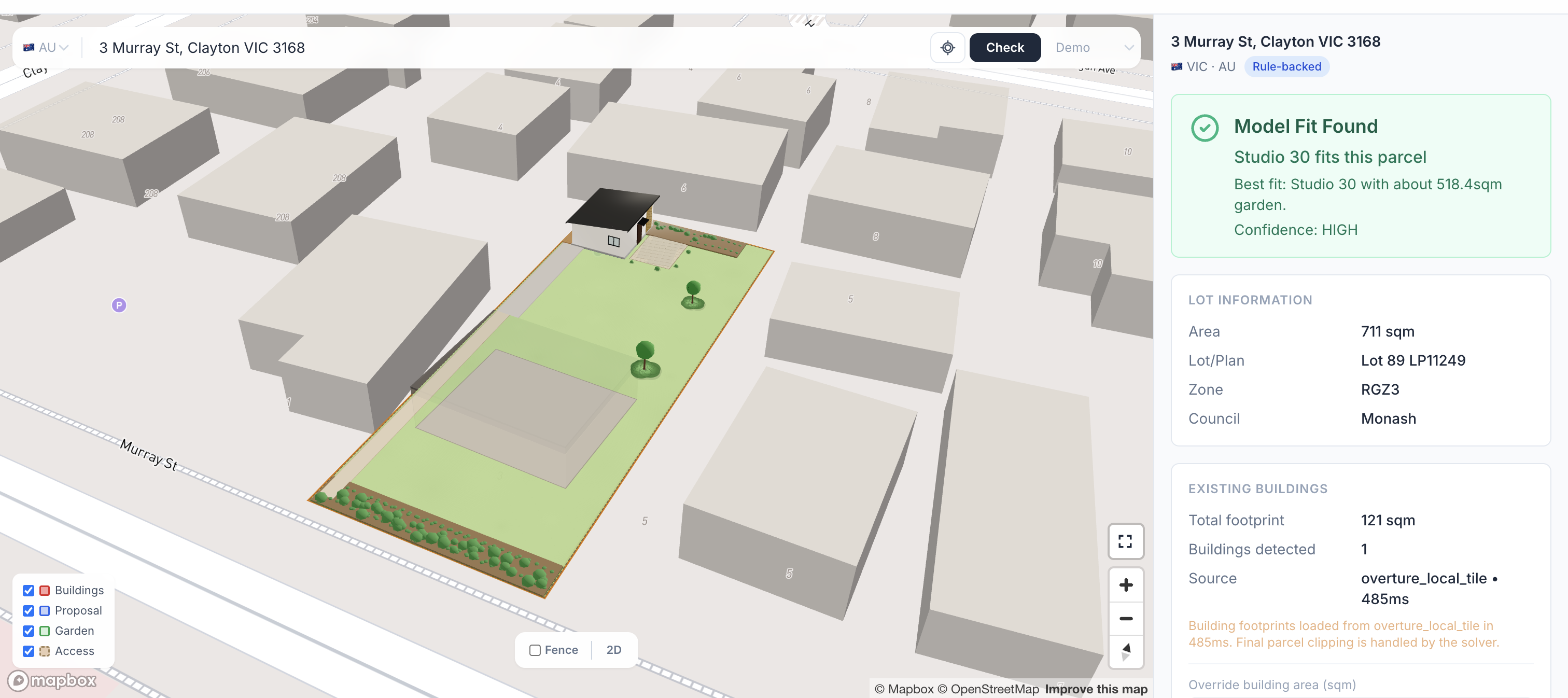
The Granny Flat Feasibility Checker in action on a Clayton, Melbourne property. Shows parcel boundary, existing building footprint, proposed granny flat placement and garden plan.
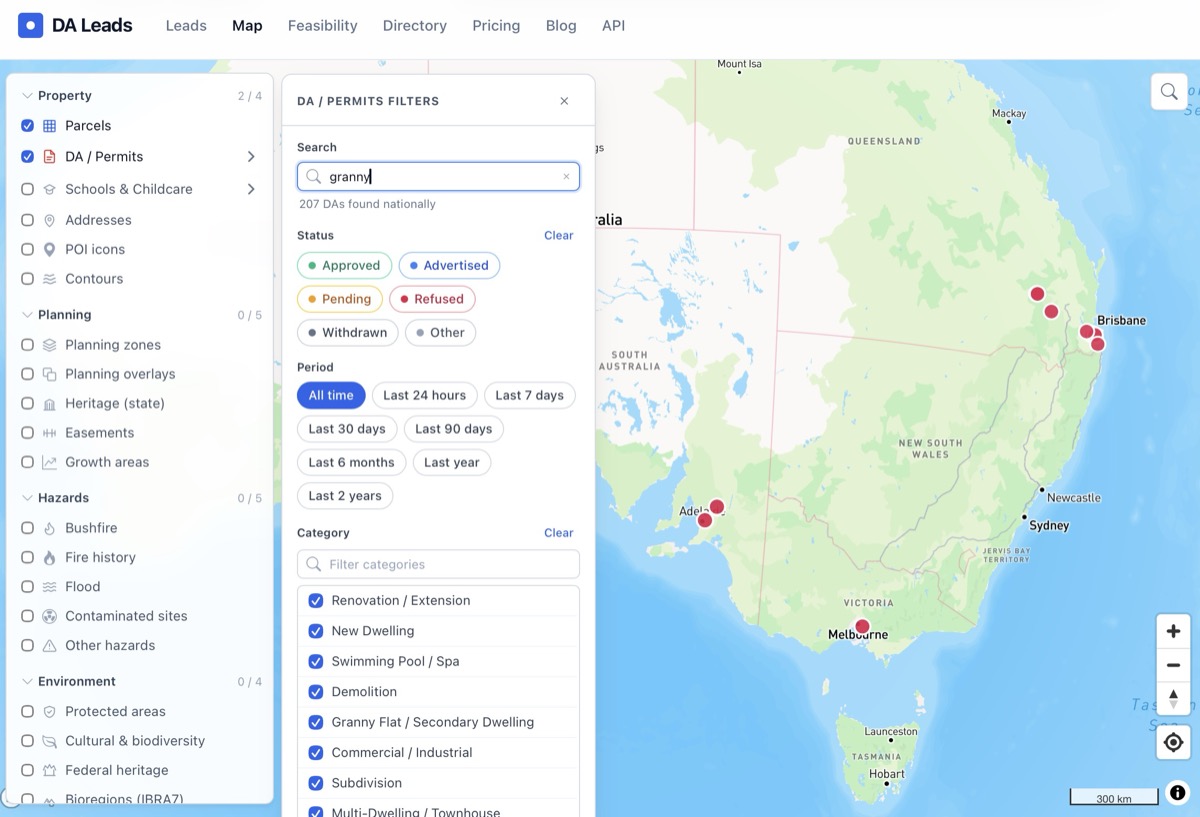
See Granny Flat Activity on the Interactive Map
Track which suburbs have active granny flat and secondary dwelling DAs right now. The DA Leads map shows live development applications with zoning overlays, school zones, and planning controls for any Victorian address.
Sources and Further Reading
- Victoria Planning, Small second dwellings
- Victoria Planning, Stronger standards and faster approvals for single homes and small second homes
- Victoria Planning, VicSmart permits
- VBA, Small second dwellings
- VBA, NCC 2022 changes from 1 May 2024
- DA Leads: 8,092 granny flat DAs in 12 months, the national data


