
On 15 September 2025, the Victorian Government introduced Amendment VC289, and the tree removal game in Victoria changed overnight.
If you're an arborist or tree services operator, this is the biggest change to your industry in years. More tree removals now need planning permits, which means more applications flowing through the council system, and more leads showing up in planning registers.
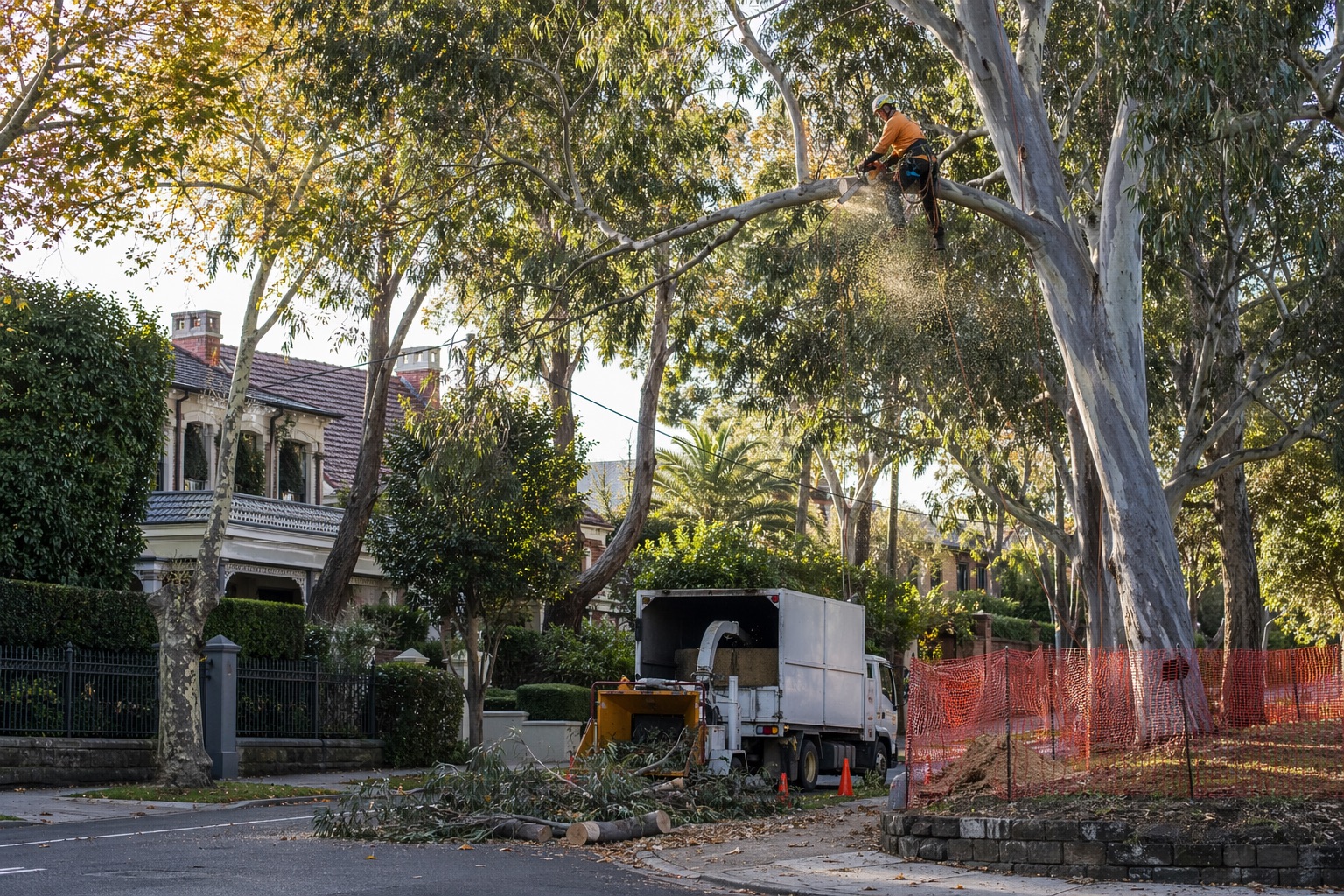
Tree removal in a leafy Melbourne suburb: an arborist in the canopy, wood chipper on the nature strip, and tree protection fencing on the adjacent development site. This is the kind of regulated work that generates planning permits and trade leads.
What Changed: Clause 52.37 Explained
The new Clause 52.37 (Canopy Trees) was added to every planning scheme in Victoria. It requires a planning permit to remove, destroy or lop a canopy tree in residential zones.
A canopy tree is defined as a tree that meets BOTH criteria:
- Height over 5 metres above ground level
- Trunk circumference over 0.5 metres (measured at 1.4m above ground)
That covers a lot of trees. More than you'd think. A mature eucalyptus, a decent-sized oak, or a well-established fruit tree could easily qualify, which means tens of thousands of previously unregulated trees across suburban Melbourne and regional Victoria are now subject to council oversight for the first time.
Minimum Canopy Cover Requirements
Clause 52.37-3 also sets minimum canopy cover targets for residential lots:
- 10% canopy cover on lots up to 1,000m²
- 20% canopy cover on lots over 1,000m²
This means even when removal is approved, councils may require replacement planting to meet these targets.
Boundary Canopy Trees Get Extra Protection
The rules are tighter for boundary canopy trees, which are trees with any part of their trunk within:
- 6 metres of the narrowest street frontage, or
- 4.5 metres of the rear boundary
These boundary trees shape street character and neighbourhood feel. Councils will be especially careful about approving their removal.
Where the Rules Apply (and Don't)
Clause 52.37 applies to all residential zones except the Low Density Residential Zone.
It doesn't override existing overlays. If your property already has a Vegetation Protection Overlay (VPO), Environmental Significance Overlay (ESO), or Significant Landscape Overlay (SLO), those controls still apply. You won't need two separate permits, but the existing overlay may have stricter requirements than Clause 52.37.
For a full rundown of how overlays modify zone rules, see our planning zones guide.
What's Exempt
You don't need a permit to remove a canopy tree if:
- The tree is dead
- It's for fire protection purposes
- The tree is a declared noxious weed or environmental weed
- Emergency situations (dangerous trees posing immediate risk)
Everything else goes through the permit process.
Why This Matters for Arborists
Before September 2025, tree removal in many suburbs was relatively unregulated unless the property had a specific overlay. A homeowner in a General Residential Zone could remove a 15-metre eucalyptus without any council involvement.
Now, that same tree requires a planning permit application, which means:
-
More work for arborists. Many permit applications require an arborist assessment report. If you can provide the report and do the work, you're a one-stop shop.
-
More leads in the system. Every tree removal permit application shows up in council planning registers, and on DA Leads. Before VC289, these leads didn't exist.
-
Higher-value jobs. Projects that go through the permit process tend to be more substantial. The homeowner has already invested in the application and is committed to seeing it through.
-
Council conditions create extra work. Permit conditions often require replacement planting: two trees for every one removed, specific species, minimum sizes. Quote the replacement planting as part of your service.
The Councils Where Tree Work Is Busiest
| Council | Why it's busy |
|---|---|
| Nillumbik | Melbourne's "Green Wedge" shire. Extensive native vegetation, large properties |
| Yarra Ranges | Mountain ash forests, fire risk management, development pressure |
| Manningham | Established suburbs with large eucalyptus trees reaching hazardous age |
| Boroondara | Heritage trees in established gardens. Elms, oaks, significant specimens |
| Bayside | Coastal vegetation, significant trees, properties being renovated or rebuilt |
With Clause 52.37 applying statewide, even councils that previously had few tree-related DAs are now seeing applications pour in from homeowners who never needed to deal with the planning system before. Bigger market. More opportunity.
Finding Tree Removal Leads
Filter for "Tree Removal" on DA Leads to find applications specifically for tree work. But also watch for:
- Construction DAs that mention vegetation removal. New homes on treed blocks often require tree removal before building starts.
- Renovation DAs where extensions encroach on the canopy zone of existing trees and need arborist input.
- Demolition DAs where site clearing includes significant trees.
The new rules mean more of this work is visible in council registers than ever before, so checking weekly is now essential rather than optional for anyone serious about growing their arborist business through council data.
See tree removal DAs across Victorian councils on DA Leads. For analysis of how tree removal permits are trending across different councils, see our data breakdown.
Sources and Further Reading
- Amendment VC289 - Victorian Planning Provisions - introduced Clause 52.37, effective 15 September 2025
- Clause 52.37 (Canopy Trees) - Planning Victoria - canopy tree definitions, permit requirements, minimum canopy cover targets, boundary tree protections, and exemptions
- VicPlan - Victoria's planning map - check Vegetation Protection Overlay (VPO), Environmental Significance Overlay (ESO), and Significant Landscape Overlay (SLO) for your property
- DA Leads internal database snapshot, queried 2026-02-08
- DA Leads council directory


