
Should you build two larger dwellings or three (or four) smaller ones? In 2026's Melbourne market, the answer depends almost entirely on your land cost. And for most suburbs, the numbers are tighter than you'd expect.
Let's break it down with real figures.
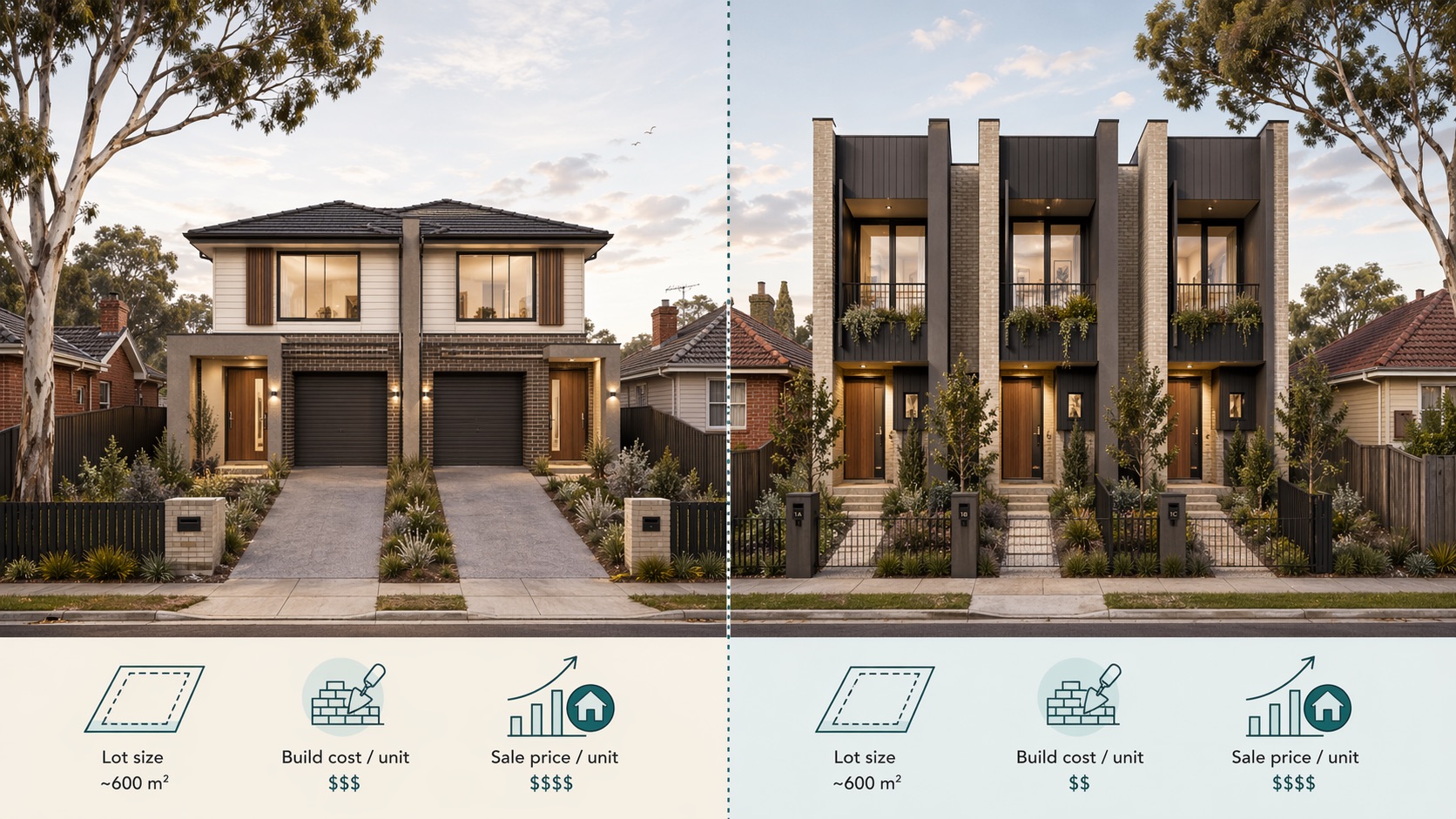
Duplex (left) vs townhouse development (right) on the same lot: fewer, larger units with more garden versus more, smaller units with higher total revenue. The right answer depends on your land cost and zoning.
Defining the Products
Duplex (dual occupancy): Two dwellings on one lot, typically side-by-side or front-and-rear. Usually 3–4 bedrooms, 2 bathrooms, double garage. Think 180–220m² per dwelling. Often on NRZ or GRZ land.
Townhouse development (3+ dwellings): Three or more attached or semi-detached dwellings. Typically 3 bedrooms, 2 bathrooms, single or double garage. Think 140–180m² per dwelling. Almost always requires GRZ, RGZ, or MUZ zoning.
The Side-by-Side Comparison
Same location, same land price, two different approaches. The construction cost used below ($2,800–$3,100/m²) reflects mid-spec developer-grade builds in Melbourne; budget builds can come in at $2,400/m², premium finishes push to $3,500+.
The Site
- Location: Reservoir, Melbourne (GRZ zoning, no significant overlays)
- Lot size: 700m²
- Frontage: 17.5m
- Land purchase price: $950,000
- Stamp duty: ~$51,000
Option A: Duplex (2 × 200m² dwellings)
| Item | Amount |
|---|---|
| Land + stamp duty | $1,001,000 |
| Demolition and site prep | $35,000 |
| Construction (2 × 200m² × $2,900/m²) | $1,160,000 |
| Professional fees (10%) | $116,000 |
| Council contributions | $28,000 |
| Finance, land (14 months @ 7.5%) | $83,000 |
| Finance, construction (10 months @ 8%) | $77,300 |
| Contingency (5%) | $58,000 |
| Selling costs (2% × sales) | $37,000 |
| Total development cost | $2,595,300 |
Revenue: 2 × $925,000 = $1,850,000
Profit: -$745,300
That's a massive loss. And that's the fundamental problem with duplexes in many Melbourne middle-ring suburbs right now. Unless you're in a premium area where 4-bedroom townhouses command $1.3 million or more, the numbers rarely work because land cost is too high relative to only two end products.
Let's adjust to a suburb where duplex end values are higher.
Option A (revised): Duplex in Bentleigh
- Land: $1,500,000 (Bentleigh is pricier)
- Stamp duty: ~$82,000
- Construction: 2 × 210m² × $3,100/m² = $1,302,000
- Total development cost: ~$3,430,000
- Revenue: 2 × $1,550,000 = $3,100,000
- Profit: -$330,000
Still a loss. The fundamental problem is simple: two dwellings rarely generate enough gross realisation to cover Melbourne land prices plus construction costs plus professional fees plus finance costs plus selling costs plus a margin that actually justifies the risk and the two years of your life you're about to spend on this project.
This is why most profitable duplexes in Melbourne fall into one of two categories:
- Subdivide and sell one, keep one. No selling costs on the retained dwelling, and you bank on long-term capital growth.
- Premium suburbs where individual dwellings sell for $1.8M+ and the land-to-value ratio finally works.
Option B: Three Townhouses on the Same Reservoir Site
| Item | Amount |
|---|---|
| Land + stamp duty | $1,001,000 |
| Demolition and site prep | $40,000 |
| Construction (3 × 160m² × $2,900/m²) | $1,392,000 |
| Professional fees (10%) | $139,200 |
| Council contributions | $42,000 |
| Finance, land (16 months @ 7.5%) | $95,000 |
| Finance, construction (12 months @ 8%) | $92,800 |
| Contingency (5%) | $69,600 |
| Selling costs (2% × sales) | $47,400 |
| Total development cost | $2,919,000 |
Revenue: 3 × $790,000 = $2,370,000
Profit: -$549,000
Still negative. This tells us something important about the Reservoir site: at $950,000, the land is simply too expensive for the achievable end values. You'd need land closer to $700,000, or end values above $900,000 per townhouse, to make this work.
Option B (revised): Three Townhouses in a More Viable Location
Let's try a growth corridor where land is cheaper and townhouse demand is strong.
- Land: $680,000 (outer ring, 680m² GRZ)
- Stamp duty: ~$35,500
- Construction: 3 × 155m² × $2,800/m² = $1,302,000
- Total development cost: ~$2,350,000
- Revenue: 3 × $780,000 = $2,340,000
- Profit: ~-$10,000 (breakeven)
Breakeven. Not exciting, but it shows the threshold. Push the land cost down to $600,000 or the end values up to $820,000 and you're looking at a $100,000–$150,000 margin. That's the reality of 2026: viable, but tight.
Where Each Product Type Actually Works
| Factor | Duplex | Townhouses (3+) |
|---|---|---|
| Land ownership | You already own the land | Land cost under 35% of gross realisation |
| Best suburbs | Premium (Bayside, inner east, $1.5M+ end values) | Middle ring ($700K–$900K buyer market) |
| Strategy | Build-to-hold, or sell one keep one | Sell all, maximise ROE |
| Zoning | NRZ (where 2 dwellings is the max anyway) | GRZ or RGZ with no dwelling cap |
| Minimum frontage | ~14m | 18m+ |
| Sweet spot | Premium product, $1.8M+ per dwelling | Four dwellings (the jump from 3 to 4 is where it gets profitable) |
The Real Comparison: Return on Equity
Raw profit doesn't tell the whole story. What matters is return on capital invested.
For both product types, you typically need 30–35% equity (land deposit plus pre-construction costs). In a scenario where the numbers do work (cheaper land, higher end values, or land you already own):
- Duplex: $400,000 equity invested, $100,000 profit over 18 months = 25% ROE, or about 16.7% annualised
- Townhouses (3): $500,000 equity invested, $150,000 profit over 20 months = 30% ROE, or about 18% annualised
The townhouse development ties up more capital for longer, but generates a higher return per dollar invested. More dwellings means more profit, as long as the site and the market support the density.
The 2026 Reality Check
Four things have changed that affect this comparison:
Construction costs are up about 8–10% since 2024. This hurts townhouses more in absolute terms (more total construction), but hurts duplexes more in relative terms (fewer units to spread fixed costs across).
Interest rates remain elevated. At 7–8.5% for development finance, holding costs punish slower projects. Duplexes are typically faster to build (10–12 months vs 12–16 for townhouses), which partially offsets their lower yield.
First-home buyers are the most active segment. They're looking for 3-bedroom townhouses in the $700,000–$900,000 range. Large 4-bedroom duplexes at $1.2M+ have a smaller buyer pool.
Garden area rules constrain density. The 35% garden area requirement in GRZ means you can't just keep adding dwellings. On a 700m² site, four townhouses with adequate garden area requires extremely efficient design.
The Verdict
For most developers in most Melbourne suburbs in 2026, townhouse developments of three or more dwellings have better margins than duplexes, but only when the land price, zoning, and end values align. And in many middle-ring suburbs, neither product type works at current land prices.
The exceptions are real. If you own the land, if you're in a premium suburb, or if you're pursuing a build-to-hold strategy, duplexes can be the smarter play.
The critical factor isn't which product type you prefer. It's whether the numbers work.
Compare Townhouse vs Duplex Activity by Suburb
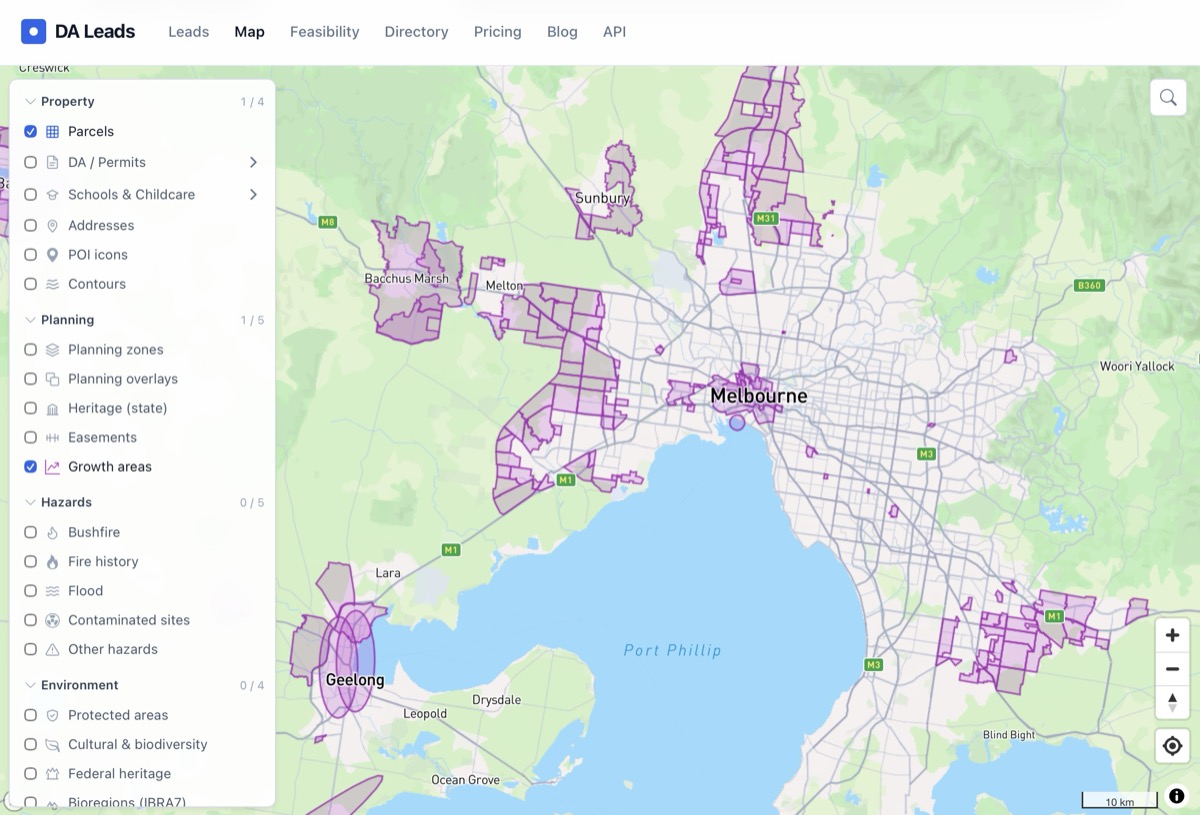
Where are developers actually building townhouses and duplexes? The map below shows DA hotspots for multi-dwelling projects across Melbourne's key corridors:
Run Your Own Comparison
Want to test whether a duplex or townhouse development works on a specific site? The DA Leads feasibility calculator lets you model both scenarios with real zoning data, construction cost benchmarks, and local comparable sales. Plug in the address, adjust the dwelling count, and compare the margins side by side.
Prefer to explore visually? The DA Leads interactive map lets you browse all multi-dwelling DAs by suburb, see what types of projects councils are approving, and check zoning overlays before you commit to a site.
For more on how to evaluate a development site before committing, see our guide on assessing development sites in Melbourne. And if you're weighing up the hidden costs of property development, make sure you've accounted for all of them before running your feasibility.
Sources and Further Reading
- Victorian Planning Provisions - Residential zones - GRZ, NRZ, and RGZ zone specifications and garden area requirements
- ResCode (Clause 55) - Victorian Planning Provisions - setback and site coverage standards
- State Revenue Office Victoria - Stamp duty calculator - current stamp duty rates
- DA Leads internal database snapshot, queried 2026-03-17
- DA Leads feasibility calculator


