
Austral recorded 97 development applications, making it the busiest suburb in New South Wales outside of the Sydney CBD. Not small. A remarkable count for a suburb that, just a decade ago, was predominantly market gardens and poultry farms.
The transformation is well underway, and the DA pipeline signals that the heaviest period of construction may still be ahead. What separates Austral from other growth suburbs that have seen similar rezoning decisions is the sheer concentration of infrastructure investment flowing into the surrounding corridor from the Western Sydney Airport, the Aerotropolis precinct, and the metro rail extension all converging within a 15-kilometre radius.
| Metric | Value |
|---|---|
| Total DAs | 97 |
| Top category | Subdivision of former rural lots |
| Typical lot size | 250 to 450 sqm |
| Council | Liverpool City Council |
| Infrastructure contributions | $30,000 to $50,000 per lot |
| Key advantage | Busiest suburb in NSW outside Sydney CBD, with Western Sydney Airport 15 km away |
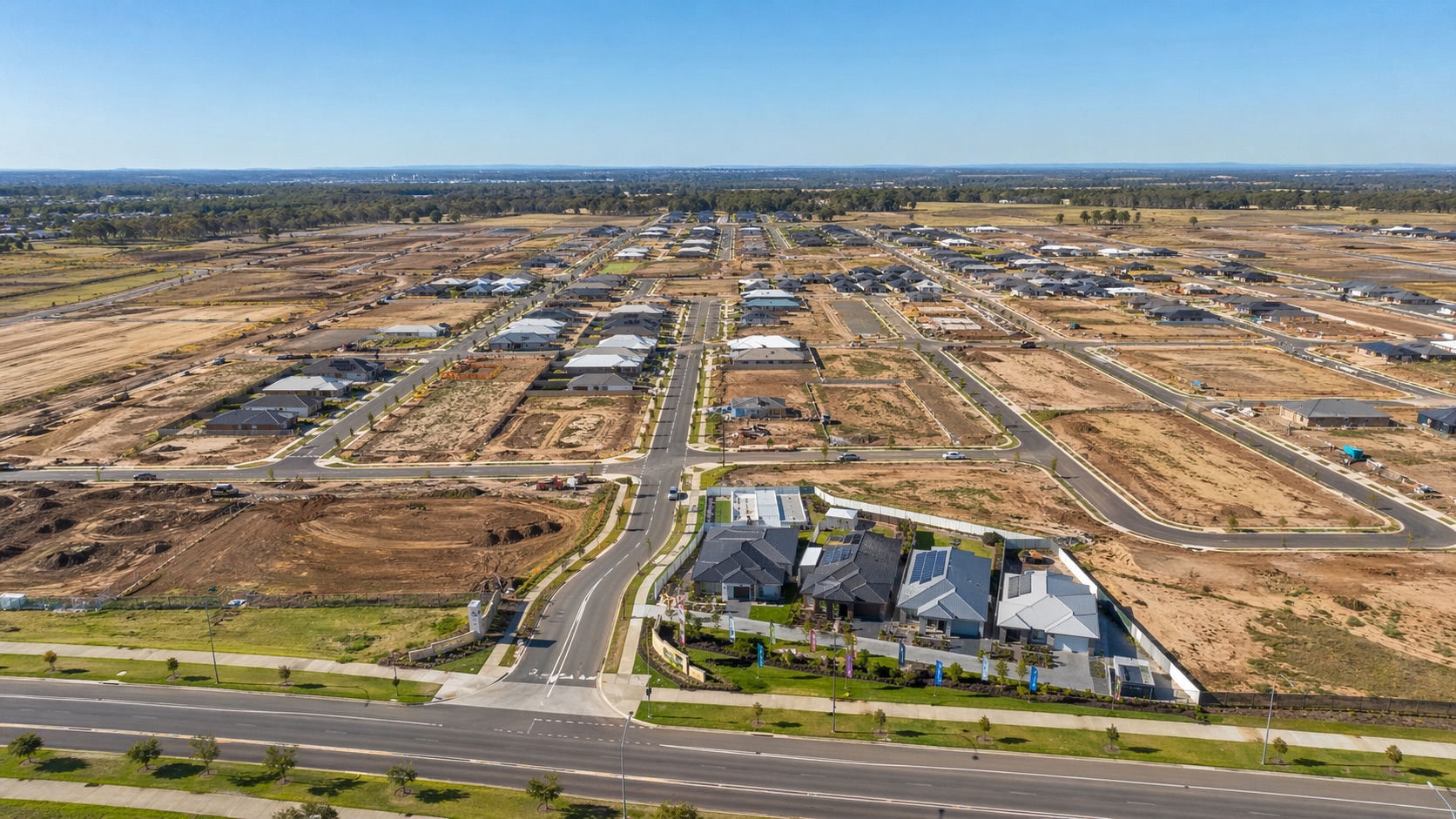
Austral from above: fresh roads in a grid, completed houses beside bare earth lots. This is what 97 DAs look like on the ground in Sydney's south-west.
Why Austral Is Growing
Austral is located approximately 45 kilometres south-west of the Sydney CBD, within Liverpool City Council. It sits at the centre of the South West Growth Area, one of the NSW Government's designated priority zones for housing delivery.
Rezoning changed everything. In 2014, the NSW Government rezoned large tracts of Austral from rural to residential under the South West Growth Area Structure Plan. Land that was previously used for agriculture became available for housing development. This single planning decision set the suburb's trajectory. One decision. Everything followed.
Proximity to the Western Sydney Airport. The new airport at Badgerys Creek, due to open in 2026, is located roughly 15 kilometres north-west of Austral. The infrastructure investment flowing into the Western Sydney Aerotropolis is lifting land values and development activity across the entire south-west corridor.
Transport connections are improving. The extension of the Sydney Metro to the Aerotropolis, combined with road upgrades along Camden Valley Way and Bringelly Road, are reducing Austral's perceived distance from employment centres.
Affordability relative to established Sydney. House-and-land packages in Austral are significantly cheaper than comparable products in middle-ring suburbs. For first-home buyers and young families, this price point is the primary draw.
What's Being Built
Austral's 97 DAs are heavily weighted toward residential development on recently rezoned land.
Subdivision of former rural lots is the primary activity. Many properties in Austral were originally 1 to 5 hectare parcels. These are being subdivided into residential lots, typically ranging from 250 to 450 square metres. Some larger sites are producing 30 or more lots per application. Scale matters here.
New dwelling construction follows subdivision. Single-storey and two-storey detached houses dominate, though the NSW planning framework is pushing for more diverse housing types in growth areas.
Dual occupancy and secondary dwellings are increasingly common. Under the NSW Codes SEPP, complying development provisions allow certain secondary dwellings without a full DA, but many sites still require consent due to lot size or flood constraints. If you're considering a secondary dwelling, the NSW granny flat rules cover the key requirements.
Infrastructure and civil works account for a meaningful share of applications. Road construction, stormwater management, and service installation are all lodged as separate DAs in the subdivision process.
Some medium-density projects are appearing near the planned Austral town centre. Townhouse and terrace developments of 6 to 20 dwellings are starting to emerge on sites designated for higher density.
For Tradies
Austral is one of the most active construction zones in Greater Sydney. The suburb offers a deep pipeline across the full range of residential trades.
Civil and earthworks contractors are at the front of the queue. Converting former farmland into residential lots requires significant ground preparation: clearing, levelling, stormwater management, and road construction. Many sites also need fill importation to meet flood planning levels. The flood planning requirement in particular creates an entire sub-market of earthworks contracts that would not exist in suburbs with more favourable topography, and contractors who specialise in bulk fill importation, compaction testing, and flood-compliant site preparation have found Austral to be one of their most productive operating areas across Greater Sydney.
Concreters have steady demand for both subdivision infrastructure (footpaths, kerbs, driveways) and house slabs. The flat to gently undulating terrain suits standard slab designs on most lots.
Structural trades (framers, steelworkers, bricklayers) are needed for the volume of new houses going up. The mix of timber-framed and brick-veneer construction means demand spans both trade types.
Plumbers and electricians are essential for new connections. The transition from rural services to urban-grade water, sewer, and electrical infrastructure creates work at both the subdivision and individual-lot level.
Finishing trades (painters, tilers, kitchen installers) follow 4 to 6 months behind the structural work. As the first wave of houses nears completion, these trades ramp up.
The key challenge in Austral is coordination. Multiple subdivisions are under construction simultaneously, and road access can be disrupted by civil works. Plan site visits carefully. Call ahead. Browse NSW development leads to track the pipeline.
For Developers
Austral offers genuine development upside, but the regulatory and infrastructure landscape requires careful navigation.
Site selection is critical. Not all land in Austral is equally development-ready. Some parcels still have unresolved flood constraints, biodiversity requirements, or fragmented ownership that complicates assembly. Sites with existing road frontage and clear zoning perform best.
Infrastructure contributions are significant. The South West Growth Area is subject to Special Infrastructure Contributions (SICs) levied by the NSW Government, in addition to local council Section 7.11 contributions. These can add $30,000 to $50,000 per lot. They must be factored into your feasibility modelling from day one. Non-negotiable.
Approval timelines can be longer than expected. Liverpool City Council manages a high volume of DAs across the growth area. Processing times for subdivision applications can stretch to 6 to 12 months, particularly for larger sites or those with environmental constraints. Our NSW DA approval process guide explains what to expect at each stage.
The market is competitive but deep. Multiple developer groups are active in Austral. Lot sales have been strong, supported by first-home buyer grants and relative affordability. The key to margin is construction cost control rather than aggressive lot pricing.
Run your numbers through a feasibility calculator to stress-test assumptions around lot yield, infrastructure costs, and sale prices before acquiring a site.
Review Liverpool City Council's DA pipeline to see how Austral compares to other growth suburbs in the LGA.
The Bottom Line
Austral is South West Sydney's most active development suburb, and the growth trajectory is supported by government infrastructure investment, rezoning, and sustained housing demand. For tradies, it offers concentrated residential construction work across all stages. For developers, the opportunity is real but requires disciplined feasibility analysis to manage infrastructure costs and approval timelines.
Explore NSW development insights or search Austral leads to stay ahead of the pipeline.


