
Blacktown is the population centre of Western Sydney. Blacktown City Council is the largest local government area in NSW by resident population, and the suburb of Blacktown itself sits at its core with 44 development applications in our tracker.
Those 44 DAs only tell part of the story. Look deeper. Blacktown is the administrative and commercial heart of an LGA that includes high-growth suburbs like Marsden Park, Schofields, and Riverstone.
| Metric | Value |
|---|---|
| Total DAs | 44 |
| Top category | Renovations, granny flats, and new dwellings |
| Development type | Mixed (renovation, new build, granny flat, multi-dwelling) |
| Council | Blacktown City Council |
| Granny flat size limit | Up to 60 sqm (NSW complying development) |
| Key advantage | Largest LGA in NSW by population, with proximity to north-west growth corridor suburbs |
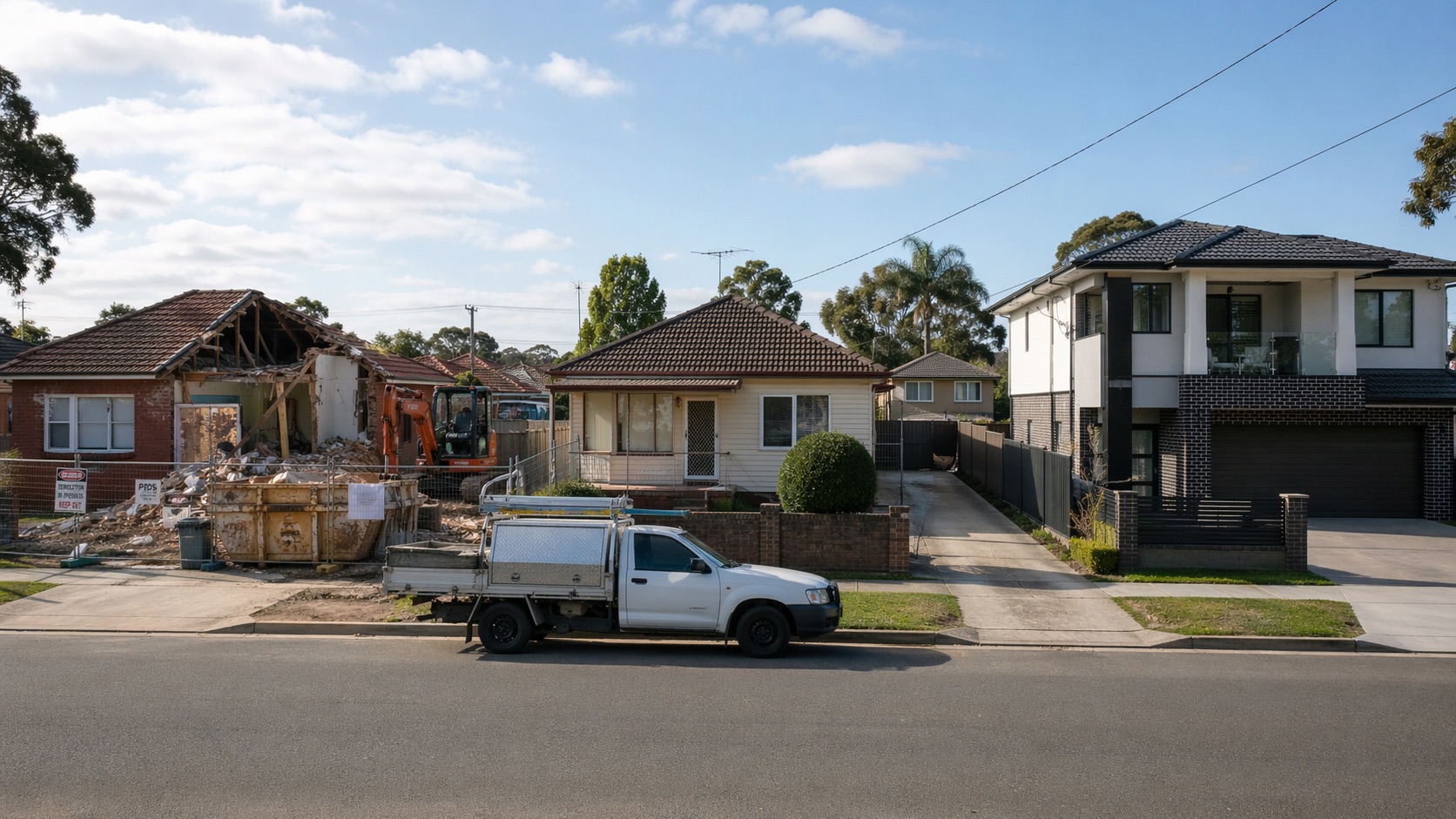
Blacktown's development diversity: demolition on one lot, an original house on the next, a completed new build on the third. Multiple trade opportunities on every street.
Why Blacktown Keeps Growing
Western Sydney Airport. The new airport at Badgerys Creek, due to open in 2026, is the single biggest catalyst for development across Western Sydney. Blacktown sits north of the airport influence zone, and the employment, transport, and housing demand generated by the airport is already flowing through the development pipeline.
Population density. Blacktown already has a large, established population base. That population needs services, housing upgrades, and commercial facilities. Unlike greenfield suburbs that are building from scratch, Blacktown has an existing economy that generates ongoing development activity.
Affordability. Relative to Sydney's inner and middle suburbs, Blacktown remains affordable. First-home buyers, migrants, and downsizers all find options here that don't exist closer to the CBD. Price drives decisions.
What 44 DAs Look Like in Blacktown
The DA mix in Blacktown reflects its dual character as both an established suburb and a growth area feeder.
Renovations and alterations are a major category. Blacktown's housing stock spans decades, from 1960s fibro cottages to 2000s project homes. Owners are constantly upgrading, extending, and modernising. Second-storey additions, granny flat conversions, and kitchen/bathroom renovations generate a steady baseline of trade work.
New dwellings appear both as knockdown-rebuilds on existing lots and as new houses on recently subdivided land. Some of Blacktown's larger residential blocks are being split, with new houses going up on the rear lot while the original house remains on the front.
Granny flats and secondary dwellings are particularly active in Blacktown. NSW's complying development pathway for granny flats up to 60sqm makes these relatively quick to approve, and the rental income they generate is attractive to property owners in an area with strong rental demand. Our NSW granny flat rules guide covers the approval pathway and size limits in detail.
Multi-dwelling developments. Townhouse and apartment projects are being approved on sites close to Blacktown station and along the main road corridors. These medium-density projects bring the largest individual DA values in the suburb.
The Tradies Playbook for Blacktown
Blacktown rewards tradies who can handle variety. Unlike a greenfield suburb where it's all new builds all the time, Blacktown's mix means you need to be comfortable with renovation work, new construction, and commercial fit-outs.
Volume through variety. In a single week, a plumber working across Blacktown might do a bathroom rough-in on a granny flat, a hot water replacement on a 1970s house, and first fix on a new duplex. The variety keeps the pipeline full even when one category slows down. Always something moving.
Granny flat specialists thrive. NSW's granny flat rules have created an entire sub-industry. Tradies who specialise in the standard granny flat build, from slab to handover, can build a business purely on this product type in suburbs like Blacktown where demand is consistent.
Proximity to growth suburbs. Blacktown is the base camp for tradies working across the north-west growth corridor. You can be in Marsden Park, Schofields, or Box Hill within 15 to 20 minutes, giving you access to both renovation work locally and new-build work nearby.
Trades in demand. The renovation pipeline needs carpenters, plasterers, plumbers, electricians, tilers, and painters. The new-build pipeline needs concreters, bricklayers, framers, and roofers. Granny flat work needs all-rounders or small teams that can deliver a complete build.
For Developers
Blacktown offers development opportunities at multiple scales.
Granny flat additions are the lowest entry point. Buy an existing house on a 600sqm+ lot, add a granny flat, and hold for dual rental income. The total investment is modest, and the rental yield on the granny flat alone can be strong. Low barrier to entry.
Duplex and dual occupancy sites are available where lots are large enough and zoning permits. Splitting a 700sqm lot into two and building a house on each is a well-proven model in Blacktown. The key is finding lots with the right dimensions and zoning. Our subdivision process guide walks through the steps from application to title registration.
Townhouse development is viable on larger sites near the station or commercial zones. A 1,000sqm+ site with appropriate zoning can support 4 to 6 townhouses. The per-unit construction cost is higher than single dwellings, but the per-square-metre sale price is also higher.
Test your development scenarios with our feasibility calculator.
Watching the Pipeline
Blacktown's 44 DAs in the suburb itself are just the tip of the iceberg. The broader Blacktown City Council area processes hundreds of DAs annually, making it one of the busiest planning authorities in Australia.
For NSW-wide development trends, visit our NSW insights page. For detailed council data including category breakdowns and recent DAs, check the Blacktown City Council page.
Western Sydney's growth story is a multi-decade reality, and Blacktown sits at its centre. The fundamentals hold. Whether you're a tradie looking for consistent work or a developer evaluating entry-level sites, the combination of population growth, transport investment, affordability relative to inner Sydney, and the Western Sydney Airport's employment multiplier effect means the pipeline of renovation, new build, and commercial development work in this LGA is backed by structural demand rather than speculative sentiment.


