
Box Hill in Sydney's north-west has 50 development applications in our tracker. A significant volume for a suburb that barely existed as a residential area a decade ago. Rapid transformation. The pace of change in Box Hill is a direct consequence of the North West Growth Area designation, the Sydney Metro rail connection nearby, and the Hills Shire's sustained demand from families willing to trade inner-city proximity for newer housing stock, larger lots, and access to well-regarded local schools. Today it's one of the fastest-growing suburbs in The Hills Shire Council, and the pipeline shows no sign of slowing down.
| Metric | Value |
|---|---|
| Total DAs | 50 |
| Top category | New dwelling construction |
| Typical lot size | 300 to 600 sqm |
| Council | The Hills Shire Council |
| Population growth | From a few thousand to over 15,000 in under a decade |
| Key advantage | Part of North West Growth Area with Sydney Metro rail nearby and planned 30,000+ resident capacity |
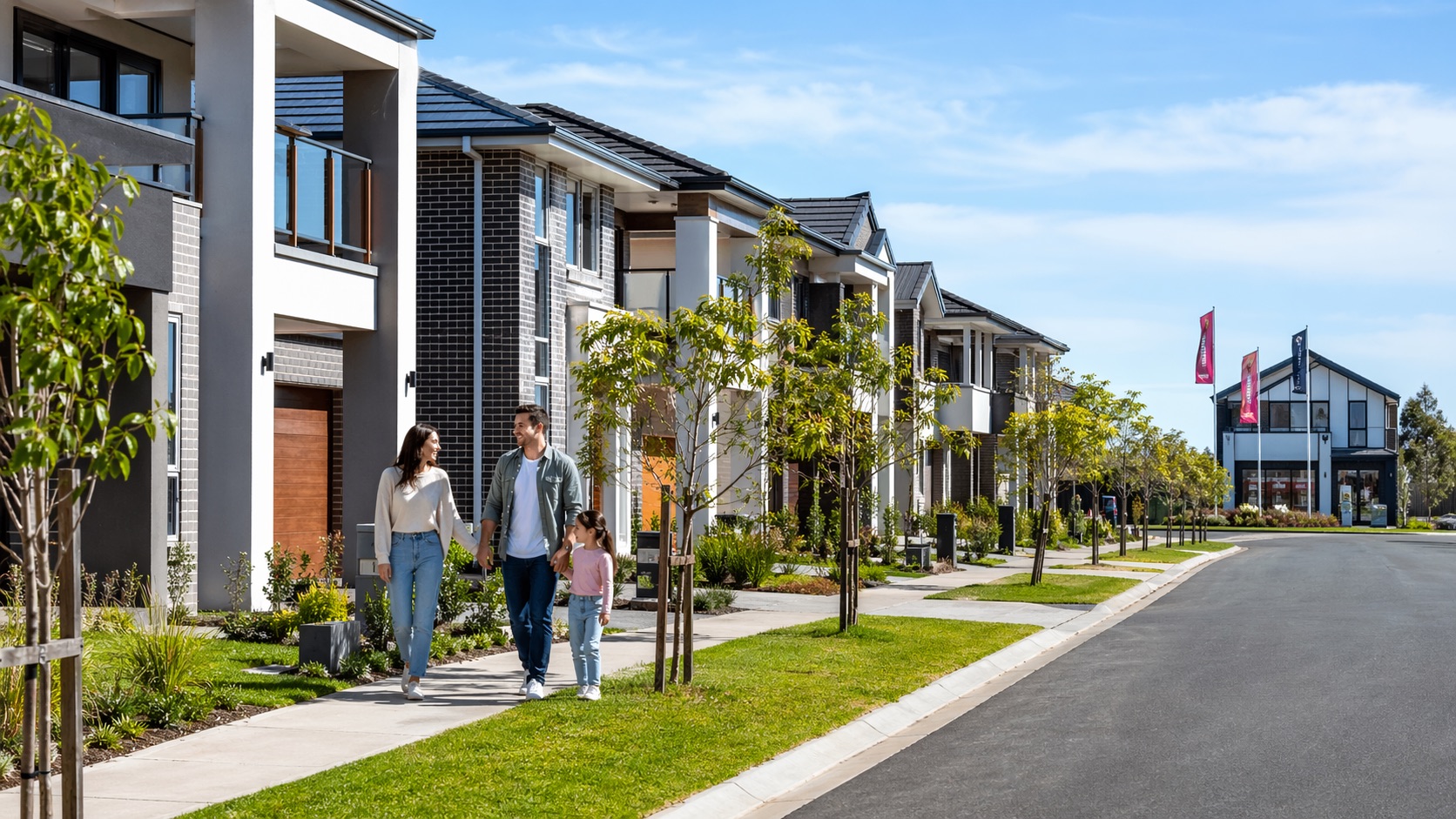
Box Hill's master-planned streets: matching new homes, young families, display village at the end. Population grew from a few thousand to over 15,000 in under a decade.
A Suburb Built from Farmland
Box Hill sits within the NSW Government's North West Growth Area, one of the largest planned urban releases in Sydney's history. What was once semi-rural land with orchards and hobby farms is being transformed into a suburban community expected to house over 30,000 residents.
The catalyst was the Sydney Metro Northwest rail line, which opened in 2019. Box Hill doesn't have its own station, but the nearby Rouse Hill and Kellyville stations put the suburb within reach of fast rail to Macquarie Park, Chatswood, and the CBD. That connectivity changed the land economics overnight. Completely transformed.
Land releases have been staged by multiple developers, creating a rolling pipeline of construction. When one precinct sells and starts building, the next one opens for sale.
Population growth is rapid. Box Hill's resident population has grown from a few thousand to over 15,000 in less than a decade, and it's still well short of capacity. Still growing.
Infrastructure is catching up. New schools, a planned town centre, road upgrades, and stormwater management works are all generating additional DAs beyond the residential pipeline.
What the 50 DAs Tell Us
The development mix in Box Hill is classic growth-area activity.
New dwellings are the core. Most DAs are for individual houses on lots ranging from 300 to 600sqm. These are the standard new builds that define Sydney's growth suburbs: double-storey, 4-bedroom homes on relatively compact lots.
Subdivision continues. Some larger parcels are still being broken down into residential lots. Each subdivision DA triggers downstream building applications as lots are sold and buyers lodge their house plans. For a breakdown of how subdivision works in NSW, see our subdivision process guide.
Medium density is emerging. Closer to the planned Box Hill town centre, applications for townhouses and duplex developments are appearing. These medium-density projects are part of the precinct's planned transition from pure detached housing to a more mixed residential outcome.
For Tradies Working in the North-West
Box Hill's location in Sydney's north-west growth corridor makes it part of a broader work zone that includes Rouse Hill, Kellyville, Marsden Park, and Schofields. Together, these suburbs form one of the densest concentrations of residential construction in NSW.
The work is steady and predictable. New estate construction follows a reliable sequence: civil works first, then slabs, frames, lock-up, and fit-out. If you can get onto a builder's subcontractor list for an estate, you'll have work for 12 to 18 months as lots progress through the build cycle.
Quality expectations are high. The Hills Shire is an affluent area. Even in the growth suburbs, buyers expect higher-spec finishes. That means better margins for trades who can deliver quality work, but also means callbacks are taken seriously. Standards matter.
Trades in demand. The pipeline favours concreters, bricklayers, plumbers, electricians, carpenters, and roofers for the new build phase. As houses complete, landscapers, fencers, and driveway specialists pick up the finishing work. Pool builders are also active, as lot sizes in some precincts are large enough to accommodate pools.
For Developers
Box Hill's development economics are shaped by two forces: land cost and the end sale price.
Land cost in Box Hill has risen significantly from initial release prices but remains below established Hills District suburbs like Castle Hill or Baulkham Hills. For developers, the question is whether the gap between land cost and finished product value justifies the build.
End values in Box Hill are strong by Sydney standards. New 4-bedroom houses in the area sell in the range that makes single-dwelling development feasible, and townhouse projects near transport or amenity nodes can achieve even better per-square-metre rates.
Council processes. The Hills Shire Council manages a high volume of DAs given the growth area activity. Standard residential applications generally move through the system efficiently, but anything requiring variation from the development control plan takes longer.
Dual occupancy and townhouse sites offer the most interesting margin opportunities. Where zoning allows, splitting a lot into two dwellings or developing 3 to 4 townhouses can significantly improve the return compared to a single house build.
Run your numbers through our feasibility calculator to test different development scenarios for Box Hill sites.
The Bigger Picture
Box Hill's 50 DAs are part of a much larger story. The entire North West Growth Area is producing hundreds of DAs annually across multiple councils, and the infrastructure investment underpinning it ensures the pipeline will continue for years.
Explore Box Hill and the North West corridor visually on the DA Leads interactive map — see live DAs, zoning, school zones, and planning controls for any address.
For broader NSW development trends, visit our NSW insights page. For Hills Shire-specific data, see the The Hills Shire Council page.
Box Hill is still early. It is still in its transformation from farmland to established suburb, and it is part of a broader pattern playing out across the state. See our analysis of where development is happening fastest for the full picture. The tradies and developers who understand the rhythm of growth-area work and position accordingly will find years of opportunity ahead.


