
The development costs that appear in every feasibility model (land, construction, stamp duty, selling costs) are the easy ones. They're the costs you know about. It's the costs you don't plan for that eat your margin.
After watching developers consistently underestimate project costs by 10-15%, we've catalogued the hidden costs that catch people out. (For a refresher on the three core feasibility frameworks, start there.) Some are modest. Some are project-killers. All of them should be in your feasibility before you sign a contract of sale.
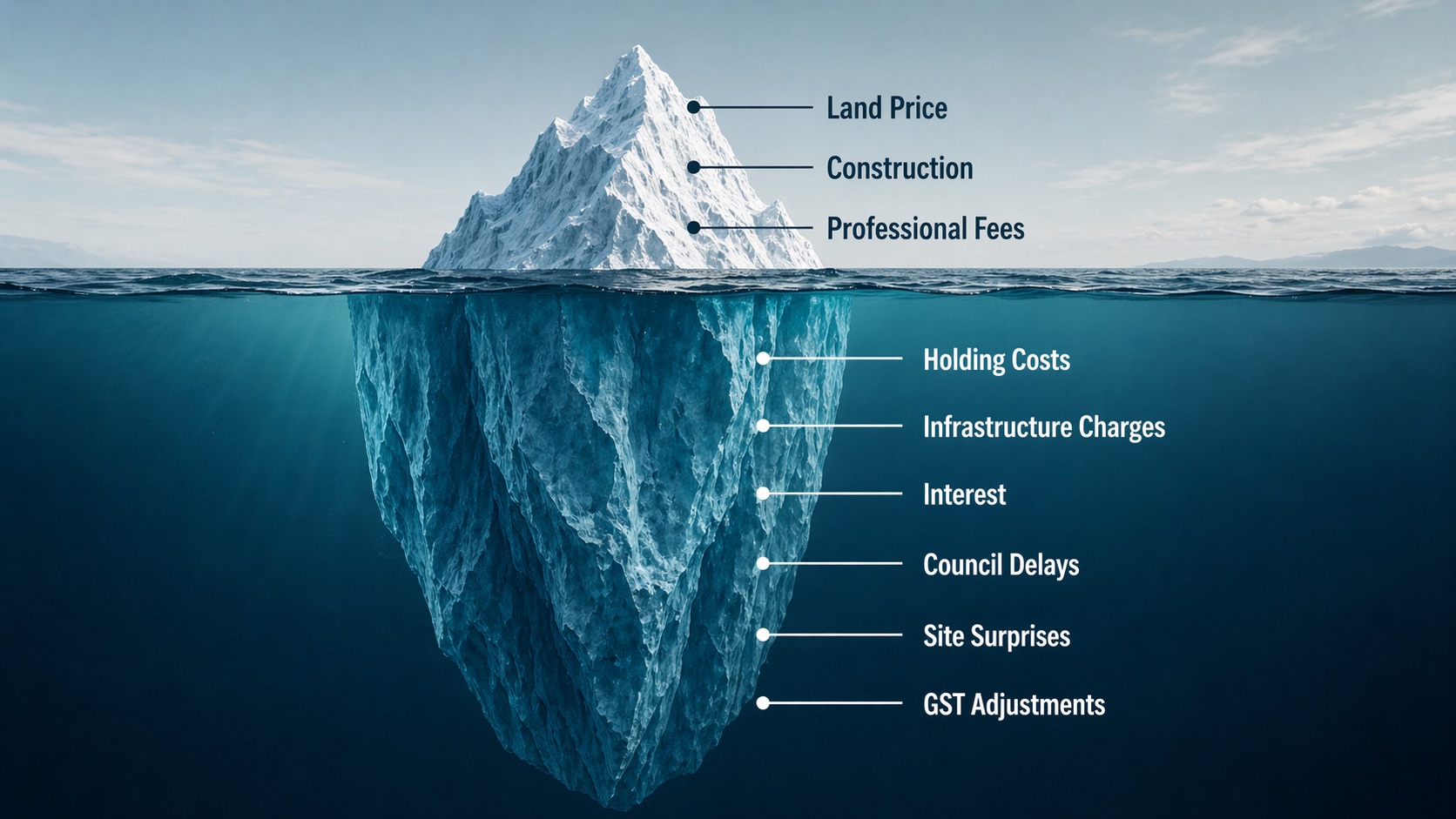
The iceberg of property development costs: the visible line items (land, construction, professional fees) are only the tip. The hidden costs below the waterline often add up to more than the obvious ones combined.
1. Infrastructure Contributions and Levies
Every council in Australia charges developers for the burden new dwellings place on public infrastructure. The problem is that these charges aren't always transparent upfront.
What you'll encounter
Development Contributions Plan (DCP) levies, Victoria: In growth areas (Wyndham, Casey, Melton, Whittlesea), DCPs can exceed $60,000–$90,000 per dwelling. These fund roads, intersections, drainage, community centres, and open space. In established areas, contributions are lower ($10,000–$25,000 per dwelling) but still significant.
Section 7.11 and 7.12 contributions, NSW: Section 7.11 contributions are based on a specific contributions plan and can be highly variable. In western Sydney growth areas, expect $30,000–$60,000 per dwelling. Section 7.12 levies are simpler: a percentage (typically 1–3%) of the total development cost.
Infrastructure charges, Queensland: Local governments set infrastructure charges covering water, sewerage, stormwater, transport, and parks. Expect $20,000–$40,000 per additional dwelling in most Brisbane and Gold Coast councils.
Public open space contribution, Victoria: When you subdivide land, council typically levies a public open space contribution of up to 5% of the site value. On a $1.2 million site subdivided into four lots, that's up to $60,000.
The trap
These charges are often not discoverable until you've lodged your application or until the subdivision stage. By then, you've already committed to the site.
How to protect yourself: Before purchasing, contact the council's development contributions team and ask for a written estimate of all charges applicable to a multi-dwelling development at the specific address.
2. Tree Removal and Replacement
Trees are not free to remove and not cheap to replace. In Victoria, the planning scheme amendments have made tree protection stricter than ever.
Costs you'll encounter
| Item | Typical cost |
|---|---|
| Arborist report (required before removal) | $1,500–$3,000 |
| Tree removal permit (council fee) | $200–$500 per tree |
| Actual tree removal (contractor) | $1,000–$5,000 per tree |
| Replacement tree bond (held by council) | $500–$2,000 per replacement tree |
| Replacement trees (supply and planting) | $300–$800 each |
| Tree Protection Zone fencing during construction | $2,000–$5,000 |
The surprise costs
Council bonds for replacement planting. Most councils now require developers to either plant replacement trees on-site or pay a bond to council for off-site planting. In some Melbourne councils, this bond is $1,500–$2,000 per tree removed. If your site has six significant trees, that's up to $12,000 in bonds alone.
Tree Protection Zone (TPZ) requirements. If you're retaining trees near the development, you'll need protective fencing during construction. If the TPZ extends across your driveway or building footprint, you may need to redesign the layout or pay for root bridging and canopy pruning under arborist supervision.
Compensation planting ratios. Some councils require two or three replacement trees for every one removed. If you're removing five trees, you might need to plant fifteen, and find space for them in your landscape plan.
3. Specialist Consultant Reports
Beyond the standard architect and town planner, council may require (or your site conditions may demand) a range of specialist reports. These add up fast.
Reports commonly required
| Report | When required | Typical cost |
|---|---|---|
| Heritage assessment | Heritage Overlay | $3,000–$8,000 |
| Traffic/parking assessment | 5+ dwellings or parking reduction | $3,000–$6,000 |
| Acoustic report | Near roads, rail, or commercial zones | $3,000–$7,000 |
| Wind assessment | Buildings 4+ storeys | $5,000–$15,000 |
| Arborist report | Significant trees on or near site | $1,500–$3,000 |
| Contamination assessment (Phase 1) | Former commercial/industrial use | $3,000–$6,000 |
| Contamination remediation (Phase 2) | If Phase 1 identifies risk | $10,000–$200,000+ |
| Geotechnical report | Sloping sites, reactive soil areas | $3,000–$5,000 |
| Stormwater management plan | Most multi-dwelling applications | $2,000–$4,000 |
| Cultural heritage assessment | Sites near Aboriginal heritage areas | $5,000–$15,000 |
| Flood study | SBO or LSIO overlay | $5,000–$15,000 |
| Bushfire assessment | BMO overlay | $3,000–$8,000 |
A development on a site with heritage, traffic, and tree issues could easily require $15,000–$25,000 in specialist consultant reports before the DA is even lodged.
The acoustic report trap
This one catches inner-city developers constantly. If your site is within a specified distance of a main road (check the overlays on your zone) (typically 100–300 metres, depending on road classification), a train line, or a commercial/industrial zone, council will almost certainly require an acoustic report.
The report itself costs $3,000–$7,000. But the recommendations (double-glazed windows, acoustic insulation in walls, mechanical ventilation because you can't open windows) can add $8,000–$15,000 per dwelling in construction costs. On a four-townhouse project, that's up to $60,000 that wasn't in your original construction estimate.
4. Contamination and Soil Issues
Every property has a history, and that history can be expensive.
Former uses that trigger contamination risk
- Petrol stations (even ones that closed decades ago)
- Dry cleaners
- Mechanics and panel beaters
- Market gardens (pesticide residue)
- Any industrial use
- Properties near former landfill sites
How contamination assessment works
Phase 1 (Preliminary Site Investigation): A desktop review of the site's history, including historical aerial photos, EPA records, and previous uses. Cost: $3,000–$6,000. If Phase 1 identifies potential contamination, you move to Phase 2.
Phase 2 (Detailed Site Investigation): Physical soil and groundwater sampling. Cost: $10,000–$30,000. If contamination is confirmed, you need a remediation action plan.
Remediation: This is where costs blow up. Removing contaminated soil and replacing it with clean fill can cost $50,000–$200,000+ depending on the extent and type of contamination. Asbestos in soil is particularly expensive to remediate because of the handling and disposal requirements.
The hidden risk
Many developers skip contamination assessment during due diligence because the site "looks fine." Bad move. Then during construction, the builder encounters asbestos fragments in the soil, everything stops dead, a remediation contractor charges $80,000 to remove and dispose of the contaminated material under EPA oversight while your holding costs keep ticking away, and the project blows both its budget and its timeline in a way that no contingency was sized to handle.
How to protect yourself: For any site with a pre-1990 structure (potential asbestos), any site with a former commercial use, or any site where the history isn't clear, get a Phase 1 contamination assessment during your due diligence period. $5,000 now prevents a $100,000 surprise later.
5. Finance Costs Beyond the Obvious
Most developers budget for construction finance. Far fewer accurately model the total cost of money across the entire project lifecycle.
The full finance picture
| Phase | Typical duration | What you're paying interest on |
|---|---|---|
| Pre-DA (design + lodgement) | 2–4 months | Land loan only |
| DA assessment | 3–8 months | Land loan only |
| Post-permit (building permit + tender) | 2–3 months | Land loan only |
| Construction | 10–16 months | Land loan + progressive construction drawdowns |
| Selling period | 2–6 months | Land loan + full construction debt |
On a typical 24-month project with $700,000 land debt and $1.5 million construction debt (drawn progressively), total interest costs can reach $180,000–$250,000 at current rates.
Costs within the finance
Establishment fees: Lenders typically charge 1–2% of the facility limit as an establishment fee. On a $2 million construction facility, that's $20,000–$40,000.
Line fees: Some lenders charge a line fee (0.25–0.5%) on the undrawn portion of the construction facility during the build.
Valuation fees: The lender will require a "before" valuation (the site as-is) and an "on completion" valuation (the finished product). Each costs $3,000–$6,000.
Quantity surveyor monitoring: The lender requires a QS to certify each progress claim before funds are drawn. Monthly monitoring fees run $1,500–$3,000.
Extension fees: If construction runs over and you need to extend the facility, expect a fee of 0.5–1% of the outstanding balance.
The interest rate trap
Most developers model interest at today's rate for the full project term. But if you're on a variable-rate construction loan and rates move up even 0.5% during the build, the impact on a $2 million facility over 12 months is an additional $10,000. Model a rate buffer of at least 0.5% above current rates.
6. Selling Costs Beyond Agent Commission
You've budgeted 2% for the real estate agent. But selling completed dwellings involves more than just commission.
Frequently forgotten selling costs
| Item | Cost per dwelling |
|---|---|
| Staging (furniture hire for display) | $3,000–$8,000 |
| Professional photography and video | $1,500–$3,000 |
| Floor plans (for marketing) | $300–$500 |
| Copywriting | $200–$500 |
| Online listing fees (Domain + REA) | $2,000–$6,000 |
| Print advertising (if applicable) | $1,000–$3,000 |
| Legal fees (contract preparation per lot) | $1,500–$3,000 |
| Settlement adjustments and disbursements | $500–$1,000 |
On a four-townhouse project, these "minor" costs can total $40,000–$60,000 on top of agent commission. That's 1.5–2% of gross realisation that many feasibilities miss entirely.
Owners corporation setup
If your development will have common property (shared driveways, visitor parking, communal areas), you'll need to establish an owners corporation. Setup costs include:
- Owners corporation plan preparation: $2,000–$4,000
- Owners corporation rules drafting: $1,500–$3,000
- Initial OC manager appointment: $1,000–$2,000
- Common property insurance: $1,500–$3,000 first year
7. The Contingency Contingency
Every feasibility includes a contingency, usually 5% of construction costs. But is 5% enough?
Consider what 5% actually covers on a $1.5 million construction project: $75,000. That sounds like a lot until you have: - A three-week rain delay ($15,000 in holding costs) - Rock encountered during excavation ($20,000 removal) - A subcontractor going bust mid-build ($15,000 to re-engage) - Council requiring an additional drainage connection ($10,000) - Upgraded finishes to match competitor developments ($20,000)
That's $80,000, already over your contingency, and none of these are extreme or unlikely events. They're Tuesday.
For experienced developers with a fixed-price contract, 5% contingency may suffice. For first-time developers or cost-plus contracts, 10% is the minimum responsible contingency. On our $1.5 million build, that's the difference between $75,000 and $150,000 in your feasibility. If you don't use it, great: it goes straight to profit. If you need it, it saves your project.
The Total Impact
Let's add up the hidden costs that a typical four-townhouse development in Melbourne might encounter:
| Hidden cost | Realistic estimate |
|---|---|
| Council infrastructure contributions | $60,000 |
| Public open space levy (5%) | $50,000 |
| Tree removal and bonds | $15,000 |
| Specialist reports (heritage + traffic + acoustic) | $18,000 |
| Acoustic construction upgrades | $32,000 |
| Phase 1 contamination assessment | $5,000 |
| Finance establishment and monitoring fees | $30,000 |
| Interest rate buffer (0.5% on $2M, 12 months) | $10,000 |
| Selling costs beyond commission | $30,000 |
| Owners corporation setup | $8,000 |
| Additional contingency (5% to 10%) | $75,000 |
| Total hidden costs | $333,000 |
That's $333,000 that separates a naive feasibility from a realistic one. On a project with a gross realisation of $3.2 million, these hidden costs represent over 10% of revenue. If your feasibility showed a 15% margin without them, the real margin is closer to 5%.
Build a Realistic Feasibility
The DA Leads feasibility calculator accounts for many of these costs automatically: infrastructure contributions, stamp duty, finance costs, and selling expenses are all built into the calculation. But no calculator can capture every site-specific cost. Use the calculator as your baseline, then layer on the site-specific costs from this list during your due diligence. The sites that still show 15%+ margin after accounting for everything? Those are the ones worth buying.
To see how these costs play out in a real scenario, read our case study of a rejected DA where $130,000 in pre-construction costs turned a 17% margin into 7%.
Sources and Further Reading
- Development Contributions Plans - Planning Victoria - DCP levies and open space contributions in Victoria
- Section 7.11 and 7.12 contributions - NSW Planning - NSW developer contribution frameworks
- Infrastructure charges - Queensland Government - QLD local government infrastructure charges
- EPA Victoria - Contaminated Land - contamination assessment and remediation guidelines
- Victorian Building Authority - building permit requirements and regulations
- DA Leads internal database snapshot, queried 2026-03-12
- DA Leads feasibility calculator


