
Ryde sits in a sweet spot of Sydney's geography. Roughly 12 kilometres north-west of the CBD, it has train and bus connections, proximity to Macquarie Park's employment hub, and an ageing housing stock that's ripe for redevelopment. Our tracker shows 56 development applications in the pipeline, and the mix tells the story of a suburb in transition.
Unlike the greenfield growth suburbs in Western Sydney where development means building on bare land, Ryde's development activity is almost entirely about replacing what's already there with something denser, taller, or more modern. Different game entirely. The skill set, capital requirements, risk profile, approval complexity, and construction methodology for infill urban redevelopment in a suburb like Ryde are fundamentally different from anything you would encounter in a greenfield release area, and tradies or developers making the transition need to understand those differences before committing.
| Metric | Value |
|---|---|
| Total DAs | 56 |
| Top category | Apartment developments (10 to 50+ units) |
| Development type | Infill redevelopment (demolish and rebuild denser) |
| Council | City of Ryde Council |
| Project duration | 18 to 36 months per apartment build |
| Key advantage | 12 km from Sydney CBD near Macquarie Park employment hub, with non-linear density uplift from lot amalgamation |
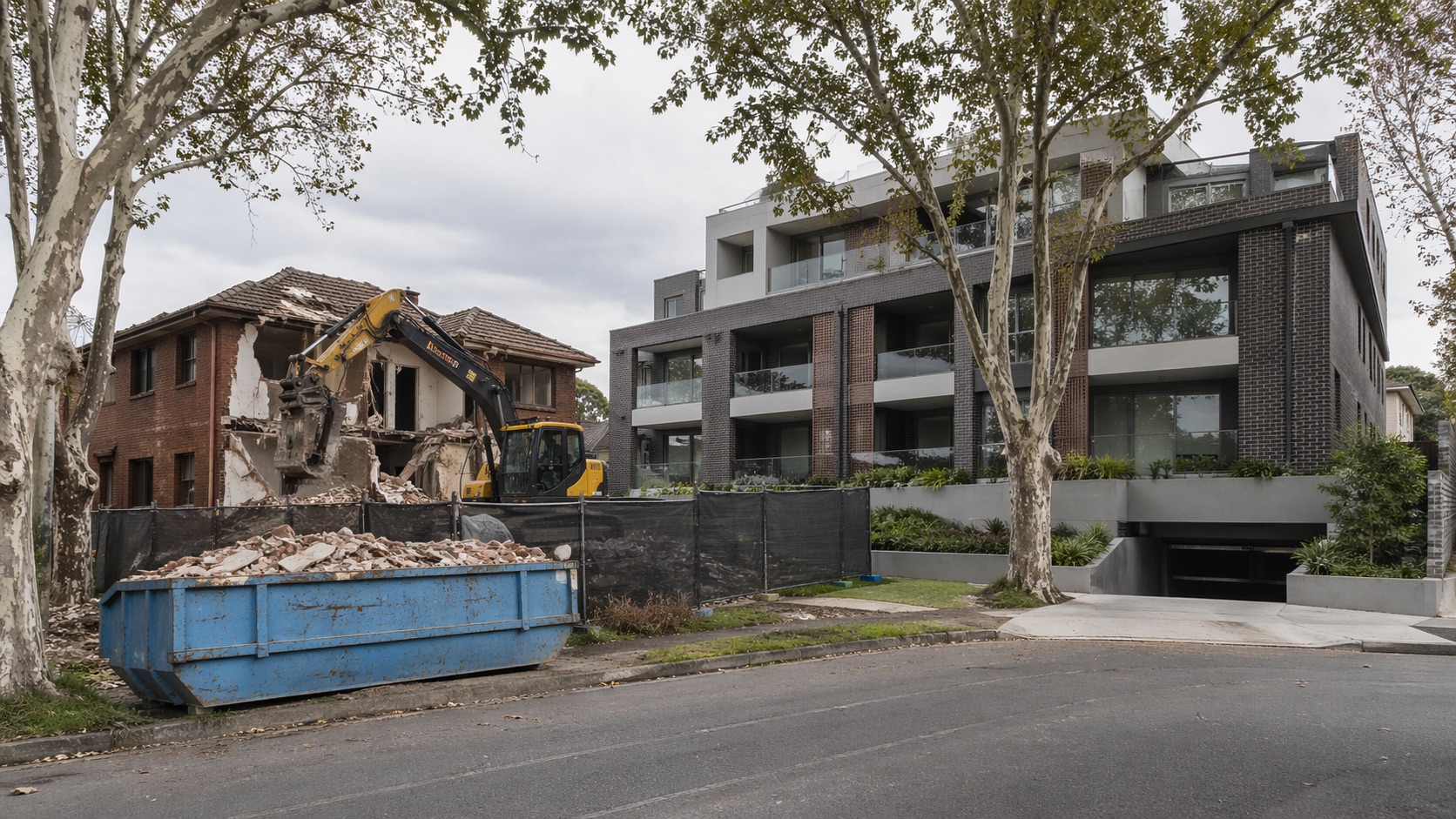
Ryde's infill story: a 1960s brick house being demolished next to a completed three-storey apartment building. Combining two 500 sqm lots can lift capacity from 6 to 18 apartments.
What's Driving Development
Ryde City Council covers several suburbs, but the Ryde locality itself has become a focal point for urban renewal. Several forces are converging.
Proximity to Macquarie Park. One of Sydney's largest employment hubs is next door. Macquarie Park's mix of tech companies, financial services, and Macquarie University creates demand for nearby housing. People want to live close to where they work, and Ryde is the closest affordable option to this job centre.
Transport connectivity. The broader LGA is served by Eastwood and West Ryde train stations, and the Sydney Metro extension has further improved the area's accessibility.
Ageing housing stock. Much of Ryde's existing housing was built in the 1960s and 1970s. These low-rise brick apartments and single-storey houses sit on land now zoned for higher density. The gap between the current use and the zoned potential creates a strong financial incentive to redevelop. The maths works.
The 56 DAs: What's Being Built
The development mix in Ryde reflects its infill character.
Apartment developments are the standout category. Multi-storey residential flat buildings make up a significant portion of DA activity. These range from smaller boutique projects of 10 to 20 apartments to larger developments with 50+ units. Each one generates substantial trade work across a long construction timeline. Steady pipeline.
Demolition and rebuild projects are common. The typical pattern: an older house or small block of flats gets knocked down, and a new medium-density or high-density development goes up in its place. The NSW DA approval process applies at every stage, from demolition consent to the new build.
Renovations and alterations form another substantial category. Many owners are extending existing houses, adding storeys, or renovating interiors. These projects are smaller individually but collectively represent a large volume of trade work.
Commercial fit-outs and mixed-use round out the pipeline. Top Ryde and Eastwood's commercial areas generate ongoing fit-out work, and new mixed-use developments combining ground-floor retail with residential above are being approved.
Tradies: What Ryde Means for You
Ryde offers a different kind of work compared to greenfield suburbs. The projects are more varied, more complex, and often higher value per square metre.
Apartment work is specialised. If you're a plumber, electrician, or tiler who can work on multi-storey residential projects, Ryde's apartment pipeline provides consistent opportunities. These projects run 18 to 36 months and need trades throughout the build cycle.
Renovation work is high-value. Ryde homeowners who aren't selling to developers are upgrading. Kitchen and bathroom renovations, second-storey additions, and deck builds are common. The clientele tends to have higher budgets, which supports premium pricing for quality work. Quality pays here.
Less travel, more density. Ryde is an established suburb with close-together properties. The time efficiency of working in a concentrated area versus driving 30 minutes between growth-area houses is significant.
Trades in demand. The apartment pipeline needs plumbers, electricians, formworkers, steel fixers, plasterers, tilers, and waterproofers. The renovation pipeline needs carpenters, kitchen installers, bathroom specialists, and roofers.
For Developers
Ryde's infill development economics are fundamentally different from greenfield.
Site acquisition is the challenge. You're buying existing properties, often at residential market rates, with the intention of demolishing and rebuilding at higher density. The feasibility depends on the gap between what you pay for the site and what the finished apartments or townhouses sell for. Factor in stamp duty and holding costs from the start.
Zoning is your friend (usually). Ryde's planning controls support density in the right locations. But the controls are specific about height, setbacks, landscaping, and car parking. Getting a DA approved often requires careful design to comply with all the requirements simultaneously.
Amalgamation opportunities. Some of the best development sites in Ryde come from combining two or three adjacent lots. A single 500sqm lot might support 6 apartments. Two lots combined at 1,000sqm might support 18. The non-linear uplift from amalgamation can dramatically improve feasibility. Big difference.
Use our feasibility calculator to model different density scenarios for Ryde sites.
Looking Ahead
Ryde's 56 DAs represent ongoing transformation rather than a one-time building boom. As long as Sydney's population keeps growing and Macquarie Park keeps generating jobs, there will be demand for housing in Ryde. And as long as the existing stock continues to age, there will be redevelopment opportunities.
For the full picture of NSW development trends, check our NSW insights page. For council-specific data including trade category breakdowns, see the Ryde City Council page.
Ryde isn't the cheapest place to develop or the easiest place to get a DA approved. Not by far. But for tradies and developers who can handle the complexity of infill urban work, the margins and consistency make it one of Sydney's most rewarding suburbs to operate in.


