
Every development site in Victoria sits within a planning zone. That zone dictates how many dwellings you can build, how tall they can be, how much garden area you must keep, and what hoops you'll jump through to get a permit.
Get the zone wrong and you'll waste money on a site that can't deliver what you need.
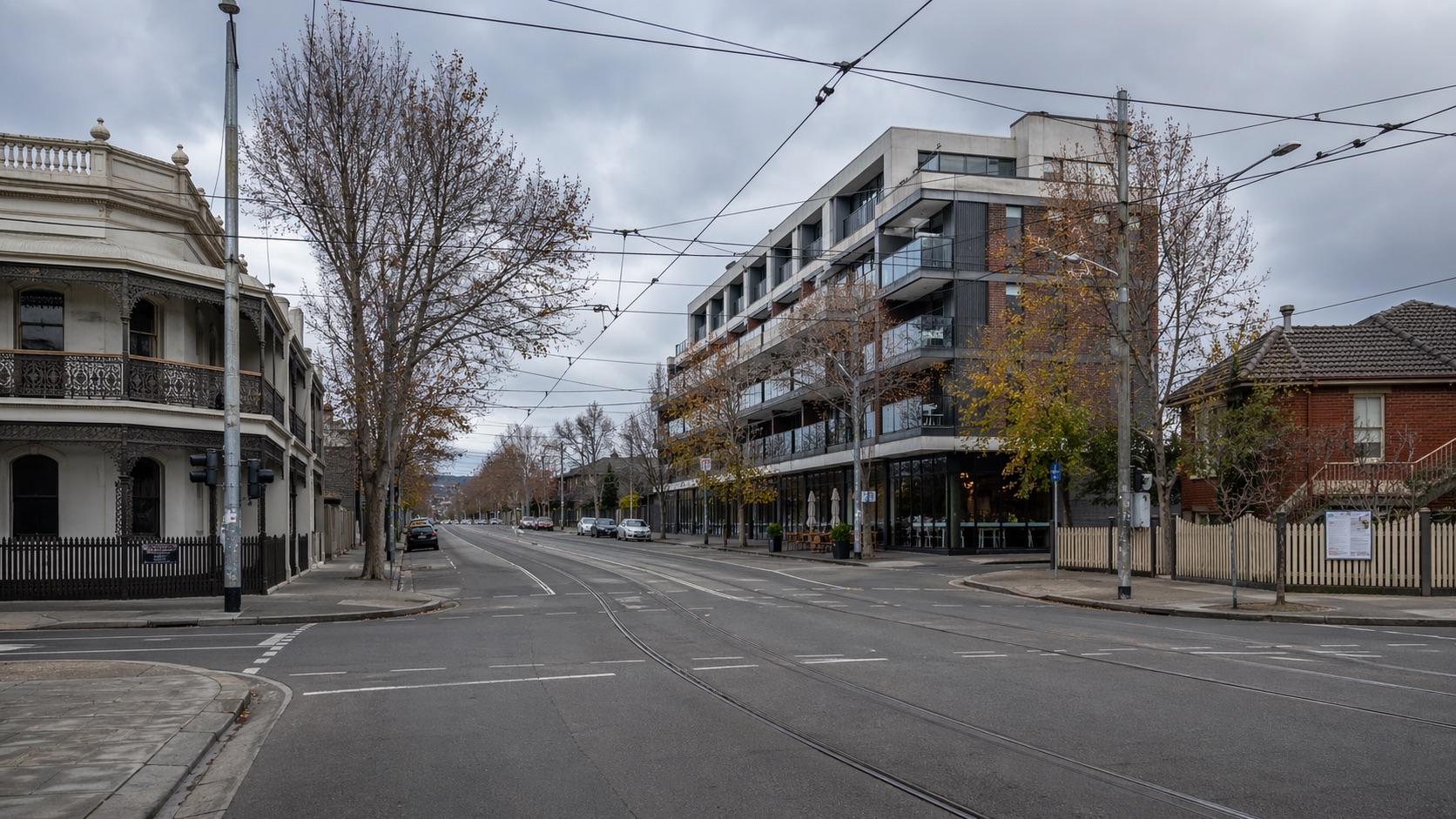
Three zones, one intersection: a heritage terrace (NRZ), a four-storey apartment building (RGZ), and a standard house with a permit application sign. Zoning determines what you can build before anything else.
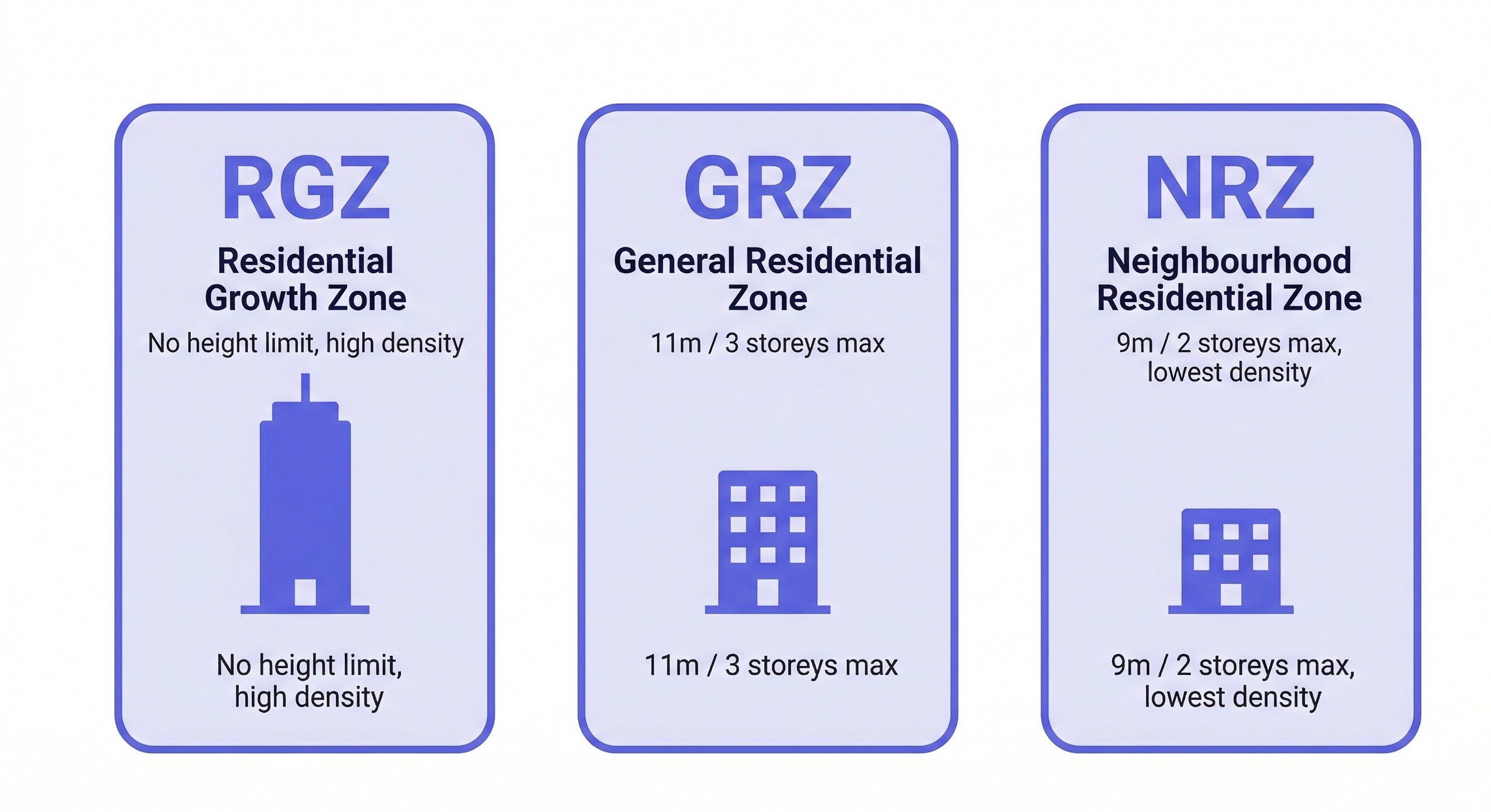
Victoria residential planning zones compared: RGZ, GRZ, and NRZ create very different density and height envelopes for developers. Source: DA Leads comparison based on public Victorian planning guidance.
Quick Comparison: Victoria's Key Residential Zones
| GRZ | NRZ | RGZ | |
|---|---|---|---|
| Max height | 11m / 3 storeys | 9m / 2 storeys | 13.5m / 4 storeys (discretionary) |
| Garden area | 25-35% on lots 400m²+ | 25-35% on lots 400m²+ | None in base zone |
| Dwelling limit | No fixed cap | No base cap (schedules may set one) | No cap |
| Permit required | Yes, for 2+ dwellings | Yes, for 2+ dwellings | Yes, for 2+ dwellings |
| Best for | Townhouse projects | Duplexes, premium builds | Medium-density apartments |
Now let's dig into each one.
The Residential Zones
These are where the majority of small-to-medium scale development happens in Melbourne and regional Victoria.
General Residential Zone (GRZ)
The workhorse zone for townhouse development.
GRZ covers the bulk of Melbourne's established suburbs: Reservoir, Preston, Oakleigh, Bentleigh East, Moorabbin, and most of the middle ring.
Key parameters:
- Maximum building height: 11 metres / 3 storeys
- Garden area requirement: 25% on 400-500m² lots, 30% above 500-650m², and 35% above 650m²
- Dwelling limit: No fixed cap (subject to ResCode standards and garden area)
- Planning permit required: Yes, for two or more dwellings on a lot
- Typical project pattern: townhouse projects where the schedule and garden area still stack up
The garden area requirement is the real density limiter here, not the height limit. Forget about storeys for a moment. On a 700m² site, 245m² must be set aside as garden area, and driveways, car parking areas and most built form do not count towards that number, which is why many middle-ring sites run into site coverage pressure before they hit the height ceiling.
Watch the schedules. Each GRZ schedule can modify the base provisions. Some schedules set a maximum number of dwellings, require a minimum lot size per dwelling, or bump up the garden area percentage. GRZ1 in one suburb can be very different from GRZ2 in the next. Always read the schedule before committing to a site.
If you're new to how council planning permits work in Victoria, start there before diving into specific zones.
Neighbourhood Residential Zone (NRZ)
The protection zone. Designed to limit change.
NRZ covers areas councils have identified for minimal development: inner-city heritage precincts, leafy established neighbourhoods, and streets with strong "neighbourhood character."
Key parameters:
- Maximum building height: 9 metres / 2 storeys (mandatory)
- Garden area requirement: 25-35% for lots 400m²+, with schedules and overlays sometimes tightening the outcome
- Dwelling limit: No cap in the base zone (Amendment VC110 removed the old two-dwelling limit in 2017 and replaced it with garden area requirements). However, many council schedules still set their own caps, so check the specific schedule for your site.
- Mandatory neighbourhood character objectives: Design must respond to the prevailing streetscape
- Planning permit required: Yes, for two or more dwellings
NRZ severely limits yield. If the schedule caps dwellings at two, that's your ceiling regardless of lot size. The neighbourhood character requirements also mean more expensive architectural design. Council planners will scrutinise the façade, materials, and landscaping more closely than in GRZ.
When NRZ still works: Duplexes and subdivisions. Buy a large NRZ lot (800m²+), build two high-quality dwellings, and sell at a premium. The limited development potential actually supports higher end values because buyers know the street won't fill up with medium-density housing.
Residential Growth Zone (RGZ)
The density zone. This is where councils want more housing.
RGZ is applied to areas near train stations, tram routes, activity centres, and major roads where state and local policy encourages increased density.
Key parameters:
- Maximum building height: 13.5 metres / 4 storeys (discretionary, not mandatory; schedules can go higher or lower)
- Garden area requirement: None in the base zone (schedules may add one)
- Dwelling limit: No cap
- Planning permit required: Yes, for two or more dwellings
- Typical project pattern: medium-density projects near centres, stations and major transport corridors
RGZ is where the margins get interesting. If you can find sites. Because councils and developers both know RGZ land is valuable, prices reflect the development potential, and you'll pay a premium per square metre compared to equivalent GRZ parcels in the same suburb. The upside: no mandatory garden area means you can achieve significantly higher site coverage than GRZ. You still need to meet ResCode standards for private open space, daylight access, and overlooking.
The catch. RGZ sites often have Design and Development Overlays (DDOs) that set specific built form requirements: street wall heights, upper-level setbacks, sometimes mandatory active frontages. These overlays can be more restrictive than the base zone itself.
The Commercial and Mixed-Use Zones
Different complexities, but potentially more development potential than purely residential zones.
Mixed Use Zone (MUZ)
Residential development above ground-floor commercial.
MUZ sits along shopping strips, near activity centres, and in transitional areas between commercial and residential.
Key parameters:
- Maximum building height: Set by schedule (varies widely)
- No garden area requirement
- Allows residential, commercial, and mixed uses
- Planning permit required: For most uses including residential above ground floor
MUZ can be excellent for apartment and mixed-use projects. Ground-floor retail with apartments above is the classic play. But the commercial component adds complexity: you need retail design standards, separate access, and a viable commercial market in the area. An empty ground-floor shop kills your project's appeal.
Commercial 1 Zone (C1Z) and Activity Centre Zone (ACZ)
C1Z and ACZ apply to larger commercial centres and allow residential development, often at greater heights than surrounding residential zones. These are typically apartment buildings of 5+ storeys and beyond the scope of most small-scale developers.
Commercial 2 Zone (C2Z)
C2Z generally does not allow residential development. Don't buy a C2Z site planning apartments. You'd need a rezoning, and that takes years.
Specialist Zones Developers Encounter
Township Zone (TZ)
Common in regional Victorian towns. Allows residential development but with character provisions reflecting the town's scale.
- Height: Typically 9–11m depending on schedule
- Yield: Generally low, one to two dwellings
- Character requirements: Design must respect the town's character
Low Density Residential Zone (LDRZ)
Applied to fringe areas where lots need to stay large enough to manage wastewater and a low-intensity residential character. The zone is generally used where the minimum subdivision area is 0.2 hectares with reticulated sewerage or 0.4 hectares without it, which makes conventional subdivision very limited. Not a development zone in any meaningful sense.
Comprehensive Development Zone (CDZ)
CDZ is applied to large, complex sites that require a tailored planning framework: former industrial sites, hospital precincts, urban renewal areas where the standard zone provisions simply can't handle the scale or complexity of what's being proposed. Each CDZ has a bespoke schedule that functions as its own mini planning scheme. Ignore everything else. If you're looking at a CDZ site, the schedule is the only document that matters.
Transport Zone (TRZ)
Applied to land used for transport purposes: railway corridors, major road reserves, bus depots. Development is generally not permitted unless ancillary to the transport function. However, surplus government land in TRZ is occasionally rezoned for development, which can create significant opportunities.
How Overlays Modify Zones
A zone tells you the base rules. Overlays add extra requirements on top. These are the ones that matter most for developers:
Heritage Overlay (HO)
Requires a permit for many demolitions, external alterations, and new buildings. Design must respond to heritage character, and the schedule to the overlay determines exactly how tightly the place is controlled. It doesn't prevent development, but it does constrain it significantly.
Design and Development Overlay (DDO)
Sets specific built form requirements: mandatory building heights, setbacks, and design standards. In RGZ and MUZ areas, DDOs can either increase or decrease what the base zone allows. Read the DDO schedule before you assume the zone height limit is what you'll get.
Environmental Significance Overlay (ESO)
Protects environmental values. May restrict vegetation removal, require environmental assessments, and limit building footprint. Common in outer eastern suburbs and areas near waterways.
Special Building Overlay (SBO)
Flood overlay. Requires floor levels above the 1% annual exceedance probability flood level. Adds engineering costs and may reduce usable floor area at ground level. Check this before buying, not after.
Practical Zone Assessment Checklist
When you find a potential site, run through this before making an offer:
- Identify the zone on VicPlan and note the base zone code
- Read the schedule to see if it modifies the standard zone provisions
- Check all overlays by clicking the parcel and reviewing every overlay listed
- Note the height limit from the zone and any DDO
- Calculate garden area (does the zone require it? what percentage?)
- Check dwelling limits in the schedule
- Review neighbourhood character requirements (NRZ character statement or DDO design objectives)
- Confirm residential use is permitted (not every zone allows it)
For a deeper walkthrough of how to assess a development site, see our guide on assessing development sites in Melbourne.
Zone Data at Your Fingertips
Looking up zones, reading schedules, and cross-referencing overlays takes time, especially when you're screening multiple sites. The DA Leads feasibility calculator automatically pulls zoning and overlay data for any Victorian address, calculates garden area requirements, estimates dwelling yield based on zone parameters, and runs the financial feasibility.
If you're considering a granny flat or secondary dwelling, the zone and garden area rules are especially critical. Check the zone first.


