Acacia Ridge
Unemployment at 10.6% runs nearly triple the QLD average, placing Acacia Ridge among Brisbane's more economically stressed suburbs. The SEIFA IRSAD decile of 1 (bottom nationally) confirms this ranking, yet the area is undergoing structural change: affordability improved from 61.4% mortgage-to-income in 2011 to 50.8% in 2021, and 38% of residents were born overseas, 16.4 percentage points above the national average. With a median house estimate of $422,000 against Brisbane's $800,000+ median, the price gap attracts both first-home buyers and migrant families seeking detached houses.
Population
7,486
Median Age
34.0
Household IncomeiMedian weekly household income (ABS Census)
$1,313/wk
DAs (12 months)iDevelopment Applications lodged in the past year
52
Median House
$422K
Estimated from rent (2025)
Separate houses account for 84.8% of stock, with 3-bedroom homes dominating at 67.9%. The estimated median of $422,000 sits well below Brisbane's citywide median, making Acacia Ridge one of the most affordable detached-housing suburbs within 15 km of the CBD. Mortgage repayments of $1,517 per month absorb 26.7% of household income, just below the stress threshold. Semi-detached stock at 12.3% provides townhouse alternatives. Buyers should note household income sits at the 33rd percentile nationally, so affordability is relative to local earnings rather than city averages.
For Buyers
Separate houses account for 84.8% of stock, with 3-bedroom homes dominating at 67.9%. The estimated median of $422,000 sits well below Brisbane's citywide median, making Acacia Ridge one of the most affordable detached-housing suburbs within 15 km of the CBD. Mortgage repayments of $1,517 per month absorb 26.7% of household income, just below the stress threshold. Semi-detached stock at 12.3% provides townhouse alternatives. Buyers should note household income sits at the 33rd percentile nationally, so affordability is relative to local earnings rather than city averages.
For Investors
Renters make up 50.8% of residents, well above the national average, creating consistent tenant demand. Weekly rent of $335 remains accessible, with rent-to-income at 25.5%. Vacancy at 6.3% is slightly elevated compared to Brisbane's average. Development activity totalled 45 applications in 12 months, with recent lodgements focused on industrial warehouse and subdivision proposals rather than residential. Net overseas migration of 151 per year provides sustained tenant inflow, though 159 internal departures annually mean the area functions as a stepping-stone suburb for domestic movers.
Development Activity
Total DAs
239
Last 12 Months
52
YoY ChangeiYear-over-year change in DA lodgements
-3.7%
Avg DA CostiAverage estimated cost per DA in the past year
N/A
Monthly DA Lodgements
DA Categories
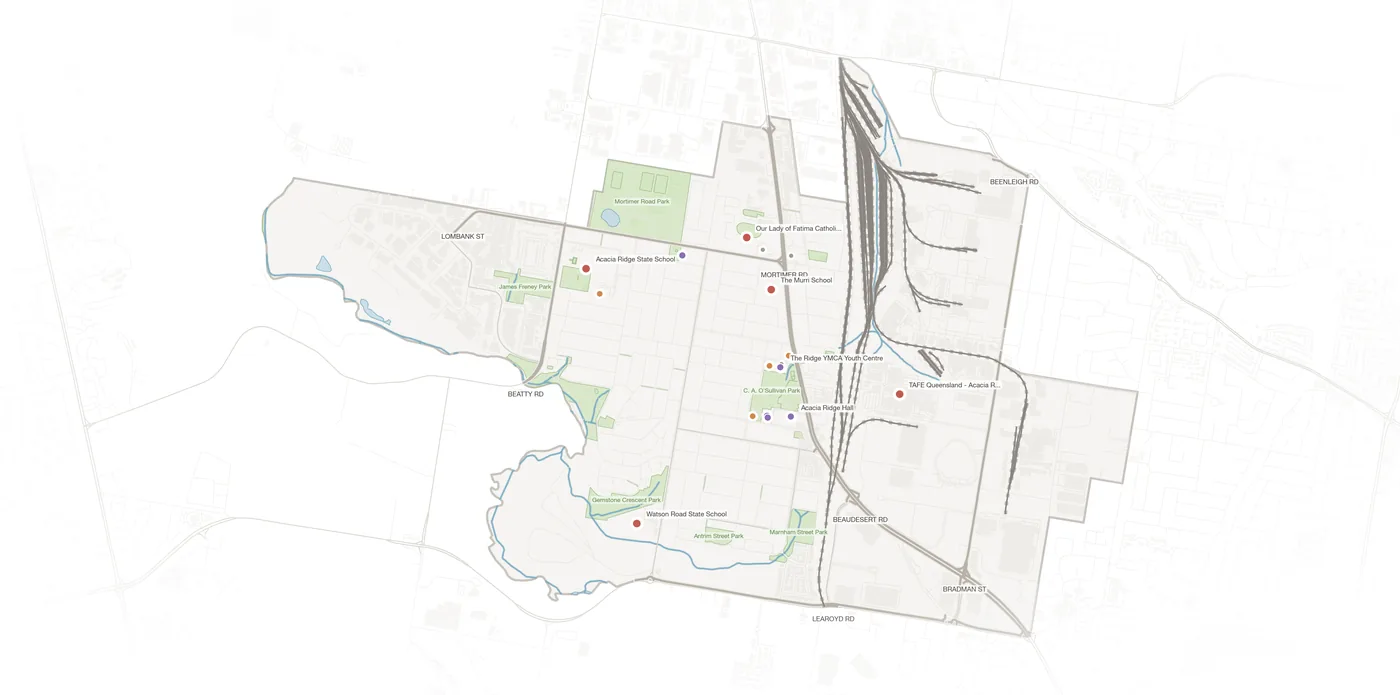
Schools in Acacia Ridge iICSEA: school advantage index. 1000 = national avg, higher = more advantaged
Our Lady of Fatima Primary School
Prep-6 · 174 students
Acacia Ridge State School
Prep-6 · 312 students
Watson Road State School
Prep-6 · 124 students
Aboriginal & Islander Independent Community School
Prep-12 · 260 students
Demographics
The median age of 34 sits 6 years below the national figure. Born-overseas residents at 38%, with Arabic (80 speakers), Punjabi (59), Mandarin (58), Hindi (42), and Gujarati (34) as top non-English languages, reflect a multicultural migrant-destination profile. English ancestry leads (1,936) but is closely followed by an unusually high "Other" category (1,881), suggesting diverse non-European backgrounds. Islam (758 adherents) is the second-largest religion after Christianity (2,868), well above the national Islam share. University attainment at 27% sits 3.1 points below the national average.
Age Distribution
Bedrooms
Dwelling Structure
84.8%
Houses
12.3%
Townhouse
2.9%
Apartment
Tenure
At an estimated median of $422,000, Acacia Ridge prices about half of Brisbane's inner-ring equivalent. Ownership splits 20.1% outright, 29.1% mortgage, 50.8% renting. The renter majority is unusual for a suburb dominated by separate houses (84.8%), suggesting rental stock includes converted houses and granny flats. Three-bedroom homes account for 67.9% of dwellings, the highest single-bedroom-count concentration among comparable Brisbane suburbs. Mortgage stress at 26.7% is manageable compared to the national median, but household income at the 33rd percentile means capacity to absorb rate rises is limited.
Mortgage / mo
$1,517
Rent / wk
$335
HH Size
2.6
Personal Income / wk
$628
Vacancy Ratei% of dwellings unoccupied on Census night (ABS 2021)
6.3%
Unoccupied
176
Rent / IncomeiMedian rent as % of household income. Over 30% = housing stress
25.5%
Mortgage / IncomeiMedian mortgage as % of household income. Over 30% = housing stress
26.7%
Community Profile
Languages Spoken at Home
Ancestry
Household Composition
21.6%
Couples, no children
5,590
Total families
Economy & Employment
Healthcare leads employment at 19.9%, followed by education (9.9%), construction (9.7%), manufacturing (8.2%), and retail (8.1%). The occupation spread is notably flat: professionals and labourers tie at 445 each, an unusual pattern indicating a dual labour market. Machinery and drivers (324) reflect the suburb's industrial corridor role. Unemployment at 10.6% is more than double the national rate. The SEIFA economic resources decile of 1 and education/occupation decile of 3 confirm a suburb with limited financial buffers, though affordability has been improving, with the mortgage-to-income ratio declining from 61.4% to 50.8% over the decade.
Unemployment
14.2%
Labour Force
5,213
Unemployed
738
Quarterly Trend
Source: SALM Dec-25
Socio-Economic Indexes (SEIFA)iABS index ranking suburbs from 1 (most disadvantaged) to 10 (most advantaged)
Full-time
64.9%
Part-time
24.5%
Participation
50.2%
Employed
2,658
Occupations
Top Industries
University
27.0%
Postgraduate
6.1%
Born Overseas
38.0%
Dwellings
2,631
Transport to Work
Car dependence is high at 84% driving, with only 5.8% using public transport and 3% walking or cycling. Four schools serve the area: Our Lady of Fatima Primary (Catholic, ICSEA 1034, 174 students) performs above the national benchmark, while Watson Road State School (ICSEA 872, 124 students) sits well below. The ICSEA spread of 162 points across schools, from 710 to 1034, is one of the widest intra-suburb ranges, reflecting the diverse socioeconomic composition. The SEIFA IRSAD decile of 1 ranks the suburb in the lowest nationally for overall advantage.
Drive
84.0%
Public Transport
5.8%
Walk / Cycle
3.0%
Work from Home
N/A
Population Forecast
+0.47%/yr
(+47 people/yr)
EstablishedPopulation grows at 0.47% per year, adding 47 persons annually. The SA2 area grew from 9,969 in 2023 to 10,061 in 2025, with projections reaching 10,382 by 2031. The population expanded 11.5% over 10 years, above the national average. Net overseas migration of 151 annually is the primary driver, while internal migration shows a net outflow of 159 per year, a pattern where overseas arrivals settle while established residents move out. Gentrification score of 40 with early signs suggests socioeconomic composition may be shifting, but real income growth of 15.5% over the decade lags behind the national average.
Historical + Forecast
Hamilton-Perry + Holt smoothing on ERP 2001-2025
Age Cohort Forecast
Primary Driver
Overseas Migration
Net Overseas / yr
+151
Net Internal / yr
-159
Gentrification Signal
Not gentrifying
Population +10% since 2011, Net internal outflow -159/yr
National Ranking iPercentile rank among ~15,000 AU suburbs. 90% = higher than 90% of suburbs
How Acacia Ridge compares to ~15,000 Australian suburbs
Frequently Asked Questions
Is Acacia Ridge a good suburb to live in?
Acacia Ridge offers some of Brisbane's most affordable detached housing within 15 km of the CBD, with an estimated median of $422,000. The SEIFA IRSAD decile of 1 indicates significant disadvantage, and unemployment at 10.6% is well above the national rate of around 4%. It suits budget-conscious buyers accepting trade-offs in socioeconomic profile.
What is the median house price in Acacia Ridge?
The estimated median house price is $422,000 (2025, derived from rent). This sits roughly half of Brisbane's citywide median, making it one of the most affordable options for detached houses. Three-bedroom homes account for 67.9% of stock.
What schools are in Acacia Ridge?
Four schools operate in Acacia Ridge: Our Lady of Fatima Primary (Catholic, ICSEA 1034, 174 students), Acacia Ridge State School (Government, ICSEA 930, 312 students), Watson Road State School (Government, ICSEA 872, 124 students), and Aboriginal & Islander Independent Community School (ICSEA 710, 260 students).
Is Acacia Ridge safe?
Suburb-level crime statistics are not available for Acacia Ridge in the current dataset. The SEIFA IRSAD decile of 1 (bottom nationally) correlates with higher-than-average crime rates in comparable suburbs. QLD Police report crime at the broader statistical area level.
Is Acacia Ridge good for property investment?
The 50.8% renter rate creates strong tenant demand, and $335 weekly rent keeps entry affordable. Vacancy at 6.3% is slightly above Brisbane's average. Net overseas migration of 151 per year sustains inflows. The 45 DAs in 12 months lean industrial (warehouses, subdivisions), limiting residential supply competition compared to higher-density suburbs.
How is Acacia Ridge's population changing?
Population grows at 0.47% annually, adding 47 people per year. The SA2 grew 11.5% over 10 years, above the national rate. Overseas migration (+151/year) drives growth while internal migration shows net outflow of 159 per year. Medium projections forecast 10,382 by 2031, up from 10,061 in 2025.
What languages are spoken in Acacia Ridge?
Arabic (80 speakers), Punjabi (59), Mandarin (58), Hindi (42), and Gujarati (34) are the top non-English languages. With 38% born overseas, 16.4 percentage points above the national average, linguistic diversity is considerably higher than most Brisbane suburbs at this price point.
How to read these comparisons
Phrases like "above the national average" reference the unweighted median across Australian suburbs with more than 1,000 residents, not population-weighted national figures. Suburb-level medians are more useful for ranking suburbs against each other; ABS census headlines are population-weighted (so dominated by Sydney and Melbourne) and can read very differently.
Current baseline (refreshed 2026-05-10): median age 40, university-educated 30.1%, born overseas 21.6%, average household size 2.5 people.
Data sources: ABS 2021 Census (demographics, income, tenure), state Valuer-General (house prices), Department of Jobs SALM (unemployment), ACARA (school ICSEA), state Crime Statistics agencies (offences), council DA portals (development applications). Population forecasts use a Hamilton-Perry cohort model calibrated to ABS ERP.
Explore Acacia Ridge on the Map
View parcels, zoning overlays, DA applications, schools and more.
Open Interactive Map