Algester
Real income declining 6.2% over the decade while population grew 9.1% creates a paradox in Algester: more residents but each earning less in real terms. Household income at the 60.3rd percentile ($1,716/week) and a $493,000 estimated median place it in Brisbane's affordable outer-middle tier. Chinese ancestry (1,356) is the third largest group behind English (2,242), an unusually high East Asian concentration for a detached-house suburb in Brisbane's south. The aging trajectory signal (senior share expanding 3.8 points, working-age share contracting 3.8 points) is the most pronounced aging shift in this batch after Beaumont Hills, indicating a suburb where founding families from the 1980s-90s development are progressing through the lifecycle.
Population
9,020
Median Age
36.0
Household IncomeiMedian weekly household income (ABS Census)
$1,716/wk
DAs (12 months)iDevelopment Applications lodged in the past year
24
Median House
$493K
Estimated from rent (2025)
At $493,000 estimated median, Algester offers affordable family housing with 81.0% detached houses. Three-bedroom homes at 49.8% dominate, with 4+ bedrooms at 44.6%. Monthly mortgage repayments of $1,750 produce a mortgage-to-income ratio of 23.6%, below the 30% stress threshold. Outright owners at 27.2% indicate a mature ownership base. Semi-detached at 16.3% provides townhouse alternatives. Two schools serve the suburb: St Stephen's (Catholic, ICSEA 1,077, 516 students) and Algester State School (ICSEA 1,041, 917 students), both above the national benchmark. Public transport at 6.4% is moderate, with car dependency at 86.2%.
For Buyers
At $493,000 estimated median, Algester offers affordable family housing with 81.0% detached houses. Three-bedroom homes at 49.8% dominate, with 4+ bedrooms at 44.6%. Monthly mortgage repayments of $1,750 produce a mortgage-to-income ratio of 23.6%, below the 30% stress threshold. Outright owners at 27.2% indicate a mature ownership base. Semi-detached at 16.3% provides townhouse alternatives. Two schools serve the suburb: St Stephen's (Catholic, ICSEA 1,077, 516 students) and Algester State School (ICSEA 1,041, 917 students), both above the national benchmark. Public transport at 6.4% is moderate, with car dependency at 86.2%.
For Investors
Renters at 31.1% provide a moderate tenant pool. Weekly rent of $395 against a $493,000 estimated median gives gross yield around 4.2%, solid for Brisbane's outer-middle suburbs. The 5.5% vacancy rate is slightly elevated. Development activity at 20 DAs in 12 months is moderate, mostly subdivision and design approvals. Net overseas migration of 185 per year provides the primary demand driver, with internal migration marginally positive at +12. Population growth of 1.17% per year (119 persons) is modest. The aging trajectory means the investor thesis is about stable yield rather than capital growth: an established, slowly aging suburb with predictable tenant demand from families and empty nesters.
Development Activity
Total DAs
88
Last 12 Months
24
YoY ChangeiYear-over-year change in DA lodgements
+33.3%
Avg DA CostiAverage estimated cost per DA in the past year
N/A
Monthly DA Lodgements
DA Categories
Schools in Algester iICSEA: school advantage index. 1000 = national avg, higher = more advantaged
St Stephen's School
Prep-6 · 516 students
Algester State School
Prep-6 · 917 students
Demographics
The median age of 36 is 4 years below the national median. Overseas-born at 42.8% is 21.2 points above national. English ancestry leads at 2,242, but Chinese ancestry at 1,356 is notably high, well above typical for an outer Brisbane suburb. Scottish (657) and Irish (626) complete the Anglo-Celtic base. Mandarin (391), Punjabi (129) and Cantonese (115) are the top non-English languages. University qualifications at 37.3% sit 7.2 points above national. Average household size of 2.8 is 0.3 above national. Christianity (3,792) dominates religion, with Islam (531) and Buddhism (324) reflecting the diverse migrant intake. Couples with children (3,437) significantly outnumber couples without (1,676).
Age Distribution
Bedrooms
Dwelling Structure
81.0%
Houses
16.3%
Townhouse
1.4%
Apartment
Tenure
Mortgage holders at 41.7% lead, with renters at 31.1% and outright owners at 27.2%. The stock is 81.0% detached houses, 16.3% semi-detached and 1.4% apartments. Three-bedroom homes at 49.8% and 4+ bedrooms at 44.6% dominate, with studios/one-bedrooms at just 1.7%. The tenure split between outright owners (27.2%) and mortgage holders (41.7%) suggests a mix of long-term paid-off residents and more recent buyers. Mortgage-to-income at 23.6% and rent-to-income at 23.0% are both below stress thresholds. All four SEIFA deciles sit at 5 or 6, clustering around the national midpoint, indicating a suburb without extreme advantage or disadvantage.
Mortgage / mo
$1,750
Rent / wk
$395
HH Size
2.8
Personal Income / wk
$752
Vacancy Ratei% of dwellings unoccupied on Census night (ABS 2021)
5.5%
Unoccupied
178
Rent / IncomeiMedian rent as % of household income. Over 30% = housing stress
23.0%
Mortgage / IncomeiMedian mortgage as % of household income. Over 30% = housing stress
23.6%
Community Profile
Languages Spoken at Home
Ancestry
Household Composition
22.5%
Couples, no children
7,441
Total families
Economy & Employment
Healthcare leads at 19.9% (566 workers), followed by Education at 10.2% (291), Construction at 8.6% (245), Professional/Tech at 8.6% (245) and Manufacturing at 7.3% (209). Professionals (878) lead occupations, with Clerical/Admin (621) and Community/Personal (500) following. Machinery/Drivers (406) and Labourers (388) rank 4th and 5th, giving the suburb a mixed white-collar and blue-collar workforce. Full-time employment at 65.5% is moderate, unemployment at 6.8% is above the national average, and participation at 57.6% is below it. Real income declined 6.2% over the decade after inflation, the only negative real income growth in this batch, suggesting household purchasing power is eroding.
Unemployment
5.8%
Labour Force
5,310
Unemployed
306
Quarterly Trend
Source: SALM Dec-25
Socio-Economic Indexes (SEIFA)iABS index ranking suburbs from 1 (most disadvantaged) to 10 (most advantaged)
Full-time
65.5%
Part-time
27.7%
Participation
57.6%
Employed
3,789
Occupations
Top Industries
University
37.3%
Postgraduate
10.3%
Born Overseas
42.8%
Dwellings
3,041
Transport to Work
Public transport at 6.4% is moderate, with car dependency at 86.2% and walking/cycling at 1.2%. Two schools serve the suburb: St Stephen's School (Catholic, ICSEA 1,077, 516 students) and Algester State School (government, ICSEA 1,041, 917 students), both above the national 1,000 ICSEA benchmark. The IRSAD decile 5 sits at the national midpoint. Rent-to-income at 23.0% is manageable. The 5.7% needing assistance rate is slightly above average. Volunteering at 11.7% is moderate. The suburb provides a practical suburban lifestyle with adequate school access, though limited public transport requires car ownership for most commutes.
Drive
86.2%
Public Transport
6.4%
Walk / Cycle
1.2%
Work from Home
N/A
Population Forecast
+1.17%/yr
(+119 people/yr)
EstablishedPopulation growth runs at 1.17% per year (119 persons), with the 10-year change at 9.1%, below the national average. The ERP reached 10,205 in 2025, and medium forecasts project 10,636 by 2031. Overseas migration at 185 per year is the primary driver, with internal migration marginally positive at +12. The trajectory is classified as 'Aging': the senior share expanded by 3.8 points and the working-age share contracted by 3.8 points, a symmetrical aging pattern. The young share grew 2.6 points, suggesting some family intake alongside the aging-in-place dynamic. Gentrification score is 21 (early signs), with population acceleration from 3% to 16%. Affordability improved modestly from 55.2% to 52.5% over the decade.
Historical + Forecast
Hamilton-Perry + Holt smoothing on ERP 2001-2025
Age Cohort Forecast
Primary Driver
Overseas Migration
Net Overseas / yr
+185
Net Internal / yr
+12
Gentrification Signal
Early signs
Population +19% since 2011, Accelerating: 3% → 16%
National Ranking iPercentile rank among ~15,000 AU suburbs. 90% = higher than 90% of suburbs
How Algester compares to ~15,000 Australian suburbs
Frequently Asked Questions
Is Algester a good suburb to live in?
Algester suits families wanting affordable detached housing (81.0% houses, $493,000 median) with two schools both scoring above the ICSEA 1,000 benchmark (1,077 and 1,041). Mortgage-to-income of 23.6% is below the stress line. The IRSAD decile 5 sits at the national midpoint. Key concerns are 86.2% car dependency and the aging trajectory (senior share up 3.8 points over a decade).
What is the median house price in Algester?
The estimated median is $493,000 (derived from rent data, 2025). Weekly rent averages $395 and monthly mortgage repayments are $1,750. Gross rental yield sits around 4.2%, solid for Brisbane's outer-middle ring. The mortgage-to-income ratio of 23.6% is below the 30% stress threshold.
What schools are in Algester?
Two primary schools serve the suburb: St Stephen's School (Catholic, ICSEA 1,077, 516 students) and Algester State School (government, ICSEA 1,041, 917 students). Both score above the national 1,000 ICSEA benchmark. Secondary schooling requires travel to neighbouring suburbs.
Is Algester safe?
Crime data is not available for Algester in the current dataset. The IRSD decile 5 and IRSAD decile 5 sit at the national midpoint, suggesting average socio-economic conditions. The 6.8% unemployment rate is slightly above the national average. The 76.5% residential stability rate indicates a reasonably settled community.
Is Algester good for property investment?
Gross yield of approximately 4.2% ($395/week on $493,000) is competitive. The 31.1% renter share provides a moderate tenant pool, but the 5.5% vacancy rate is slightly elevated. Population growth of 1.17% per year is modest, and real income declined 6.2% over the decade, limiting capital growth potential. The 20 DAs in 12 months indicate moderate development activity.
How is Algester's population changing?
Growth is slow at 1.17% per year (119 persons), with a 9.1% increase over 10 years. The ERP reached 10,205 in 2025. Overseas migration (+185/year) is the primary driver. The suburb is aging: senior share expanded 3.8 points and working-age share contracted 3.8 points over the decade. The median age of 36 is 4 years below national, but the aging trend is the most pronounced in Brisbane suburbs of this batch.
What languages are spoken in Algester?
With 42.8% born overseas (21.2 points above national), Algester has notable linguistic diversity. Mandarin leads at 391 speakers, followed by Punjabi (129), Cantonese (115), Korean (84) and Hindi (58). Chinese ancestry at 1,356 is unusually high for an outer Brisbane suburb, making it a key destination for East Asian migrants in the southern corridor.
How to read these comparisons
Phrases like "above the national average" reference the unweighted median across Australian suburbs with more than 1,000 residents, not population-weighted national figures. Suburb-level medians are more useful for ranking suburbs against each other; ABS census headlines are population-weighted (so dominated by Sydney and Melbourne) and can read very differently.
Current baseline (refreshed 2026-05-10): median age 40, university-educated 30.1%, born overseas 21.6%, average household size 2.5 people.
Data sources: ABS 2021 Census (demographics, income, tenure), state Valuer-General (house prices), Department of Jobs SALM (unemployment), ACARA (school ICSEA), state Crime Statistics agencies (offences), council DA portals (development applications). Population forecasts use a Hamilton-Perry cohort model calibrated to ABS ERP.
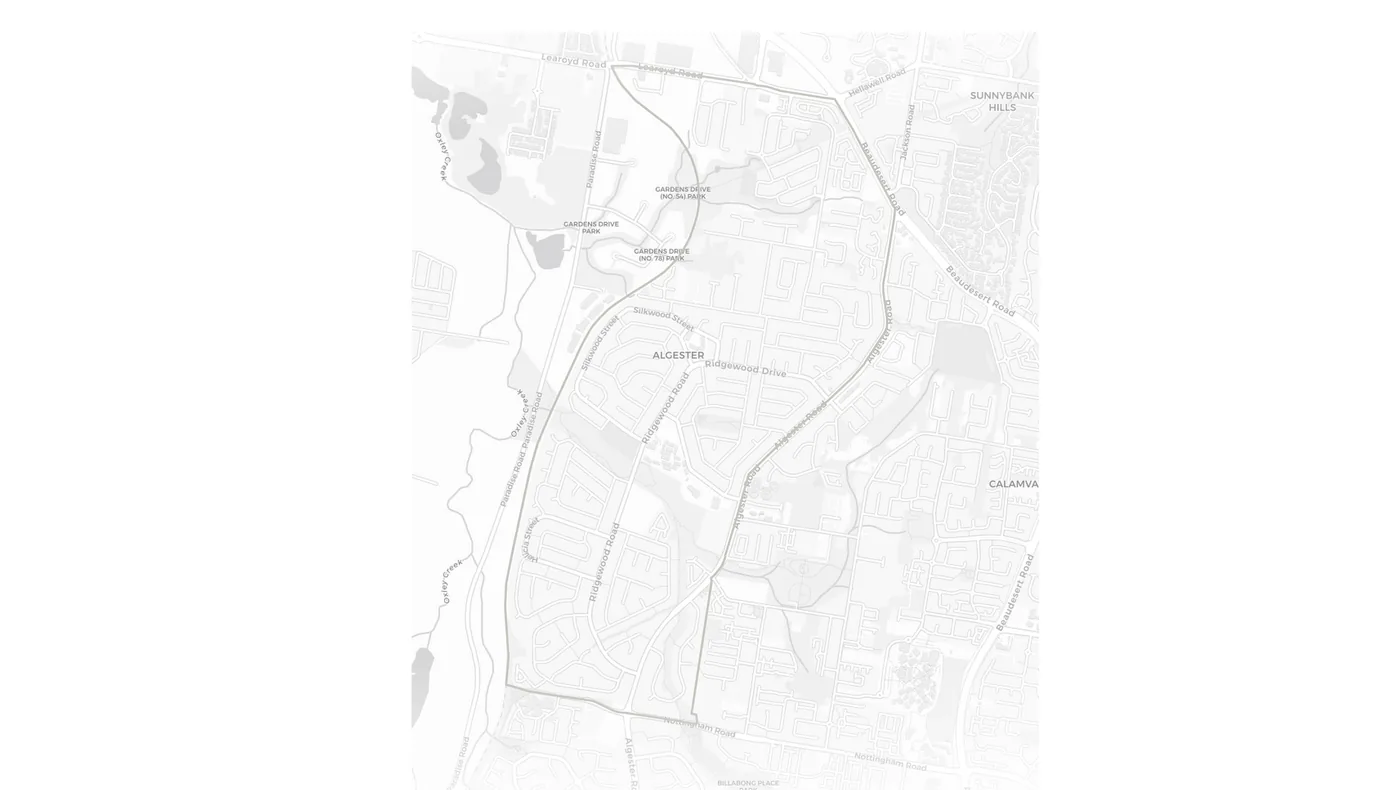
Explore Algester on the Map
View parcels, zoning overlays, DA applications, schools and more.
Open Interactive Map