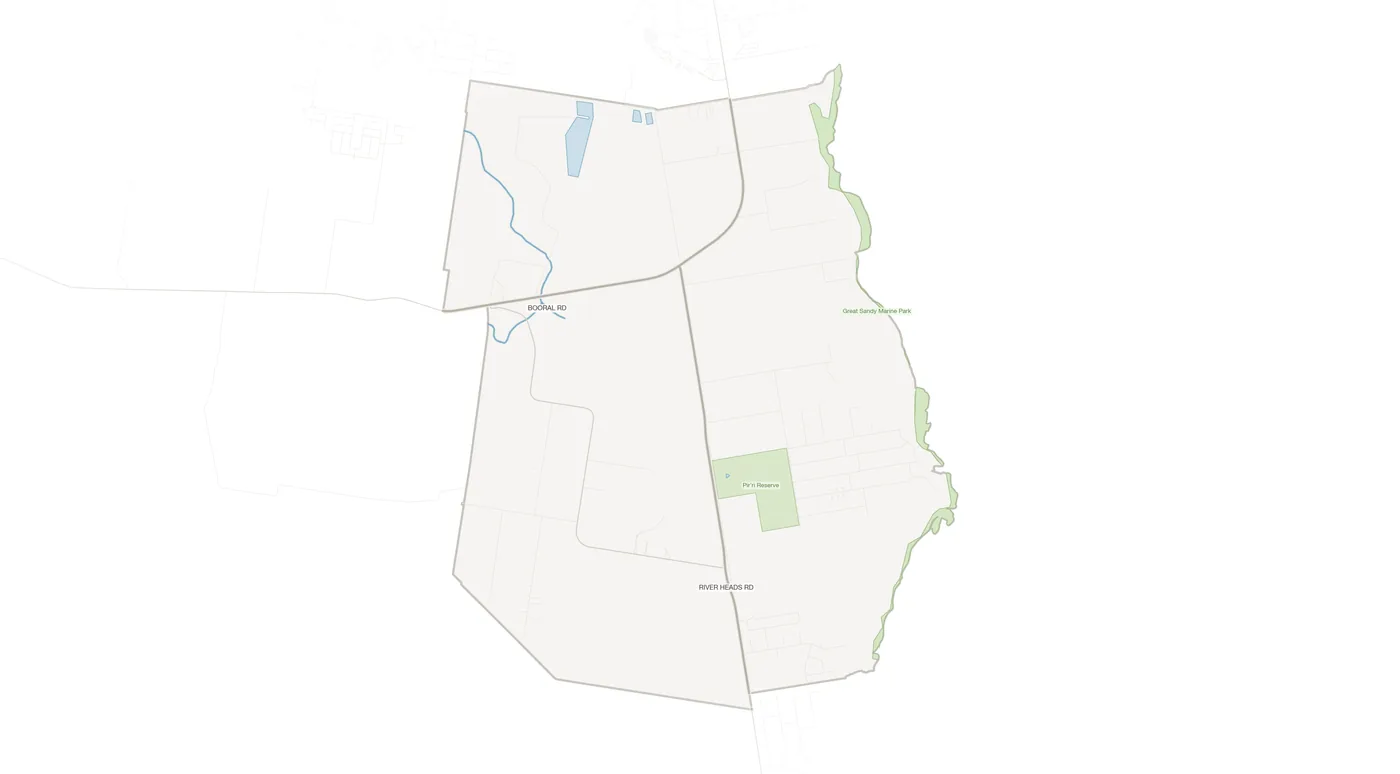
Booral
With a median age of 47, Booral sits 7 years above the national figure, making it one of the older-skewing suburbs in the Fraser Coast region. The population of 1,636 is spread across 27.86 square kilometres, giving a low density of 58.7 residents per km2. Home ownership is high: 43.8% own outright and another 43.8% hold a mortgage, leaving only 12.4% renting, well below state averages. The IRSAD decile of 2 places Booral near the bottom fifth nationally for relative socio-economic advantage, yet the IER decile of 7 signals reasonable access to economic resources, an anomaly explained by the suburb's owner-occupier bias and lower cost housing relative to income.
Population
1,636
Median Age
47.0
Household IncomeiMedian weekly household income (ABS Census)
$1,412/wk
DAs (12 months)iDevelopment Applications lodged in the past year
8
Median House
$422K
Estimated from rent (2025)
The estimated median house price of $422,000 sits at an accessible level compared to Queensland coastal markets, with a mortgage-to-income ratio of 24.8%, below the 30% stress threshold. Monthly mortgage repayments average $1,517. The stock is almost entirely detached houses at 98% of dwellings, with 4-plus bedroom homes accounting for 46% and 3-bedroom homes 41.8%, so buyers find large family-sized properties rather than apartments or smaller units. Households have an average size of 2.8 people, slightly above the national average of 2.5. The high outright ownership rate of 43.8% indicates an established, long-settled base rather than a suburb turning over rapidly, which can provide price stability but also limits available supply for new buyers.
For Buyers
The estimated median house price of $422,000 sits at an accessible level compared to Queensland coastal markets, with a mortgage-to-income ratio of 24.8%, below the 30% stress threshold. Monthly mortgage repayments average $1,517. The stock is almost entirely detached houses at 98% of dwellings, with 4-plus bedroom homes accounting for 46% and 3-bedroom homes 41.8%, so buyers find large family-sized properties rather than apartments or smaller units. Households have an average size of 2.8 people, slightly above the national average of 2.5. The high outright ownership rate of 43.8% indicates an established, long-settled base rather than a suburb turning over rapidly, which can provide price stability but also limits available supply for new buyers.
For Investors
Rental demand is thin in Booral. Only 12.4% of households rent, compared to state and national figures typically above 30%, and the vacancy rate sits at 8.3%, a level that signals more supply than active demand. Weekly rent of $335 against a $422,000 median gives a gross yield close to 4.1%, reasonable in absolute terms but limited by the low tenant pool. Just 6 development applications were lodged in the past 12 months, all building works on existing dwellings, confirming this is not a high-activity construction market. The participation rate of 50.4% and unemployment rate of 8.5% are both weaker than national benchmarks, which dampens tenant income growth. Investors should weigh the yield against the vacancy risk and slow turnover of a 78.2% resident-stay community.
Development Activity
Total DAs
21
Last 12 Months
8
YoY ChangeiYear-over-year change in DA lodgements
+100.0%
Avg DA CostiAverage estimated cost per DA in the past year
N/A
Monthly DA Lodgements
DA Categories
Demographics
Booral's median age of 47 is 7 years above the national median of 40, reflecting an aging-resident base where a large share has already retired or is approaching it. Overseas-born residents at 17% sit 4.6 percentage points below the national figure, consistent with the predominantly Anglo-Celtic ancestry profile: English (793), Scottish (153), Irish (134) and German (133) dominate. No other languages feature in the brief, signalling a low-diversity linguistic environment. University qualifications at 16.1% are 14 percentage points below the national rate, a significant gap that correlates with the blue-collar and community services occupational structure. Average household size of 2.8 is 0.3 above national, suggesting family households remain common despite the older age profile, with 34.2% couples without children and 34.3% couples with children in the household composition data.
Age Distribution
Bedrooms
Dwelling Structure
98.0%
Houses
N/A
Townhouse
0.9%
Apartment
Tenure
Detached houses dominate at 98% of dwellings, one of the highest rates among Queensland suburbs. Large homes are the norm: 4-plus bedroom dwellings account for 46% of stock and 3-bedroom homes cover 41.8%, leaving very little demand for smaller configurations (only 9.2% are 2-bedroom). The tenure split is unusual by national standards, with outright owners and mortgage holders each at 43.8% and renters at just 12.4%. Mortgage stress is absent at 24.8% of income, and rent-to-income at 23.7% is comfortably below the 30% stress threshold. These figures indicate housing affordability is not a burden here, in contrast to metro markets. The estimated $422,000 median is derived from rent data given limited price transaction volume, so buyers should treat it as indicative rather than market-tested.
Mortgage / mo
$1,517
Rent / wk
$335
HH Size
2.8
Personal Income / wk
$585
Vacancy Ratei% of dwellings unoccupied on Census night (ABS 2021)
8.3%
Unoccupied
50
Rent / IncomeiMedian rent as % of household income. Over 30% = housing stress
23.7%
Mortgage / IncomeiMedian mortgage as % of household income. Over 30% = housing stress
24.8%
Community Profile
Ancestry
Household Composition
32.2%
Couples, no children
1,354
Total families
Economy & Employment
Healthcare dominates local employment at 24.2% of workers (108 people), well above its national share, followed by Construction at 15.7% and Education at 10.5%. The top occupations are Community and Personal Services (118 workers), Labourers (91) and Professionals (84). This profile fits a regional service hub with a SEIFA IRSD decile of 3, indicating disadvantage relative to most of the country. Weekly household income of $1,412 places Booral in the 41st percentile nationally, below the median. The unemployment rate of 8.5% is elevated compared to national averages typically below 5%, and the participation rate of 50.4% is low, partly explained by the high median age of 47 where many residents have exited the workforce. Full-time employment among workers is 57.7%, below typical metro benchmarks.
Socio-Economic Indexes (SEIFA)iABS index ranking suburbs from 1 (most disadvantaged) to 10 (most advantaged)
Full-time
57.7%
Part-time
33.8%
Participation
50.4%
Employed
634
Occupations
Top Industries
University
16.1%
Postgraduate
2.1%
Born Overseas
17.0%
Dwellings
554
Transport to Work
Car dependence is high, with 89.6% of residents driving to work, above national averages, and no public transport usage recorded in the brief, reflecting Booral's low-density regional setting. Only 2.3% walk or cycle. Schools are not listed within the suburb boundary, so families rely on facilities in nearby centres. The need-for-assistance rate of 10.9% (170 residents) is notable given the aging population, suggesting healthcare and community services are genuinely in demand, which aligns with Healthcare being the top local employer at 24.2%. Volunteering sits at 11.8% of the population, a moderate level reflecting community engagement. The IRSAD decile of 2 positions Booral near the lower end of the national advantage scale, while the IER decile of 7 indicates access to economic resources remains reasonable for a rural suburb of this profile.
Drive
89.6%
Public Transport
N/A
Walk / Cycle
2.3%
Work from Home
N/A
National Ranking iPercentile rank among ~15,000 AU suburbs. 90% = higher than 90% of suburbs
How Booral compares to ~15,000 Australian suburbs
Frequently Asked Questions
Is Booral a good suburb to live in?
Booral suits owner-occupiers seeking affordable, large detached homes in a quiet regional setting. The median house price is around $422,000, mortgage-to-income sits at 24.8% (below the stress threshold), and 43.8% of residents own their home outright. The trade-offs are limited public transport, no schools recorded within the suburb, and an IRSAD decile of 2, placing it near the bottom fifth nationally for socio-economic advantage.
What is the median house price in Booral?
The estimated median house price is $422,000, derived from rent data for 2025. Weekly rent averages $335 and monthly mortgage repayments run about $1,517, giving a mortgage-to-income ratio of 24.8%, comfortably below the 30% stress benchmark. The 8.3% vacancy rate signals there is more supply than active buyer demand at present.
What schools are in Booral?
No schools are recorded inside the Booral suburb boundary in this dataset, so families rely on schools in nearby centres such as Howard or Maryborough. University qualifications among residents sit at 16.1%, which is 14 percentage points below the national figure, reflecting the blue-collar and community services employment base.
Is Booral safe?
Detailed crime rate statistics are not available for Booral in this dataset. As an indirect measure, the suburb scores IRSD decile 3, meaning it ranks in the lower third nationally for relative disadvantage, which is a factor associated with higher crime risk compared to higher-decile suburbs. The 10.9% need-for-assistance rate (170 residents) is above average, reflecting the older median age of 47.
Is Booral good for property investment?
The gross yield on a $422,000 median with $335 weekly rent is about 4.1%, reasonable for a regional market. However, the 8.3% vacancy rate and low renter share of 12.4% mean finding and retaining tenants is harder than in higher-density suburbs. Development activity is minimal at 6 applications in 12 months, limiting capital growth from new supply pressure.
How is Booral's population changing?
No population forecast data is available in the brief. The current population is 1,636 across 27.86 km2. Resident stability is high, with 78.2% staying at the same address, pointing to low turnover rather than active growth. The median age of 47 is 7 years above national, suggesting natural population growth is limited and the community profile is gradually aging.
How to read these comparisons
Phrases like "above the national average" reference the unweighted median across Australian suburbs with more than 1,000 residents, not population-weighted national figures. Suburb-level medians are more useful for ranking suburbs against each other; ABS census headlines are population-weighted (so dominated by Sydney and Melbourne) and can read very differently.
Current baseline (refreshed 2026-05-10): median age 40, university-educated 30.1%, born overseas 21.6%, average household size 2.5 people.
Data sources: ABS 2021 Census (demographics, income, tenure), state Valuer-General (house prices), Department of Jobs SALM (unemployment), ACARA (school ICSEA), state Crime Statistics agencies (offences), council DA portals (development applications). Population forecasts use a Hamilton-Perry cohort model calibrated to ABS ERP.
Explore Booral on the Map
View parcels, zoning overlays, DA applications, schools and more.
Open Interactive Map