Boronia Heights
Population exploded 63.5% over the past decade, making Boronia Heights one of Queensland's fastest-growing established suburbs. Annual growth runs at 3.53% (957 persons/yr), driven primarily by internal migration at +1,427 per year, meaning Australians relocating from other parts of the country. The median age of 34 sits 6 years below the national figure, and unemployment at 9.1% is nearly double the national average, a tension between rapid growth and socioeconomic reality that places the suburb in SEIFA decile 2 for advantage.
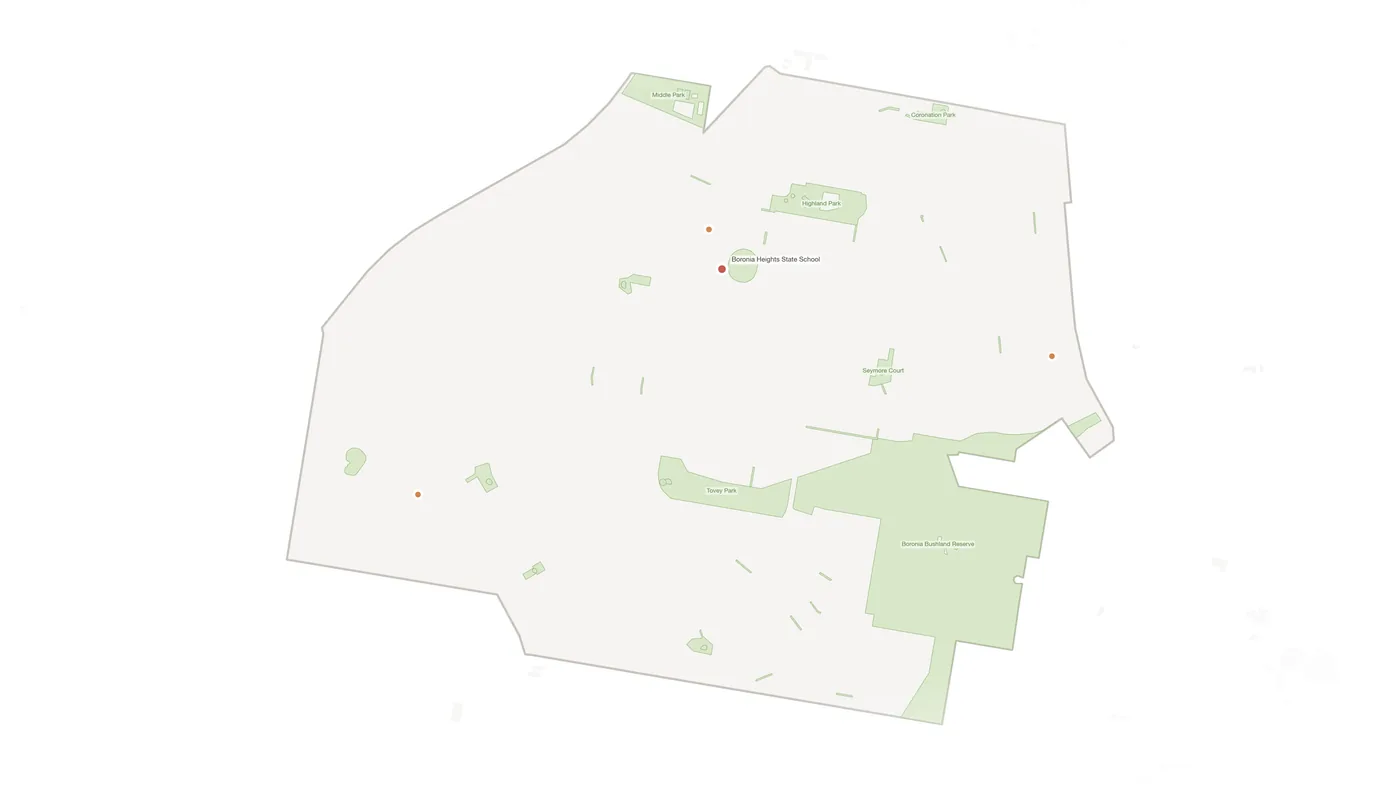
Population
8,175
Median Age
34.0
Household IncomeiMedian weekly household income (ABS Census)
$1,453/wk
DAs (12 months)iDevelopment Applications lodged in the past year
107
Median House
$431K
Estimated from rent (2025)
The estimated $431,000 median house price is among the lowest in Brisbane's south, well below the metro median. Separate houses at 87.5% dominate, with 3-bedroom properties at 54.0% and 4-plus at 38.3% providing ample family-sized stock. Mortgage repayments of $1,500/month push mortgage-to-income to only 23.8%, comfortably below stress levels. The suburb is firmly mortgage-belt territory, with 40.6% on a mortgage and 41.5% renting. Turnover at 21.8% reflects the high-growth character. With 98 DAs in 12 months, including new dwellings and commercial applications, buyers should expect ongoing construction activity.
For Buyers
The estimated $431,000 median house price is among the lowest in Brisbane's south, well below the metro median. Separate houses at 87.5% dominate, with 3-bedroom properties at 54.0% and 4-plus at 38.3% providing ample family-sized stock. Mortgage repayments of $1,500/month push mortgage-to-income to only 23.8%, comfortably below stress levels. The suburb is firmly mortgage-belt territory, with 40.6% on a mortgage and 41.5% renting. Turnover at 21.8% reflects the high-growth character. With 98 DAs in 12 months, including new dwellings and commercial applications, buyers should expect ongoing construction activity.
For Investors
The 41.5% renter share is high, providing robust tenant demand. Weekly rent of $350 against a $431,000 estimated median produces roughly 4.2% gross yield, above Brisbane averages. Vacancy at 6.1% is moderate. The explosive population growth (3.53%/yr, +957 persons) is the standout investment case: 98 DAs in 12 months confirm supply is trying to catch up with demand. Internal migration adds 1,427 people per year, the primary driver. The medium forecast projects 30,376 residents by 2031, up from 25,593 in 2026. The new development gentrification signal suggests the suburb is still in its build-out phase.
Development Activity
Total DAs
172
Last 12 Months
107
YoY ChangeiYear-over-year change in DA lodgements
+664.3%
Avg DA CostiAverage estimated cost per DA in the past year
N/A
Monthly DA Lodgements
DA Categories
Schools in Boronia Heights iICSEA: school advantage index. 1000 = national avg, higher = more advantaged
Boronia Heights State School
Prep-6 · 565 students
Demographics
The median age of 34 sits 6 years below the national figure, reflecting the young families drawn by affordable housing. English ancestry leads (2,841), followed by Scottish (633) and Irish (571). Overseas-born residents at 28.5% are 6.9pp above the national average. Punjabi (157 speakers) is the top non-English language, followed by Samoan (54) and Hindi (45). University attainment at 18.4% is 11.7pp below the national average, consistent with the blue-collar workforce. The household size of 2.8 exceeds the national 2.5, confirming the family-dominated composition.
Age Distribution
Bedrooms
Dwelling Structure
87.5%
Houses
12.3%
Townhouse
0.1%
Apartment
Tenure
The estimated median of $431,000 makes Boronia Heights one of the most affordable suburbs in Greater Brisbane. Detached houses at 87.5% dominate, with apartments at just 0.1%. Four-plus bedroom homes at 38.3% are the second-largest stock category, reflecting newer builds catering to larger families. The tenure split is almost equal between mortgage (40.6%) and renting (41.5%), with only 17.9% owning outright, the lowest outright-ownership rate in comparable suburbs. Both housing stress measures stay below 30%: mortgage at 23.8% and rent at 24.1%.
Mortgage / mo
$1,500
Rent / wk
$350
HH Size
2.8
Personal Income / wk
$718
Vacancy Ratei% of dwellings unoccupied on Census night (ABS 2021)
6.1%
Unoccupied
178
Rent / IncomeiMedian rent as % of household income. Over 30% = housing stress
24.1%
Mortgage / IncomeiMedian mortgage as % of household income. Over 30% = housing stress
23.8%
Community Profile
Languages Spoken at Home
Ancestry
Household Composition
19.5%
Couples, no children
6,365
Total families
Economy & Employment
Healthcare dominates at 19.4% (391 workers), followed by construction (12.4%), transport (8.9%), manufacturing (8.5%), and retail (8.5%). The occupational mix skews blue-collar: machinery/drivers (540) is the top group, ahead of community/personal (460) and labourers (453). Professionals rank only 5th at 356. Unemployment at 9.1% is nearly double the national average, and 9.2% need daily assistance (703 people). SEIFA IRSAD decile 2 places the suburb in the most disadvantaged 20% nationally. Despite this, affordability has improved markedly, from 62.7% to 48.6% over the decade.
Unemployment
5.9%
Labour Force
13,716
Unemployed
809
Quarterly Trend
Source: SALM Dec-25
Socio-Economic Indexes (SEIFA)iABS index ranking suburbs from 1 (most disadvantaged) to 10 (most advantaged)
Full-time
65.6%
Part-time
25.3%
Participation
55.3%
Employed
3,176
Occupations
Top Industries
University
18.4%
Postgraduate
4.4%
Born Overseas
28.5%
Dwellings
2,722
Transport to Work
Car dependence is extreme at 89.8%, with public transport at just 2.3% and walking/cycling at 0.9%. Boronia Heights State School is the sole local school (Government primary, ICSEA 925, 565 students), scoring below the national median of 1000. No secondary school sits within the suburb boundary. SEIFA IEO decile 2 indicates limited educational opportunity compared nationally. Need for assistance at 9.2% is above average. The volunteering rate of 9.5% sits below the national figure. The 98 DAs in 12 months suggest infrastructure is still catching up with population growth.
Drive
89.8%
Public Transport
2.3%
Walk / Cycle
0.9%
Work from Home
N/A
Population Forecast
+3.53%/yr
(+957 people/yr)
High GrowthAnnual growth of 3.53% (957 persons/yr) is exceptional for an established suburb, far above the national average. Internal migration at +1,427 per year drives the expansion, with overseas migration adding +155/yr. The 63.5% population gain over the decade is one of the highest in Queensland. The medium forecast projects 30,376 residents by 2031, nearly doubling from 2011 levels. Age structure remains stable: the young share delta is +0.4pp and senior share +0.4pp, meaning the suburb is not aging despite rapid growth. Real income grew 18.0% over the decade, higher than comparable areas.
Historical + Forecast
Hamilton-Perry + Holt smoothing on ERP 2001-2025
Age Cohort Forecast
Primary Driver
Internal Migration
Net Overseas / yr
+155
Net Internal / yr
+1,427
Gentrification Signal
New development
National Ranking iPercentile rank among ~15,000 AU suburbs. 90% = higher than 90% of suburbs
How Boronia Heights compares to ~15,000 Australian suburbs
Frequently Asked Questions
Is Boronia Heights a good suburb to live in?
Boronia Heights sits in SEIFA IRSAD decile 2, the most disadvantaged 20% nationally. Housing is affordable at $431,000 estimated median with mortgage stress at just 23.8%. The sole school has an ICSEA of 925, below the national median. Car dependence is very high at 89.8%.
What is the median house price in Boronia Heights?
The estimated median house price is $431,000, derived from rental data. Monthly mortgage repayments average $1,500, and mortgage-to-income sits at 23.8%, well below the 30% stress threshold. This makes it one of Brisbane's most affordable suburbs.
What schools are in Boronia Heights?
Boronia Heights has 1 school: Boronia Heights State School (Government primary, ICSEA 925, 565 students). The ICSEA score sits below the national median of 1000. No secondary school exists within the suburb; students travel to neighbouring suburbs.
Is Boronia Heights safe?
Suburb-level crime data is not available for Boronia Heights. The SEIFA IRSD decile of 3 and 9.1% unemployment rate are both correlated with higher crime risk in Australian research. Need-for-assistance sits at 9.2%, above the national average.
Is Boronia Heights good for property investment?
Gross yield of roughly 4.2% ($350/week vs $431,000 median) outperforms many Brisbane suburbs. Population growth at 3.53% per year (+957 persons) and 98 DAs in 12 months signal surging demand. The 41.5% renter share provides a deep tenant pool. Vacancy sits at 6.1%.
How is Boronia Heights's population changing?
Population is booming at 3.53% annually, adding 957 people per year. Growth over the past decade was 63.5%, driven by internal migration (+1,427/yr). The medium forecast projects 30,376 residents by 2031, up from 25,593 in 2026. Age structure remains stable.
How to read these comparisons
Phrases like "above the national average" reference the unweighted median across Australian suburbs with more than 1,000 residents, not population-weighted national figures. Suburb-level medians are more useful for ranking suburbs against each other; ABS census headlines are population-weighted (so dominated by Sydney and Melbourne) and can read very differently.
Current baseline (refreshed 2026-05-10): median age 40, university-educated 30.1%, born overseas 21.6%, average household size 2.5 people.
Data sources: ABS 2021 Census (demographics, income, tenure), state Valuer-General (house prices), Department of Jobs SALM (unemployment), ACARA (school ICSEA), state Crime Statistics agencies (offences), council DA portals (development applications). Population forecasts use a Hamilton-Perry cohort model calibrated to ABS ERP.
Explore Boronia Heights on the Map
View parcels, zoning overlays, DA applications, schools and more.
Open Interactive Map