Caravonica
With a median age of 46, Caravonica sits 6 years above the national figure, making it one of the more age-skewed suburbs in Far North Queensland. That demographic weight explains much of the suburb's character: 95.1% of dwellings are detached houses, owner-occupiers dominate at 81.3% combined (outright plus mortgage), and community volunteering reaches 16%. Population is 2,183 across 4.64 square kilometres, giving a low density of 470 residents per km2. Household income sits at the 58th percentile nationally, above average but not affluent, and mortgage-to-income at 22.1% keeps most households well below financial stress thresholds.
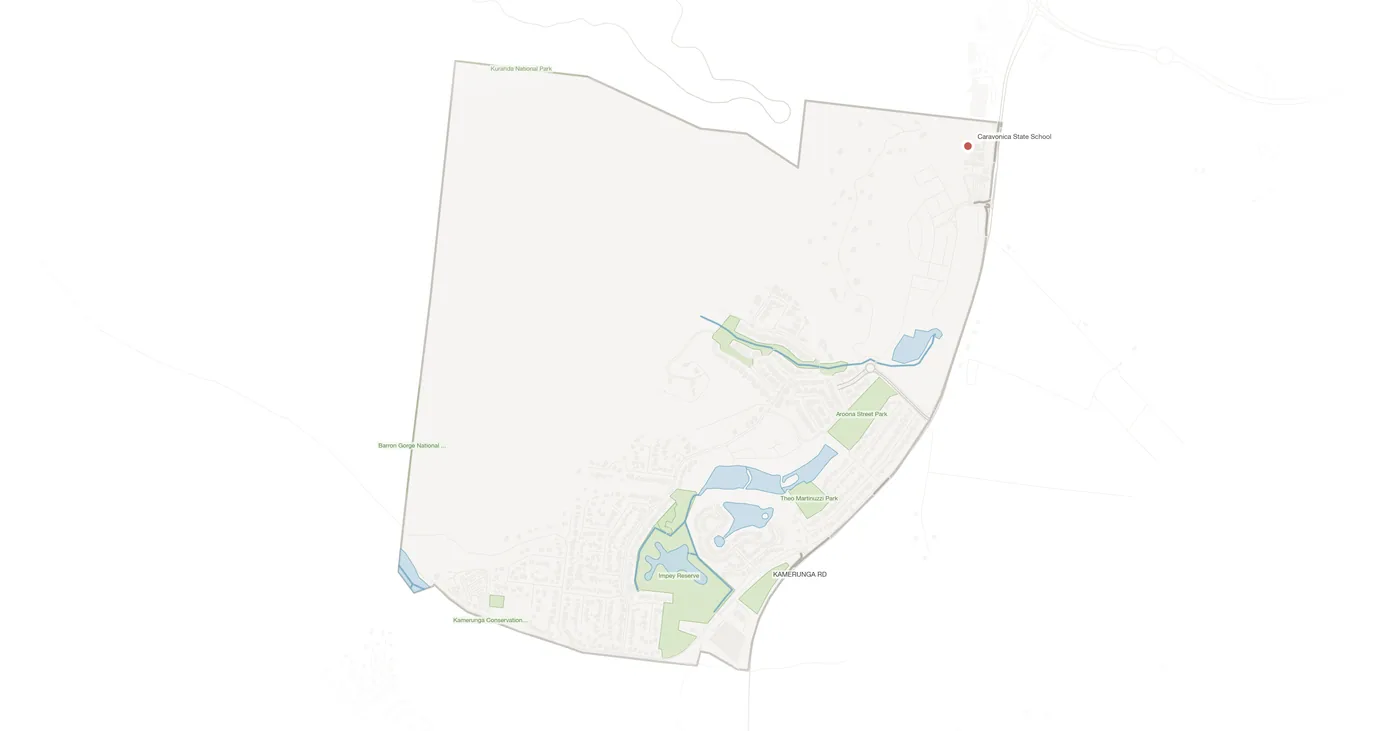
Population
2,183
Median Age
46.0
Household IncomeiMedian weekly household income (ABS Census)
$1,670/wk
DAs (12 months)iDevelopment Applications lodged in the past year
1
Median House
$450K
Estimated from rent (2025)
The estimated median house price is $450,000, derived from rental data for 2025, which makes Caravonica noticeably more affordable than many Cairns-region suburbs. Monthly mortgage repayments average $1,601, and mortgage-to-income at 22.1% is comfortably below the 30% stress threshold compared to many capital-city markets. The housing stock skews large: 38.1% of dwellings have 4 or more bedrooms and 44.2% have 3 bedrooms, so buyers get generous space. Detached houses represent 95.1% of all dwellings, meaning apartment or townhouse options are minimal. Outright ownership at 35.4% is high, suggesting long-term residents who bought years ago and have paid down debt, a stable backdrop for any new buyer entering the market.
For Buyers
The estimated median house price is $450,000, derived from rental data for 2025, which makes Caravonica noticeably more affordable than many Cairns-region suburbs. Monthly mortgage repayments average $1,601, and mortgage-to-income at 22.1% is comfortably below the 30% stress threshold compared to many capital-city markets. The housing stock skews large: 38.1% of dwellings have 4 or more bedrooms and 44.2% have 3 bedrooms, so buyers get generous space. Detached houses represent 95.1% of all dwellings, meaning apartment or townhouse options are minimal. Outright ownership at 35.4% is high, suggesting long-term residents who bought years ago and have paid down debt, a stable backdrop for any new buyer entering the market.
For Investors
The rental yield case is modest. Weekly rent of $360 against an estimated $450,000 median implies a gross yield near 4.2%, which is in line with broader regional QLD figures rather than above them. Only 18.7% of households rent, a low renter share compared to capital-city norms, so the tenant pool is limited. The vacancy rate is 5.3%, above the 3% threshold generally considered balanced, signalling that supply currently exceeds demand in the rental market. Development activity is minimal, with just 1 application in the past 12 months. The 73.6% of residents who stayed at the same address over the census period points to low churn, which supports rent stability but also means turnover-driven opportunity is infrequent.
Development Activity
Total DAs
1
Last 12 Months
1
YoY ChangeiYear-over-year change in DA lodgements
—
Avg DA CostiAverage estimated cost per DA in the past year
N/A
Monthly DA Lodgements
DA Categories
Schools in Caravonica iICSEA: school advantage index. 1000 = national avg, higher = more advantaged
Caravonica State School
Prep-6 · 540 students
Demographics
Caravonica's median age of 46 is 6 years above the national average, one of the clearest signals of an aging resident base in the region. The overseas-born share of 23.8% is 2.2 percentage points above the national figure, slightly more internationally diverse than the country-wide norm. Ancestry is predominantly Anglo-Celtic: English (880), Scottish (239), Irish (228) and German (170) are the top groups. University qualifications reach 25.9%, which is 4.2 percentage points below the national rate, reflecting a workforce oriented more toward trades and services than knowledge professions. Average household size is 2.4, marginally below the national figure, consistent with a population where couples without children (31.2% of families) and empty-nesters are well represented.
Age Distribution
Bedrooms
Dwelling Structure
95.1%
Houses
2.9%
Townhouse
N/A
Apartment
Tenure
Caravonica is almost entirely a detached-house suburb, with 95.1% of dwellings in separate houses and semi-detached at just 2.9%. Bedrooms skew toward 3 and 4-plus configurations (44.2% and 38.1% respectively), making it a family-sized stock even though the median age suggests many residents have grown children who have left home. Tenure splits into 35.4% outright ownership, 45.9% mortgage and 18.7% renting, with owner-occupiers totalling 81.3%, well above national norms. Rent at $360 per week and mortgage repayments at $1,601 per month are both affordable relative to household income. The vacancy rate of 5.3% is elevated above a healthy market balance, suggesting the rental segment has more supply than tenants at present.
Mortgage / mo
$1,601
Rent / wk
$360
HH Size
2.4
Personal Income / wk
$807
Vacancy Ratei% of dwellings unoccupied on Census night (ABS 2021)
5.3%
Unoccupied
45
Rent / IncomeiMedian rent as % of household income. Over 30% = housing stress
21.6%
Mortgage / IncomeiMedian mortgage as % of household income. Over 30% = housing stress
22.1%
Community Profile
Ancestry
Household Composition
31.2%
Couples, no children
1,594
Total families
Economy & Employment
Healthcare is by far the largest employing industry at 22.0% of workers (158 people), followed by Construction at 12.7% (91) and Education at 12.5% (90). Public Administration at 10.4% (75) and Transport at 7.8% (56) round out the top five. By occupation, Professionals lead with 222 workers, followed by Community and Personal Service at 151, and Managers at 128. The unemployment rate is 4.7%, higher than typical for a low-density owner-occupier suburb, and the participation rate is 56.5%, which is below average because 628 residents are not in the labour force, consistent with the older age profile. Weekly household income of $1,670 sits at the 58th percentile nationally, above average but not markedly so.
Socio-Economic Indexes (SEIFA)iABS index ranking suburbs from 1 (most disadvantaged) to 10 (most advantaged)
Full-time
62.6%
Part-time
32.7%
Participation
56.5%
Employed
974
Occupations
Top Industries
University
25.9%
Postgraduate
5.6%
Born Overseas
23.8%
Dwellings
782
Transport to Work
Car dependence is high in Caravonica: 91.0% of commuters drive, and only 1.5% use public transport, well below state and national averages. This is typical for a low-density Far North Queensland suburb without rail access. Walkable or cycleable trips account for 2.8%. No schools are recorded within the suburb boundary, so families rely on schools in surrounding Cairns suburbs. Rent-to-income at 21.6% and mortgage-to-income at 22.1% are both below 25%, keeping housing costs manageable compared to major-city benchmarks. The volunteering rate of 16.0% is solid, and 9.0% of residents (185 people) need daily assistance, a rate that may rise as the 46-year median age cohort moves into older age brackets over the coming decade.
Drive
91.0%
Public Transport
1.5%
Walk / Cycle
2.8%
Work from Home
N/A
National Ranking iPercentile rank among ~15,000 AU suburbs. 90% = higher than 90% of suburbs
How Caravonica compares to ~15,000 Australian suburbs
Frequently Asked Questions
Is Caravonica a good suburb to live in?
Caravonica suits owner-occupier families and retirees who prefer detached houses, low density and affordability. With 95.1% separate houses, a median age of 46 (6 years above national) and mortgage-to-income at 22.1%, it offers genuine housing comfort below the stress threshold. The main trade-offs are high car dependence (91% drive to work) and no schools recorded within the suburb boundary.
What is the median house price in Caravonica?
The estimated median house price is $450,000 based on 2025 rental data. Weekly rent averages $360, and monthly mortgage repayments run about $1,601. Mortgage-to-income sits at 22.1%, well below the 30% stress threshold, making Caravonica more affordable than many comparable Cairns-region suburbs.
What schools are in Caravonica?
No schools are recorded inside the Caravonica boundary in this dataset. Families rely on schools in neighbouring suburbs such as Smithfield and Cairns North. The suburb's university qualification rate of 25.9% is 4.2 percentage points below the national figure, reflecting a workforce oriented more toward trades and services than tertiary pathways.
Is Caravonica safe?
Detailed crime statistics are not available for Caravonica in this dataset. As indirect indicators, mortgage-to-income stress is low at 22.1%, owner-occupiers make up 81.3% of households, and 73.6% of residents remained at the same address over the census period. Community stability of this kind is generally associated with lower crime exposure compared to high-turnover rental-dominated suburbs.
Is Caravonica good for property investment?
Weekly rent of $360 against a $450,000 median implies a gross yield near 4.2%, in line with regional QLD averages rather than above them. The 5.3% vacancy rate signals current oversupply in the rental market, and only 18.7% of households rent, limiting the tenant pool. With just 1 development application in the past 12 months, new supply is not a concern, but capital growth depends on broader Far North Queensland demand.
How is Caravonica's population changing?
A detailed population growth trend is not available in this dataset, but signals point to a stable, aging phase. The median age of 46 is 6 years above the national figure, 73.6% of residents stayed at the same address over the census period, and the sole development application in the past 12 months was for a Tourist Attraction, not new dwellings. The 2,183-person population is unlikely to grow rapidly without new residential development.
How to read these comparisons
Phrases like "above the national average" reference the unweighted median across Australian suburbs with more than 1,000 residents, not population-weighted national figures. Suburb-level medians are more useful for ranking suburbs against each other; ABS census headlines are population-weighted (so dominated by Sydney and Melbourne) and can read very differently.
Current baseline (refreshed 2026-05-10): median age 40, university-educated 30.1%, born overseas 21.6%, average household size 2.5 people.
Data sources: ABS 2021 Census (demographics, income, tenure), state Valuer-General (house prices), Department of Jobs SALM (unemployment), ACARA (school ICSEA), state Crime Statistics agencies (offences), council DA portals (development applications). Population forecasts use a Hamilton-Perry cohort model calibrated to ABS ERP.
Explore Caravonica on the Map
View parcels, zoning overlays, DA applications, schools and more.
Open Interactive Map