Churchill
At $361,000, Churchill's median house price sits well below the national median, making it one of the more affordable entry points in Queensland's Ipswich corridor. The suburb has 1,842 residents with a median age of 34, six years younger than the national figure, yet it scores IRSAD decile 3, placing it among the more disadvantaged communities in Australia. Household income lands in the 23.3rd percentile nationally, and unemployment runs at 10.7%, more than double the typical rate for metro suburbs. These two facts are connected: the affordable housing stock draws lower-income households, while limited local employment options push many to look further afield. Over 88% of residents drive to work, reflecting that most jobs are elsewhere.
Population
1,842
Median Age
34.0
Household IncomeiMedian weekly household income (ABS Census)
$1,174/wk
DAs (12 months)iDevelopment Applications lodged in the past year
0
Median House
$361K
Estimated from rent (2025)
A median house price of $361,000 makes Churchill substantially cheaper than state and national benchmarks, and monthly mortgage repayments average $1,213, which at 23.9% of household income stays below the 30% stress threshold. The stock is predominantly detached houses at 84.8%, with semi-detached making up the remaining 15.2% and no apartment stock recorded. Three-bedroom homes dominate at 62.6% of dwellings, followed by four-plus bedroom at 21.7%, so families looking for space have strong options. The rent-to-income ratio of 25.6% also remains comfortable, suggesting housing costs are manageable for residents across tenure types. The main trade-off compared to pricier suburbs is lower SEIFA advantage: the IEO decile of 2 means buyers are entering a lower-opportunity area by national standards.
For Buyers
A median house price of $361,000 makes Churchill substantially cheaper than state and national benchmarks, and monthly mortgage repayments average $1,213, which at 23.9% of household income stays below the 30% stress threshold. The stock is predominantly detached houses at 84.8%, with semi-detached making up the remaining 15.2% and no apartment stock recorded. Three-bedroom homes dominate at 62.6% of dwellings, followed by four-plus bedroom at 21.7%, so families looking for space have strong options. The rent-to-income ratio of 25.6% also remains comfortable, suggesting housing costs are manageable for residents across tenure types. The main trade-off compared to pricier suburbs is lower SEIFA advantage: the IEO decile of 2 means buyers are entering a lower-opportunity area by national standards.
For Investors
Churchill presents a classic yield-over-growth profile. Weekly rent of $300 against a $361,000 median implies a gross yield around 4.3%, higher than most inner-city Queensland markets. However, a vacancy rate of 8.0% is elevated, indicating periodic difficulty filling properties and downward pressure on achievable rents. The renter share of 39.6% is above average, confirming demand from tenants, but the income base is thin with household incomes in the 23.3rd percentile nationally. Rent grew 43.8% over the measured period, outpacing income growth of 15.8%, which has compressed affordability for tenants and may limit further rent increases. Net overseas migration averages 46 persons a year, the primary external demand driver, while internal migration is roughly balanced.
Schools in Churchill iICSEA: school advantage index. 1000 = national avg, higher = more advantaged
Churchill State School
Prep-6 · 285 students
Demographics
Churchill skews young, with a median age of 34 that is 6 years below the national figure. Despite this, the trajectory is aging: the senior share rose 7.9 percentage points over the decade while the working-age share fell 1.9 points, a shift that often precedes declining household formation rates. Overseas-born residents make up 12.5% of the population, which is 9.1 points below the national average, reflecting a largely locally-born community. Ancestry is Anglo-Celtic: English (730 residents), German (205), Scottish (196) and Irish (195) are the top four groups. University qualifications reach just 12.6%, compared to the national average that is 17.5 points higher, pointing to a workforce concentrated in trade and service roles rather than professional careers. Average household size of 2.5 matches the national figure.
Age Distribution
Bedrooms
Dwelling Structure
84.8%
Houses
15.2%
Townhouse
N/A
Apartment
Tenure
The housing stock is overwhelmingly detached, with 84.8% separate houses and 15.2% semi-detached dwellings, and no apartments. Three-bedroom homes account for 62.6% of all dwellings, making Churchill a suburb built around family occupancy. Tenure splits see 26.3% owning outright, 34.1% on a mortgage and 39.6% renting, with renters as the largest single tenure group. The estimated median house price of $361,000 is derived from rent yield data for 2025 rather than direct sales volumes, so should be treated as an approximation. Monthly mortgage costs of $1,213 represent 23.9% of median household income, below the 30% stress threshold, which is better than many comparable Queensland suburbs. The rent-to-income ratio of 25.6% similarly stays within comfortable bounds.
Mortgage / mo
$1,213
Rent / wk
$300
HH Size
2.5
Personal Income / wk
$615
Vacancy Ratei% of dwellings unoccupied on Census night (ABS 2021)
8.0%
Unoccupied
57
Rent / IncomeiMedian rent as % of household income. Over 30% = housing stress
25.6%
Mortgage / IncomeiMedian mortgage as % of household income. Over 30% = housing stress
23.9%
Community Profile
Ancestry
Household Composition
20.6%
Couples, no children
1,370
Total families
Economy & Employment
Healthcare leads employment at 22.9% of local workers (98 people), consistent with the national pattern in outer suburban areas that serve aging populations. Retail (11.2%), Education (10.3%) and Public Administration (9.6%) follow, with Construction at 8.6% reflecting ongoing residential activity in the Ipswich region. By occupation, Community/Personal workers and Labourers each number 121, pointing to a service and trades-heavy workforce rather than a professional one. The unemployment rate of 10.7% is high, more than double the national benchmark. Participation at 50.5% is also low, with 557 residents not in the labour force. SEIFA scores put the suburb at IRSD decile 3 and IEO decile 2, both below average nationally, meaning economic resources and educational opportunity are well below the state median.
Unemployment
4.7%
Labour Force
6,187
Unemployed
288
Quarterly Trend
Source: SALM Dec-25
Socio-Economic Indexes (SEIFA)iABS index ranking suburbs from 1 (most disadvantaged) to 10 (most advantaged)
Full-time
63.4%
Part-time
25.9%
Participation
50.5%
Employed
666
Occupations
Top Industries
University
12.6%
Postgraduate
1.4%
Born Overseas
12.5%
Dwellings
660
Transport to Work
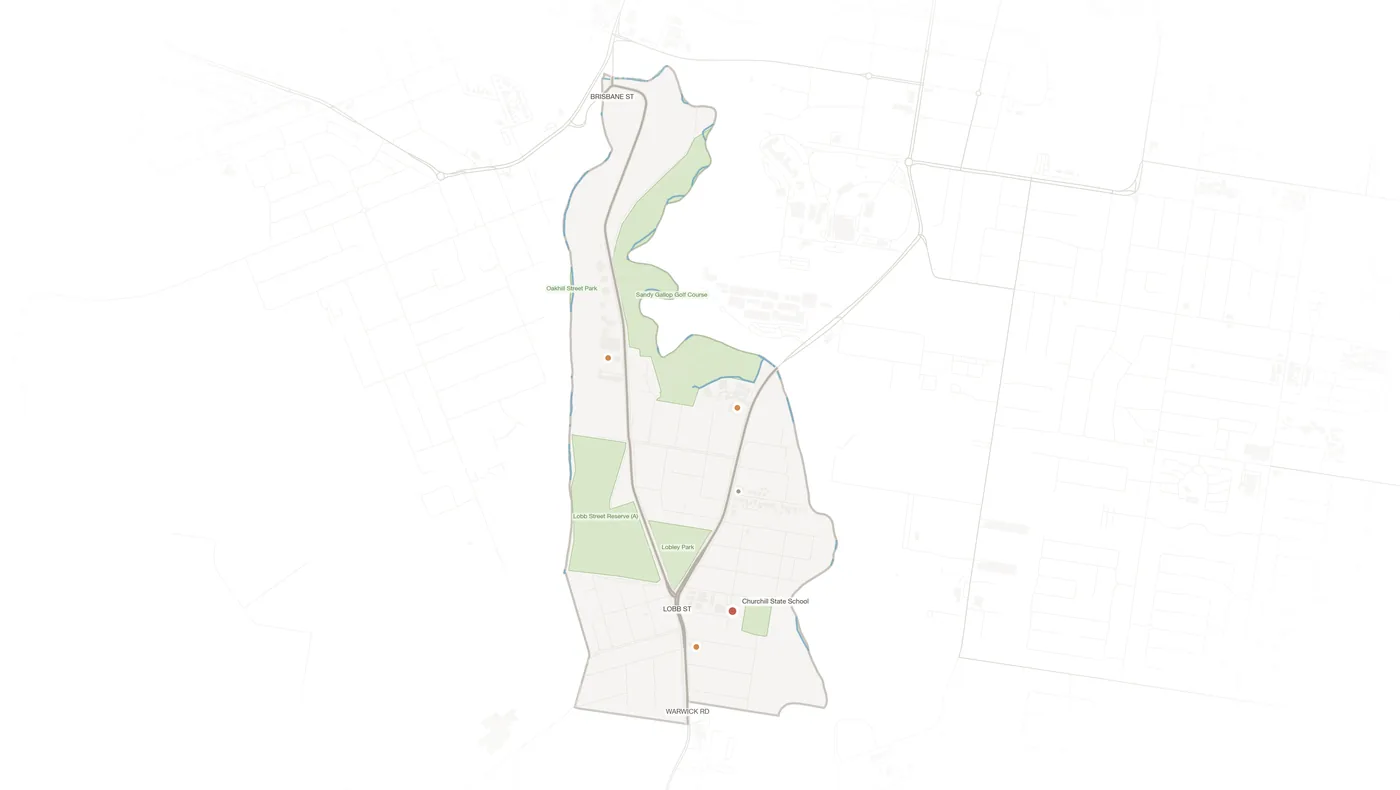
Car dependency is near-total: 88.5% of employed residents drive to work, compared to the national average, and only 2.2% use public transport, reflecting limited bus frequency in this part of Ipswich. Walking and cycling cover 0.9% of commutes. No schools are recorded within the Churchill boundary in this dataset, so families rely on institutions in neighbouring suburbs. Crime statistics are not available at the suburb level. The IRSAD decile of 3 places Churchill among the bottom third nationally for socioeconomic advantage and disadvantage, a measure that captures access to education, income and employment. On the positive side, housing stress indicators are reasonable: rent-to-income at 25.6% and mortgage-to-income at 23.9% both stay below the 30% stress threshold, meaning residents are not overstretched on shelter costs despite lower incomes.
Drive
88.5%
Public Transport
2.2%
Walk / Cycle
0.9%
Work from Home
N/A
Population Forecast
+0.42%/yr
(+52 people/yr)
EstablishedChurchill's population grew 4.6% over the past decade, a slow pace that reflects its established, limited-land character at 1.71 km2. Annual growth is forecast at 0.42%, adding roughly 52 people a year through to 2031, when the suburb is projected to reach around 12,472 residents across the broader SA2 area. The primary growth driver is overseas migration averaging 46 net arrivals annually, while internal migration is roughly balanced at plus 1 per year. The gentrification score sits at zero with no active signals, which aligns with the IRSAD decile 3 position and stable affordability trend: the mortgage-to-income ratio barely moved from 34.1% in 2011 to 34.4% in 2021. Real income growth of 15.8% over the decade has not been enough to shift the suburb's structural disadvantage profile.
Historical + Forecast
Hamilton-Perry + Holt smoothing on ERP 2001-2025
Age Cohort Forecast
Primary Driver
Balanced
Net Overseas / yr
+46
Net Internal / yr
+1
Gentrification Signal
Not gentrifying
National Ranking iPercentile rank among ~15,000 AU suburbs. 90% = higher than 90% of suburbs
How Churchill compares to ~15,000 Australian suburbs
Frequently Asked Questions
Is Churchill a good suburb to live in?
Churchill offers affordable housing with a $361,000 median house price and mortgage costs averaging $1,213 a month, below the stress threshold at 23.9% of household income. The trade-offs are a high unemployment rate of 10.7% and an IRSAD decile of 3, placing it among the bottom third nationally for socioeconomic advantage. Car ownership is essential since 88.5% of residents drive to work.
What is the median house price in Churchill?
The estimated median house price is $361,000, derived from rent yield data for 2025. Weekly rent averages $300. Monthly mortgage repayments run approximately $1,213, which sits at 23.9% of median household income, comfortably below the 30% mortgage stress threshold.
What schools are in Churchill?
No schools are recorded within the Churchill boundary in this dataset. Families rely on schools in neighbouring suburbs within the broader Ipswich area. Churchill's university qualification rate is 12.6%, which is 17.5 percentage points below the national average, reflecting the workforce profile of the suburb.
Is Churchill safe?
Crime statistics are not available at the Churchill suburb level in this dataset. As a broader indicator, the suburb scores IRSAD decile 3, placing it in the lower third nationally for socioeconomic advantage and disadvantage. About 10.2% of residents (177 people) require daily assistance, above the typical rate for younger suburbs with a median age of 34.
Is Churchill good for property investment?
Weekly rent of $300 against a $361,000 median implies a gross yield around 4.3%, higher than most inner-city Queensland markets. Rent grew 43.8% over the measured period. However, an 8.0% vacancy rate is elevated, and household incomes sit in the 23.3rd percentile nationally, which limits further rent growth. The investment case favours yield over capital growth given the 0.42% annual population growth forecast.
How is Churchill's population changing?
The suburb grew 4.6% over the past decade and is forecast to grow 0.42% annually, adding roughly 52 residents per year. Overseas migration averaging 46 net arrivals a year is the primary driver. The population trajectory is aging, with the senior share rising 7.9 percentage points over the decade, while the working-age share fell 1.9 points.
How to read these comparisons
Phrases like "above the national average" reference the unweighted median across Australian suburbs with more than 1,000 residents, not population-weighted national figures. Suburb-level medians are more useful for ranking suburbs against each other; ABS census headlines are population-weighted (so dominated by Sydney and Melbourne) and can read very differently.
Current baseline (refreshed 2026-05-10): median age 40, university-educated 30.1%, born overseas 21.6%, average household size 2.5 people.
Data sources: ABS 2021 Census (demographics, income, tenure), state Valuer-General (house prices), Department of Jobs SALM (unemployment), ACARA (school ICSEA), state Crime Statistics agencies (offences), council DA portals (development applications). Population forecasts use a Hamilton-Perry cohort model calibrated to ABS ERP.
Explore Churchill on the Map
View parcels, zoning overlays, DA applications, schools and more.
Open Interactive Map