Corryong
A median age of 52 is the most revealing number in Corryong: residents are 12 years older than the national median, which explains much else about this Upper Murray town. With just 1,352 people spread across 69 square kilometres, density sits at 19.5 per km2, far below state norms. Household income lands at the 12.6th percentile nationally, yet housing costs remain low enough that neither mortgage stress nor rent stress applies. Healthcare alone accounts for 28.5% of local employment, more than double agriculture at 13.0%, making this a service-town rather than a pure farming community. The 11.8% vacancy rate is high compared to metropolitan averages, pointing to thin demand and a slowly contracting resident base.
Population
1,352
Median Age
52.0
Household IncomeiMedian weekly household income (ABS Census)
$988/wk
DAs (12 months)iDevelopment Applications lodged in the past year
0
Median House
$352K
Apr-Jun 2024
The median house price of $351,500 recorded in April to June 2024 makes Corryong accessible relative to Victorian state medians, and 97.0% of the housing stock is separate houses. Monthly mortgage repayments average $888, with a mortgage-to-income ratio of 20.8%, well below the 30% stress threshold, so buyers who secure employment locally are not financially stretched. Price history shows volatility: the median fell from a peak of $380,000 in early 2024 to $351,500 by mid-year, a 7.5% correction. Over the full period since 2013, prices have risen 111.1% from $166,500, delivering a compound annual growth rate of 5.5% across 14 years. Three-bedroom homes dominate at 60.4% of the stock, with 4-plus bedroom properties comprising a further 23.4%, so family-sized homes are the norm rather than the exception.
For Buyers
The median house price of $351,500 recorded in April to June 2024 makes Corryong accessible relative to Victorian state medians, and 97.0% of the housing stock is separate houses. Monthly mortgage repayments average $888, with a mortgage-to-income ratio of 20.8%, well below the 30% stress threshold, so buyers who secure employment locally are not financially stretched. Price history shows volatility: the median fell from a peak of $380,000 in early 2024 to $351,500 by mid-year, a 7.5% correction. Over the full period since 2013, prices have risen 111.1% from $166,500, delivering a compound annual growth rate of 5.5% across 14 years. Three-bedroom homes dominate at 60.4% of the stock, with 4-plus bedroom properties comprising a further 23.4%, so family-sized homes are the norm rather than the exception.
For Investors
A 23.4% renter share and a median weekly rent of $200 produce yields that look attractive on paper against a $351,500 median, implying a gross yield near 3.0%, which is higher than most metropolitan markets. The problem is the 11.8% vacancy rate, well above the 3% threshold typically used to gauge market tightness, signalling that landlord competition for tenants is real. Development activity records zero applications in the past 12 months, confirming that no new supply is entering. The thin rental pool, aging population, and income base at the 12.6th national percentile mean demand drivers are limited. Investors are better positioned as long-term holders capturing the 5.5% CAGR since 2013 than as yield-focused landlords banking on rent growth.
Development Activity
Total DAs
3
Last 12 Months
0
YoY ChangeiYear-over-year change in DA lodgements
-100.0%
Avg DA CostiAverage estimated cost per DA in the past year
N/A
Monthly DA Lodgements
DA Categories
Schools in Corryong iICSEA: school advantage index. 1000 = national avg, higher = more advantaged
Sacred Heart School
Prep-6 · 56 students
Corryong College
Prep-12 · 257 students
Demographics
Corryong skews strongly toward older, Anglo-Celtic residents. The median age of 52 is 12.0 years above the national figure, and the workforce participation rate of 47.4% reflects how many residents are retired or semi-retired. University qualifications reach only 16.0%, which is 14.1 percentage points below the national average, lower than the regional Victorian norm. Overseas-born residents account for just 10.8%, compared to the national figure of around 21.6%, making the community less internationally diverse than Australian averages. Ancestry is predominantly English (560 people), followed by Scottish and Irish. The 31.1% volunteering rate stands out as notably high compared to the national average of around 19%, suggesting strong civic participation in a small community where residents carry a larger share of service delivery.
Age Distribution
Bedrooms
Dwelling Structure
97.0%
Houses
1.6%
Townhouse
1.4%
Apartment
Tenure
Outright ownership is the defining tenure characteristic: 49.1% of households own their home free of any mortgage, more than double the 27.4% carrying a mortgage. This pattern is consistent with the older median age of 52, where debt has typically been paid off. Just 23.4% of households rent, with a low weekly median rent of $200. The vacancy rate of 11.8% is elevated, indicating that available stock exceeds current demand. Prices rose 111.1% from $166,500 in 2013 to $351,500 in mid-2024, though a peak-to-latest correction of 7.5% from the $380,000 high in early 2024 suggests the market is normalising. The stock is almost exclusively detached houses at 97.0%, with apartments at just 1.4%, giving buyers limited choice of dwelling type but strong supply of family homes.
Median House Price Trend
Source: State Valuer-General
Mortgage / mo
$888
Rent / wk
$200
HH Size
2.1
Personal Income / wk
$589
Vacancy Ratei% of dwellings unoccupied on Census night (ABS 2021)
11.8%
Unoccupied
75
Rent / IncomeiMedian rent as % of household income. Over 30% = housing stress
20.2%
Mortgage / IncomeiMedian mortgage as % of household income. Over 30% = housing stress
20.8%
Community Profile
Ancestry
Household Composition
42.0%
Couples, no children
871
Total families
Economy & Employment
Healthcare is the backbone of Corryong's economy, employing 28.5% of the local workforce at 94 people, well above the national industry share. Agriculture comes second at 13.0% and Education third at 12.1%, with Utilities at 7.3% reflecting the area's role as a service node for the surrounding Upper Murray region. By occupation, Managers (101 people) and Professionals (89) lead, followed by Labourers (89), which is an unusual compression of white-collar and blue-collar roles that reflects a rural service centre where management skills are needed across small operations. Unemployment sits at 5.2% against a participation rate of 47.4%, lower than typical because so many residents are outside working age. Weekly personal income averages $589, placing household income at the 12.6th percentile nationally, below most Victorian regional centres.
Socio-Economic Indexes (SEIFA)iABS index ranking suburbs from 1 (most disadvantaged) to 10 (most advantaged)
Full-time
58.6%
Part-time
36.2%
Participation
47.4%
Employed
515
Occupations
Top Industries
University
16.0%
Postgraduate
2.8%
Born Overseas
10.8%
Dwellings
558
Transport to Work
Car dependence is very high: 75.4% of workers drive to work, above national averages, while only 0.9% use public transport, which is typical of remote Victorian towns with no rail or regular bus service. A notable 18.9% walk or cycle to work, high for a rural town, likely reflecting the compact township layout and short distances within Corryong's small built area. The crime rate of 76.9 offences per 1,000 residents totals 104 incidents, with property and deception offences accounting for 64 cases, the largest category. No schools are recorded within the suburb boundary in this dataset, so families rely on nearby educational facilities in the broader Upper Murray region. The volunteering rate of 31.1% is well above the national average, and at 9.1%, the share of residents needing daily assistance is moderate compared to other aging communities.
Drive
75.4%
Public Transport
0.9%
Walk / Cycle
18.9%
Work from Home
N/A
Safety & Crime
Total Offences
104
Year ending June 2024
Rate per 1,000 People
76.9
Offence Categories
Source: Crime Statistics Agency Victoria / SA Police
National Ranking iPercentile rank among ~15,000 AU suburbs. 90% = higher than 90% of suburbs
How Corryong compares to ~15,000 Australian suburbs
Frequently Asked Questions
Is Corryong a good suburb to live in?
Corryong suits those seeking affordable, low-stress ownership in a quiet Upper Murray setting. The median house price is $351,500, mortgage repayments average $888 per month, and the mortgage-to-income ratio of 20.8% is well below the 30% stress threshold. The median age of 52 reflects a predominantly older, established resident base, and 31.1% of residents volunteer, indicating active community involvement.
What is the median house price in Corryong?
The median house price in Corryong was $351,500 in the April to June 2024 quarter, down 7.5% from the peak of $380,000 in early 2024. Since 2013 prices have grown 111.1% from $166,500, representing a compound annual growth rate of 5.5% over 14 years. Weekly rent is $200 and monthly mortgage repayments average $888.
What schools are in Corryong?
No schools are recorded inside the Corryong suburb boundary in this dataset. Families in the area rely on educational facilities in the broader Upper Murray region. The suburb's university qualification rate is 16.0%, which is 14.1 percentage points below the national average, reflecting the regional and older demographic profile.
Is Corryong safe?
Corryong recorded 104 total offences, giving a crime rate of 76.9 per 1,000 residents. Property and deception offences were the largest category at 64 incidents, followed by crimes against the person at 15. With a population of only 1,352, even a small number of incidents produces a rate above typical suburban benchmarks.
Is Corryong good for property investment?
The $351,500 median and $200 weekly rent imply a gross yield near 3.0%, higher than most metropolitan markets. However, the 11.8% vacancy rate is elevated compared to the 3% tightness threshold, and zero development applications in 12 months reflects limited demand growth. The 5.5% CAGR since 2013 makes Corryong better suited to long-term capital growth than near-term yield strategies.
How is Corryong's population changing?
Corryong's population of 1,352 faces ongoing pressure from its aging base, with a median age of 52 that is 12 years above the national average. The workforce participation rate of 47.4% is low because a large share of residents are retired. Residential turnover is 21.3%, and 78.7% of residents have remained in the area, indicating stability within a slowly contracting demographic profile.
How to read these comparisons
Phrases like "above the national average" reference the unweighted median across Australian suburbs with more than 1,000 residents, not population-weighted national figures. Suburb-level medians are more useful for ranking suburbs against each other; ABS census headlines are population-weighted (so dominated by Sydney and Melbourne) and can read very differently.
Current baseline (refreshed 2026-05-10): median age 40, university-educated 30.1%, born overseas 21.6%, average household size 2.5 people.
Data sources: ABS 2021 Census (demographics, income, tenure), state Valuer-General (house prices), Department of Jobs SALM (unemployment), ACARA (school ICSEA), state Crime Statistics agencies (offences), council DA portals (development applications). Population forecasts use a Hamilton-Perry cohort model calibrated to ABS ERP.
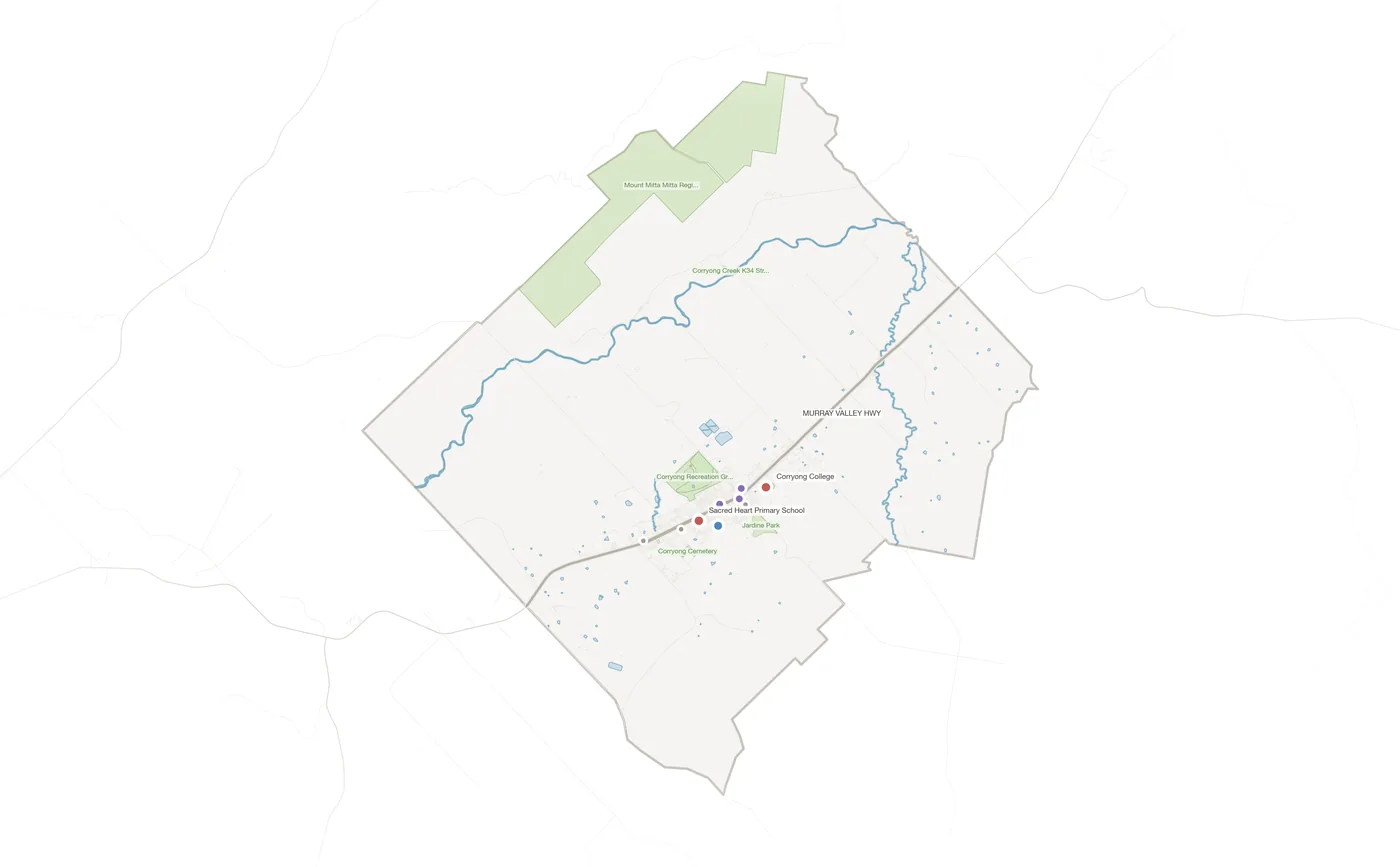
Explore Corryong on the Map
View parcels, zoning overlays, DA applications, schools and more.
Open Interactive Map