Eimeo
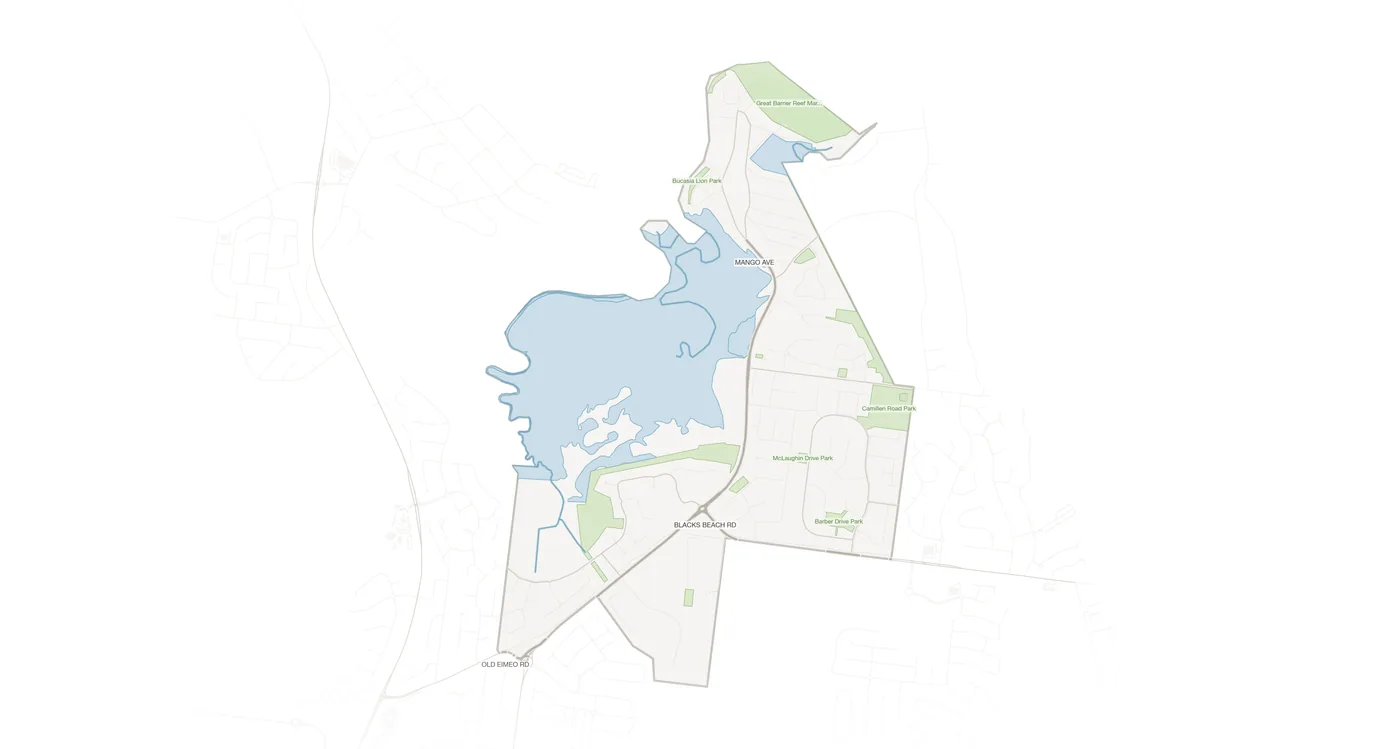
Household income in Eimeo sits at the 88.2nd percentile nationally, yet the median house price is estimated at $488,000, a combination that makes mortgage costs relatively accessible compared to most high-income suburbs. The suburb has 3,285 residents across 3.42 square kilometres and is almost entirely separate houses at 96.4%. Vacancy runs at 11.6%, above typical residential norms, reflecting the broader Mackay market dynamics. Population growth of 46% since 2011 puts Eimeo in early-signs gentrification territory, driven by balanced internal and overseas migration flows of around 60 and 69 persons annually.
Population
3,285
Median Age
36.0
Household IncomeiMedian weekly household income (ABS Census)
$2,304/wk
DAs (12 months)iDevelopment Applications lodged in the past year
6
Median House
$488K
Estimated from rent (2025)
At an estimated $488,000 median house price, Eimeo sits well below the national median for detached housing, which makes the mortgage-to-income ratio of 17.4% notably lower than the 30% stress threshold. Monthly mortgage repayments average $1,733. The stock is overwhelmingly separate houses at 96.4%, with semi-detached at just 3.6%. Bedroom composition skews large: 53.2% of dwellings have 4 or more bedrooms and 40.5% have 3 bedrooms, meaning buyers get substantial family-sized homes at this price point. With 49.1% of dwellings under mortgage and 24.1% owned outright, the suburb shows a mortgage-belt profile where most residents are still building equity rather than holding debt-free assets.
For Buyers
At an estimated $488,000 median house price, Eimeo sits well below the national median for detached housing, which makes the mortgage-to-income ratio of 17.4% notably lower than the 30% stress threshold. Monthly mortgage repayments average $1,733. The stock is overwhelmingly separate houses at 96.4%, with semi-detached at just 3.6%. Bedroom composition skews large: 53.2% of dwellings have 4 or more bedrooms and 40.5% have 3 bedrooms, meaning buyers get substantial family-sized homes at this price point. With 49.1% of dwellings under mortgage and 24.1% owned outright, the suburb shows a mortgage-belt profile where most residents are still building equity rather than holding debt-free assets.
For Investors
The 26.8% renter share and $390 weekly rent provide a landlord yield that compares favourably to most coastal QLD markets at the $488,000 price level, implying a gross yield near 4.2%. However, the 11.6% vacancy rate is a significant caution flag, sitting above the 3% threshold that most investors treat as balanced. Demand support is meaningful: net internal migration averages 60 per year and overseas migration adds 69, giving a balanced driver that is more durable than either source alone. Population grew 46% since 2011 and the medium forecast projects growth from 14,911 in 2025 to 17,324 by 2031 at the SA2 level. Development activity is modest at 5 applications in the past 12 months, with recent applications covering bulk earthworks, civil works and a hotel/multiple-dwelling material change of use.
Development Activity
Total DAs
6
Last 12 Months
6
YoY ChangeiYear-over-year change in DA lodgements
—
Avg DA CostiAverage estimated cost per DA in the past year
N/A
Monthly DA Lodgements
DA Categories
Demographics
The median age of 36 is 4 years below the national figure, giving Eimeo a younger profile than average nationally. Overseas-born residents at 14.9% run 6.7 points below the national figure, reflecting a predominantly locally-born population. English ancestry leads at 1,430 residents, followed by Scottish (385), Irish (352) and German (225), showing a strongly Anglo-Celtic heritage composition. University qualifications reach 21.9%, which is 8.2 points below the national average, a gap that aligns with the suburb's mining and trades employment mix. Average household size of 2.7 is 0.2 above the national figure, consistent with the family-oriented 4-bedroom housing stock. Couples with children make up the dominant household type at 1,238 families, compared to 665 couples without children.
Age Distribution
Bedrooms
Dwelling Structure
96.4%
Houses
3.6%
Townhouse
N/A
Apartment
Tenure
Tenure is split between mortgage holders at 49.1%, outright owners at 24.1% and renters at 26.8%, a profile typical of an outer-suburban growth area where owner-occupier demand dominates but renting remains a meaningful segment. The 96.4% separate house rate leaves almost no apartment or unit stock, so the market is effectively a single product type. Bedroom composition is skewed toward large homes: 53.2% have 4 or more bedrooms, which is well above national norms and reflects the family-focused demographic. Rent-to-income at 16.9% is comfortably below the 30% stress threshold, and mortgage-to-income at 17.4% is similarly low, because household income at the 88.2nd percentile nationally is high relative to estimated local property values. The high vacancy rate of 11.6% points to periods of soft demand linked to the cyclical Mackay mining economy.
Mortgage / mo
$1,733
Rent / wk
$390
HH Size
2.7
Personal Income / wk
$1,031
Vacancy Ratei% of dwellings unoccupied on Census night (ABS 2021)
11.6%
Unoccupied
145
Rent / IncomeiMedian rent as % of household income. Over 30% = housing stress
16.9%
Mortgage / IncomeiMedian mortgage as % of household income. Over 30% = housing stress
17.4%
Community Profile
Languages Spoken at Home
Ancestry
Household Composition
26.0%
Couples, no children
2,560
Total families
Economy & Employment
Healthcare leads local employment at 18.3% of workers (210 people), followed by Mining at 13.9% (159) and Education at 12.4% (142). The mining share is significant given that Mackay serves as the service hub for Bowen Basin coal operations, and mining incomes drive the high 88.2nd-percentile household income rank nationally. By occupation, Professionals lead at 319 workers, with Community/Personal Service (227) and Clerical/Admin (185) also prominent. The full-time employment rate is 70.0% and unemployment sits at 4.2%, above the 3.2% typical of advantaged suburbs. SEIFA scores show an anomaly: the IER (economic resources) decile is 8, above average nationally, while the IEO (education/occupation) decile is only 4, which reflects the mining-wage effect lifting incomes without lifting qualification levels. IRSD decile 7 and IRSAD decile 6 place the suburb in the mid-to-upper range for overall advantage.
Unemployment
1.8%
Labour Force
8,890
Unemployed
161
Quarterly Trend
Source: SALM Dec-25
Socio-Economic Indexes (SEIFA)iABS index ranking suburbs from 1 (most disadvantaged) to 10 (most advantaged)
Full-time
70.0%
Part-time
25.8%
Participation
66.2%
Employed
1,608
Occupations
Top Industries
University
21.9%
Postgraduate
3.5%
Born Overseas
14.9%
Dwellings
1,102
Transport to Work
Car dependence is extreme at 93.0% of residents commuting by car, with public transport at 1.7% and walking or cycling at just 0.6%, reflecting the suburban layout and limited transit in Mackay. No schools are recorded within the Eimeo boundary in this dataset, so families rely on schools in neighbouring suburbs. Rent-to-income at 16.9% and mortgage-to-income at 17.4% both fall well below the 30% stress threshold, which means cost-of-housing pressure is lower here than in most Australian suburbs ranked above the 85th income percentile. The IRSAD decile of 6 places the suburb in the middle tier nationally, and 3.4% of residents need daily assistance. Volunteering reaches 14.3% of residents, suggesting community engagement is reasonably active. The 11.6% vacancy rate warrants monitoring, but the low housing-cost ratios buffer residents from financial stress even during softer rental periods.
Drive
93.0%
Public Transport
1.7%
Walk / Cycle
0.6%
Work from Home
N/A
Population Forecast
+2.36%/yr
(+352 people/yr)
EstablishedPopulation grew 36.2% over the decade to 2021, and the SA2 area containing Eimeo recorded 14,911 residents in 2025, up from 14,487 in 2023. The medium forecast projects growth to 17,324 by 2031 at an annual rate of approximately 2.36%, or 352 persons per year. Migration is balanced: internal net migration averages 60 per year and overseas net migration 69 per year, so no single driver dominates. The gentrification stage reads as early signs, with a score of 23 and signals including 46% population growth since 2011 and net internal migration of 60 per year. However, the suburb also carries aging-trajectory signals: the working-age share fell 3.1 points and the senior share rose 4.1 points over the decade, while real income growth of negative 9.8% reflects post-mining-boom income compression. The forecast trajectory is established-growth rather than speculative.
Historical + Forecast
Hamilton-Perry + Holt smoothing on ERP 2001-2025
Age Cohort Forecast
Primary Driver
Balanced
Net Overseas / yr
+69
Net Internal / yr
+60
Gentrification Signal
Early signs
Population +46% since 2011, Net internal migration +60/yr
National Ranking iPercentile rank among ~15,000 AU suburbs. 90% = higher than 90% of suburbs
How Eimeo compares to ~15,000 Australian suburbs
Frequently Asked Questions
Is Eimeo a good suburb to live in?
Eimeo offers high household income at the 88.2nd percentile nationally with relatively affordable housing at an estimated $488,000 median, giving a mortgage-to-income ratio of just 17.4%. The suburb is almost entirely separate houses at 96.4%, suits families with large 4-plus bedroom stock at 53.2% of dwellings, and has low housing cost stress. The main trade-offs are high car dependence at 93% and an 11.6% vacancy rate reflecting Mackay's cyclical economy.
What is the median house price in Eimeo?
The median house price is estimated at $488,000 (2025 estimate derived from rental data). Weekly rent averages $390 and monthly mortgage repayments run approximately $1,733. With household income at the 88.2nd percentile nationally, the mortgage-to-income ratio of 17.4% is well below the 30% stress threshold.
What schools are in Eimeo?
No schools are recorded within the Eimeo boundary in this dataset. Families rely on schools in neighbouring Mackay suburbs. The suburb's university qualification rate of 21.9% is 8.2 points below the national average, consistent with a workforce concentrated in healthcare, mining and trades rather than graduate professions.
Is Eimeo safe?
Detailed suburb-level crime statistics are not available for Eimeo in this dataset. As an indirect measure, the IRSD decile of 7 places the suburb above the national median for relative advantage, and only 3.4% of the 3,285 residents require daily assistance. The income level at the 88.2nd percentile nationally is generally associated with lower deprivation-related crime risk.
Is Eimeo good for property investment?
The $390 weekly rent against a $488,000 median implies a gross yield near 4.2%, which is above average compared to most coastal QLD markets. However, the 11.6% vacancy rate is well above the 3% balanced market threshold, and real income growth was negative 9.8% over the decade, reflecting post-mining-boom compression. Population growth of 46% since 2011 and a medium forecast of 17,324 by 2031 support long-term demand.
How is Eimeo's population changing?
Eimeo's SA2 area grew 36.2% over the decade to 2021, with the population reaching 14,911 in 2025 and forecast to reach 17,324 by 2031 at 2.36% annual growth. Migration is balanced, with net internal migration of 60 per year and overseas migration of 69 per year. The suburb shows early gentrification signals but also an aging trajectory, with the working-age share down 3.1 points over the decade.
How to read these comparisons
Phrases like "above the national average" reference the unweighted median across Australian suburbs with more than 1,000 residents, not population-weighted national figures. Suburb-level medians are more useful for ranking suburbs against each other; ABS census headlines are population-weighted (so dominated by Sydney and Melbourne) and can read very differently.
Current baseline (refreshed 2026-05-10): median age 40, university-educated 30.1%, born overseas 21.6%, average household size 2.5 people.
Data sources: ABS 2021 Census (demographics, income, tenure), state Valuer-General (house prices), Department of Jobs SALM (unemployment), ACARA (school ICSEA), state Crime Statistics agencies (offences), council DA portals (development applications). Population forecasts use a Hamilton-Perry cohort model calibrated to ABS ERP.
Explore Eimeo on the Map
View parcels, zoning overlays, DA applications, schools and more.
Open Interactive Map