Gladstone Central
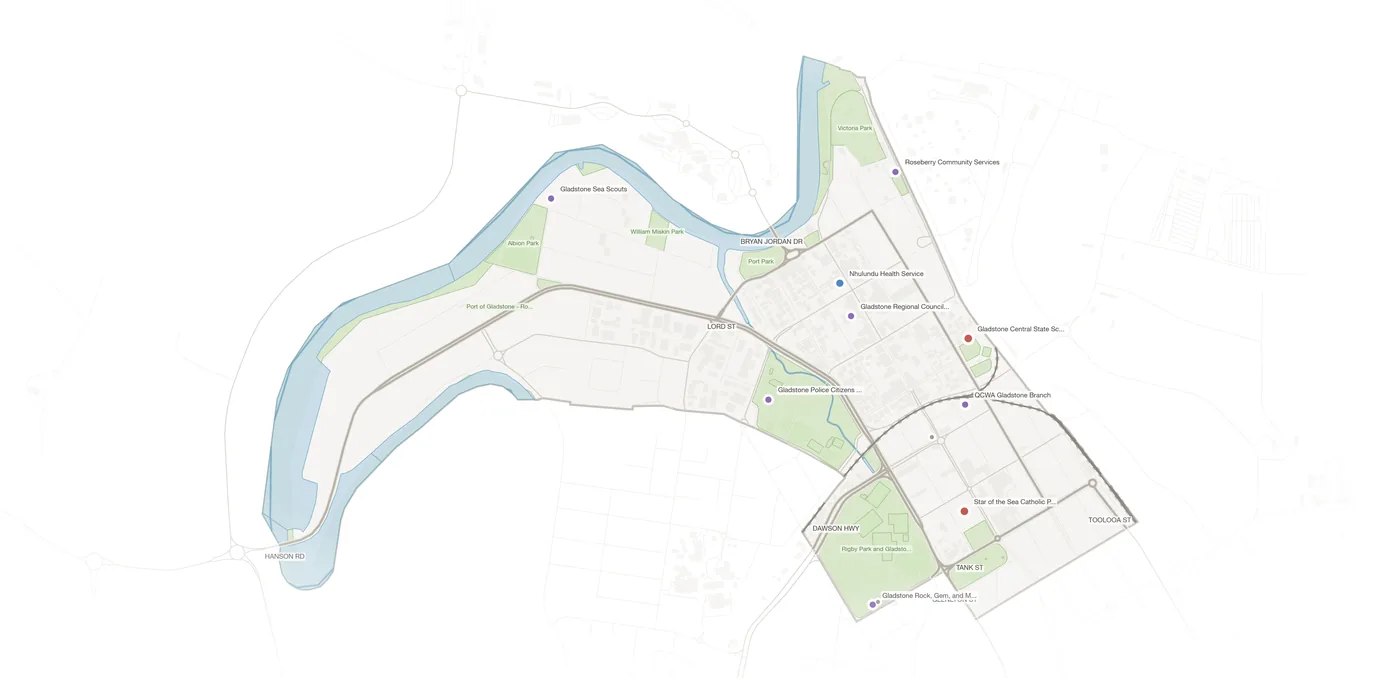
A 30.3% vacancy rate in a suburb where 69% of residents rent tells a story about structural oversupply that shapes everything from rents to property values. Gladstone Central is the urban core of a regional port city, compact at 3.08 km2 with a population of 1,550. The median house price of $311,000 sits well below the national median, and the area scores SEIFA decile 1 on three of four indexes, placing it among the most disadvantaged suburbs nationally. Unemployment runs at 10.9%, above state and national averages, and household income sits at the 33rd percentile nationally, reflecting the blue-collar and service-sector employment base that dominates the local economy.
Population
1,550
Median Age
39.0
Household IncomeiMedian weekly household income (ABS Census)
$1,324/wk
DAs (12 months)iDevelopment Applications lodged in the past year
0
Median House
$311K
Estimated from rent (2025)
At $311,000, the median house price in Gladstone Central is substantially lower than the national median, making entry accessible on paper. Monthly mortgage repayments average $1,165, and the mortgage-to-income ratio is 20.3%, below the 30% stress threshold. However, only 32.1% of dwellings are separate houses, while 58% are apartments, so buyers seeking a house must compete for limited stock. Two-bedroom dwellings dominate at 55.1%, with three-bedroom homes at 26.6% and four-plus bedroom properties at just 7.6%. The high renter share of 69% and very low owner-occupier rate of 16.5% outright ownership suggest the market is dominated by investment stock rather than owner-occupied homes, which can affect resale liquidity compared to more owner-occupied suburbs.
For Buyers
At $311,000, the median house price in Gladstone Central is substantially lower than the national median, making entry accessible on paper. Monthly mortgage repayments average $1,165, and the mortgage-to-income ratio is 20.3%, below the 30% stress threshold. However, only 32.1% of dwellings are separate houses, while 58% are apartments, so buyers seeking a house must compete for limited stock. Two-bedroom dwellings dominate at 55.1%, with three-bedroom homes at 26.6% and four-plus bedroom properties at just 7.6%. The high renter share of 69% and very low owner-occupier rate of 16.5% outright ownership suggest the market is dominated by investment stock rather than owner-occupied homes, which can affect resale liquidity compared to more owner-occupied suburbs.
For Investors
The 69% renter share is well above national norms and provides a large tenant pool, but the 30.3% vacancy rate signals significant oversupply in the apartment segment, which makes up 58% of dwellings. Weekly rent of $240 against a $311,000 median implies a gross yield around 4%, higher than most capital city markets. Net overseas migration averages 98 persons per year, the primary demand driver, while internal migration contributes a net 16 annually. Annual population growth is 0.56%, adding around 38 persons per year. Rent fell 17.9% over the measured period in real terms, a caution sign for income-focused investors. The 45.8% residential turnover rate indicates a transient tenant base, which can increase vacancy risk between leases.
Development Activity
Total DAs
109
Last 12 Months
0
YoY ChangeiYear-over-year change in DA lodgements
—
Avg DA CostiAverage estimated cost per DA in the past year
N/A
Monthly DA Lodgements
Schools in Gladstone Central iICSEA: school advantage index. 1000 = national avg, higher = more advantaged
Gladstone Central State School
Prep-6 · 356 students
Demographics
Gladstone Central's median age of 39 is 1 year below the national figure of around 40, and the trajectory is aging, with the senior share rising 3.2 points over the decade while the working-age share fell 0.9 points. Overseas-born residents account for 25.2%, which is 3.6 percentage points above the national average, with overseas migration being the primary population growth driver at 98 net arrivals per year. Ancestry is predominantly English (578 residents), followed by Irish (164) and Scottish (113), reflecting the historical settlement pattern of Queensland's industrial regions. Average household size is 1.8, which is 0.7 below the national average, consistent with the high apartment share and transient renter population. University qualifications reach 28.3%, which is 1.8 points below the national figure.
Age Distribution
Bedrooms
Dwelling Structure
32.1%
Houses
9.8%
Townhouse
58.0%
Apartment
Tenure
The tenure structure is unusual: 69% of residents rent, 16.5% own outright and 14.6% carry a mortgage. Renters outnumbering owners by such a margin is typical of inner urban cores in regional cities, where apartment blocks serve fly-in-fly-out workers and transient residents. Apartments account for 58% of dwellings, compared to 32.1% separate houses and 9.8% semi-detached, a composition more like a CBD fringe than a typical residential suburb. Rent-to-income is 18.1%, below the 30% stress threshold, so current rents are affordable relative to local incomes. Two-bedroom apartments dominate at 55.1% of the stock. The median house price of $311,000 is an estimate derived from rent data, as transaction volumes are insufficient for a direct median, and should be read as indicative rather than definitive.
Mortgage / mo
$1,165
Rent / wk
$240
HH Size
1.8
Personal Income / wk
$786
Vacancy Ratei% of dwellings unoccupied on Census night (ABS 2021)
30.3%
Unoccupied
308
Rent / IncomeiMedian rent as % of household income. Over 30% = housing stress
18.1%
Mortgage / IncomeiMedian mortgage as % of household income. Over 30% = housing stress
20.3%
Community Profile
Languages Spoken at Home
Ancestry
Household Composition
31.7%
Couples, no children
767
Total families
Economy & Employment
Healthcare is the largest employer at 17.2% of local workers (79 people), followed by Manufacturing at 12.0% (55), Hospitality at 11.1% (51), Transport at 9.8% (45) and Construction at 9.6% (44). The occupation mix has Professionals as the largest group (167 workers) ahead of Labourers (96), Managers (76) and Community and Personal Service workers (73). Unemployment stands at 10.9%, above the national average, and the participation rate is 56.4%, which is lower than national norms. Real incomes fell 20.3% over the decade, a significant contraction that reflects the post-resources-boom adjustment Gladstone experienced after the peak of LNG construction activity. Household income sits at the 33rd percentile nationally, and SEIFA IEO scores at decile 2, signalling below-average educational and occupational advantage.
Unemployment
10.2%
Labour Force
3,632
Unemployed
371
Quarterly Trend
Source: SALM Dec-25
Socio-Economic Indexes (SEIFA)iABS index ranking suburbs from 1 (most disadvantaged) to 10 (most advantaged)
Full-time
71.0%
Part-time
18.1%
Participation
56.4%
Employed
679
Occupations
Top Industries
University
28.3%
Postgraduate
5.9%
Born Overseas
25.2%
Dwellings
703
Transport to Work
Car dependency is high, with 76.2% of residents driving to work, though 16.7% walk or cycle, above average for a regional centre, because the compact 3.08 km2 footprint puts much of the CBD within walking distance. Public transport use is very low at 0.7%, below state and national norms. No schools are recorded within the Gladstone Central boundary, so families rely on institutions in surrounding suburbs. The suburb scores SEIFA IRSAD decile 1, the lowest advantage tier nationally, and IEO decile 2, indicating limited educational and economic opportunity relative to most Australian suburbs. Volunteering reaches 15.2% of residents, and 5.8% of the population needs daily assistance. Rent-to-income at 18.1% keeps housing costs manageable for tenants at current income levels.
Drive
76.2%
Public Transport
0.7%
Walk / Cycle
16.7%
Work from Home
N/A
Population Forecast
+0.56%/yr
(+38 people/yr)
EstablishedAnnual population growth is 0.56%, adding around 38 persons per year, but the 10-year change is -2.2%, reflecting the decline following the end of the resources construction cycle. The medium forecast holds the broader population near 6,840 through 2031, suggesting steady but modest growth. Overseas migration at 98 net arrivals per year is the dominant driver; internal migration contributes a further net 16. The suburb is not gentrifying, with a gentrification score of 15 and no sustained income or qualification uplift over the period. Affordability improved from 39.9% in 2011 to 33.4% in 2021, a positive trend, because incomes held firmer than prices during the post-boom contraction. Real income growth was -20.3%, below any national or state benchmark, which remains a structural headwind.
Historical + Forecast
Hamilton-Perry + Holt smoothing on ERP 2001-2025
Age Cohort Forecast
Primary Driver
Overseas Migration
Net Overseas / yr
+98
Net Internal / yr
+16
Gentrification Signal
Not gentrifying
Accelerating: -5% → 11%
National Ranking iPercentile rank among ~15,000 AU suburbs. 90% = higher than 90% of suburbs
How Gladstone Central compares to ~15,000 Australian suburbs
Frequently Asked Questions
Is Gladstone Central a good suburb to live in?
Gladstone Central suits people who value affordability and walkability in a compact regional centre. Rent-to-income is 18.1%, well below stress levels, and 16.7% of residents walk or cycle to work. The trade-offs are significant: the suburb scores SEIFA decile 1 on three indexes, unemployment sits at 10.9% and the 30.3% vacancy rate reflects a soft rental market.
What is the median house price in Gladstone Central?
The median house price is estimated at $311,000, derived from rent data for 2025. Monthly mortgage repayments average $1,165, and the mortgage-to-income ratio is 20.3%, below the 30% stress threshold. Weekly rent averages $240, giving a gross yield around 4% for investors.
What schools are in Gladstone Central?
No schools are recorded inside the Gladstone Central boundary in this dataset. Families rely on schools in surrounding Gladstone suburbs. University qualifications among residents reach 28.3%, which is 1.8 percentage points below the national average, consistent with a blue-collar and service-sector employment base.
Is Gladstone Central safe?
Detailed crime statistics are not available for Gladstone Central in this dataset. As an indirect indicator, the suburb scores SEIFA IRSD decile 1, the highest disadvantage tier nationally, which research consistently links to higher crime exposure compared to higher-decile suburbs. The 10.9% unemployment rate adds to that context.
Is Gladstone Central good for property investment?
The 69% renter share and estimated gross yield around 4% are positives, but the 30.3% vacancy rate is a significant risk, signalling oversupply in the 58% apartment-dominated stock. Rent fell 17.9% in real terms over the measured period. Net overseas migration of 98 per year provides underlying demand, but the suburb scores SEIFA decile 1 nationally, which limits the pool of higher-income tenants.
How is Gladstone Central's population changing?
Annual growth is 0.56%, adding around 38 persons per year, but the 10-year change is -2.2%, reflecting the post-LNG construction cycle decline. Overseas migration averaging 98 net arrivals per year is the primary growth driver. The profile is aging, with the senior share up 3.2 points over the decade, and medium forecasts hold the broader area at around 6,840 by 2031.
How to read these comparisons
Phrases like "above the national average" reference the unweighted median across Australian suburbs with more than 1,000 residents, not population-weighted national figures. Suburb-level medians are more useful for ranking suburbs against each other; ABS census headlines are population-weighted (so dominated by Sydney and Melbourne) and can read very differently.
Current baseline (refreshed 2026-05-10): median age 40, university-educated 30.1%, born overseas 21.6%, average household size 2.5 people.
Data sources: ABS 2021 Census (demographics, income, tenure), state Valuer-General (house prices), Department of Jobs SALM (unemployment), ACARA (school ICSEA), state Crime Statistics agencies (offences), council DA portals (development applications). Population forecasts use a Hamilton-Perry cohort model calibrated to ABS ERP.
Explore Gladstone Central on the Map
View parcels, zoning overlays, DA applications, schools and more.
Open Interactive Map