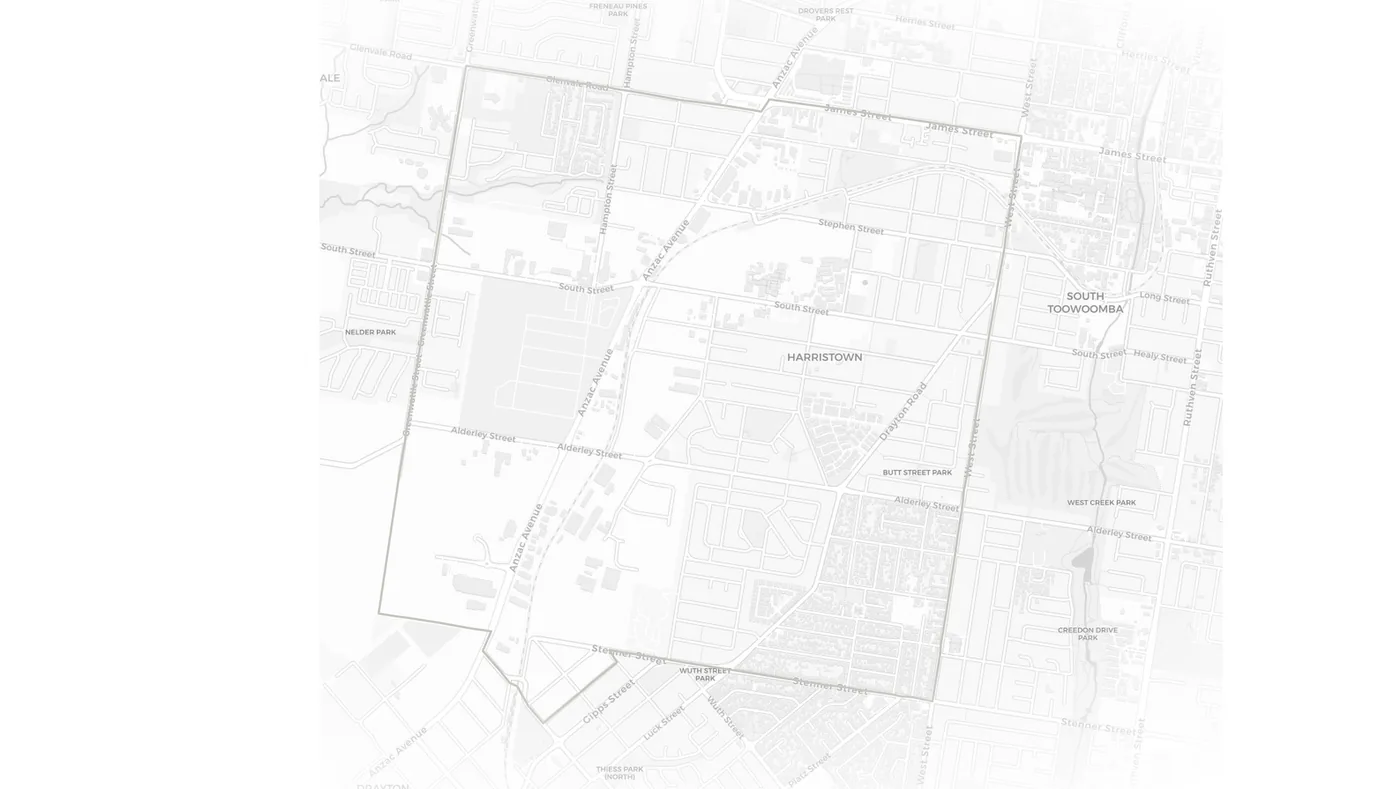
Harristown
All four SEIFA deciles at 1 or 2 place Harristown in the bottom quintile nationally for socio-economic conditions, yet the $367,000 estimated median and 28.1% outright ownership rate reveal a suburb where long-term residents have accumulated housing assets at historically low prices. Household income at the 22.3rd percentile ($1,158/week) is the lowest in this batch. Healthcare dominates employment at 26.1% (617 workers), more than double the next sector, likely driven by proximity to Toowoomba Hospital. The 10.5% needing assistance rate is the highest in this dataset, nearly triple the national average, reflecting an aging, lower-income population in this regional Queensland suburb.
Population
9,081
Median Age
38.0
Household IncomeiMedian weekly household income (ABS Census)
$1,158/wk
DAs (12 months)iDevelopment Applications lodged in the past year
16
Median House
$367K
Estimated from rent (2025)
At $367,000 estimated median, Harristown offers deep affordability by national standards, though mortgage-to-income at 25.9% is higher than many more expensive suburbs because of the low household income base ($1,158/week). The stock is 70.0% detached houses, with semi-detached at 24.3% and apartments at 5.3%, providing diverse options. Three-bedroom homes at 48.2% dominate, with 4+ bedrooms at just 21.8%, smaller than typical growth suburbs. Two-bedroom stock at 24.5% is above average. Two government schools serve the suburb: Harristown State High (ICSEA 929, 1,641 students) and Harristown State School (ICSEA 859, 446 students), both well below the national 1,000 ICSEA benchmark.
For Buyers
At $367,000 estimated median, Harristown offers deep affordability by national standards, though mortgage-to-income at 25.9% is higher than many more expensive suburbs because of the low household income base ($1,158/week). The stock is 70.0% detached houses, with semi-detached at 24.3% and apartments at 5.3%, providing diverse options. Three-bedroom homes at 48.2% dominate, with 4+ bedrooms at just 21.8%, smaller than typical growth suburbs. Two-bedroom stock at 24.5% is above average. Two government schools serve the suburb: Harristown State High (ICSEA 929, 1,641 students) and Harristown State School (ICSEA 859, 446 students), both well below the national 1,000 ICSEA benchmark.
For Investors
Renters at 43.1% provide a strong tenant pool, well above the national average. Weekly rent of $295 against a $367,000 estimated median produces gross yield around 4.2%, competitive for regional Queensland. However, the 8.6% vacancy rate is elevated, suggesting soft demand despite the high renter share. Only 15 DAs were lodged in 12 months, indicating limited new supply. Net overseas migration of 78 per year and internal migration of +12 provide minimal demand growth. Rent grew 32.3% over the decade, above average for a regional suburb, likely driven by the healthcare workforce. The 7.5% unemployment rate and low participation (49.9%) add tenant default risk that investors should weigh against the high yield.
Development Activity
Total DAs
99
Last 12 Months
16
YoY ChangeiYear-over-year change in DA lodgements
+6.7%
Avg DA CostiAverage estimated cost per DA in the past year
N/A
Monthly DA Lodgements
DA Categories
Schools in Harristown iICSEA: school advantage index. 1000 = national avg, higher = more advantaged
Harristown State High School
7-12 · 1641 students
Harristown State School
Prep-6 · 446 students
Demographics
The median age of 38 is 2 years below the national median. Overseas-born at 17.3% is 4.3 points below the national average, making this one of the most Australian-born suburbs in the batch. English ancestry dominates at 3,392, followed by Irish (1,064), German (912) and Scottish (870), forming a traditional Anglo-Celtic profile. Non-English language diversity is minimal: Arabic (48), Mandarin (21) and Gujarati (21) lead. University qualifications at 23.6% sit 6.5 points below national, consistent with IEO decile 2. Average household size of 2.2 is 0.3 below national. Christianity at 4,656 is the dominant religion. Couples without children (29.0%) are almost equal to couples with children (37.0%), reflecting a mixed demographic.
Age Distribution
Bedrooms
Dwelling Structure
70.0%
Houses
24.3%
Townhouse
5.3%
Apartment
Tenure
The tenure split is relatively balanced: renters at 43.1%, outright owners at 28.1%, and mortgage holders at 28.8%. This unusually high outright ownership rate compared to mortgage holders suggests long-term residents who have paid off their loans, consistent with the aging trajectory. The stock is 70.0% detached houses, 24.3% semi-detached and 5.3% apartments. Three-bedroom homes dominate at 48.2%, with two-bedrooms at 24.5% above average and 4+ bedrooms at just 21.8%. Studios/one-bedrooms at 5.6% are also above average. All four SEIFA deciles sit at 1 or 2, the lowest in this dataset. Mortgage-to-income at 25.9% and rent-to-income at 25.5% are both approaching but not exceeding the 30% stress threshold.
Mortgage / mo
$1,300
Rent / wk
$295
HH Size
2.2
Personal Income / wk
$637
Vacancy Ratei% of dwellings unoccupied on Census night (ABS 2021)
8.6%
Unoccupied
348
Rent / IncomeiMedian rent as % of household income. Over 30% = housing stress
25.5%
Mortgage / IncomeiMedian mortgage as % of household income. Over 30% = housing stress
25.9%
Community Profile
Languages Spoken at Home
Ancestry
Household Composition
29.0%
Couples, no children
6,359
Total families
Economy & Employment
Healthcare overwhelmingly leads at 26.1% (617 workers), more than double Education at 13.3% (315), reflecting Toowoomba Hospital's influence. Construction at 9.2%, Retail at 6.9% and Manufacturing at 6.8% complete the top five. Community/Personal workers (613) lead occupations, ahead of Professionals (565) and Labourers (505), giving the suburb a service-oriented workforce profile. Full-time employment at 63.1% is moderate, but participation at just 49.9% is notably low, and 3,049 residents are not in the labour force, the highest share in this dataset. Unemployment at 7.5% is above average. The IER decile 1 (lowest economic resources nationally) confirms limited household wealth, consistent with the high renter share and low ownership equity.
Unemployment
6.3%
Labour Force
5,458
Unemployed
345
Quarterly Trend
Source: SALM Dec-25
Socio-Economic Indexes (SEIFA)iABS index ranking suburbs from 1 (most disadvantaged) to 10 (most advantaged)
Full-time
63.1%
Part-time
29.4%
Participation
49.9%
Employed
3,415
Occupations
Top Industries
University
23.6%
Postgraduate
4.9%
Born Overseas
17.3%
Dwellings
3,714
Transport to Work
Car dependency at 87.1% dominates, with public transport at just 0.3% (effectively non-existent) and walking/cycling at 4.0%. Two government schools serve the suburb: Harristown State High School (ICSEA 929, 1,641 students) and Harristown State School (ICSEA 859, 446 students), both significantly below the national 1,000 ICSEA benchmark. The IRSAD decile 1 is the lowest in this dataset, confirming significant socio-economic disadvantage. The 10.5% needing assistance rate is nearly triple the national average. Volunteering at 14.3% is moderate. Rent-to-income at 25.5% is approaching stress levels. Despite the low SEIFA profile, the suburb offers affordable housing and regional lifestyle in the Toowoomba region.
Drive
87.1%
Public Transport
0.3%
Walk / Cycle
4.0%
Work from Home
N/A
Population Forecast
+0.76%/yr
(+88 people/yr)
EstablishedPopulation growth is slow at 0.76% per year (88 persons), with the 10-year change at 7.2%. The ERP reached 11,514 in 2025, and medium forecasts project 11,945 by 2031. Overseas migration at 78 per year is the primary driver, with internal migration marginally positive at +12. The trajectory is classified as 'Mixed': the senior share expanded by 1.2 points and the young share contracted by 1.1 points, consistent with gradual aging. Gentrification score is 26 (early signs noted in the data), though this likely reflects modest demographic shifts rather than significant transformation. Real income growth of 7.5% over the decade barely exceeded inflation. Affordability has been stable, with ratios at 45.4% in 2011 and 45.5% in 2021.
Historical + Forecast
Hamilton-Perry + Holt smoothing on ERP 2001-2025
Age Cohort Forecast
Primary Driver
Overseas Migration
Net Overseas / yr
+78
Net Internal / yr
+12
Gentrification Signal
Not gentrifying
Population +10% since 2011, Accelerating: -0% → 11%
National Ranking iPercentile rank among ~15,000 AU suburbs. 90% = higher than 90% of suburbs
How Harristown compares to ~15,000 Australian suburbs
Frequently Asked Questions
Is Harristown a good suburb to live in?
Harristown offers deep affordability at a $367,000 estimated median in regional Toowoomba. The IRSAD decile 1 is the lowest tier nationally, and schools score well below the ICSEA 1,000 benchmark (929 and 859). Public transport is effectively absent at 0.3%. The 28.1% outright ownership and 14.3% volunteering rate suggest a settled, community-oriented population despite the low socio-economic profile.
What is the median house price in Harristown?
The estimated median is $367,000 (derived from rent data, 2025). Weekly rent averages $295 and monthly mortgage repayments are $1,300. Gross rental yield sits around 4.2%, competitive for regional Queensland. The mortgage-to-income ratio of 25.9% is approaching but below the 30% stress threshold.
What schools are in Harristown?
Two government schools serve the suburb: Harristown State High School (ICSEA 929, 1,641 students) and Harristown State School (ICSEA 859, 446 students). Both score well below the national 1,000 ICSEA benchmark. The ICSEA readings are consistent with the suburb's IRSAD decile 1 socio-economic profile.
Is Harristown safe?
Crime data is not available for Harristown in the current dataset. The IRSD decile 2 and IRSAD decile 1 indicate significant socio-economic disadvantage, which typically correlates with above-average crime. The 7.5% unemployment rate and 10.5% needing assistance rate are both above national averages, suggesting elevated social vulnerability.
Is Harristown good for property investment?
Gross yield of approximately 4.2% ($295/week on $367,000) is attractive. The 43.1% renter share provides a strong tenant pool, but the 8.6% vacancy rate signals soft demand. Population growth of just 0.76% per year limits capital growth potential. Rent grew 32.3% over the decade, above average for regional QLD. The 7.5% unemployment rate adds tenant default risk.
How is Harristown's population changing?
Growth is slow at 0.76% per year (88 persons), with a 7.2% increase over 10 years. The ERP reached 11,514 in 2025. Overseas migration (+78/year) is the primary driver, with internal migration marginally positive (+12). The median age of 38 is 2 years below national. The senior share expanded by 1.2 points, indicating gradual aging.
How to read these comparisons
Phrases like "above the national average" reference the unweighted median across Australian suburbs with more than 1,000 residents, not population-weighted national figures. Suburb-level medians are more useful for ranking suburbs against each other; ABS census headlines are population-weighted (so dominated by Sydney and Melbourne) and can read very differently.
Current baseline (refreshed 2026-05-10): median age 40, university-educated 30.1%, born overseas 21.6%, average household size 2.5 people.
Data sources: ABS 2021 Census (demographics, income, tenure), state Valuer-General (house prices), Department of Jobs SALM (unemployment), ACARA (school ICSEA), state Crime Statistics agencies (offences), council DA portals (development applications). Population forecasts use a Hamilton-Perry cohort model calibrated to ABS ERP.
Explore Harristown on the Map
View parcels, zoning overlays, DA applications, schools and more.
Open Interactive Map