Hyde Park
A 13.1% vacancy rate in a suburb where 52.2% of residents rent tells the core story of Hyde Park: supply outpaces demand, keeping prices well below the Queensland median. The estimated median house price of $353,000 places this 1.18 km2 inner-Townsville suburb among the more affordable urban pockets in regional QLD, and household income sits at the 34th percentile nationally. SEIFA scores reinforce the picture, with IRSD and IRSAD at deciles 2 and 3, indicating above-average disadvantage compared to the rest of Australia. Healthcare and education anchor local employment at a combined 32% of the workforce.
Population
1,374
Median Age
37.0
Household IncomeiMedian weekly household income (ABS Census)
$1,338/wk
DAs (12 months)iDevelopment Applications lodged in the past year
2
Median House
$353K
Estimated from rent (2025)
At an estimated $353,000 median, Hyde Park is priced well below the national median for detached housing, making entry achievable for buyers with modest deposits. Monthly mortgage repayments average $1,444, and mortgage-to-income sits at 24.9%, below the 30% stress threshold, meaning repayments are manageable relative to local incomes. Separate houses make up 55.8% of the stock with semi-detached dwellings at 31.4% and apartments at 11.7%, offering variety across price points. Two-bedroom dwellings dominate at 43.1%, followed by three-bedroom at 28.4% and four-plus at 20.9%. The 52.2% renter majority means owner-occupiers are buying into a tenant-heavy environment, which may affect street-level upkeep compared to higher owner-occupier suburbs.
For Buyers
At an estimated $353,000 median, Hyde Park is priced well below the national median for detached housing, making entry achievable for buyers with modest deposits. Monthly mortgage repayments average $1,444, and mortgage-to-income sits at 24.9%, below the 30% stress threshold, meaning repayments are manageable relative to local incomes. Separate houses make up 55.8% of the stock with semi-detached dwellings at 31.4% and apartments at 11.7%, offering variety across price points. Two-bedroom dwellings dominate at 43.1%, followed by three-bedroom at 28.4% and four-plus at 20.9%. The 52.2% renter majority means owner-occupiers are buying into a tenant-heavy environment, which may affect street-level upkeep compared to higher owner-occupier suburbs.
For Investors
Hyde Park presents a high-yield, high-risk profile. Weekly rent of $253 against a $353,000 median implies a gross yield around 3.7%, which is higher than most capital-city benchmarks, but the 13.1% vacancy rate signals persistent oversupply. Over half of residents rent (52.2%), providing a large pool of prospective tenants, yet one in eight properties sits vacant, putting downward pressure on achievable rents. Only 2 development applications were lodged in the past 12 months, so new supply is not driving vacancy. Instead, the high-vacancy figure likely reflects population churn, given a 30.9% turnover rate, and the 34th-percentile household income base, which limits rent growth. Investors should model vacancy carefully rather than assuming full occupancy.
Development Activity
Total DAs
2
Last 12 Months
2
YoY ChangeiYear-over-year change in DA lodgements
—
Avg DA CostiAverage estimated cost per DA in the past year
N/A
Monthly DA Lodgements
DA Categories
Schools in Hyde Park iICSEA: school advantage index. 1000 = national avg, higher = more advantaged
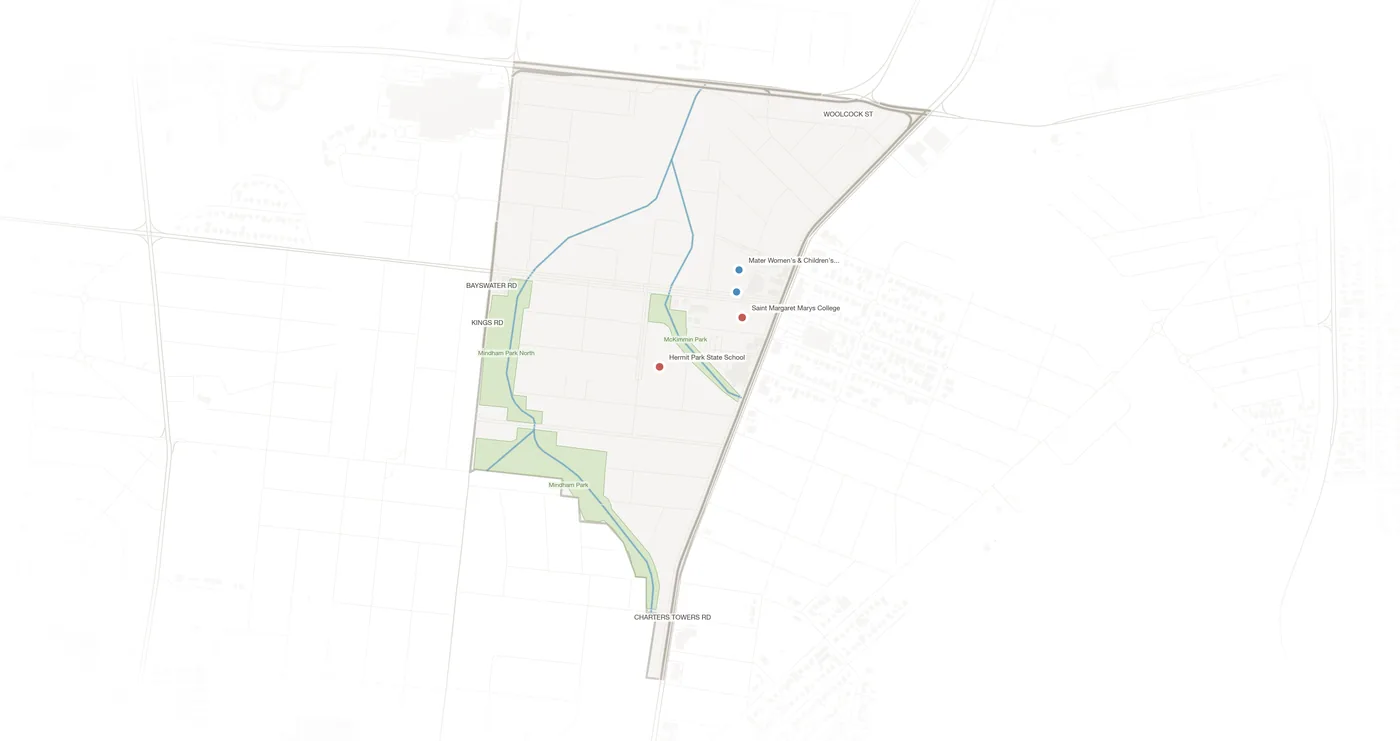
Hermit Park State School
Prep-6 · 630 students
St Margaret Mary's College
7-12 · 707 students
Demographics
The median age of 37 is 3 years below the national figure, indicating a somewhat younger resident base than average. University qualifications reach 32.1%, about 2 percentage points above the national average, meaning Hyde Park punches slightly above its income ranking for educational attainment. Overseas-born residents account for 16.5% of the population, 5.1 points below the national share, reflecting the anglo-leaning character of the suburb, with English (521), Scottish (182) and Irish (178) ancestry dominating. Average household size is 2.1, which is 0.4 below national, consistent with a higher proportion of single-person and couple-only households. Couples with no children make up 26.9% of families, compared to couples with children at 36.9% of the family total.
Age Distribution
Bedrooms
Dwelling Structure
55.8%
Houses
31.4%
Townhouse
11.7%
Apartment
Tenure
Tenure in Hyde Park is strongly skewed toward renting: 52.2% of dwellings are rented, 27.3% are mortgaged and only 20.5% are owned outright. This renter-majority split is unusual even for regional QLD and reflects a transient population rather than a settled owner base. The stock is predominantly separate houses (55.8%) and semi-detached (31.4%), with apartments at 11.7%. Two-bedroom homes account for 43.1% of dwellings, the largest segment, suited to small households given the 2.1 average household size. The median house price of $353,000 is an estimate derived from rent levels as of 2025, so buyers should verify with current sales data. Rent-to-income at 18.9% is comfortably below the 30% stress benchmark, keeping housing costs manageable for renters relative to local incomes.
Mortgage / mo
$1,444
Rent / wk
$253
HH Size
2.1
Personal Income / wk
$848
Vacancy Ratei% of dwellings unoccupied on Census night (ABS 2021)
13.1%
Unoccupied
91
Rent / IncomeiMedian rent as % of household income. Over 30% = housing stress
18.9%
Mortgage / IncomeiMedian mortgage as % of household income. Over 30% = housing stress
24.9%
Community Profile
Ancestry
Household Composition
26.9%
Couples, no children
913
Total families
Economy & Employment
Healthcare dominates Hyde Park's employment base at 20.7% of the workforce (95 workers), reflecting proximity to Townsville Hospital and related facilities. Education follows at 11.3% (52 workers), with Construction and Public Admin tied at 9.6% each (44 workers). Professional/Tech employs 7.4% (34 workers). By occupation, Professionals lead with 153 workers, ahead of Community/Personal (112) and Clerical/Admin (90). The unemployment rate of 5.5% is above the headline national figure, and the participation rate of 64.4% is moderate. The IRSAD decile of 3 and IRSD decile of 2 place Hyde Park in the lower tier of socioeconomic advantage nationally, which is partly explained by the high renter share and below-average household incomes at the 34th percentile.
Socio-Economic Indexes (SEIFA)iABS index ranking suburbs from 1 (most disadvantaged) to 10 (most advantaged)
Full-time
66.9%
Part-time
27.6%
Participation
64.4%
Employed
700
Occupations
Top Industries
University
32.1%
Postgraduate
5.0%
Born Overseas
16.5%
Dwellings
599
Transport to Work
Car dependency is high in Hyde Park, with 81.9% of residents driving to work, compared to 3.4% using public transport and 5.6% walking or cycling. This is typical for Townsville but sits above the national average reliance on cars. The IRSAD decile of 3 places the suburb in the lower advantage tier nationally, though rent-to-income at 18.9% means renters face less financial strain than in many urban markets. No schools are recorded within the suburb boundary, so families rely on nearby Townsville institutions. Crime statistics are not available for this suburb in the dataset. The volunteering rate of 14.9% suggests moderate community engagement, and 4.7% of residents (60 people) need daily assistance, a figure consistent with the below-average disadvantage profile indicated by the IRSD decile of 2.
Drive
81.9%
Public Transport
3.4%
Walk / Cycle
5.6%
Work from Home
N/A
National Ranking iPercentile rank among ~15,000 AU suburbs. 90% = higher than 90% of suburbs
How Hyde Park compares to ~15,000 Australian suburbs
Frequently Asked Questions
Is Hyde Park a good suburb to live in?
Hyde Park suits renters and lower-income households well: rent-to-income sits at 18.9%, well below the 30% stress threshold, and the median house price of $353,000 is among the more affordable in the region. Trade-offs include a 13.1% vacancy rate suggesting limited amenity investment and IRSAD and IRSD SEIFA deciles of 3 and 2, placing it in the lower advantage tier nationally.
What is the median house price in Hyde Park?
The estimated median house price is $353,000 as of 2025, derived from rental yields rather than recorded sales data. Monthly mortgage repayments average $1,444, giving a mortgage-to-income ratio of 24.9%, below the stress threshold. Weekly rent averages $253.
What schools are in Hyde Park?
No schools are recorded within the Hyde Park suburb boundary in this dataset. The suburb spans just 1.18 km2, so families rely on nearby Townsville schools. Locally, 32.1% of residents hold university qualifications, about 2 percentage points above the national average.
Is Hyde Park safe?
Detailed crime statistics are not available for Hyde Park in this dataset. As a contextual indicator, the suburb scores IRSD decile 2 on the SEIFA index of relative disadvantage, placing it in the lower advantage tier compared to the rest of Australia. Household income sits at the 34th percentile nationally.
Is Hyde Park good for property investment?
The high renter share of 52.2% provides tenant demand, and weekly rent of $253 against a $353,000 median implies a gross yield around 3.7%, higher than most capital-city benchmarks. However, the 13.1% vacancy rate and 30.9% annual turnover indicate occupancy risk. Only 2 development applications were lodged in 12 months, limiting future supply pressure.
How is Hyde Park's population changing?
Specific population growth forecasts are not available in the brief, but the combination of a 30.9% annual turnover rate and just 2 development applications in 12 months points to a stable rather than growing suburb. The population of 1,374 is spread across 1.18 km2 at a density of 1,168 per km2, with limited infill capacity.
How to read these comparisons
Phrases like "above the national average" reference the unweighted median across Australian suburbs with more than 1,000 residents, not population-weighted national figures. Suburb-level medians are more useful for ranking suburbs against each other; ABS census headlines are population-weighted (so dominated by Sydney and Melbourne) and can read very differently.
Current baseline (refreshed 2026-05-10): median age 40, university-educated 30.1%, born overseas 21.6%, average household size 2.5 people.
Data sources: ABS 2021 Census (demographics, income, tenure), state Valuer-General (house prices), Department of Jobs SALM (unemployment), ACARA (school ICSEA), state Crime Statistics agencies (offences), council DA portals (development applications). Population forecasts use a Hamilton-Perry cohort model calibrated to ABS ERP.
Explore Hyde Park on the Map
View parcels, zoning overlays, DA applications, schools and more.
Open Interactive Map