Jamboree Heights
At 42% university-qualified residents, Jamboree Heights sits 11.9 percentage points above the national average, making it one of the more educated pockets in Brisbane's western suburbs. Household income lands in the 76.7th percentile nationally, yet the estimated median house price of $520,000 remains well below state capital norms, producing a mortgage-to-income ratio of just 20.5%, below the 30% stress threshold. The suburb covers only 1.15 square kilometres with a density of 2,731 people per square kilometre, and every dwelling is a separate house, a rarity in urban Brisbane. Overseas-born residents at 34.9% run 13.3 percentage points above the national figure, reflecting steady overseas migration inflows that now exceed internal departures.
Population
3,141
Median Age
37.0
Household IncomeiMedian weekly household income (ABS Census)
$2,049/wk
DAs (12 months)iDevelopment Applications lodged in the past year
6
Median House
$520K
Estimated from rent (2025)
The estimated median house price of $520,000 is the central reference point for buyers, derived from rent data as at 2025 given the suburb's small transaction volume. Monthly mortgage repayments average $1,816, and the mortgage-to-income ratio of 20.5% is comfortably below the 30% stress threshold, lower than most Brisbane metropolitan areas. Every dwelling in Jamboree Heights is a separate house, so buyers are not competing across mixed stock types. The bedroom split leans toward 3-bedroom homes at 62.4%, with 4-plus bedroom homes at 35.8%, suggesting strong family-oriented stock. Outright owners at 31.8% and mortgagees at 44.9% together make up the majority, while renters at 23.4% are fewer than the national average, consistent with an owner-occupier suburb rather than a transient one.
For Buyers
The estimated median house price of $520,000 is the central reference point for buyers, derived from rent data as at 2025 given the suburb's small transaction volume. Monthly mortgage repayments average $1,816, and the mortgage-to-income ratio of 20.5% is comfortably below the 30% stress threshold, lower than most Brisbane metropolitan areas. Every dwelling in Jamboree Heights is a separate house, so buyers are not competing across mixed stock types. The bedroom split leans toward 3-bedroom homes at 62.4%, with 4-plus bedroom homes at 35.8%, suggesting strong family-oriented stock. Outright owners at 31.8% and mortgagees at 44.9% together make up the majority, while renters at 23.4% are fewer than the national average, consistent with an owner-occupier suburb rather than a transient one.
For Investors
Jamboree Heights presents a modest but stable rental profile. Weekly rent of $420 against an estimated $520,000 median implies a gross yield around 4.2%, reasonable for a low-vacancy suburban market. The vacancy rate of 3.9% is at the upper edge of balanced-market territory, worth monitoring. The renter share of 23.4% is below the national average, limiting the depth of the rental pool. Migration data shows overseas arrivals averaging 86 per year offset by net internal outflow of 62, leaving thin positive population growth. Development activity is low at 5 applications in the past 12 months, meaning no near-term oversupply risk. The suburb's affordability relative to Brisbane and its high-income professional base support stable tenancy quality over volume.
Development Activity
Total DAs
9
Last 12 Months
6
YoY ChangeiYear-over-year change in DA lodgements
+200.0%
Avg DA CostiAverage estimated cost per DA in the past year
N/A
Monthly DA Lodgements
DA Categories
Schools in Jamboree Heights iICSEA: school advantage index. 1000 = national avg, higher = more advantaged
Jamboree Heights State School
Prep-6 · 893 students
Demographics
The median age of 37 sits 3.0 years below the national figure, producing a relatively young profile despite an aging trajectory over the decade where the senior share rose 7.3 points. Overseas-born residents at 34.9% exceed the national average by 13.3 percentage points, driven by overseas migration as the primary population driver at 86 arrivals per year. English ancestry leads at 1,054 residents, followed by Irish, Scottish and Chinese. University qualifications at 42.0% run 11.9 points above the national average, concentrated in the professional and managerial workforce. The average household size of 2.8 is 0.3 above the national figure, and couples with children at 1,222 families dominate the household mix. Volunteers make up 15.7% of residents, and only 5.5% need daily assistance.
Age Distribution
Bedrooms
Dwelling Structure
100.0%
Houses
N/A
Townhouse
N/A
Apartment
Tenure
Every dwelling in Jamboree Heights is a separate house, a 100% detached rate that distinguishes it from most urban Brisbane suburbs where apartment and semi-detached stock dilutes the mix. Tenure divides into 44.9% with a mortgage, 31.8% owned outright and 23.4% renting. The mortgage-holder majority, rather than outright owners, indicates a suburb still in wealth-accumulation mode rather than a settled, debt-free base. Three-bedroom homes account for 62.4% of stock, with 4-plus bedroom at 35.8%, meaning supply is heavily weighted toward family-sized dwellings. The vacancy rate of 3.9% sits above the tight 2-3% band typically associated with landlord pricing power, so rental conditions are balanced rather than pressured. Monthly mortgage repayments of $1,816 are among the more affordable in the Brisbane metro.
Mortgage / mo
$1,816
Rent / wk
$420
HH Size
2.8
Personal Income / wk
$875
Vacancy Ratei% of dwellings unoccupied on Census night (ABS 2021)
3.9%
Unoccupied
45
Rent / IncomeiMedian rent as % of household income. Over 30% = housing stress
20.5%
Mortgage / IncomeiMedian mortgage as % of household income. Over 30% = housing stress
20.5%
Community Profile
Languages Spoken at Home
Ancestry
Household Composition
24.3%
Couples, no children
2,682
Total families
Economy & Employment
Healthcare is the dominant industry at 19.5% of employed residents (235 workers), followed by Education at 14.0% (168), Professional/Tech at 9.0% (108), Construction at 8.4% and Public Admin at 7.9%. This pattern, heavily weighted toward public-sector and knowledge jobs, aligns with the SEIFA decile 9 on IRSD and decile 8 on IRSAD and IEO, placing the suburb in the top quintile nationally on advantage measures. Professionals lead occupations at 448 workers, ahead of Managers (192) and Clerical/Admin (189). Full-time employment runs at 66.8% and the unemployment rate is 5.0%, slightly above the Brisbane average. The participation rate of 60.9% is moderate. Real income grew just 0.6% over the decade, so while incomes are above median, real purchasing power has barely moved.
Unemployment
4.0%
Labour Force
3,938
Unemployed
158
Quarterly Trend
Source: SALM Dec-25
Socio-Economic Indexes (SEIFA)iABS index ranking suburbs from 1 (most disadvantaged) to 10 (most advantaged)
Full-time
66.8%
Part-time
28.2%
Participation
60.9%
Employed
1,439
Occupations
Top Industries
University
42.0%
Postgraduate
11.2%
Born Overseas
34.9%
Dwellings
1,109
Transport to Work
Car dependence is high at 85.3% driving to work, well above the national average, while public transport use at 5.9% and walking or cycling at 2.9% are low, reflecting the suburb's disconnected position from heavy rail. No schools are recorded within the 1.15 square kilometre boundary, so families rely on institutions in adjacent suburbs. The IRSAD decile of 8 and IRSD decile of 9 place the suburb in the top advantage tier nationally, meaning very low rates of deprivation. Housing stress is absent: rent-to-income at 20.5% and mortgage-to-income at 20.5% are both below stress thresholds. The overseas-born share of 34.9% and presence of Mandarin, Cantonese, Arabic and Persian speakers indicate cultural diversity above the national average, supported by a volunteering rate of 15.7%.
Drive
85.3%
Public Transport
5.9%
Walk / Cycle
2.9%
Work from Home
N/A
Population Forecast
-0.12%/yr
(-9 people/yr)
EstablishedPopulation has been flat over the 10-year period at 0.0% change and is in slight annual decline at minus 0.12% per year, losing roughly 9 people annually, below the national average for suburban growth. The SA2-level medium forecast holds population near 7,220 by 2031, a gradual contraction from the current 7,411. Overseas migration at 86 arrivals per year is the primary driver, offset by net internal outflow of 62, leaving the suburb dependent on overseas arrivals. Rent grew 16.2% over the period, outpacing real income growth of 0.6%, while affordability improved from 52.5% in 2011 to 49.3% in 2021. The gentrification score is zero, consistent with an established suburb that has already reached a stable socioeconomic level with a SEIFA decile 9 IRSD rating and no upward gentrification momentum.
Historical + Forecast
Hamilton-Perry + Holt smoothing on ERP 2001-2025
Age Cohort Forecast
Primary Driver
Overseas Migration
Net Overseas / yr
+86
Net Internal / yr
-62
Gentrification Signal
Not gentrifying
National Ranking iPercentile rank among ~15,000 AU suburbs. 90% = higher than 90% of suburbs
How Jamboree Heights compares to ~15,000 Australian suburbs
Frequently Asked Questions
Is Jamboree Heights a good suburb to live in?
Jamboree Heights ranks in IRSD decile 9 and IRSAD decile 8, placing it in the top advantage tier nationally. University qualifications at 42% run 11.9 points above the national average, and housing stress is absent with mortgage-to-income at just 20.5%. The main trade-off is high car dependence, with 85.3% of residents driving to work and limited public transport options.
What is the median house price in Jamboree Heights?
The estimated median house price is $520,000 as at 2025, derived from rental data given the suburb's small transaction volume. Weekly rent averages $420 and monthly mortgage repayments average $1,816. The mortgage-to-income ratio of 20.5% is well below the 30% stress threshold.
What schools are in Jamboree Heights?
No schools are recorded within the 1.15 square kilometre Jamboree Heights boundary in this dataset. Families rely on schools in neighbouring suburbs. The resident population is highly educated, with 42.0% holding university qualifications, which is 11.9 percentage points above the national figure.
Is Jamboree Heights safe?
Detailed crime statistics are not available for Jamboree Heights in this dataset. As an indirect indicator, the suburb scores IRSD decile 9, the second-highest tier nationally for low disadvantage. Only 5.5% of residents (167 people) need daily assistance, and housing stress indicators are absent, both consistent with a stable, low-disadvantage area.
Is Jamboree Heights good for property investment?
Weekly rent of $420 against an estimated $520,000 median implies a gross yield around 4.2%, reasonable by Brisbane suburban standards. The vacancy rate of 3.9% is at the upper end of balanced territory. Net population growth is near zero, with overseas migration of 86 per year offset by internal outflow of 62, so demand growth is limited rather than driven by strong expansion.
How is Jamboree Heights's population changing?
Population is declining slightly at minus 0.12% per year, losing around 9 people annually. Over 10 years, total change is 0.0%, meaning the suburb has been essentially static. The SA2-level medium forecast projects a gradual fall to around 7,220 residents by 2031 from the current 7,411. Overseas migration at 86 arrivals per year is the only growth driver, offset by net internal outflow of 62.
What languages are spoken in Jamboree Heights?
About 34.9% of residents were born overseas, which is 13.3 percentage points above the national figure. Non-English languages include Mandarin (50 speakers), Cantonese (29), Arabic (21), Persian (20) and Gujarati (18), reflecting a diverse overseas-born community that has grown through sustained overseas migration inflows.
How to read these comparisons
Phrases like "above the national average" reference the unweighted median across Australian suburbs with more than 1,000 residents, not population-weighted national figures. Suburb-level medians are more useful for ranking suburbs against each other; ABS census headlines are population-weighted (so dominated by Sydney and Melbourne) and can read very differently.
Current baseline (refreshed 2026-05-10): median age 40, university-educated 30.1%, born overseas 21.6%, average household size 2.5 people.
Data sources: ABS 2021 Census (demographics, income, tenure), state Valuer-General (house prices), Department of Jobs SALM (unemployment), ACARA (school ICSEA), state Crime Statistics agencies (offences), council DA portals (development applications). Population forecasts use a Hamilton-Perry cohort model calibrated to ABS ERP.
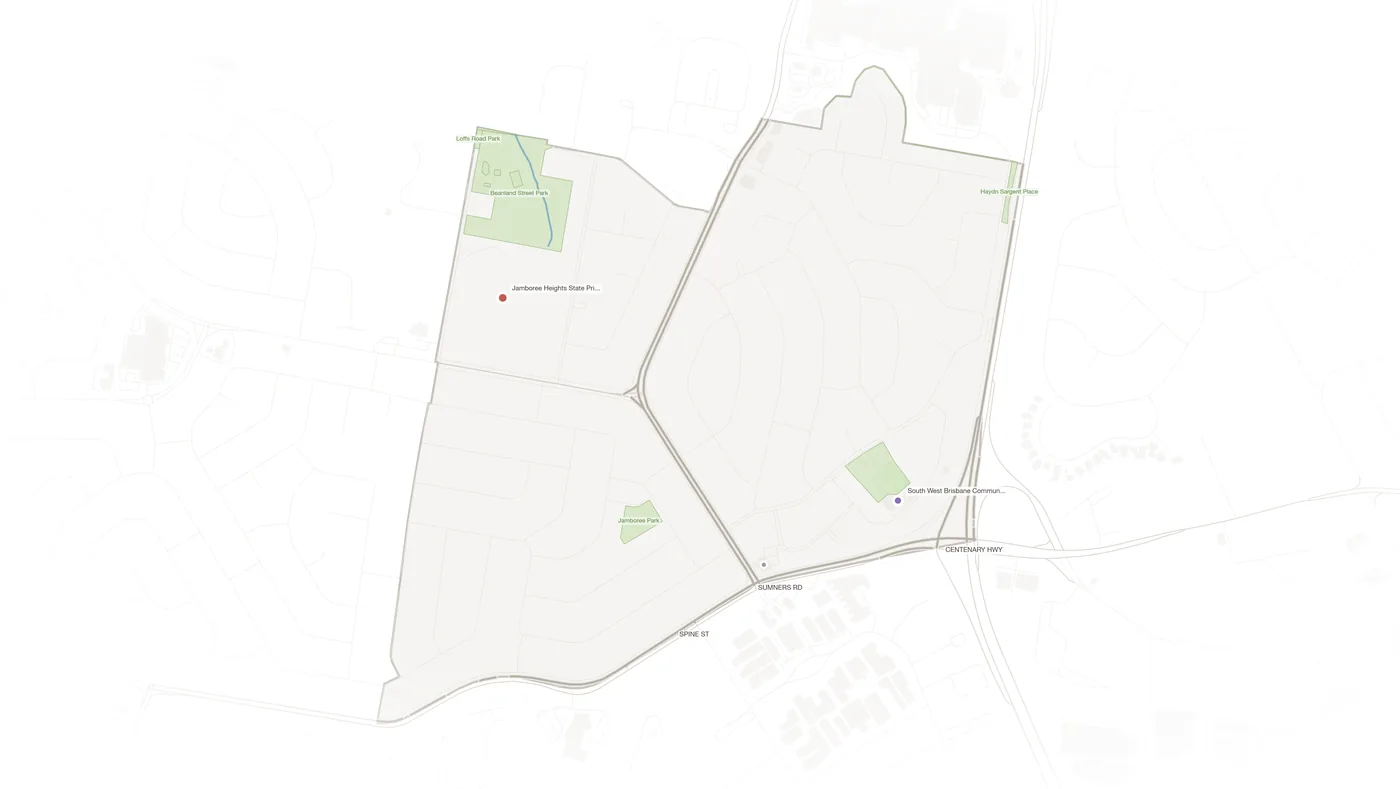
Explore Jamboree Heights on the Map
View parcels, zoning overlays, DA applications, schools and more.
Open Interactive Map