Kearneys Spring
Healthcare employs 31.6% of workers (910 people), nearly double the next sector, making Kearneys Spring one of Toowoomba's most health-sector concentrated suburbs. Despite this professional anchor, household incomes sit at just the 33.9th percentile nationally ($1,335/week), and the estimated $404,000 median house price reflects regional Queensland affordability. The female majority (53.9%) is unusual, 3.9 points above the national baseline, and the 45.3% renter share is high for a suburb with 59.4% detached houses. The 34.1% semi-detached rate is notably above the national average, suggesting townhouse-style densification.
Population
9,419
Median Age
35.0
Household IncomeiMedian weekly household income (ABS Census)
$1,335/wk
DAs (12 months)iDevelopment Applications lodged in the past year
15
Median House
$404K
Estimated from rent (2025)
The estimated $404,000 median puts Kearneys Spring well below the national capital city average. Detached houses make up 59.4% of stock, with semi-detached at 34.1%, a mix that gives buyers flexibility across price points. Three-bedroom homes dominate at 39.0%, with four-plus at 33.2% and two-bedrooms at 24.9%. Monthly mortgage repayments of $1,517 produce a mortgage-to-income ratio of 26.2%, comfortably below the stress threshold. Only 26.2% hold mortgages and 28.4% own outright, leaving a large rental cohort. Walking/cycling at 2.5% and public transport at 0.6% mean this is a car-dependent market, with 88.5% driving to work.
For Buyers
The estimated $404,000 median puts Kearneys Spring well below the national capital city average. Detached houses make up 59.4% of stock, with semi-detached at 34.1%, a mix that gives buyers flexibility across price points. Three-bedroom homes dominate at 39.0%, with four-plus at 33.2% and two-bedrooms at 24.9%. Monthly mortgage repayments of $1,517 produce a mortgage-to-income ratio of 26.2%, comfortably below the stress threshold. Only 26.2% hold mortgages and 28.4% own outright, leaving a large rental cohort. Walking/cycling at 2.5% and public transport at 0.6% mean this is a car-dependent market, with 88.5% driving to work.
For Investors
The 45.3% renter share provides a solid tenant base, and median weekly rent of $310 against a $404,000 estimated price gives a gross yield of roughly 4.0%, above the national average and attractive by regional standards. Vacancy at 7.2% is elevated but below concerning levels. Only 15 DAs lodged in 12 months suggests low supply-side pressure. Residential turnover at 32.2% is high, meaning tenant retention may require competitive pricing. The healthcare-dominated economy provides some resilience to downturns, as hospital and aged-care employment is counter-cyclical compared to construction or mining.
Development Activity
Total DAs
69
Last 12 Months
15
YoY ChangeiYear-over-year change in DA lodgements
+36.4%
Avg DA CostiAverage estimated cost per DA in the past year
N/A
Monthly DA Lodgements
DA Categories
Demographics
English ancestry leads at 3,004, with Irish (896), Scottish (814) and German (753) forming a broad Anglo-European base. The 28.7% overseas-born rate is 7.1 points above national. University qualifications at 36.3% are 6.2 points above the national average, higher than expected for a regional suburb and consistent with the healthcare/education workforce. Median age of 35 is 5 years below national. Average household size of 2.4 sits just below the national 2.5. Punjabi (133), Nepali (129), Mandarin (89) and Arabic (86) lead non-English languages. Christianity dominates at 4,722, with Hinduism (632) the second largest religion.
Age Distribution
Bedrooms
Dwelling Structure
59.4%
Houses
34.1%
Townhouse
5.5%
Apartment
Tenure
Ownership splits between 28.4% outright and 26.2% on mortgages, with renters at 45.3%. The dwelling mix is unusual: 59.4% detached houses, 34.1% semi-detached (well above the national average), and 5.5% apartments. Three-bedroom homes make up 39.0% and four-plus bedrooms 33.2%. The estimated $404,000 median is derived from rents. At household income of $1,335/week, the price-to-income ratio is approximately 5.8x annual income, broadly affordable compared to capital city benchmarks. Rent-to-income at 23.2% and mortgage-to-income at 26.2% both sit comfortably below the 30% stress threshold.
Mortgage / mo
$1,517
Rent / wk
$310
HH Size
2.4
Personal Income / wk
$746
Vacancy Ratei% of dwellings unoccupied on Census night (ABS 2021)
7.2%
Unoccupied
289
Rent / IncomeiMedian rent as % of household income. Over 30% = housing stress
23.2%
Mortgage / IncomeiMedian mortgage as % of household income. Over 30% = housing stress
26.2%
Community Profile
Languages Spoken at Home
Ancestry
Household Composition
27.5%
Couples, no children
6,858
Total families
Economy & Employment
Healthcare dominates at 31.6% (910 workers), a concentration higher than most suburbs in this dataset and roughly double the national healthcare employment share. Education follows at 14.3% (412), retail at 7.8% (225), public administration at 6.2% (178) and hospitality at 5.8% (166). Professionals lead occupations at 928, with community/personal workers (708) running close behind, reflecting the care-sector economy. Full-time employment at 61.5% is below the national average, consistent with high part-time work in healthcare. Unemployment at 6.3% sits above the national rate. The 7.8% needing-assistance rate (692 people) is elevated, likely linked to the aged-care workforce and resident population.
Socio-Economic Indexes (SEIFA)iABS index ranking suburbs from 1 (most disadvantaged) to 10 (most advantaged)
Full-time
61.5%
Part-time
32.2%
Participation
55.8%
Employed
3,953
Occupations
Top Industries
University
36.3%
Postgraduate
10.3%
Born Overseas
28.7%
Dwellings
3,708
Transport to Work
Transport is overwhelmingly car-dependent: 88.5% drive to work, public transport at 0.6% is negligible, and walking/cycling is just 2.5%, well below the national average. No schools are located within the suburb boundaries, so families rely on neighbouring suburbs for education. The volunteering rate of 15.3% is above the national average, suggesting engaged community participation. The 7.8% needing-assistance rate (692 people) is higher than average, consistent with the aged-care workforce and resident base. Mortgage-to-income at 26.2% and rent-to-income at 23.2% both indicate manageable housing costs.
Drive
88.5%
Public Transport
0.6%
Walk / Cycle
2.5%
Work from Home
N/A
National Ranking iPercentile rank among ~15,000 AU suburbs. 90% = higher than 90% of suburbs
How Kearneys Spring compares to ~15,000 Australian suburbs
Frequently Asked Questions
Is Kearneys Spring a good suburb to live in?
Kearneys Spring suits healthcare workers and families seeking affordable regional living. The estimated $404,000 median is well below capital city averages, and mortgage-to-income at 26.2% sits comfortably below the stress threshold. The suburb is car-dependent (88.5% drive to work), and no schools are within the boundaries, so families commute to neighbouring suburbs. The 31.6% healthcare employment share provides economic stability.
What is the median house price in Kearneys Spring?
The estimated median is $404,000 (derived from rents). Monthly mortgage repayments average $1,517 and median weekly rent is $310. At household income of $1,335/week (33.9th percentile nationally), the mortgage-to-income ratio is 26.2% and rent-to-income is 23.2%, both well below the 30% stress line, making this suburb more affordable than most comparable markets.
What schools are in Kearneys Spring?
No schools are located within Kearneys Spring's boundaries. Families access schools in neighbouring Toowoomba suburbs. The university qualification rate of 36.3% is 6.2 points above the national average, suggesting residents value education and likely commute to schools in the broader Toowoomba region, which has multiple government and independent options.
Is Kearneys Spring safe?
Crime data is not available for Kearneys Spring in the current dataset. SEIFA scores are not available for this suburb, limiting socio-economic benchmarking. The household income at the 33.9th percentile nationally indicates moderate disadvantage. The healthcare-dominated economy (31.6%) and 15.3% volunteering rate suggest an engaged, service-oriented community. QLD Police data should be consulted for specific statistics.
Is Kearneys Spring good for property investment?
Gross yield is roughly 4.0% ($310/week on $404,000), above the national average and attractive for regional Queensland. The 45.3% renter share provides a solid tenant pool, and only 15 DAs in 12 months means low supply pressure. Vacancy at 7.2% is slightly elevated. The healthcare-dominated economy (31.6%) provides resilience to cyclical downturns, a positive for rental demand stability.
How is Kearneys Spring's population changing?
Kearneys Spring has a population of 9,419 with a median age of 35, which is 5 years below the national median. Residential turnover at 32.2% is high, indicating a mobile population. The 28.7% overseas-born rate is 7.1 points above the national average. Average household size of 2.4 sits just below the national 2.5, consistent with a mix of families and smaller households.
How to read these comparisons
Phrases like "above the national average" reference the unweighted median across Australian suburbs with more than 1,000 residents, not population-weighted national figures. Suburb-level medians are more useful for ranking suburbs against each other; ABS census headlines are population-weighted (so dominated by Sydney and Melbourne) and can read very differently.
Current baseline (refreshed 2026-05-10): median age 40, university-educated 30.1%, born overseas 21.6%, average household size 2.5 people.
Data sources: ABS 2021 Census (demographics, income, tenure), state Valuer-General (house prices), Department of Jobs SALM (unemployment), ACARA (school ICSEA), state Crime Statistics agencies (offences), council DA portals (development applications). Population forecasts use a Hamilton-Perry cohort model calibrated to ABS ERP.
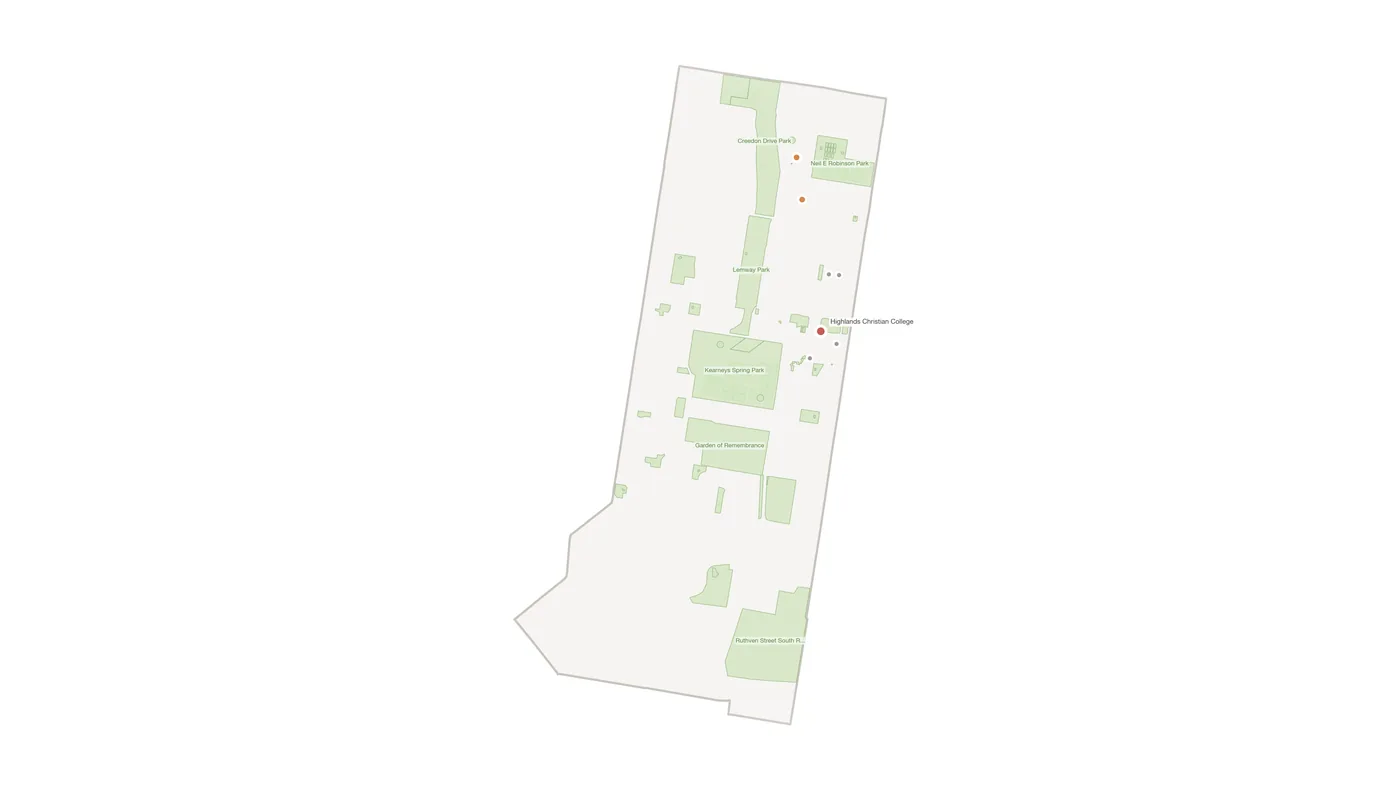
Explore Kearneys Spring on the Map
View parcels, zoning overlays, DA applications, schools and more.
Open Interactive Map