Lyons
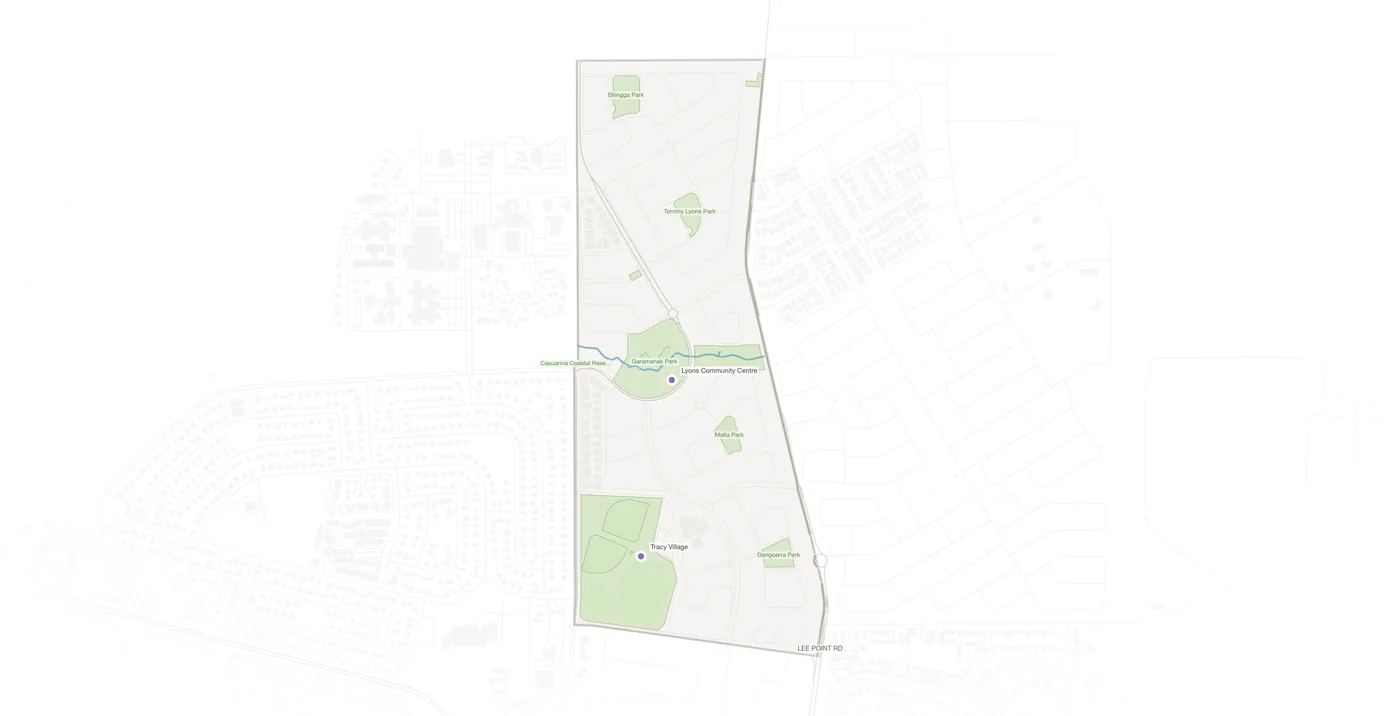
Household income in Lyons sits at the 96.9th percentile nationally, yet the median house price of $448,000 remains well below capital city benchmarks, creating an unusual combination of high earnings and relative affordability. On all four SEIFA indexes the suburb scores decile 9 or 10, placing it among the most advantaged communities in Australia. The population jumped 190% over the past decade, driven by overseas migration averaging 112 residents a year. With a median age of just 30, ten years below the national figure, and 62.9% of households renting, Lyons is shaped by a transient, publicly employed, high-income workforce concentrated in a 0.97 square kilometre footprint.
Population
2,219
Median Age
30.0
Household IncomeiMedian weekly household income (ABS Census)
$2,931/wk
DAs (12 months)iDevelopment Applications lodged in the past year
0
Median House
$448K
Estimated from rent (2025)
At $448,000, the median house price in Lyons is substantially lower than most high-income suburbs nationally, partly because the price estimate is derived from rental data rather than a thick transaction history. The dominant dwelling type is the separate house at 82.0%, well above the national average, and bedrooms skew large: 70.0% of dwellings have four or more bedrooms and 26.3% have three. Monthly mortgage repayments of $2,600 represent 20.5% of median household income, below the 30% stress threshold that applies in many comparable SEIFA decile 10 suburbs. Only 10.7% of households own outright and 26.4% carry a mortgage, compared with the 62.9% who rent, so buyers acquire into a market dominated by tenants, which affects resale depth.
For Buyers
At $448,000, the median house price in Lyons is substantially lower than most high-income suburbs nationally, partly because the price estimate is derived from rental data rather than a thick transaction history. The dominant dwelling type is the separate house at 82.0%, well above the national average, and bedrooms skew large: 70.0% of dwellings have four or more bedrooms and 26.3% have three. Monthly mortgage repayments of $2,600 represent 20.5% of median household income, below the 30% stress threshold that applies in many comparable SEIFA decile 10 suburbs. Only 10.7% of households own outright and 26.4% carry a mortgage, compared with the 62.9% who rent, so buyers acquire into a market dominated by tenants, which affects resale depth.
For Investors
A 62.9% renter share is among the highest for any high-income suburb nationally, underpinning consistent demand for rental stock. Weekly rent of $265 against a $448,000 median implies a gross yield in the range of 3.0%, higher than most SEIFA decile 10 suburbs. The vacancy rate of 5.9% is elevated and worth monitoring, as it suggests occasional oversupply relative to tenant demand. Overseas migration averaging 112 residents per year is the primary population driver, well above the net internal inflow of 56, providing a steady pipeline of new renters from professional and government placements. Annual population growth of 4.58% is classified as high-growth, pointing to sustained rental demand if vacancy is absorbed.
Demographics
The median age of 30 is 10 years below the national figure, the result of a workforce population anchored in public administration and healthcare rather than an established resident base. Overseas-born residents account for 31.1% of the population, 9.5 percentage points above the national rate, and the top languages spoken at home include Greek (65 speakers), Malayalam (31) and Urdu (21), reflecting migration from South Asia and the Mediterranean. University qualifications reach 38.8%, which is 8.7 points above the national average, consistent with a professional workforce. Average household size of 3.3 is 0.8 above the national figure, pointing to larger family units, and 66.4% of families are couples with children, a high share for a renter-dominated suburb.
Age Distribution
Bedrooms
Dwelling Structure
82.0%
Houses
2.5%
Townhouse
15.5%
Apartment
Tenure
Separate houses dominate at 82.0%, with apartments at 15.5% and semi-detached at just 2.5%, giving Lyons a more suburban housing profile than its high density of 2,297 residents per square kilometre would suggest. Four-plus bedroom dwellings account for 70.0% of stock, making Lyons unusual among inner Darwin suburbs for its concentration of large family homes. The 62.9% renting rate far exceeds the national average and reflects the government-employment base, where Defence and public service postings create a revolving tenant pool. Outright ownership at 10.7% is low, indicating limited long-term owner-occupier accumulation. Mortgage-to-income at 20.5% and rent-to-income at 9.0% both sit below stress thresholds, meaning current occupants are not under financial pressure.
Mortgage / mo
$2,600
Rent / wk
$265
HH Size
3.3
Personal Income / wk
$1,340
Vacancy Ratei% of dwellings unoccupied on Census night (ABS 2021)
5.9%
Unoccupied
40
Rent / IncomeiMedian rent as % of household income. Over 30% = housing stress
9.0%
Mortgage / IncomeiMedian mortgage as % of household income. Over 30% = housing stress
20.5%
Community Profile
Languages Spoken at Home
Ancestry
Household Composition
17.0%
Couples, no children
1,910
Total families
Economy & Employment
Public administration is the dominant industry at 39.2% of employed residents (336 workers), more than 3.5 times its national employment share. Healthcare follows at 23.3% (200 workers) and Education at 9.1% (78 workers), producing an economy almost entirely oriented toward government services. By occupation, Professionals make up the largest group at 327, followed by Community/Personal workers at 222 and Managers at 178. The full-time employment rate of 76.1% is high, and the unemployment rate of 3.2% is low. All four SEIFA scores sit at decile 9 or 10, with IRSAD at decile 10 indicating both high income and low deprivation. Real household income grew 7.9% over the decade, supporting a stable economic base despite the public-sector concentration.
Unemployment
0.6%
Labour Force
4,193
Unemployed
24
Quarterly Trend
Source: SALM Dec-25
Socio-Economic Indexes (SEIFA)iABS index ranking suburbs from 1 (most disadvantaged) to 10 (most advantaged)
Full-time
76.1%
Part-time
20.7%
Participation
71.0%
Employed
1,073
Occupations
Top Industries
University
38.8%
Postgraduate
11.8%
Born Overseas
31.1%
Dwellings
644
Transport to Work
Car dependence is pronounced: 87.3% of employed residents drive to work, compared with just 1.1% using public transport. Active transport accounts for 5.6%, which is modest but consistent with Darwin's walking and cycling infrastructure. No schools are recorded inside the 0.97 square kilometre boundary, so families in Lyons rely on institutions in neighbouring suburbs. Crime statistics are not available at the suburb level for Lyons, though the SEIFA IRSAD decile 10 ranking places it in the lowest disadvantage tier nationally. The need-for-assistance rate of 3.1% (64 residents) is low for a suburb of 2,219 people, and volunteering stands at 20.2%, above the national average, suggesting a community-engaged resident base despite high turnover of 36.9% annually.
Drive
87.3%
Public Transport
1.1%
Walk / Cycle
5.6%
Work from Home
N/A
Population Forecast
+4.58%/yr
(+341 people/yr)
High GrowthPopulation grew 190% over the past decade, one of the largest percentage increases recorded for an established urban suburb. Annual growth currently runs at 4.58%, adding approximately 341 residents per year. The primary driver is overseas migration at 112 net arrivals annually, supplemented by 56 net internal migrants. The medium forecast projects population rising from roughly 7,442 in 2025 to around 9,717 by 2031, a 31% increase over six years. The suburb is classified in a new development gentrification stage with a score of zero, meaning the growth reflects expansion rather than displacement. Rent grew 12.0% over the measured period while affordability improved from 24.5% in 2011 to 20.6% in 2021, suggesting income gains are outpacing housing costs.
Historical + Forecast
Hamilton-Perry + Holt smoothing on ERP 2001-2025
Age Cohort Forecast
Primary Driver
Overseas Migration
Net Overseas / yr
+112
Net Internal / yr
+56
Gentrification Signal
New development
National Ranking iPercentile rank among ~15,000 AU suburbs. 90% = higher than 90% of suburbs
How Lyons compares to ~15,000 Australian suburbs
Frequently Asked Questions
Is Lyons a good suburb to live in?
Lyons ranks at SEIFA decile 9 or 10 on all four indexes, with household income at the 96.9th percentile nationally. The median age of 30 and 70.0% of dwellings having 4-plus bedrooms suit families. The main trade-offs are a 5.9% vacancy rate, heavy car dependence at 87.3%, and a high 36.9% annual resident turnover from the transient government workforce.
What is the median house price in Lyons?
The median house price is estimated at $448,000, derived from rental data for 2025. Weekly rent averages $265 and monthly mortgage repayments run about $2,600, giving a mortgage-to-income ratio of 20.5%, below the 30% stress threshold. Household income sits in the 96.9th percentile nationally, making Lyons relatively affordable for its income tier.
What schools are in Lyons?
No schools are recorded inside the 0.97 square kilometre Lyons boundary in this dataset, so families rely on schools in neighbouring Darwin suburbs. Despite this, university qualifications among residents reach 38.8%, which is 8.7 percentage points above the national figure, reflecting the professional and government workforce profile.
Is Lyons safe?
Suburb-level crime statistics are not available for Lyons in this dataset. As an indirect indicator, Lyons scores decile 10 on IRSAD (the lowest disadvantage tier nationally) and decile 9 on IEO. Only 3.1% of the 2,219 residents need daily assistance, and unemployment is 3.2%, both consistent with a low-disadvantage community profile.
Is Lyons good for property investment?
The 62.9% renter share provides a large and consistent tenant pool, with weekly rent of $265 implying a gross yield around 3.0% against the $448,000 median, higher than most SEIFA decile 10 suburbs. Overseas migration adds 112 residents per year and annual population growth runs at 4.58%, both supporting rental demand. The 5.9% vacancy rate warrants monitoring as a risk factor.
How is Lyons's population changing?
Population grew 190% over the past decade and currently stands at 2,219, growing at 4.58% annually (about 341 people per year). The primary driver is overseas migration at 112 net arrivals annually. Medium forecasts project growth from around 7,442 residents in the broader SA2 area in 2025 to approximately 9,717 by 2031, a 31% increase.
What languages are spoken in Lyons?
Around 31.1% of Lyons residents were born overseas, which is 9.5 percentage points above the national rate. The top non-English languages spoken at home are Greek (65 speakers), Malayalam (31), Urdu (21) and Sinhalese (19), reflecting migration from South Asia, Sri Lanka and the Mediterranean alongside Darwin's broader multicultural workforce.
How to read these comparisons
Phrases like "above the national average" reference the unweighted median across Australian suburbs with more than 1,000 residents, not population-weighted national figures. Suburb-level medians are more useful for ranking suburbs against each other; ABS census headlines are population-weighted (so dominated by Sydney and Melbourne) and can read very differently.
Current baseline (refreshed 2026-05-10): median age 40, university-educated 30.1%, born overseas 21.6%, average household size 2.5 people.
Data sources: ABS 2021 Census (demographics, income, tenure), state Valuer-General (house prices), Department of Jobs SALM (unemployment), ACARA (school ICSEA), state Crime Statistics agencies (offences), council DA portals (development applications). Population forecasts use a Hamilton-Perry cohort model calibrated to ABS ERP.
Explore Lyons on the Map
View parcels, zoning overlays, DA applications, schools and more.
Open Interactive Map