Main Beach
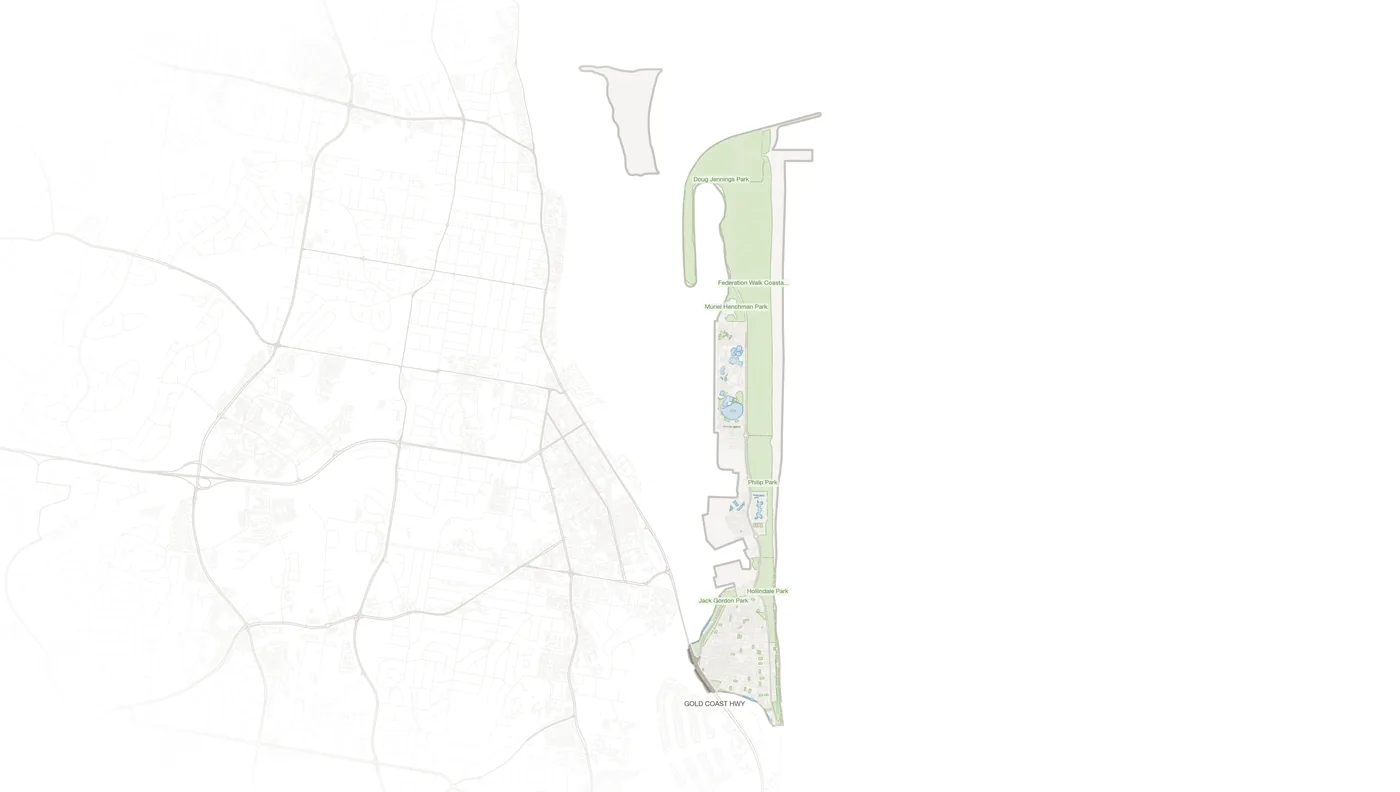
With a median age of 57, Main Beach sits 17 years above the national figure, making it one of the oldest resident bases on the Gold Coast. The suburb is apartment-dominant, with 90.1% of dwellings in multi-storey stock and only 3.4% separate houses. What stands out is the 33.7% vacancy rate, far above typical suburban norms, pointing to a large proportion of dwellings used as holiday homes or investment properties rather than primary residences. The SEIFA IRSAD decile of 8 confirms above-average advantage nationally, and 47.7% of residents own their homes outright, a proportion more common in retirement-oriented coastal markets than working-age suburbs.
Population
3,998
Median Age
57.0
Household IncomeiMedian weekly household income (ABS Census)
$1,682/wk
DAs (12 months)iDevelopment Applications lodged in the past year
0
Median House
$610K
Estimated from rent (2025)
The median house price is estimated at $610,000, derived from rental data given the limited transaction volume in this compact 3.46 km2 suburb. Monthly mortgage repayments average $2,091, producing a mortgage-to-income ratio of 28.7%, which sits just below the 30% stress threshold. The stock is almost entirely apartments at 90.1%, with two-bedroom dwellings the clear majority at 59.0% and three-bedroom units at 25.4%. Separate houses account for just 3.4% of dwellings, so buyers seeking detached housing will find almost no supply here compared to broader Gold Coast suburbs. Outright owners at 47.7% outnumber mortgage holders at 20.7% by more than two to one, consistent with an established, wealth-holding resident base rather than a first-home buyer market.
For Buyers
The median house price is estimated at $610,000, derived from rental data given the limited transaction volume in this compact 3.46 km2 suburb. Monthly mortgage repayments average $2,091, producing a mortgage-to-income ratio of 28.7%, which sits just below the 30% stress threshold. The stock is almost entirely apartments at 90.1%, with two-bedroom dwellings the clear majority at 59.0% and three-bedroom units at 25.4%. Separate houses account for just 3.4% of dwellings, so buyers seeking detached housing will find almost no supply here compared to broader Gold Coast suburbs. Outright owners at 47.7% outnumber mortgage holders at 20.7% by more than two to one, consistent with an established, wealth-holding resident base rather than a first-home buyer market.
For Investors
A 31.6% renter share and weekly rent of $500 give investors a moderate tenant pool, though the 33.7% vacancy rate is a significant risk signal well above healthy market norms. Against the $610,000 median, $500 weekly rent implies a gross yield near 4.3%, reasonable by Gold Coast standards. Population growth averages 38 persons per year at 0.86% annually, driven primarily by overseas migration at 89 net arrivals annually compared to 16 from internal migration. The high vacancy reflects the holiday and investor-held nature of much of the stock rather than weak underlying demand. No development applications were recorded in the past 12 months, so new supply pressure is minimal, which may support rents over time.
Demographics
The median age of 57 is 17 years above the national figure, and the suburb is on a clear aging trajectory: the senior share rose 12.4 points while the working-age share fell 7.8 points over the decade. Average household size of 1.9 is 0.6 below national, consistent with a couples-without-children profile where 60.4% of families are couples with no children. Overseas-born residents reach 29.4%, which is 7.8 points above the national figure. Ancestry is predominantly Anglo-Celtic, led by English (1,663), Irish (594) and Scottish (475). University qualifications reach 37.5%, which is 7.4 points above national, suggesting a skilled and educated resident base despite the older median age. The participation rate of 46.3% is low compared to national norms, because 1,389 residents are not in the labour force, reflecting the high proportion of retirees.
Age Distribution
Bedrooms
Dwelling Structure
3.4%
Houses
4.9%
Townhouse
90.1%
Apartment
Tenure
Tenure data tells a clear story: 47.7% own outright, 20.7% carry a mortgage, and 31.6% rent. Outright owners more than doubling mortgage holders points to debt-free wealth accumulation typical of retiree coastal markets rather than a churning buyer pool. The stock is 90.1% apartments and 4.9% semi-detached, leaving separate houses at only 3.4%, one of the lowest ratios you will find in any established suburb. Two-bedroom dwellings dominate at 59.0%, followed by three-bedroom at 25.4%, with studio or one-bedroom units at 9.6%. The 33.7% vacancy rate is the defining housing characteristic and signals that a large share of apartments are held as holiday properties or investment dwellings rather than primary residences. Rent-to-income at 29.7% sits just below the 30% stress threshold, meaning renters are not under severe pressure.
Mortgage / mo
$2,091
Rent / wk
$500
HH Size
1.9
Personal Income / wk
$938
Vacancy Ratei% of dwellings unoccupied on Census night (ABS 2021)
33.7%
Unoccupied
924
Rent / IncomeiMedian rent as % of household income. Over 30% = housing stress
29.7%
Mortgage / IncomeiMedian mortgage as % of household income. Over 30% = housing stress
28.7%
Community Profile
Languages Spoken at Home
Ancestry
Household Composition
60.4%
Couples, no children
2,443
Total families
Economy & Employment
Healthcare is the largest employing industry at 16.6% of workers (205 people), followed by Education at 12.2% (150) and Professional/Tech at 11.6% (143), with Hospitality at 7.9% and Construction at 7.7%. By occupation, Professionals (498) and Managers (389) lead, consistent with the SEIFA IEO decile of 8, which ranks education and occupation advantage in the upper tier nationally. Unemployment is 5.2%, above the national low, partly because the aging population creates a higher share of people entering retirement rather than seeking work. The participation rate of 46.3% is low, driven by 1,389 residents not in the labour force. Real income growth over the decade was negative at -4.4%, meaning purchasing power fell in real terms, a pattern shared by many coastal resort markets where older fixed-income residents are concentrated.
Unemployment
1.6%
Labour Force
2,431
Unemployed
40
Quarterly Trend
Source: SALM Dec-25
Socio-Economic Indexes (SEIFA)iABS index ranking suburbs from 1 (most disadvantaged) to 10 (most advantaged)
Full-time
57.4%
Part-time
37.4%
Participation
46.3%
Employed
1,654
Occupations
Top Industries
University
37.5%
Postgraduate
9.4%
Born Overseas
29.4%
Dwellings
1,803
Transport to Work
Car dependence is high at 86.6% of residents driving to work, while only 2.2% use public transport, below state and national norms. Walking and cycling account for 7.6%, reflecting the compact 3.46 km2 layout and beach-adjacent environment. The suburb earns SEIFA IRSAD decile 8 nationally, placing it in the upper advantage tier. Only 4.0% of residents (142 people) need daily assistance despite a median age of 57, suggesting a healthy older population. Volunteering runs at 15.3%, above average for a resort-oriented suburb. No schools are recorded within the suburb boundary, so families with children rely on institutions in neighbouring Gold Coast suburbs. The 33.7% vacancy rate means streets and facilities are less intensively used than the dwelling count suggests, which can benefit permanent residents in terms of amenity and space.
Drive
86.6%
Public Transport
2.2%
Walk / Cycle
7.6%
Work from Home
N/A
Population Forecast
+0.86%/yr
(+38 people/yr)
EstablishedMain Beach grew 14.6% over the past decade, adding around 500 residents, and the medium forecast projects the population reaching 4,512 by 2031 from the current 3,998. Annual growth of 0.86% (about 38 persons per year) is modest but steady. Overseas migration is the primary driver at 89 net arrivals annually, far outpacing internal migration at 16 per year. The suburb is classified as not gentrifying, with a gentrification score of 15, because it is already in SEIFA decile 8 and the demographic shift is toward aging rather than incoming younger professional cohorts. The young-adult share fell 1 point while the senior share rose 12.4 points over the decade, reinforcing the aging trajectory. Affordability has remained stable: rent-to-income was 53.9% in 2011 and 53.3% in 2021, suggesting the market has not meaningfully priced out renters relative to incomes.
Historical + Forecast
Hamilton-Perry + Holt smoothing on ERP 2001-2025
Age Cohort Forecast
Primary Driver
Overseas Migration
Net Overseas / yr
+89
Net Internal / yr
+16
Gentrification Signal
Not gentrifying
Population +18% since 2011
National Ranking iPercentile rank among ~15,000 AU suburbs. 90% = higher than 90% of suburbs
How Main Beach compares to ~15,000 Australian suburbs
Frequently Asked Questions
Is Main Beach a good suburb to live in?
Main Beach ranks in SEIFA IRSAD decile 8 nationally, placing it in the upper advantage tier. The median age of 57, the 90.1% apartment stock and the 33.7% vacancy rate shape a lifestyle suited to retirees and part-time residents rather than families. Permanent residents benefit from low density year-round, but public transport access is minimal at 2.2% usage.
What is the median house price in Main Beach?
The median house price is estimated at $610,000 based on 2025 rental data. Weekly rent averages $500 and monthly mortgage repayments run about $2,091, giving a mortgage-to-income ratio of 28.7%. Separate houses are extremely scarce at only 3.4% of dwellings, making apartments the dominant purchase option.
What schools are in Main Beach?
No schools are recorded inside the Main Beach boundary in this dataset. Families rely on schools in neighbouring Gold Coast suburbs. The local population is educated, with university qualifications at 37.5%, which is 7.4 points above the national figure, though the suburb's median age of 57 means few school-age children live here permanently.
Is Main Beach safe?
Crime statistics are not available for Main Beach in this dataset. As an indirect indicator, the suburb scores SEIFA IRSAD decile 8 nationally, placing it in the upper advantage tier for relative disadvantage, and only 4.0% of its 3,998 residents need daily assistance. Both signals are consistent with a low-disadvantage environment.
Is Main Beach good for property investment?
Rent of $500 a week against a $610,000 median implies a gross yield near 4.3%, reasonable compared to many eastern-seaboard markets. The 33.7% vacancy rate is the key risk, reflecting significant holiday and part-time dwelling use. Overseas migration of 89 net arrivals annually supports demand, and no new development applications were lodged in the past 12 months, limiting supply pressure.
How is Main Beach's population changing?
The population grew 14.6% over the past decade and is forecast to reach around 4,512 by 2031 at 0.86% annual growth. Overseas migration drives growth at 89 net arrivals per year versus 16 from internal migration. The profile is aging strongly, with the senior share up 12.4 points and the working-age share down 7.8 points over the decade.
What type of housing dominates Main Beach?
Apartments make up 90.1% of dwellings, well above state and national norms, with two-bedroom units the most common at 59.0% of stock. Separate houses are just 3.4% of dwellings. The 33.7% vacancy rate indicates a large share of apartments are held as holiday or investment properties rather than primary residences.
How to read these comparisons
Phrases like "above the national average" reference the unweighted median across Australian suburbs with more than 1,000 residents, not population-weighted national figures. Suburb-level medians are more useful for ranking suburbs against each other; ABS census headlines are population-weighted (so dominated by Sydney and Melbourne) and can read very differently.
Current baseline (refreshed 2026-05-10): median age 40, university-educated 30.1%, born overseas 21.6%, average household size 2.5 people.
Data sources: ABS 2021 Census (demographics, income, tenure), state Valuer-General (house prices), Department of Jobs SALM (unemployment), ACARA (school ICSEA), state Crime Statistics agencies (offences), council DA portals (development applications). Population forecasts use a Hamilton-Perry cohort model calibrated to ABS ERP.
Explore Main Beach on the Map
View parcels, zoning overlays, DA applications, schools and more.
Open Interactive Map