Millbank
At a median age of 47, Millbank sits 7.0 years above the national figure, making it one of the older residential pockets in the Bundaberg region. Household income lands in the 12.8th percentile nationally, well below average, yet 38.2% of dwellings are owned outright, more than a third of all homes with no mortgage at all. The suburb covers 3.42 square kilometres at a density of 731 people per km2, with 2,499 residents and a stock dominated by detached houses at 76.7%. Both SEIFA advantage indexes sit at decile 1, placing Millbank in the lowest 10% nationally for education-occupation opportunity and relative advantage, a combination that shapes housing demand and workforce structure throughout the area.
Population
2,499
Median Age
47.0
Household IncomeiMedian weekly household income (ABS Census)
$997/wk
DAs (12 months)iDevelopment Applications lodged in the past year
0
Median House
$336K
Estimated from rent (2025)
The median house price is estimated at $336,000, considerably lower than the Queensland state median, which puts first-home buyers in a position where purchase is often more viable than renting. Monthly mortgage repayments average $1,188, and the mortgage-to-income ratio is 27.5%, below the 30% stress threshold, so buyers who can secure finance are not immediately under pressure. Three-bedroom homes are the dominant format at 52.9% of dwellings, with four-plus bedroom homes at 23.2%, giving families reasonable choice at this price point. Separate houses make up 76.7% of stock, higher than many comparable regional suburbs, meaning the detached-house buyer faces less competition from apartment or semi-detached alternatives. With 38.2% of dwellings owned outright compared to only 24.0% with a mortgage, the suburb has a large cohort of debt-free owners who are unlikely to be forced sellers.
For Buyers
The median house price is estimated at $336,000, considerably lower than the Queensland state median, which puts first-home buyers in a position where purchase is often more viable than renting. Monthly mortgage repayments average $1,188, and the mortgage-to-income ratio is 27.5%, below the 30% stress threshold, so buyers who can secure finance are not immediately under pressure. Three-bedroom homes are the dominant format at 52.9% of dwellings, with four-plus bedroom homes at 23.2%, giving families reasonable choice at this price point. Separate houses make up 76.7% of stock, higher than many comparable regional suburbs, meaning the detached-house buyer faces less competition from apartment or semi-detached alternatives. With 38.2% of dwellings owned outright compared to only 24.0% with a mortgage, the suburb has a large cohort of debt-free owners who are unlikely to be forced sellers.
For Investors
A 37.8% renter share gives landlords a solid tenant base, and weekly rent of $270 sits at a level accessible to lower-income households, which form the majority here given household income at the 12.8th percentile nationally. The gross yield on a $336,000 median at $270 weekly rent is roughly 4.2%, higher than most capital-city markets. However, the vacancy rate of 9.3% is elevated and signals excess rental supply relative to demand, which limits rent growth. Development activity recorded zero applications in the past 12 months, suggesting the suburb is not attracting speculative construction, which reduces supply-side risk for existing landlords but also points to limited market momentum. Investors should weigh the above-average yield against the high vacancy and low-income tenant base, which can increase arrears risk.
Demographics
The median age of 47 is 7.0 years above the national average, reflecting a strongly established, older resident base. University qualifications reach 20.9%, which is 9.2 percentage points below the national figure, consistent with the decile 1 IEO score for education and occupation opportunity. The proportion of residents born overseas is 12.4%, also 9.2 percentage points below national, pointing to a predominantly locally-born population. Ancestry is Anglo-Celtic: English (1,114) leads by a wide margin, followed by Irish (271) and Scottish (237), with German (209) and Other (199) rounding out the top five. Average household size of 2.2 is 0.3 below national, fitting the older age profile where couples without children make up 34.2% of all families. The need-for-assistance rate of 15.5% (370 people) is higher than would be expected in a suburb with younger demographics, directly linked to the aging population.
Age Distribution
Bedrooms
Dwelling Structure
76.7%
Houses
13.9%
Townhouse
7.5%
Apartment
Tenure
Tenure splits into three roughly equal bands: 38.2% own outright, 24.0% carry a mortgage, and 37.8% rent. Outright ownership exceeding mortgage holders by 14 percentage points is unusual and reflects the older, settled demographic rather than active buyer churn. The stock is 76.7% separate houses, with semi-detached homes at 13.9% and apartments at 7.5%, meaning the suburb is strongly detached-dominant compared to many Queensland regional centres. Three-bedroom homes account for 52.9% of dwellings, four-plus at 23.2%, and two-bedroom at 21.4%, so the size profile leans mid-to-large. The median house price of $336,000 is an estimate derived from rent data for 2025 because direct sale data was insufficient. Rent-to-income at 27.1% is just below the 30% stress threshold, meaning renters are carrying a significant but technically manageable housing cost burden relative to incomes.
Mortgage / mo
$1,188
Rent / wk
$270
HH Size
2.2
Personal Income / wk
$517
Vacancy Ratei% of dwellings unoccupied on Census night (ABS 2021)
9.3%
Unoccupied
104
Rent / IncomeiMedian rent as % of household income. Over 30% = housing stress
27.1%
Mortgage / IncomeiMedian mortgage as % of household income. Over 30% = housing stress
27.5%
Community Profile
Languages Spoken at Home
Ancestry
Household Composition
34.2%
Couples, no children
1,763
Total families
Economy & Employment
Healthcare dominates the local industry mix at 34.6% of employed residents (178 workers), nearly three times the share of the next sector. Education follows at 10.7% (55 workers), then Construction at 8.5% (44), Retail at 7.8% (40) and Public Administration at 4.9% (25). This skew toward healthcare aligns with the aged resident profile: older suburbs generate disproportionate demand for care services and also attract workers in those roles. The unemployment rate is 9.5%, above the Queensland average, and the participation rate of 42.9% is low because 1,055 residents are not in the labour force, partly explained by retired or semi-retired residents in an older population. Full-time employment among those who do work is 61.0%. The IRSD decile of 2 and IRSAD decile of 1 confirm that Millbank ranks near the bottom nationally for both relative disadvantage and combined advantage-disadvantage.
Socio-Economic Indexes (SEIFA)iABS index ranking suburbs from 1 (most disadvantaged) to 10 (most advantaged)
Full-time
61.0%
Part-time
29.5%
Participation
42.9%
Employed
821
Occupations
Top Industries
University
20.9%
Postgraduate
4.5%
Born Overseas
12.4%
Dwellings
995
Transport to Work
Car reliance is high: 89.6% of residents drive to work, above the national average, reflecting Millbank's position as a lower-density regional suburb without strong public transport infrastructure. Walking and cycling account for 3.8% of commute modes. No schools are recorded within the suburb boundary in the dataset, so families depend on facilities in surrounding parts of the Bundaberg local government area. Crime data are not available for Millbank in this dataset, so safety cannot be directly quantified. As an indirect indicator, the IRSAD decile of 1 places the suburb in the bottom 10% nationally for socioeconomic advantage, which is a known correlate of higher crime rates in comparative national research. The volunteering rate of 13.6% and a need-for-assistance rate of 15.5% together suggest a community with significant care needs alongside active community participation.
Drive
89.6%
Public Transport
N/A
Walk / Cycle
3.8%
Work from Home
N/A
National Ranking iPercentile rank among ~15,000 AU suburbs. 90% = higher than 90% of suburbs
How Millbank compares to ~15,000 Australian suburbs
Frequently Asked Questions
Is Millbank a good suburb to live in?
Millbank suits buyers seeking affordable detached housing in a stable, lower-density setting. The median house price is around $336,000, well below Queensland state median, and mortgage costs at 27.5% of income are below the stress threshold. The trade-offs are a SEIFA IRSAD decile of 1 (bottom 10% nationally for socioeconomic advantage) and a median age of 47, which reflects an older, quieter community rather than a growth-focused environment.
What is the median house price in Millbank?
The median house price is estimated at $336,000 based on 2025 rent data, as direct sale volumes were insufficient for a market median. Weekly rent averages $270, and monthly mortgage repayments run approximately $1,188, giving a mortgage-to-income ratio of 27.5%, which is below the 30% stress threshold.
What schools are in Millbank?
No schools are recorded inside the Millbank suburb boundary in this dataset. Families rely on schools in surrounding Bundaberg suburbs. The local university qualification rate is 20.9%, which is 9.2 percentage points below the national figure, consistent with the suburb's decile 1 IEO score for education and occupation opportunity.
Is Millbank safe?
Specific crime statistics are not available for Millbank in this dataset. As an indirect indicator, the suburb's IRSAD decile of 1 places it in the bottom 10% nationally for socioeconomic advantage, which nationally correlates with elevated crime rates. The need-for-assistance rate is 15.5% (370 residents), reflecting the older demographic rather than acute social disadvantage alone.
Is Millbank good for property investment?
A gross yield of approximately 4.2% (weekly rent $270 against a $336,000 median) is higher than most capital-city markets. However, the vacancy rate of 9.3% is elevated, signalling excess supply in the rental pool. Zero development applications in the past 12 months limits new supply risk, but the low-income tenant base (household income at the 12.8th percentile nationally) increases arrears exposure.
How is Millbank's population changing?
Current population is 2,499 across 3.42 square kilometres. No forecast data are available in the brief. The suburb shows high residential stability, with 70.9% of residents remaining at the same address over the census period and a turnover rate of 29.1%. The median age of 47, which is 7.0 years above national, suggests gradual aging rather than population growth as the dominant trend.
How to read these comparisons
Phrases like "above the national average" reference the unweighted median across Australian suburbs with more than 1,000 residents, not population-weighted national figures. Suburb-level medians are more useful for ranking suburbs against each other; ABS census headlines are population-weighted (so dominated by Sydney and Melbourne) and can read very differently.
Current baseline (refreshed 2026-05-10): median age 40, university-educated 30.1%, born overseas 21.6%, average household size 2.5 people.
Data sources: ABS 2021 Census (demographics, income, tenure), state Valuer-General (house prices), Department of Jobs SALM (unemployment), ACARA (school ICSEA), state Crime Statistics agencies (offences), council DA portals (development applications). Population forecasts use a Hamilton-Perry cohort model calibrated to ABS ERP.
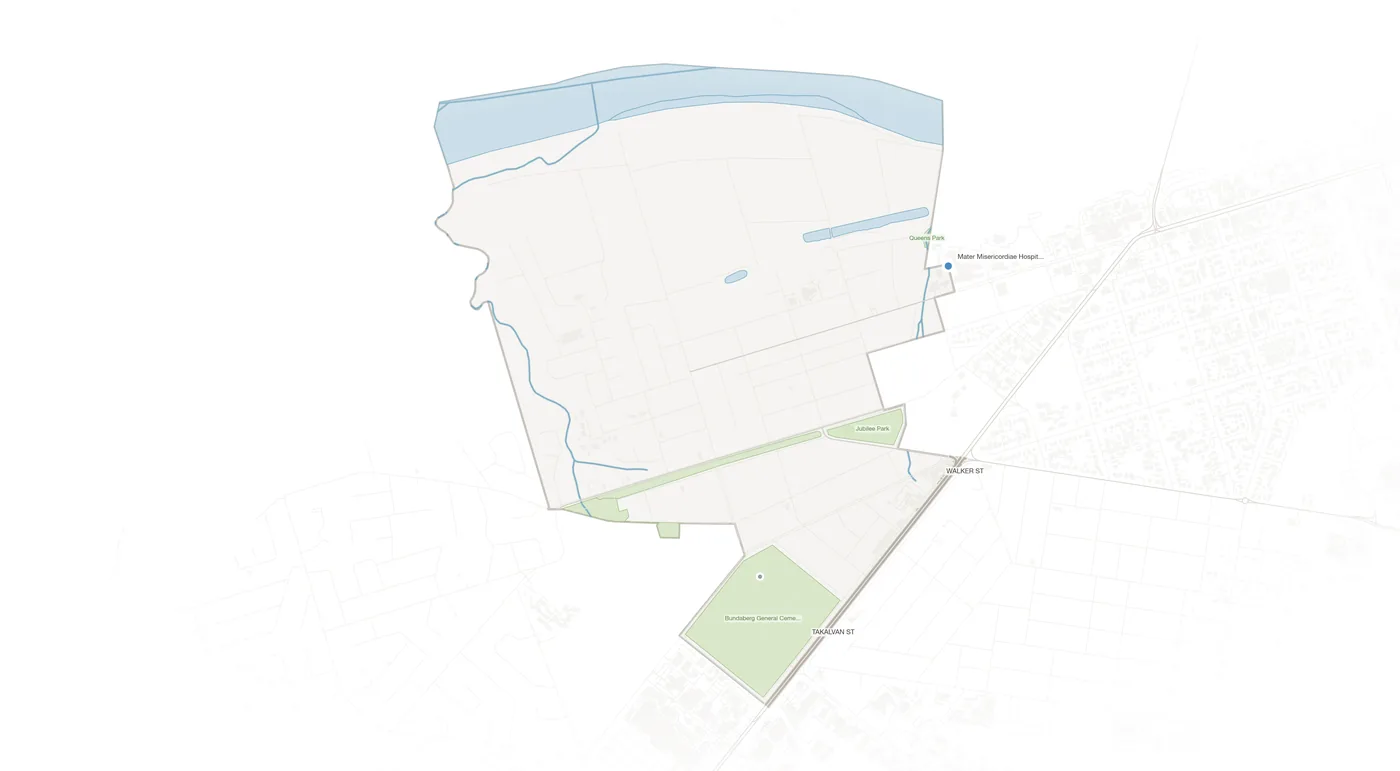
Explore Millbank on the Map
View parcels, zoning overlays, DA applications, schools and more.
Open Interactive Map