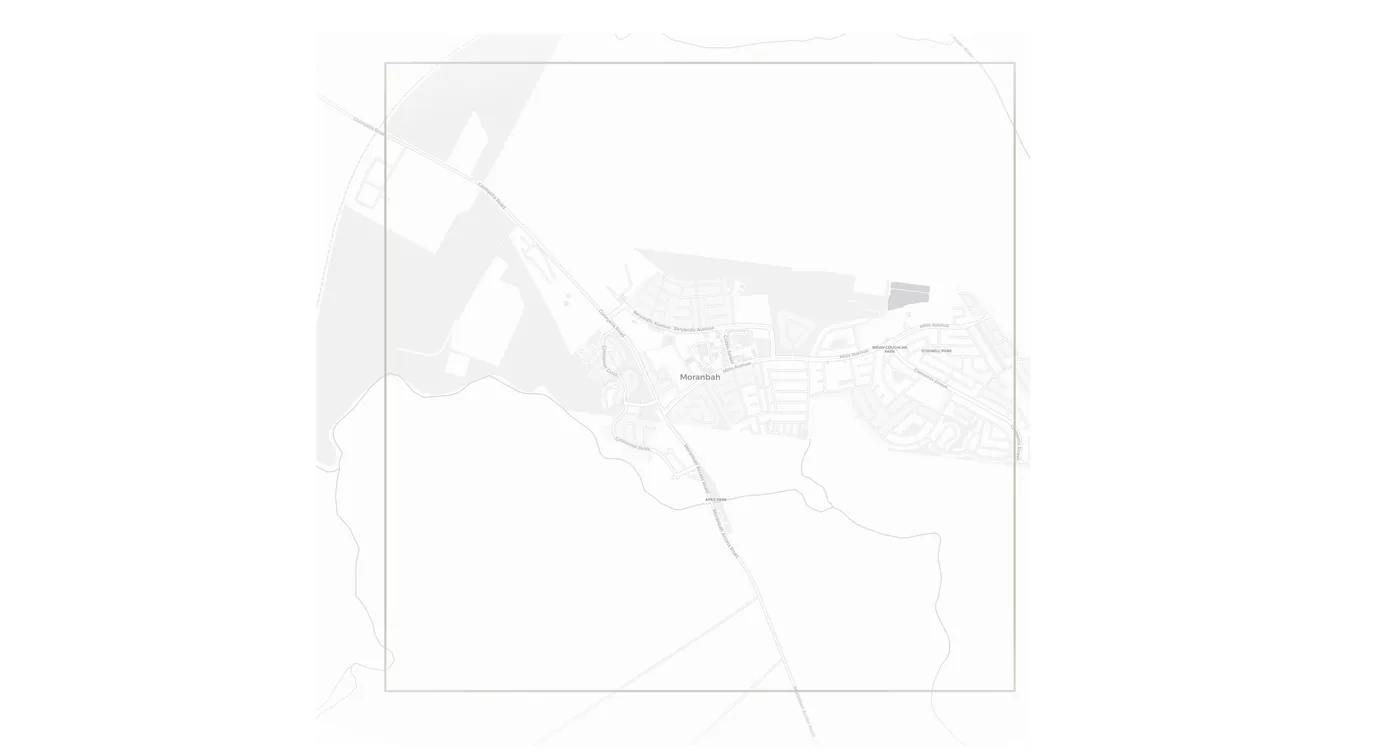
Moranbah
Household incomes at the 97.6th percentile nationally ($3,079/week) against a $231,000 estimated median house price create one of Australia's most extreme affordability ratios, with mortgage-to-income at just 9.8%. This is a mining town in pure form: 45.1% of workers are in mining (1,340 people), the vacancy rate is 29.5%, and 71.4% of residents rent. The male share of 55.9% is well above the 49.3% national baseline, consistent with fly-in-fly-out workforce dynamics. Population grew 5.1% over 10 years, but net internal migration runs at negative 115 per year, meaning the town loses residents domestically even as overseas workers arrive.
Population
9,425
Median Age
31.0
Household IncomeiMedian weekly household income (ABS Census)
$3,079/wk
DAs (12 months)iDevelopment Applications lodged in the past year
0
Median House
$231K
Estimated from rent (2025)
The estimated $231,000 median makes Moranbah one of Queensland's most affordable markets in absolute terms. Detached houses comprise 81.9% of stock, with 43.3% having four or more bedrooms and 46.1% three bedrooms, so family-sized housing is plentiful. Monthly mortgage repayments of $1,300 produce a mortgage-to-income ratio of just 9.8%, far below the 30% stress line. Only 8.8% own outright and 19.8% hold mortgages, while 71.4% rent, reflecting a transient, employer-housed population rather than a traditional buyer market. Buyers should factor in the commodity cycle: house prices historically swing with coal prices more sharply than in diversified economies.
For Buyers
The estimated $231,000 median makes Moranbah one of Queensland's most affordable markets in absolute terms. Detached houses comprise 81.9% of stock, with 43.3% having four or more bedrooms and 46.1% three bedrooms, so family-sized housing is plentiful. Monthly mortgage repayments of $1,300 produce a mortgage-to-income ratio of just 9.8%, far below the 30% stress line. Only 8.8% own outright and 19.8% hold mortgages, while 71.4% rent, reflecting a transient, employer-housed population rather than a traditional buyer market. Buyers should factor in the commodity cycle: house prices historically swing with coal prices more sharply than in diversified economies.
For Investors
The 71.4% renter share is extraordinary, more than double the national average, driven by mining company housing and FIFO accommodation. However, the 29.5% vacancy rate is among the highest in Australia and signals massive oversupply during downcycles. Median weekly rent of just $111 against a $231,000 estimated price gives a gross yield around 2.5%, low despite cheap entry. Zero development applications in 12 months confirms the market is in consolidation, not growth mode. Net internal migration of negative 115 per year means the domestic population is shrinking, offset partially by 65 overseas arrivals annually. Investment here is a commodity bet, not a property fundamentals play.
Schools in Moranbah iICSEA: school advantage index. 1000 = national avg, higher = more advantaged
Moranbah State School
Prep-6 · 531 students
Moranbah East State School
Prep-6 · 610 students
Moranbah State High School
7-12 · 756 students
Demographics
English ancestry leads at 3,187, with Irish (812) and Scottish (777) forming a traditional Anglo-Celtic base. Only 14.6% were born overseas, 7.0 points below the national average. The median age of 31 is 9 years below national, reflecting a young, working-age population. University qualification at 15.3% runs 14.8 points below national, consistent with the trade and machinery-operator dominated workforce. The male share of 55.9% is well above the national 49.3%, a hallmark of mining communities. Average household size of 2.8 sits above the national 2.5. Christianity dominates at 3,442, with very small Hindu (67) and Muslim (60) communities.
Age Distribution
Bedrooms
Dwelling Structure
81.9%
Houses
16.6%
Townhouse
1.4%
Apartment
Tenure
Only 8.8% own outright, 19.8% hold mortgages, and renters dominate at 71.4%, a tenure split that reflects employer-provided housing and transient FIFO populations rather than typical residential preferences. Detached houses make up 81.9% of stock with semi-detached at 16.6%. Four-plus bedroom homes at 43.3% and three-bedrooms at 46.1% mean virtually all housing is family-sized. The estimated $231,000 median is derived from rents, as transaction volumes are too low for sales-based estimates. Residential turnover at 31.4% is very high, consistent with a workforce that rotates on mining contract cycles.
Mortgage / mo
$1,300
Rent / wk
$111
HH Size
2.8
Personal Income / wk
$1,553
Vacancy Ratei% of dwellings unoccupied on Census night (ABS 2021)
29.5%
Unoccupied
1,106
Rent / IncomeiMedian rent as % of household income. Over 30% = housing stress
3.6%
Mortgage / IncomeiMedian mortgage as % of household income. Over 30% = housing stress
9.8%
Community Profile
Languages Spoken at Home
Ancestry
Household Composition
18.6%
Couples, no children
6,338
Total families
Economy & Employment
Mining at 45.1% (1,340 workers) dwarfs all other sectors, making Moranbah one of Australia's most single-industry dependent towns. Education at 9.3% (275) and construction at 5.6% (167) provide limited diversification. Machinery operators/drivers lead occupations at 1,131, outnumbering professionals (579) by 2:1, a ratio well above the national average. Full-time employment at 77.8% is very high, and unemployment at 2.5% sits well below the national rate. Participation at 63.2% is above average. The SEIFA profile shows an unusual split: IRSD decile 7 (low disadvantage) against IEO decile 3 (low education), consistent with high-income trades workers.
Unemployment
1.1%
Labour Force
6,626
Unemployed
72
Quarterly Trend
Source: SALM Dec-25
Socio-Economic Indexes (SEIFA)iABS index ranking suburbs from 1 (most disadvantaged) to 10 (most advantaged)
Full-time
77.8%
Part-time
19.7%
Participation
63.2%
Employed
4,387
Occupations
Top Industries
University
15.3%
Postgraduate
2.7%
Born Overseas
14.6%
Dwellings
2,633
Transport to Work
Transport is heavily car-dependent: 83.6% drive to work, public transport usage is just 2.7%, and walking/cycling accounts for 4.5%. Moranbah has 3 government schools, all below the national 1,000 ICSEA benchmark: Moranbah State School (957, 531 students), Moranbah East State School (952, 610 students), and Moranbah State High School (949, 756 students). ICSEA scores cluster around 950, which is below average but within a narrow band. The IRSAD decile 6 indicates moderate socio-economic conditions overall. The volunteering rate of 15.8% is above average, suggesting community engagement despite high population turnover.
Drive
83.6%
Public Transport
2.7%
Walk / Cycle
4.5%
Work from Home
N/A
Population Forecast
+1.1%/yr
(+109 people/yr)
EstablishedPopulation growth averages 1.1% per year (109 persons), but the pattern is volatile. Net internal migration of negative 115 per year means domestic outflow, partially offset by 65 overseas arrivals annually. The 10-year population change of 5.1% is below the national average. Working-age share expanded 2.5 points while the young cohort shrank 3.2 points, signaling a maturing workforce without replacement generation. The medium forecast projects growth to 10,731 by 2031. Real income growth at negative 1.1% over the decade suggests wages have not kept pace with inflation despite high absolute levels, consistent with a commodity sector that has already passed peak pricing power.
Historical + Forecast
Hamilton-Perry + Holt smoothing on ERP 2001-2025
Age Cohort Forecast
Primary Driver
Overseas Migration
Net Overseas / yr
+65
Net Internal / yr
-115
Gentrification Signal
Not gentrifying
Net internal outflow -115/yr
National Ranking iPercentile rank among ~15,000 AU suburbs. 90% = higher than 90% of suburbs
How Moranbah compares to ~15,000 Australian suburbs
Frequently Asked Questions
Is Moranbah a good suburb to live in?
Moranbah is a mining town where lifestyle is secondary to employment. Household incomes sit at the 97.6th percentile nationally ($3,079/week), and mortgage-to-income at 9.8% means housing stress is effectively zero. However, the 29.5% vacancy rate and 71.4% renter share reflect a transient FIFO community. Three schools serve the area, all with ICSEA scores around 950, below the 1,000 benchmark.
What is the median house price in Moranbah?
The estimated median is $231,000 (derived from rents, as sales volume is insufficient for direct calculation). Monthly mortgage repayments average $1,300, producing a mortgage-to-income ratio of just 9.8%, one of the lowest in Australia. Median weekly rent is $111. Prices are heavily correlated with coal commodity cycles rather than traditional property market fundamentals.
What schools are in Moranbah?
Moranbah has 3 government schools: Moranbah State School (ICSEA 957, 531 students), Moranbah East State School (ICSEA 952, 610 students), and Moranbah State High School (ICSEA 949, 756 students). All sit below the national 1,000 ICSEA benchmark, though total enrolment of 1,897 across the 3 schools provides reasonable capacity for the local population.
Is Moranbah safe?
Crime data is not available for Moranbah in the current dataset. The IRSD decile 7 indicates relatively low disadvantage, which is above average nationally. The young median age of 31 and male-skewed population (55.9% male vs 49.3% national) are demographic factors that correlate with higher incident rates in some mining communities. QLD Police data should be consulted for current figures.
Is Moranbah good for property investment?
Entry is cheap at $231,000 estimated median, but the 29.5% vacancy rate is among Australia's highest, and gross yield is only around 2.5% ($111/week rent). Zero DAs in 12 months confirms no development pressure. Net internal migration of negative 115 per year means domestic population is shrinking. Investment here is essentially a commodity cycle bet: returns correlate with coal prices, not housing fundamentals.
How is Moranbah's population changing?
Growth averages 1.1% per year (109 persons), with medium projections reaching 10,731 by 2031. Net internal migration runs at negative 115 per year, offset by 65 overseas arrivals annually. The young cohort shrank 3.2 percentage points over the decade while working-age expanded 2.5 points, indicating a maturing workforce. Population hit 9,928 in 2025, up from 9,897 in 2023.
How to read these comparisons
Phrases like "above the national average" reference the unweighted median across Australian suburbs with more than 1,000 residents, not population-weighted national figures. Suburb-level medians are more useful for ranking suburbs against each other; ABS census headlines are population-weighted (so dominated by Sydney and Melbourne) and can read very differently.
Current baseline (refreshed 2026-05-10): median age 40, university-educated 30.1%, born overseas 21.6%, average household size 2.5 people.
Data sources: ABS 2021 Census (demographics, income, tenure), state Valuer-General (house prices), Department of Jobs SALM (unemployment), ACARA (school ICSEA), state Crime Statistics agencies (offences), council DA portals (development applications). Population forecasts use a Hamilton-Perry cohort model calibrated to ABS ERP.
Explore Moranbah on the Map
View parcels, zoning overlays, DA applications, schools and more.
Open Interactive Map