Mount Cotton
When 99.7% of dwellings are separate houses and 79% have 4 or more bedrooms, you are looking at a purpose-built family suburb. Mount Cotton's 7,302 residents carry household incomes at the 94th percentile nationally, yet the estimated median house price of $593,000 keeps mortgage-to-income at 18.4%, one of the lowest stress ratios in Brisbane's bayside corridor. The 66.8% mortgage rate, the highest tenure category by far, confirms this is a community of recent purchasers, with a median age of 34 that sits 6 years below the national figure.
Population
7,302
Median Age
34.0
Household IncomeiMedian weekly household income (ABS Census)
$2,640/wk
DAs (12 months)iDevelopment Applications lodged in the past year
0
Median House
$593K
Estimated from rent (2025)
At an estimated $593,000, Mount Cotton delivers 4-plus-bedroom detached homes at a price point well below Brisbane's inner ring. The near-total detached housing stock (99.7%) and 79% four-plus-bedroom share mean almost every listing suits a family with children. Mortgage repayments absorb just 18.4% of household income, compared to 30%+ in many Brisbane suburbs. Only 19.3% own outright versus 66.8% on mortgages, indicating most households purchased within the last 15 years. The 2.9% vacancy rate and 78.6% residential retention suggest a stable market where homes sell to occupiers rather than sitting empty.
For Buyers
At an estimated $593,000, Mount Cotton delivers 4-plus-bedroom detached homes at a price point well below Brisbane's inner ring. The near-total detached housing stock (99.7%) and 79% four-plus-bedroom share mean almost every listing suits a family with children. Mortgage repayments absorb just 18.4% of household income, compared to 30%+ in many Brisbane suburbs. Only 19.3% own outright versus 66.8% on mortgages, indicating most households purchased within the last 15 years. The 2.9% vacancy rate and 78.6% residential retention suggest a stable market where homes sell to occupiers rather than sitting empty.
For Investors
Weekly rent of $475 on the estimated $593,000 median generates a gross yield of approximately 4.2%, above most Brisbane benchmarks. The 2.9% vacancy rate, well below the 3.5% healthy threshold, signals tight rental supply. Only 13.8% of households rent, which limits the tenant pool but also means minimal rental stock competition. Population growth of 1.77% per year (+155 persons) projects to 9,955 by 2031, a 28.7% expansion over the decade. Zero formal DAs in 12 months suggests the development cycle is at the lot-subdivision stage rather than infill, typical of outer-ring greenfield suburbs.
Schools in Mount Cotton iICSEA: school advantage index. 1000 = national avg, higher = more advantaged
Mount Cotton State School
Prep-6 · 605 students
Demographics
Mount Cotton's median age of 34 is 6 years below the national median, placing it firmly in the family-formation demographic. University attainment at 28.4% is 1.7 percentage points below the national average, but the occupation profile skews professional: managers (643) and professionals (834) together dominate the workforce. English ancestry leads (3,510), followed by Scottish (848) and Irish (812), with German (496) higher than in most QLD suburbs. At 19.8% born overseas, the suburb sits just 1.8 points below the national average. Household size of 3.1 is 0.6 above the national figure, confirming the family orientation.
Age Distribution
Bedrooms
Dwelling Structure
99.7%
Houses
0.2%
Townhouse
0.1%
Apartment
Tenure
The estimated median house price of $593,000 reflects a rent-based estimate. Detached houses account for 99.7% of stock, with virtually no apartments (0.1%) or semi-detached (0.2%). Bedroom distribution is extreme: 79% four-plus and 19.2% three-bedroom, leaving under 2% for smaller formats. Ownership skews heavily to mortgages at 66.8%, with 19.3% outright and 13.8% renting. This mortgage dominance is among the highest in QLD suburbs of comparable size. Both rent-to-income (18%) and mortgage-to-income (18.4%) sit well below stress thresholds, indicating the income base comfortably supports local housing costs.
Mortgage / mo
$2,100
Rent / wk
$475
HH Size
3.1
Personal Income / wk
$1,114
Vacancy Ratei% of dwellings unoccupied on Census night (ABS 2021)
2.9%
Unoccupied
68
Rent / IncomeiMedian rent as % of household income. Over 30% = housing stress
18.0%
Mortgage / IncomeiMedian mortgage as % of household income. Over 30% = housing stress
18.4%
Community Profile
Languages Spoken at Home
Ancestry
Household Composition
19.6%
Couples, no children
6,684
Total families
Economy & Employment
Three industries share the lead: construction (15.6%, 435 workers), healthcare (15.4%, 429), and education (14.9%, 414). This tri-sector balance is unusual; most suburbs show healthcare dominance. The construction share, above the national average, reflects both the suburb's own growth and commuting to Brisbane development projects. Unemployment at 2.9% is well below the national rate, and the participation rate of 71.7% is among the highest in any suburb profiled. SEIFA scores confirm advantage: IRSD decile 10, IER decile 10, and IRSAD decile 8, though IEO at decile 7 suggests educational outcomes do not fully match economic resources.
Unemployment
1.4%
Labour Force
5,648
Unemployed
77
Quarterly Trend
Source: SALM Dec-25
Socio-Economic Indexes (SEIFA)iABS index ranking suburbs from 1 (most disadvantaged) to 10 (most advantaged)
Full-time
69.1%
Part-time
28.0%
Participation
71.7%
Employed
3,766
Occupations
Top Industries
University
28.4%
Postgraduate
5.8%
Born Overseas
19.8%
Dwellings
2,284
Transport to Work
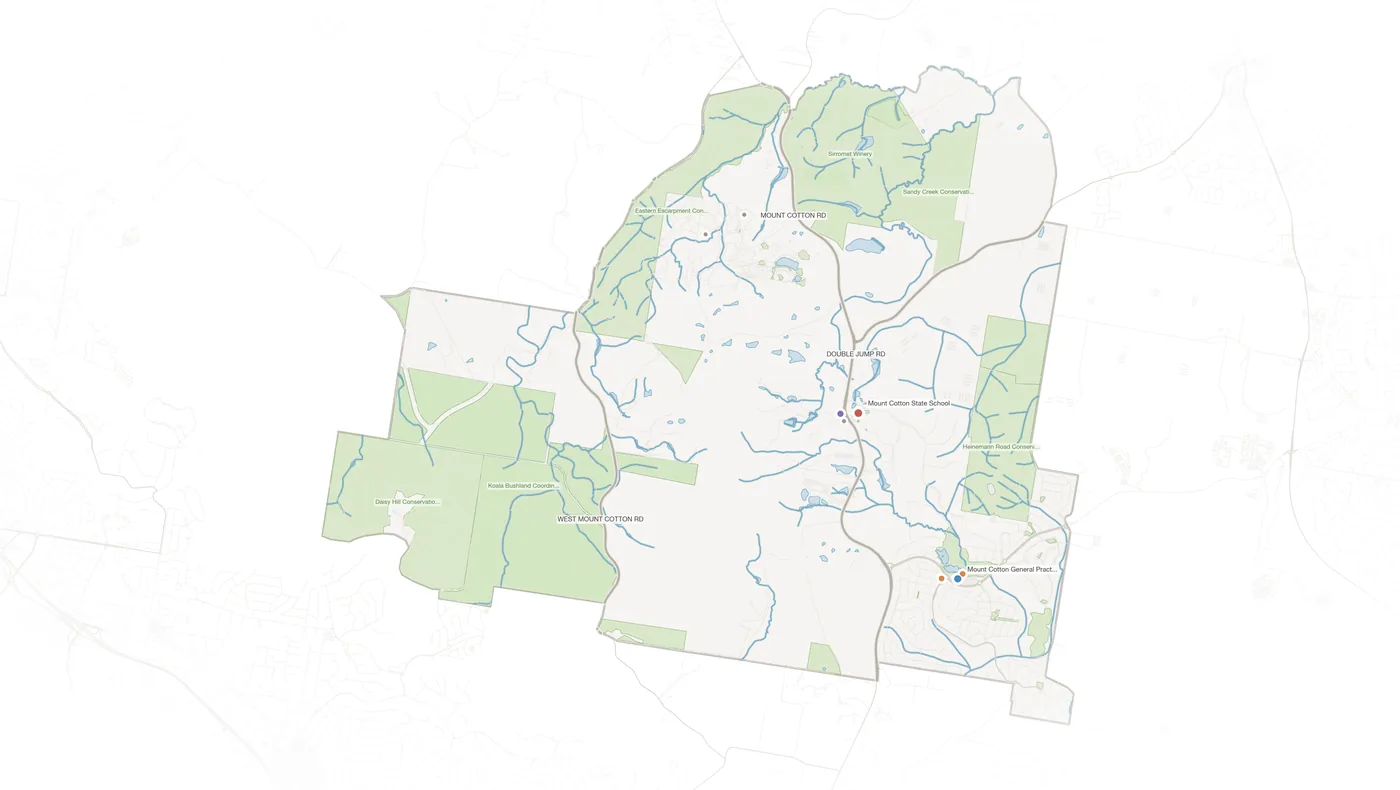
Mount Cotton State School (Government, ICSEA 1047, 605 students) is the sole school, scoring 47 points above the national benchmark. Car dependency is extreme at 93.8%, the highest among all suburbs profiled in this batch, with public transport at just 1.1%. Walking and cycling combined capture only 1%, reflecting the semi-rural layout across 42.7 sq km. The need-for-assistance rate of 3.8% is below the national average, consistent with the younger demographic. IRSAD decile 8 places Mount Cotton in the top 20% nationally for socio-economic advantage.
Drive
93.8%
Public Transport
1.1%
Walk / Cycle
1.0%
Work from Home
N/A
Population Forecast
+1.77%/yr
(+155 people/yr)
EstablishedPopulation growth of 1.77% per year (+155 persons) projects a 2031 population of 9,955. The 10-year growth of 28.7% is strong, though the suburb shows aging-trajectory signals: the senior share rose 3.7 points while the young share dropped 2.2 points, meaning the original wave of young families is maturing. Affordability improved from 50.1% mortgage-to-income in 2011 to 45.2% in 2021. Real income growth was 7%, modest compared to the housing cost trajectory. Net overseas migration of +34 per year slightly exceeds internal migration of -30, making growth primarily natural increase rather than inward movement.
Historical + Forecast
Hamilton-Perry + Holt smoothing on ERP 2001-2025
Age Cohort Forecast
Primary Driver
Overseas Migration
Net Overseas / yr
+34
Net Internal / yr
-30
Gentrification Signal
Not gentrifying
Population +30% since 2011
National Ranking iPercentile rank among ~15,000 AU suburbs. 90% = higher than 90% of suburbs
How Mount Cotton compares to ~15,000 Australian suburbs
Frequently Asked Questions
Is Mount Cotton a good suburb to live in?
Mount Cotton is well-suited to families seeking large detached homes on acreage-style lots, with 79% of properties having 4-plus bedrooms and mortgage stress at just 18.4% of income. Unemployment of 2.9% is below the national average. The trade-off is extreme car dependency at 93.8% and limited local services.
What is the median house price in Mount Cotton?
The estimated median house price is $593,000 as of 2025, derived from rental data. With household incomes at the 94th percentile nationally, mortgage repayments absorb only 18.4% of income, well below the 30% stress threshold.
What schools are in Mount Cotton?
Mount Cotton has 1 school: Mount Cotton State School (Government, ICSEA 1047, 605 students). Its ICSEA score sits 47 points above the national benchmark of 1000. Families requiring secondary schooling commute to nearby suburbs such as Cleveland or Victoria Point.
Is Mount Cotton safe?
Crime data is not available for Mount Cotton in the current dataset. The SEIFA IRSD decile of 10 (lowest disadvantage nationally) and high homeownership at 86.1% (outright plus mortgage) are both strong correlates of low crime. The need-for-assistance rate of 3.8% is below the national average.
Is Mount Cotton good for property investment?
Gross yield of approximately 4.2% ($475/week on $593,000) is above the Brisbane average. The 2.9% vacancy rate signals tight supply. However, only 13.8% of households rent, limiting the tenant pool. Population growth of 1.77% per year (+155 persons) and projected expansion to 9,955 by 2031 provides demand support.
How is Mount Cotton's population changing?
Population grows at 1.77% per year, adding about 155 people annually, projecting to 9,955 by 2031. The 10-year growth of 28.7% is strong. However, the demographic is aging in place: the senior share rose 3.7 points while the young cohort dropped 2.2 points over the decade.
How to read these comparisons
Phrases like "above the national average" reference the unweighted median across Australian suburbs with more than 1,000 residents, not population-weighted national figures. Suburb-level medians are more useful for ranking suburbs against each other; ABS census headlines are population-weighted (so dominated by Sydney and Melbourne) and can read very differently.
Current baseline (refreshed 2026-05-10): median age 40, university-educated 30.1%, born overseas 21.6%, average household size 2.5 people.
Data sources: ABS 2021 Census (demographics, income, tenure), state Valuer-General (house prices), Department of Jobs SALM (unemployment), ACARA (school ICSEA), state Crime Statistics agencies (offences), council DA portals (development applications). Population forecasts use a Hamilton-Perry cohort model calibrated to ABS ERP.
Explore Mount Cotton on the Map
View parcels, zoning overlays, DA applications, schools and more.
Open Interactive Map