Ooralea
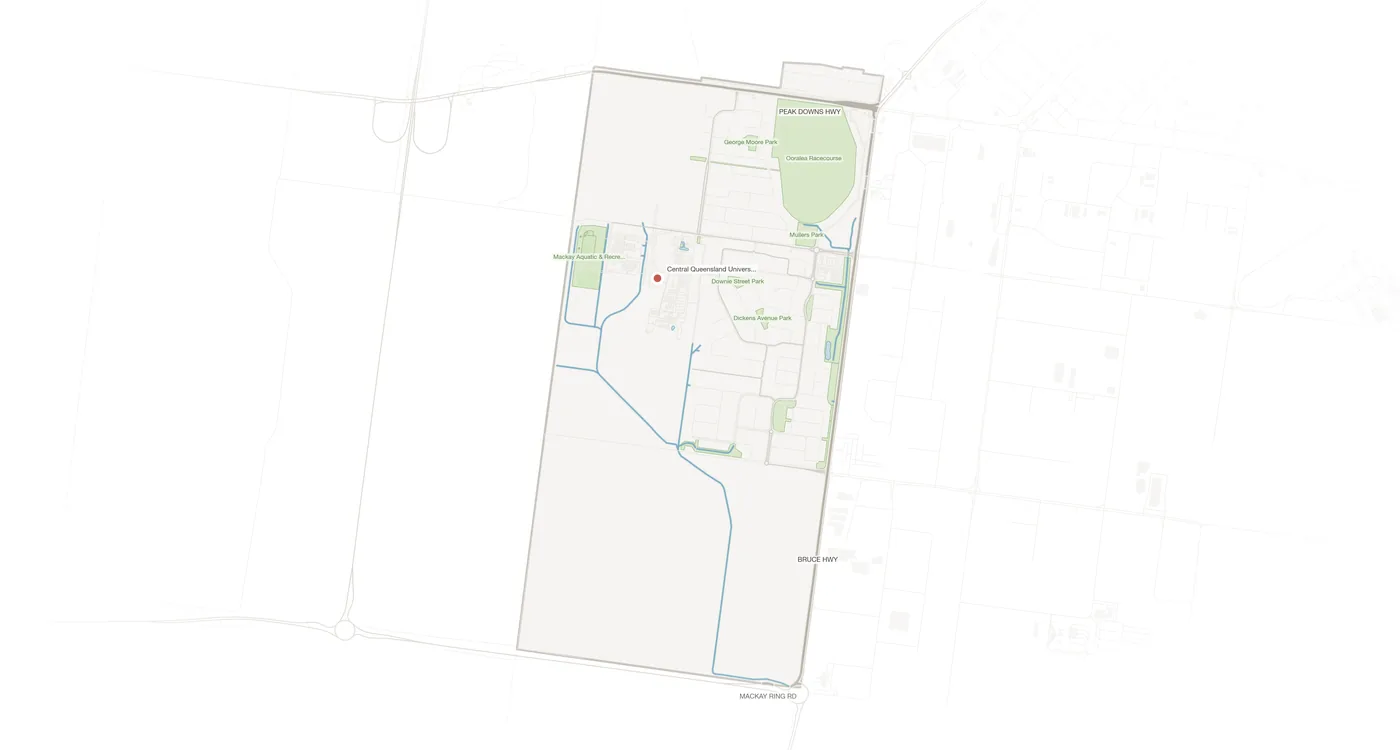
Household income in the 84.8th percentile nationally is the standout data point for Ooralea, a suburb where 15% of workers are employed in mining, driving wages well above regional norms. Population has grown 44% over the past decade, reaching 3,691 residents across a 5.5 square kilometre footprint, and the gentrification score reads Active with net internal migration adding 81 people a year. The suburb sits at a SEIFA IEO decile 3, meaning educational attainment runs below average compared to national peers, yet the income picture tells a different story because resource-sector earnings lift household finances without requiring tertiary credentials.
Population
3,691
Median Age
35.0
Household IncomeiMedian weekly household income (ABS Census)
$2,248/wk
DAs (12 months)iDevelopment Applications lodged in the past year
3
Median House
$535K
Estimated from rent (2025)
The estimated median house price sits at $535,000, a figure derived from rent benchmarks rather than a deep sales dataset, so buyers should treat it as a directional guide. Separate houses dominate at 92.5% of stock, with semi-detached properties making up the remaining 7.5% and no apartment supply recorded. Four-plus bedroom homes account for 55.6% of dwellings, making Ooralea one of the larger-home suburbs in the Mackay region. Monthly mortgage repayments average $1,820, producing a mortgage-to-income ratio of 18.7%, well below the 30% stress threshold and lower than the national average for comparable price points. At 42% of households carrying a mortgage compared to 31.6% owning outright, a significant share of residents are still in the wealth-building phase.
For Buyers
The estimated median house price sits at $535,000, a figure derived from rent benchmarks rather than a deep sales dataset, so buyers should treat it as a directional guide. Separate houses dominate at 92.5% of stock, with semi-detached properties making up the remaining 7.5% and no apartment supply recorded. Four-plus bedroom homes account for 55.6% of dwellings, making Ooralea one of the larger-home suburbs in the Mackay region. Monthly mortgage repayments average $1,820, producing a mortgage-to-income ratio of 18.7%, well below the 30% stress threshold and lower than the national average for comparable price points. At 42% of households carrying a mortgage compared to 31.6% owning outright, a significant share of residents are still in the wealth-building phase.
For Investors
A 7.7% vacancy rate sits higher than the typical healthy threshold of 3%, signalling that the local rental market is looser than supply-constrained capital cities. Weekly rent averages $440, and with rent-to-income at 19.6%, tenants are not under pressure to leave, providing stable if not tight occupancy. The rental pool is relatively small at 26.4% of households, lower than the national average, because the suburb skews toward owner-occupiers. Rent grew 12.3% over the period, a positive signal for yield direction, and net migration of 81 internal plus 39 overseas arrivals annually supports ongoing demand. Population is forecast to reach 7,636 by 2031 under medium projections, a 16% increase from the 2025 baseline of 6,600, which creates a structural tailwind for housing demand.
Development Activity
Total DAs
3
Last 12 Months
3
YoY ChangeiYear-over-year change in DA lodgements
—
Avg DA CostiAverage estimated cost per DA in the past year
N/A
Monthly DA Lodgements
DA Categories
Demographics
The median age of 35 is 5 years below the national figure, giving Ooralea a younger profile than most established suburbs. Overseas-born residents account for 14.3% of the population, which is 7.3 percentage points below the national figure, reflecting the suburb's Anglo-Celtic heritage, led by English (1,316), Irish (392) and Scottish (390) ancestry. University qualifications reach 24.4%, which is 5.7 points below the national average, consistent with the SEIFA IEO decile 3 rating for educational opportunity. Households average 2.7 people, slightly above the national figure, and couples with children (1,379 families) are the dominant household type, underscoring the family-oriented character that also explains the high share of four-plus bedroom homes.
Age Distribution
Bedrooms
Dwelling Structure
92.5%
Houses
7.5%
Townhouse
N/A
Apartment
Tenure
Tenure is heavily weighted toward owner-occupiers: 31.6% own outright and 42% carry a mortgage, leaving 26.4% renting, which is below the national renter share. The stock is almost entirely detached houses at 92.5%, with 7.5% semi-detached and no recorded apartment supply, so buyers have little product diversity to choose from. Bedrooms skew large: 55.6% of dwellings have four or more bedrooms and 38.3% have three bedrooms, meaning two-bedroom and smaller stock is rare at around 6%. Mortgage stress is low at 18.7% of income compared to the national benchmark, and rent stress at 19.6% is similarly comfortable. The affordability trend improved from 46.7% in 2011 to 43.3% in 2021, suggesting housing has become marginally more accessible relative to incomes over the decade.
Mortgage / mo
$1,820
Rent / wk
$440
HH Size
2.7
Personal Income / wk
$996
Vacancy Ratei% of dwellings unoccupied on Census night (ABS 2021)
7.7%
Unoccupied
106
Rent / IncomeiMedian rent as % of household income. Over 30% = housing stress
19.6%
Mortgage / IncomeiMedian mortgage as % of household income. Over 30% = housing stress
18.7%
Community Profile
Languages Spoken at Home
Ancestry
Household Composition
26.6%
Couples, no children
2,900
Total families
Economy & Employment
Healthcare is the largest industry at 18.6% of employed residents (235 workers), but Mining is the economic engine at 15% (189 workers), a share that is unusually high compared to national averages and explains why household income sits in the 84.8th percentile despite below-average university rates. Education accounts for 8.8% and Transport for 7%, consistent with Mackay's regional service-centre role. By occupation, Professionals lead with 379 workers, followed by Clerical and Admin (256) and Machinery and Drivers (235), a split that reflects both the white-collar healthcare and education base and the blue-collar resource workforce. Unemployment is 2.8%, well below the national average, and the full-time employment rate is 71.8%, with a labour force participation rate of 64.9%.
Unemployment
1.9%
Labour Force
3,874
Unemployed
72
Quarterly Trend
Source: SALM Dec-25
Socio-Economic Indexes (SEIFA)iABS index ranking suburbs from 1 (most disadvantaged) to 10 (most advantaged)
Full-time
71.8%
Part-time
25.4%
Participation
64.9%
Employed
1,840
Occupations
Top Industries
University
24.4%
Postgraduate
3.8%
Born Overseas
14.3%
Dwellings
1,262
Transport to Work
Car dependency is high: 91.3% of residents drive to work, which is above the national average, and public transport use is just 1.6%, reflecting Mackay's limited transit network. Walking and cycling account for 1.8% of commutes. Crime data is not available for Ooralea in this dataset, so safety cannot be quantified directly. The SEIFA IRSAD decile sits at 5, placing the suburb in the middle tier nationally for relative socioeconomic advantage and disadvantage. Rent and mortgage stress rates are both below 20%, meaning housing costs are manageable across tenure types. The volunteering rate of 13.4% is moderate, and only 3.8% of residents (133 people) need daily assistance, consistent with the younger median age of 35 and a working-age-dominated population.
Drive
91.3%
Public Transport
1.6%
Walk / Cycle
1.8%
Work from Home
N/A
Population Forecast
+2.5%/yr
(+165 people/yr)
EstablishedPopulation grew 44% over the past decade to reach an estimated 6,600 in 2025, a rate far above the national average for established suburbs. Annual growth is tracking at 2.5%, or about 165 additional persons per year, driven by a balanced combination of internal migration (81 net arrivals annually) and overseas migration (39 net arrivals annually). Medium forecasts project the population reaching 7,636 by 2031, a further 16% rise from the 2025 baseline. The gentrification score reads Active at 44, supported by signals including 56% population growth since 2011 and an accelerating professional share. Real incomes fell 1.5% over the decade despite the resource-sector premium, a signal that cost-of-living gains partially offset wages growth for established residents.
Historical + Forecast
Hamilton-Perry + Holt smoothing on ERP 2001-2025
Age Cohort Forecast
Primary Driver
Balanced
Net Overseas / yr
+39
Net Internal / yr
+81
Gentrification Signal
Active
Population +56% since 2011, Net internal migration +81/yr, Accelerating: 22% → 28%
National Ranking iPercentile rank among ~15,000 AU suburbs. 90% = higher than 90% of suburbs
How Ooralea compares to ~15,000 Australian suburbs
Frequently Asked Questions
Is Ooralea a good suburb to live in?
Ooralea suits families and working households well. Household income sits in the 84.8th percentile nationally, mortgage stress at 18.7% is below the typical 30% threshold, and the median age of 35 reflects a younger, active community. The main trade-offs are limited public transport, a vacancy rate of 7.7%, and an SEIFA IEO decile 3 score indicating below-average educational opportunity nearby.
What is the median house price in Ooralea?
The estimated median house price is $535,000, based on 2025 rent benchmarks. Weekly rent averages $440 and monthly mortgage repayments average $1,820, giving a mortgage-to-income ratio of 18.7%. The stock is 92.5% separate houses with a strong preference for four-plus bedroom homes at 55.6% of dwellings.
What schools are in Ooralea?
No schools are recorded inside the Ooralea boundary in this dataset. Families rely on schools in the broader Mackay area. University qualification rates are 24.4%, which is 5.7 percentage points below the national figure, consistent with the suburb's SEIFA IEO decile 3 score for educational opportunity.
Is Ooralea safe?
Crime statistics are not available for Ooralea in this dataset. As an indirect indicator, the SEIFA IRSD decile is 6 and the IRSAD decile is 5, both in the middle tier nationally. Unemployment is 2.8%, below the national average, and only 3.8% of residents require daily assistance, both consistent with a functionally stable community.
Is Ooralea good for property investment?
The investment case is mixed. Rent grew 12.3% over the period and net annual migration of 120 people supports demand, but the 7.7% vacancy rate is above the typical healthy threshold of 3%. Population is forecast to grow 16% to 7,636 by 2031, which underpins long-term demand. Gross yield on the $535,000 median at $440 weekly rent is around 4.3%, reasonable for a regional market.
How is Ooralea's population changing?
Population grew 44% over the past decade and is estimated at 6,600 in 2025. Annual growth is 2.5%, adding around 165 people per year, split between 81 net internal migrants and 39 net overseas arrivals. Medium forecasts project a further rise to 7,636 by 2031. The suburb's gentrification score is Active at 44, supported by accelerating professional share and sustained migration.
What industries drive employment in Ooralea?
Healthcare leads at 18.6% of workers (235 people) and Mining follows at 15% (189 people). The mining share is significantly higher than the national average, which explains why household income sits in the 84.8th percentile despite university rates at 24.4%. Education accounts for 8.8% and Transport for 7%, reflecting Mackay's regional service role. Unemployment is just 2.8%.
How to read these comparisons
Phrases like "above the national average" reference the unweighted median across Australian suburbs with more than 1,000 residents, not population-weighted national figures. Suburb-level medians are more useful for ranking suburbs against each other; ABS census headlines are population-weighted (so dominated by Sydney and Melbourne) and can read very differently.
Current baseline (refreshed 2026-05-10): median age 40, university-educated 30.1%, born overseas 21.6%, average household size 2.5 people.
Data sources: ABS 2021 Census (demographics, income, tenure), state Valuer-General (house prices), Department of Jobs SALM (unemployment), ACARA (school ICSEA), state Crime Statistics agencies (offences), council DA portals (development applications). Population forecasts use a Hamilton-Perry cohort model calibrated to ABS ERP.
Explore Ooralea on the Map
View parcels, zoning overlays, DA applications, schools and more.
Open Interactive Map