Sadadeen
At a median age of 32, Sadadeen sits 8 years below the national figure, making it one of the younger residential pockets in Alice Springs. The suburb's 2,307 residents are spread across 4.65 square kilometres, with household income at the 64.2nd percentile nationally, a mid-range standing that co-exists with a 52.6% renter majority and a 10.7% vacancy rate well above typical metropolitan norms. Healthcare and Public Administration dominate local employment, accounting for nearly half of all jobs, which explains why the suburb attracts working-age residents rather than retirees. With a university qualification rate of 32.6%, 2.5 points above the national average, the workforce skews professional despite the affordable price point.
Population
2,307
Median Age
32.0
Household IncomeiMedian weekly household income (ABS Census)
$1,805/wk
DAs (12 months)iDevelopment Applications lodged in the past year
0
Median House
$380K
Estimated from rent (2025)
The estimated median house price of $380,000 positions Sadadeen well below capital city markets, offering accessible entry for buyers willing to accept a high renter base. Monthly mortgage repayments average $1,733, and mortgage-to-income sits at 22.2%, below the conventional 30% stress threshold, so the debt load is manageable relative to local incomes in the 64.2nd percentile nationally. The dwelling stock is 58.9% separate houses, with semi-detached homes a substantial 35.2%. Most stock sits in the three-bedroom band at 54%, with two-bedroom dwellings at 24.5%. Outright ownership is low at 10.1%, compared to the national average which exceeds 30%, indicating most buyers here are still servicing mortgages rather than holding unencumbered assets.
For Buyers
The estimated median house price of $380,000 positions Sadadeen well below capital city markets, offering accessible entry for buyers willing to accept a high renter base. Monthly mortgage repayments average $1,733, and mortgage-to-income sits at 22.2%, below the conventional 30% stress threshold, so the debt load is manageable relative to local incomes in the 64.2nd percentile nationally. The dwelling stock is 58.9% separate houses, with semi-detached homes a substantial 35.2%. Most stock sits in the three-bedroom band at 54%, with two-bedroom dwellings at 24.5%. Outright ownership is low at 10.1%, compared to the national average which exceeds 30%, indicating most buyers here are still servicing mortgages rather than holding unencumbered assets.
For Investors
With 52.6% of households renting, Sadadeen has one of the stronger renter-majority profiles among NT suburbs, supporting a steady tenant pool for landlords. Weekly rent of $320 against a $380,000 median implies a gross yield around 4.4%, materially higher than yields common in Melbourne or Sydney. The rent-to-income ratio is 17.7%, below the 30% stress mark, meaning tenants are not stretched, which supports rent stability. The downside is a 10.7% vacancy rate, elevated compared to most capital-city investment markets, which signals that supply has historically outpaced demand. Residential development applications in the past 12 months recorded 0, so no imminent new supply is adding to vacancy pressure.
Demographics
The median age of 32 is 8 years lower than the national figure, reflecting a working-age demographic drawn to Alice Springs public sector and health roles. Overseas-born residents make up 24.4% of the population, 2.8 points above the national average, with English (501), Scottish (171) and Irish (163) ancestries dominating. Aboriginal and Torres Strait Islander languages are spoken by 159 residents, signalling the cultural context of the broader Alice Springs area. Punjabi (24 speakers) and Nepali (13) point to a small but growing South Asian component. Average household size of 2.6 is marginally above the national figure, consistent with a family-oriented age profile rather than a predominantly singles market.
Age Distribution
Bedrooms
Dwelling Structure
58.9%
Houses
35.2%
Townhouse
5.5%
Apartment
Tenure
The 52.6% renter share stands well above national renting levels, while outright owners at 10.1% are substantially lower than national averages that typically exceed 30%. This tenure profile reflects the transient, working-age character of the suburb: residents come for employment contracts and leave rather than accumulating long-term equity. Monthly mortgage repayments of $1,733 and a mortgage-to-income ratio of 22.2% keep purchase viable, but the 10.7% vacancy rate warrants caution. The stock leans toward three-bedroom houses at 54% and separate houses at 58.9%, with semi-detached homes adding 35.2%, a configuration suited to families and share-households rather than singles. Annual turnover is 29.4%, meaning roughly one in three households changes each year.
Mortgage / mo
$1,733
Rent / wk
$320
HH Size
2.6
Personal Income / wk
$984
Vacancy Ratei% of dwellings unoccupied on Census night (ABS 2021)
10.7%
Unoccupied
98
Rent / IncomeiMedian rent as % of household income. Over 30% = housing stress
17.7%
Mortgage / IncomeiMedian mortgage as % of household income. Over 30% = housing stress
22.2%
Community Profile
Languages Spoken at Home
Ancestry
Household Composition
18.8%
Couples, no children
1,742
Total families
Economy & Employment
Healthcare is the defining industry, employing 30% of local workers (226 people), well above national sector averages, because Alice Springs serves as the regional health hub for Central Australia. Public Administration follows at 19.8% (149 workers), driven by NT Government and federal agency presence. Education accounts for 10.8% (81 workers). By occupation, Community and Personal Service workers lead at 247, followed closely by Professionals at 224, then Clerical/Admin at 145 and Managers at 119. The full-time employment rate is 77.5%, above what many outer-suburban areas achieve, and the 6.2% unemployment rate reflects the regional labour market conditions rather than severe structural weakness. Participation stands at 61.3%.
Socio-Economic Indexes (SEIFA)iABS index ranking suburbs from 1 (most disadvantaged) to 10 (most advantaged)
Full-time
77.5%
Part-time
16.3%
Participation
61.3%
Employed
1,022
Occupations
Top Industries
University
32.6%
Postgraduate
9.5%
Born Overseas
24.4%
Dwellings
819
Transport to Work
Car dependency defines daily movement in Sadadeen, with 81.2% of residents driving to work, compared to national figures where public transport and active travel play a larger role. Only 0.9% use public transport and 7.3% walk or cycle. Crime data is not available in the current dataset for direct comparison. No schools are recorded within the suburb boundary, so families depend on nearby Alice Springs institutions for schooling. Volunteering participation is 14.3%, a reasonable level of community engagement. Need-for-assistance is 3.2% (70 residents), close to national norms. Rent-to-income at 17.7% keeps housing costs comfortable for tenants, well below the 30% stress threshold that many higher-cost suburban markets breach.
Drive
81.2%
Public Transport
0.9%
Walk / Cycle
7.3%
Work from Home
N/A
National Ranking iPercentile rank among ~15,000 AU suburbs. 90% = higher than 90% of suburbs
How Sadadeen compares to ~15,000 Australian suburbs
Frequently Asked Questions
Is Sadadeen a good suburb to live in?
Sadadeen suits working-age residents employed in Alice Springs health and government sectors. Household income sits at the 64.2nd percentile nationally and mortgage-to-income is 22.2%, below the 30% stress level. The main drawbacks are a 10.7% vacancy rate, limited public transport at 0.9%, and no schools recorded within the suburb boundary.
What is the median house price in Sadadeen?
The estimated median house price is $380,000, derived from rental data for 2025. Weekly rent averages $320 and monthly mortgage repayments run approximately $1,733. At these levels, the gross rental yield is around 4.4%, higher than typical yields in Sydney or Melbourne markets.
What schools are in Sadadeen?
No schools are recorded within the Sadadeen boundary in this dataset. Families in the suburb rely on schools in surrounding Alice Springs suburbs. Despite this, 32.6% of local residents hold university qualifications, which is 2.5 points above the national average.
Is Sadadeen safe?
Detailed crime statistics are not available for Sadadeen in the current dataset. As a contextual indicator, 3.2% of residents (70 people) need daily assistance, close to national norms, and need-for-assistance levels tend to correlate broadly with disadvantage rather than direct crime exposure. The suburb's 6.2% unemployment rate is worth monitoring as a socioeconomic factor.
Is Sadadeen good for property investment?
The 52.6% renter majority and estimated 4.4% gross yield are stronger than many capital-city alternatives. Rent-to-income at 17.7% means tenants are not stretched, supporting rent stability. However, the 10.7% vacancy rate is elevated, and the 29.4% annual turnover rate means landlords face frequent re-letting costs compared to more settled suburban markets.
How is Sadadeen's population changing?
Long-term population forecasts are not available for Sadadeen, but the 29.4% annual turnover rate indicates significant resident churn each year, typical for NT suburbs driven by government and health contract employment. The median age of 32 is 8 years below the national figure, showing the suburb consistently attracts younger working households rather than long-term settlers.
How to read these comparisons
Phrases like "above the national average" reference the unweighted median across Australian suburbs with more than 1,000 residents, not population-weighted national figures. Suburb-level medians are more useful for ranking suburbs against each other; ABS census headlines are population-weighted (so dominated by Sydney and Melbourne) and can read very differently.
Current baseline (refreshed 2026-05-10): median age 40, university-educated 30.1%, born overseas 21.6%, average household size 2.5 people.
Data sources: ABS 2021 Census (demographics, income, tenure), state Valuer-General (house prices), Department of Jobs SALM (unemployment), ACARA (school ICSEA), state Crime Statistics agencies (offences), council DA portals (development applications). Population forecasts use a Hamilton-Perry cohort model calibrated to ABS ERP.
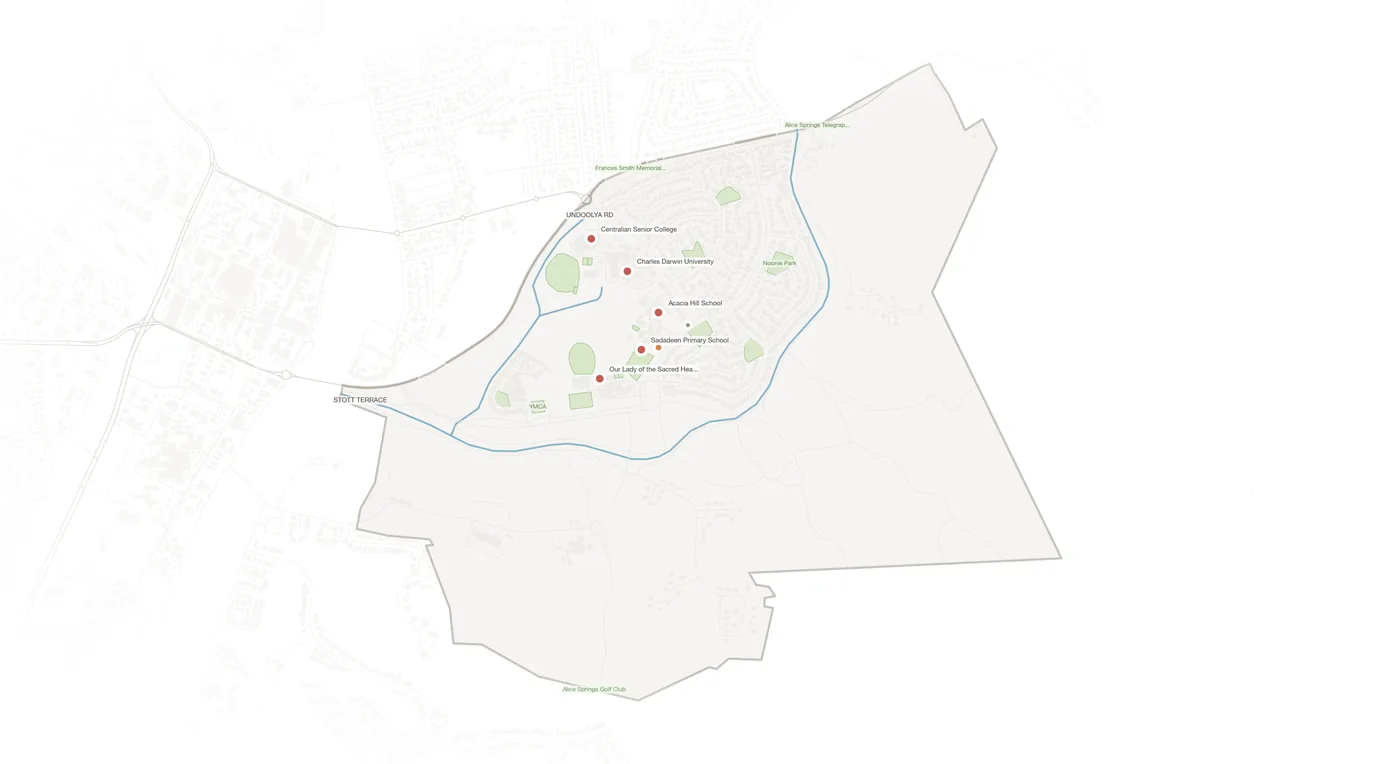
Explore Sadadeen on the Map
View parcels, zoning overlays, DA applications, schools and more.
Open Interactive Map