Sheldon
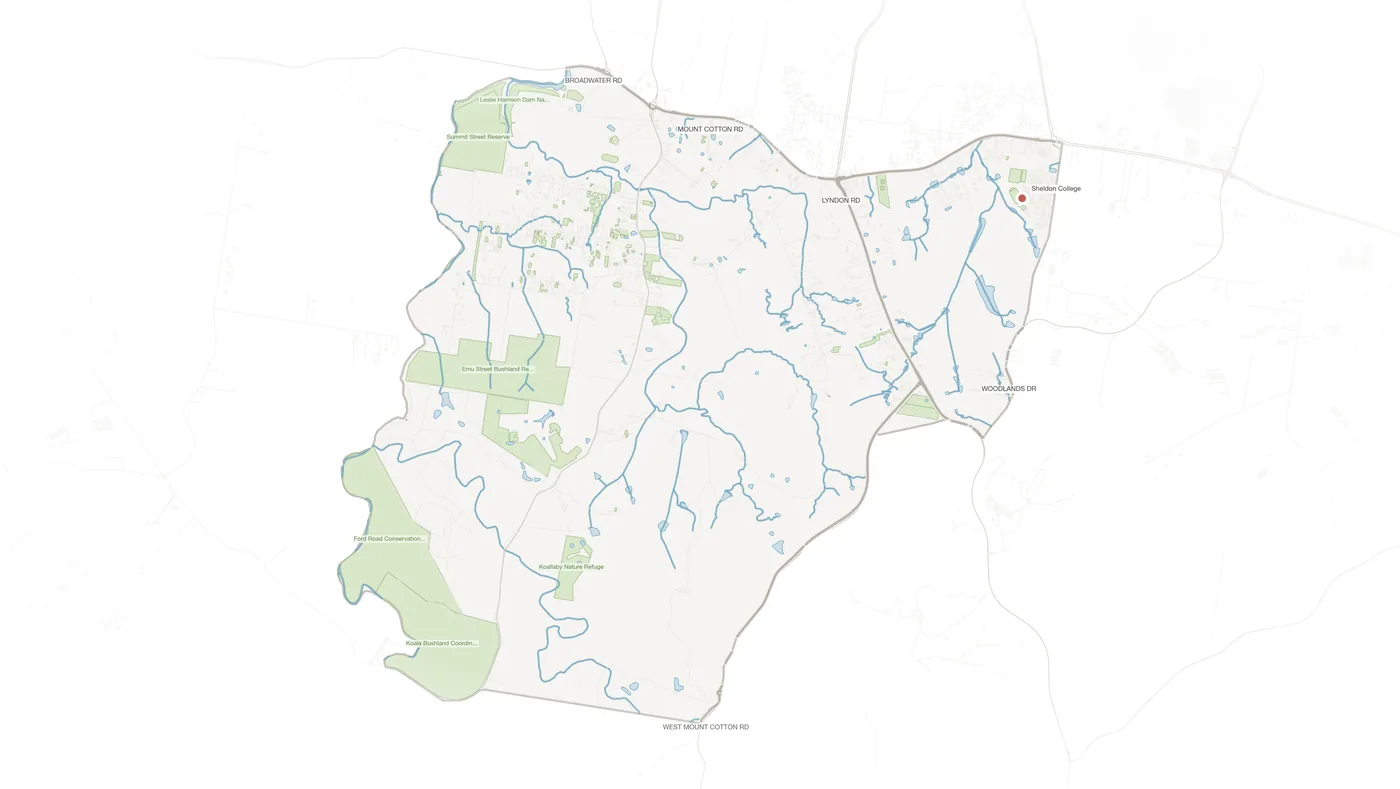
With 99.3% of dwellings being separate houses and household income at the 92.9th percentile nationally, Sheldon sits firmly in the established-wealth tier of Brisbane's outer fringe. The suburb spans 22.76 square kilometres with just 1,762 residents, giving a density of 77.4 people per km2, far below the national urban average. A median age of 47 places residents 7 years above the national figure, and the IRSD decile of 10 marks Sheldon among Australia's least disadvantaged communities. Population grew 28.7% over the decade, pointing to steady demand for this low-density lifestyle.
Population
1,762
Median Age
47.0
Household IncomeiMedian weekly household income (ABS Census)
$2,558/wk
DAs (12 months)iDevelopment Applications lodged in the past year
0
Median House
$649K
Estimated from rent (2025)
The estimated median house price of $649,000 is supported by weekly household income of $2,558, placing Sheldon in the 92.9th income percentile nationally. Monthly mortgage repayments average $2,600, with a mortgage-to-income ratio of 23.5%, comfortably below the 30% stress threshold. Nearly half of all residents, 49.3%, own their home outright, while 45.5% carry a mortgage, leaving only 5.1% renting. Stock is overwhelmingly detached houses at 99.3%, with 72.5% of dwellings having 4 or more bedrooms, well above the national mix. The low renter share suggests the area attracts committed owner-occupiers rather than transient households.
For Buyers
The estimated median house price of $649,000 is supported by weekly household income of $2,558, placing Sheldon in the 92.9th income percentile nationally. Monthly mortgage repayments average $2,600, with a mortgage-to-income ratio of 23.5%, comfortably below the 30% stress threshold. Nearly half of all residents, 49.3%, own their home outright, while 45.5% carry a mortgage, leaving only 5.1% renting. Stock is overwhelmingly detached houses at 99.3%, with 72.5% of dwellings having 4 or more bedrooms, well above the national mix. The low renter share suggests the area attracts committed owner-occupiers rather than transient households.
For Investors
At 5.1% renter share, Sheldon has one of the thinnest rental markets you will find, limiting landlord demand. Weekly rent of $473 against a $649,000 median implies a gross yield around 3.8%, modest compared to higher-density suburbs. The vacancy rate of 2.9% indicates no immediate oversupply, but the near-total absence of apartment stock leaves little room for high-yield plays. Rent grew 18.8% over the period, a positive signal for rent escalation. Net overseas migration averages 34 residents per year against a net internal outflow of 30, keeping population growth thin at 1.77% annually. Investment suits a long-hold capital growth strategy rather than yield-focused acquisition.
Schools in Sheldon iICSEA: school advantage index. 1000 = national avg, higher = more advantaged
Sheldon College
Prep-12 · 1481 students
Demographics
The median age of 47 is 7.0 years above the national figure, and the senior share rose 3.7 points over the decade as the young-adult share fell 2.2 points. Average household size of 3.1 is 0.6 above national, driven by couples with children making up the dominant family type. Residents born overseas account for 19.4%, which is 2.2 points below the national rate, with ancestry led by English (758), Scottish (210) and Irish (204). University qualifications at 33.6% sit 3.5 points above the national average, consistent with the professional household profile. The volunteering rate of 17.5% points to a well-established community with stable long-term residents.
Age Distribution
Bedrooms
Dwelling Structure
99.3%
Houses
N/A
Townhouse
0.7%
Apartment
Tenure
Sheldon's housing stock is unusually uniform: 99.3% separate houses, with 72.5% having 4 or more bedrooms. Tenure leans strongly toward ownership, with 49.3% owning outright and 45.5% on a mortgage, leaving renters at just 5.1%, far below state and national averages. The estimated median house price of $649,000 reflects a rent-derived estimate for 2025. Monthly mortgage repayments average $2,600, with a mortgage-to-income ratio of 23.5%, below the stress threshold. Outright ownership at nearly half of all dwellings, compared to the national figure closer to 31%, signals long-held properties and low forced-sale risk. Vacancy at 2.9% is in the moderate range.
Mortgage / mo
$2,600
Rent / wk
$473
HH Size
3.1
Personal Income / wk
$849
Vacancy Ratei% of dwellings unoccupied on Census night (ABS 2021)
2.9%
Unoccupied
16
Rent / IncomeiMedian rent as % of household income. Over 30% = housing stress
18.5%
Mortgage / IncomeiMedian mortgage as % of household income. Over 30% = housing stress
23.5%
Community Profile
Ancestry
Household Composition
29.5%
Couples, no children
1,571
Total families
Economy & Employment
Healthcare leads local employment at 16.2% of workers (101 people), followed by Construction at 15.3% (95) and Education at 11.1% (69). Professional/Technical services at 10.9% (68 workers) is the fourth sector. By occupation, Professionals (210) and Managers (148) dominate, consistent with the IRSAD decile 8 and IEO decile 7 scores. Full-time employment reaches 61.2% of the employed workforce. The unemployment rate of 4.2% sits slightly above the national average of around 4%, and participation at 58.7% is moderate, reflecting the older median age of 47 with 485 residents not in the labour force. Real incomes grew 7.0% over the decade.
Unemployment
1.4%
Labour Force
5,648
Unemployed
77
Quarterly Trend
Source: SALM Dec-25
Socio-Economic Indexes (SEIFA)iABS index ranking suburbs from 1 (most disadvantaged) to 10 (most advantaged)
Full-time
61.2%
Part-time
34.6%
Participation
58.7%
Employed
838
Occupations
Top Industries
University
33.6%
Postgraduate
7.3%
Born Overseas
19.4%
Dwellings
541
Transport to Work
Sheldon is almost entirely car-dependent: 90.9% of residents drive to work, and only 1.0% use public transport, well below state and national averages. The 22.76 km2 area with just 1,762 people gives 77.4 residents per km2, so distances to services are real. No schools are recorded within the suburb boundary, requiring families to rely on surrounding areas. The IRSAD decile of 8 and IRSD decile of 10 mark Sheldon as advantaged nationally, with housing stress absent at a rent-to-income ratio of 18.5%. Only 4.6% of residents need daily assistance. The low turnover rate of 19.5%, with 80.5% of residents having stayed, indicates genuine long-term residential satisfaction.
Drive
90.9%
Public Transport
1.0%
Walk / Cycle
2.2%
Work from Home
N/A
Population Forecast
+1.77%/yr
(+155 people/yr)
EstablishedPopulation grew 28.7% over the past decade, from roughly 1,369 to 1,762, and the medium forecast puts the broader SA2 reaching 9,800 by 2030 at 1.77% annual growth. Overseas migration drives inflows at a net 34 per year, while internal migration produces a net outflow of 30 per year. The gentrification score of 23 registers as early signs, supported by population growth above 30% since 2011, though the suburb starts from an already-advantaged base at IRSD decile 10. Affordability improved from 50.1% in 2011 to 45.2% in 2021, suggesting housing costs have grown more slowly than incomes. No COVID population dip was recorded, pointing to consistent demand.
Historical + Forecast
Hamilton-Perry + Holt smoothing on ERP 2001-2025
Age Cohort Forecast
Primary Driver
Overseas Migration
Net Overseas / yr
+34
Net Internal / yr
-30
Gentrification Signal
Not gentrifying
Population +30% since 2011
National Ranking iPercentile rank among ~15,000 AU suburbs. 90% = higher than 90% of suburbs
How Sheldon compares to ~15,000 Australian suburbs
Frequently Asked Questions
Is Sheldon a good suburb to live in?
Sheldon scores at IRSD decile 10, the top tier nationally for low disadvantage, with household income in the 92.9th percentile. Its 22.76 km2 low-density setting offers large 4-plus bedroom homes to 80.5% of long-term residents. The main trade-offs are near-total car dependency (90.9% drive) and no schools recorded inside the suburb boundary.
What is the median house price in Sheldon?
The estimated median house price is $649,000 (2025, derived from rent data). Monthly mortgage repayments average $2,600, with a mortgage-to-income ratio of 23.5%, below the stress threshold. Weekly rent averages $473 for the small rental market of 5.1% of dwellings.
What schools are in Sheldon?
No schools are recorded within the Sheldon suburb boundary in this dataset. Families rely on schools in neighbouring suburbs. The local education level is strong, with 33.6% of residents holding university qualifications, which is 3.5 points above the national average.
Is Sheldon safe?
Specific crime statistics are not available for Sheldon. As an indirect measure, the suburb scores at IRSD decile 10, the highest advantage tier nationally, and only 4.6% of its 1,762 residents (79 people) need daily assistance. Low-disadvantage areas consistently correlate with lower crime rates at the national level.
Is Sheldon good for property investment?
The renter share is just 5.1%, limiting tenant demand, and weekly rent of $473 against a $649,000 median gives a gross yield around 3.8%. Rent grew 18.8% over the period, supporting rental income growth. Population grew 28.7% over the decade, but the dominant owner-occupier profile means this market suits capital growth strategies more than yield.
How is Sheldon's population changing?
Population grew 28.7% over the past decade and is forecast to continue at 1.77% annually. Overseas migration contributes a net 34 residents per year, while internal migration records a net outflow of 30. The aging trajectory shows the senior share rising 3.7 points over the decade, with the median age already 7 years above the national figure at 47.
How to read these comparisons
Phrases like "above the national average" reference the unweighted median across Australian suburbs with more than 1,000 residents, not population-weighted national figures. Suburb-level medians are more useful for ranking suburbs against each other; ABS census headlines are population-weighted (so dominated by Sydney and Melbourne) and can read very differently.
Current baseline (refreshed 2026-05-10): median age 40, university-educated 30.1%, born overseas 21.6%, average household size 2.5 people.
Data sources: ABS 2021 Census (demographics, income, tenure), state Valuer-General (house prices), Department of Jobs SALM (unemployment), ACARA (school ICSEA), state Crime Statistics agencies (offences), council DA portals (development applications). Population forecasts use a Hamilton-Perry cohort model calibrated to ABS ERP.
Explore Sheldon on the Map
View parcels, zoning overlays, DA applications, schools and more.
Open Interactive Map