Springwood
Overseas migration averaging 374 people per year is the dominant growth engine in Springwood, nearly double the internal outflow of 200/year, producing a net population increase of 1.05% annually. This high overseas inflow is reshaping the suburb's composition: Korean (85), Mandarin (70), and Punjabi (59) speakers lead non-English languages, and 31.8% were born overseas (10.2 points above national). Despite this churn, the suburb sits in a stable SEIFA band (IRSAD decile 6, IRSD decile 6) and the mortgage-to-income ratio of 23.1% is comfortably below the stress threshold. 137 development applications in 12 months, the highest in this batch, confirm Springwood is being actively redeveloped.
Population
9,710
Median Age
40.0
Household IncomeiMedian weekly household income (ABS Census)
$1,736/wk
DAs (12 months)iDevelopment Applications lodged in the past year
143
Median House
$480K
Estimated from rent (2025)
The estimated $480,000 median makes Springwood accessible for the Logan corridor. Detached houses at 72.3% dominate, but semi-detached at 23.8% provides significant alternative stock. Three-bedroom homes (42.1%) and four-plus bedrooms (39.2%) are the most common formats. Monthly mortgage repayments of $1,733 produce a comfortable mortgage-to-income ratio of 23.1%, well below the stress line. Mortgage holders at 40.0% and outright owners at 29.8% mean 69.8% own or are buying. Public transport at 5.6% benefits from bus connections to the Brisbane CBD. All 4 local schools cluster near or above the ICSEA 1,000 benchmark.
For Buyers
The estimated $480,000 median makes Springwood accessible for the Logan corridor. Detached houses at 72.3% dominate, but semi-detached at 23.8% provides significant alternative stock. Three-bedroom homes (42.1%) and four-plus bedrooms (39.2%) are the most common formats. Monthly mortgage repayments of $1,733 produce a comfortable mortgage-to-income ratio of 23.1%, well below the stress line. Mortgage holders at 40.0% and outright owners at 29.8% mean 69.8% own or are buying. Public transport at 5.6% benefits from bus connections to the Brisbane CBD. All 4 local schools cluster near or above the ICSEA 1,000 benchmark.
For Investors
Renters at 30.1% provide a solid tenant pool, and median weekly rent of $380 against a $480,000 estimated median produces a gross yield around 4.1%, above the national average. The vacancy rate of 5.3% is moderate. 137 DAs in 12 months, including commercial fit-outs, pools, and residential construction, indicate a highly active development pipeline. Overseas migration of 374/year ensures sustained demand, though internal outflow of 200/year reflects resident displacement. Rents grew 35.6% over the decade, and real incomes rose 16.0%, both well above the national average, confirming structural rental growth.
Development Activity
Total DAs
281
Last 12 Months
143
YoY ChangeiYear-over-year change in DA lodgements
+429.6%
Avg DA CostiAverage estimated cost per DA in the past year
N/A
Monthly DA Lodgements
DA Categories
Schools in Springwood iICSEA: school advantage index. 1000 = national avg, higher = more advantaged
Calvary Christian College
Prep-12 · 952 students
Chatswood Hills State School
Prep-6 · 607 students
Springwood State High School
7-12 · 577 students
Springwood Central State School
Prep-6 · 252 students
Demographics
English ancestry leads at 3,545, with Scottish (1,038), Irish (989), and German (567) forming a European base, while a substantial 'Other' category (1,265) reflects the overseas-born share. At 31.8% born overseas (10.2 points above national), Springwood's migrant population is significant. Korean (85), Mandarin (70), Punjabi (59), Cantonese (33), and Arabic (31) lead non-English languages. The median age of 40 matches the national figure, and the trajectory is stable (senior share barely changed at +0.1 points). Average household size of 2.6 is near the national 2.5, and the 24.8% turnover rate is above average, consistent with a suburb experiencing demographic transition.
Age Distribution
Bedrooms
Dwelling Structure
72.3%
Houses
23.8%
Townhouse
3.9%
Apartment
Tenure
Mortgage holders at 40.0% lead, with outright owners at 29.8% and renters at 30.1%. Detached houses at 72.3% dominate, with semi-detached at 23.8% and apartments at 3.9%. Three-bedroom homes (42.1%) and four-plus (39.2%) account for 81.3% of stock, with two-bedroom at 16.0%. The estimated $480,000 median is rent-derived. Mortgage-to-income at 23.1% and rent-to-income at 21.9% are both well below stress thresholds, making Springwood one of the more affordable suburbs in this batch relative to income. The affordability trend is improving (48.8% to 46.4% ratio over the decade).
Mortgage / mo
$1,733
Rent / wk
$380
HH Size
2.6
Personal Income / wk
$791
Vacancy Ratei% of dwellings unoccupied on Census night (ABS 2021)
5.3%
Unoccupied
199
Rent / IncomeiMedian rent as % of household income. Over 30% = housing stress
21.9%
Mortgage / IncomeiMedian mortgage as % of household income. Over 30% = housing stress
23.1%
Community Profile
Languages Spoken at Home
Ancestry
Household Composition
27.0%
Couples, no children
7,689
Total families
Economy & Employment
Healthcare leads at 16.7% (534 workers), followed by Education at 13.6% (435), Construction at 10.8% (345), Professional/Technical at 8.5% (272), and Public Administration at 8.5% (270). Professionals (1,046) dominate occupations, with Clerical/Admin (743) and Managers (563) following. The 5.7% unemployment rate is slightly above the national average, and participation at 57.6% is moderate. Full-time employment at 65.3% runs close to the national average. The SEIFA IEO decile 6 and IER decile 6 confirm mid-range education, occupation, and economic resource levels.
Unemployment
6.2%
Labour Force
11,174
Unemployed
690
Quarterly Trend
Source: SALM Dec-25
Socio-Economic Indexes (SEIFA)iABS index ranking suburbs from 1 (most disadvantaged) to 10 (most advantaged)
Full-time
65.3%
Part-time
29.0%
Participation
57.6%
Employed
4,336
Occupations
Top Industries
University
33.0%
Postgraduate
7.2%
Born Overseas
31.8%
Dwellings
3,533
Transport to Work
Four schools cluster near the national ICSEA benchmark: Calvary Christian College (Independent Combined, 1,069, 952 students), Chatswood Hills State School (Government Primary, 1,028, 607 students), Springwood State High School (Government Secondary, 991, 577 students), and Springwood Central State School (Government Primary, 984, 252 students). The independent school sits notably above the government schools. Public transport at 5.6% is above many comparable outer suburbs. The IRSAD decile 6 and IRSD decile 6 place Springwood in the middle band of advantage. Rent-to-income at 21.9% is comfortable.
Drive
86.8%
Public Transport
5.6%
Walk / Cycle
2.2%
Work from Home
N/A
Population Forecast
+1.05%/yr
(+208 people/yr)
EstablishedPopulation grows at 1.05% per year (208 persons), reaching an estimated 19,779 in 2025. Overseas migration of 374/year is the primary engine, offsetting internal outflow of 200/year. The 10-year change of 16.9% is above the national average. The trajectory is stable (neither aging nor rejuvenating significantly), with senior share barely changed at +0.1 points. The gentrification score of 34 (early signs) from the shift analysis reflects rising incomes (16.0% real growth) and the population influx. Medium projections forecast 21,042 by 2031.
Historical + Forecast
Hamilton-Perry + Holt smoothing on ERP 2001-2025
Age Cohort Forecast
Primary Driver
Overseas Migration
Net Overseas / yr
+374
Net Internal / yr
-200
Gentrification Signal
Not gentrifying
Population +19% since 2011, Net internal outflow -200/yr, Strong overseas inflow +374/yr
National Ranking iPercentile rank among ~15,000 AU suburbs. 90% = higher than 90% of suburbs
How Springwood compares to ~15,000 Australian suburbs
Frequently Asked Questions
Is Springwood a good suburb to live in?
Springwood suits families wanting affordable housing ($480,000 estimated median) with a comfortable 23.1% mortgage-to-income ratio. Four schools cluster near the ICSEA benchmark, and public transport at 5.6% connects to Brisbane. IRSAD decile 6 indicates mid-range advantage. The 137 DAs in 12 months signal a suburb in active transition.
What is the median house price in Springwood?
The estimated median is $480,000, derived from rental data. Monthly mortgage repayments average $1,733, and median weekly rent is $380. The mortgage-to-income ratio of 23.1% is comfortable against the $1,736/week household income, which sits in the 60.9th percentile nationally.
What schools are in Springwood?
Four schools serve the suburb: Calvary Christian College (Independent Combined, ICSEA 1,069, 952 students) sits well above the benchmark. Chatswood Hills State School (Government, 1,028, 607 students) also exceeds it. Springwood State High School (Government Secondary, 991, 577 students) and Springwood Central (Government Primary, 984, 252 students) sit just below the 1,000 line.
Is Springwood safe?
Crime-specific data is not available in the current dataset. The IRSD decile 6 and IRSAD decile 6 indicate mid-range socioeconomic standing. The 5.7% unemployment rate is slightly above the national average. The 69.8% ownership rate and family-dominated household composition are typically associated with moderate crime levels.
Is Springwood good for property investment?
Gross yield is approximately 4.1% ($380/week on $480,000), above the national median. The 5.3% vacancy rate is moderate. 137 DAs in 12 months represent the highest development activity in this batch. Overseas migration of 374/year ensures sustained demand. Rents grew 35.6% and real incomes rose 16.0% over the decade, both supporting long-term rental growth.
How is Springwood's population changing?
Population grows at 1.05% per year (208 persons), reaching an estimated 19,779 in 2025. Overseas migration of 374/year is the dominant driver, offsetting internal outflow of 200/year. The 10-year growth of 16.9% exceeds the national average. The median age of 40 matches national, and the age structure is stable (senior share barely changed at +0.1 points).
How much development is happening in Springwood?
137 development applications were lodged in the past 12 months, the highest in this batch. Applications include commercial fit-outs, swimming pools, carports, and residential construction. This level of activity reflects Springwood's position in the fast-growing Logan corridor, with 1.05% annual population growth and strong overseas migration inflow.
How to read these comparisons
Phrases like "above the national average" reference the unweighted median across Australian suburbs with more than 1,000 residents, not population-weighted national figures. Suburb-level medians are more useful for ranking suburbs against each other; ABS census headlines are population-weighted (so dominated by Sydney and Melbourne) and can read very differently.
Current baseline (refreshed 2026-05-10): median age 40, university-educated 30.1%, born overseas 21.6%, average household size 2.5 people.
Data sources: ABS 2021 Census (demographics, income, tenure), state Valuer-General (house prices), Department of Jobs SALM (unemployment), ACARA (school ICSEA), state Crime Statistics agencies (offences), council DA portals (development applications). Population forecasts use a Hamilton-Perry cohort model calibrated to ABS ERP.
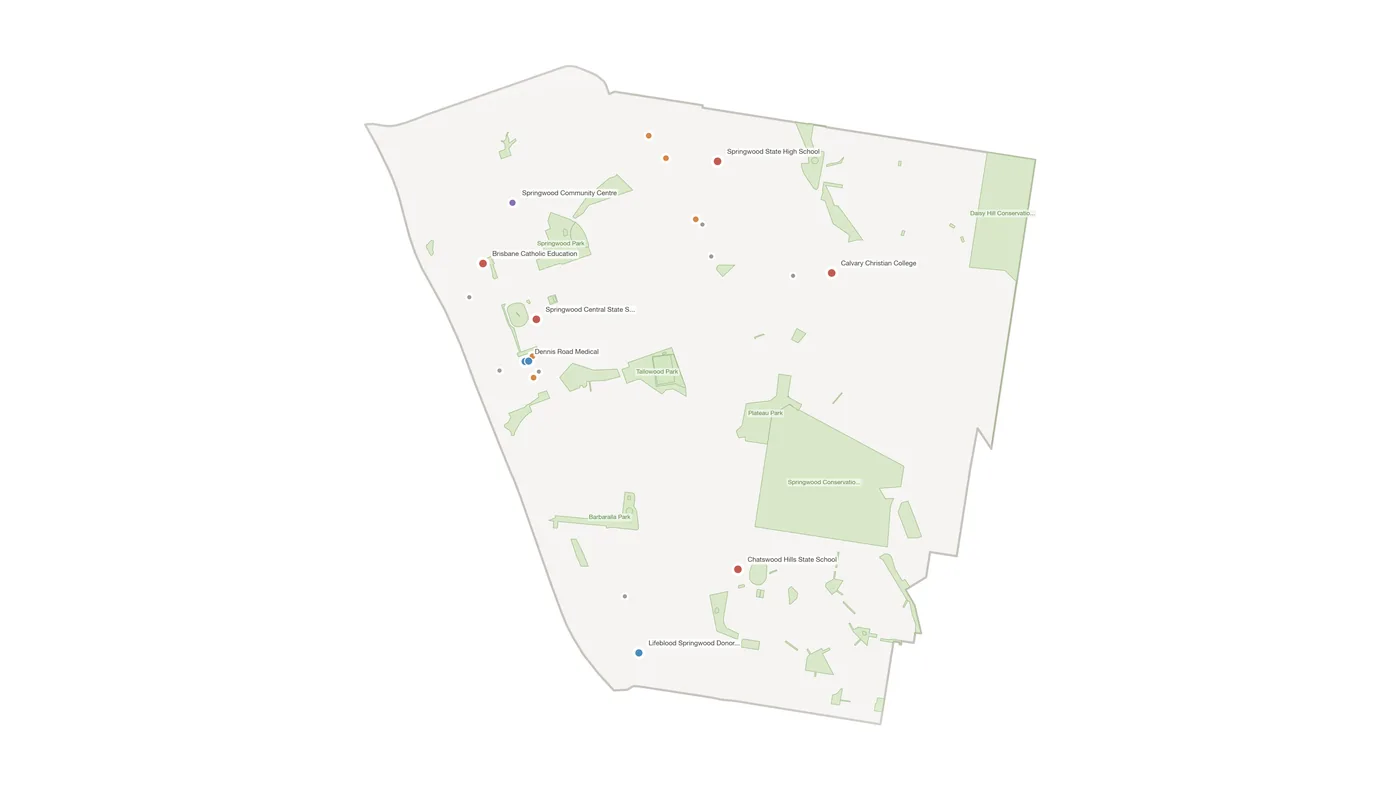
Explore Springwood on the Map
View parcels, zoning overlays, DA applications, schools and more.
Open Interactive Map