Tallebudgera
Household income in Tallebudgera sits at the 89.7th percentile nationally, yet 91.8% of residents commute by car because public transport serves only 0.8% of workers. That infrastructure gap tells the story: this is a spacious, well-off Gold Coast hinterland suburb that trades urban connectivity for land. At 19.21 km2 with just 3,826 people and a density of 199 per km2, it is one of the lower-density pockets in the region. More than 94% of dwellings are separate houses and 67.4% have four or more bedrooms, well above the national average for bedroom size.
Population
3,826
Median Age
42.0
Household IncomeiMedian weekly household income (ABS Census)
$2,372/wk
DAs (12 months)iDevelopment Applications lodged in the past year
0
Median House
$728K
Estimated from rent (2025)
The estimated median house price is $728,000, derived from rent data for 2025, which places Tallebudgera below most comparable Gold Coast coastal suburbs. Monthly mortgage repayments average $2,500, giving a mortgage-to-income ratio of 24.3%, which sits below the 30% stress threshold, meaning repayments are manageable relative to local incomes at the 89.7th percentile nationally. The stock is overwhelmingly detached houses at 94.4%, with 67.4% having four or more bedrooms, and only 1.1% apartments. Outright owners (41.1%) nearly match mortgage holders (50.8%), signalling an established community with meaningful equity depth. Semi-detached dwellings are 4.5%, leaving very limited entry-level attached housing.
For Buyers
The estimated median house price is $728,000, derived from rent data for 2025, which places Tallebudgera below most comparable Gold Coast coastal suburbs. Monthly mortgage repayments average $2,500, giving a mortgage-to-income ratio of 24.3%, which sits below the 30% stress threshold, meaning repayments are manageable relative to local incomes at the 89.7th percentile nationally. The stock is overwhelmingly detached houses at 94.4%, with 67.4% having four or more bedrooms, and only 1.1% apartments. Outright owners (41.1%) nearly match mortgage holders (50.8%), signalling an established community with meaningful equity depth. Semi-detached dwellings are 4.5%, leaving very limited entry-level attached housing.
For Investors
The rental market is thin, with only 8.1% of dwellings rented compared to a much higher national average, which reflects the ownership-dominant character of the suburb. Weekly rent of $595 against an estimated $728,000 median implies a gross yield around 4.2%, reasonable for a house-dominant market. Vacancy sits at 3.2%, slightly above the 3% equilibrium level, suggesting mild oversupply pressure in the rental segment. Annual net overseas migration of 68 persons and net internal migration of 36 provide steady underlying demand. Population grew 12.6% over the past decade and is forecast at roughly 0.97% annual growth, reaching around 8,500 residents by 2031, which supports long-term demand more than near-term yield.
Schools in Tallebudgera iICSEA: school advantage index. 1000 = national avg, higher = more advantaged
St Andrews Lutheran College
Prep-12 · 1377 students
Tallebudgera State School
Prep-6 · 751 students
Demographics
The median age of 42 is 2 years above the national figure, and the aging trend is pronounced: the senior share rose 5.3 points while working-age share fell 2.8 points over the decade. Overseas-born residents at 18.7% sit 2.9 points below national, consistent with the Anglo-Celtic ancestry concentration: English (1,786), Irish (497) and Scottish (469) lead the heritage data. University qualifications reach 29.2%, which is 0.9 points below national, meaning the suburb is educated but not at the level seen in knowledge-economy suburbs. Average household size of 3.3 is 0.8 above national, driven by the high share of couples with children (1,451 families out of 3,182 total) and large-format four-plus bedroom homes.
Age Distribution
Bedrooms
Dwelling Structure
94.4%
Houses
4.5%
Townhouse
1.1%
Apartment
Tenure
Tenure divides into outright owners at 41.1% and mortgage holders at 50.8%, with only 8.1% renting. That 92% owner-occupier rate is well above national norms and reflects long-held, stable ownership rather than investor churn. Stock is 94.4% separate houses, with four-plus bedroom homes accounting for 67.4% of all dwellings, 3-bedroom at 24.0%, and only 6.1% two-bedroom. This size distribution is skewed large even compared to other detached-dominant suburbs. Mortgage-to-income at 24.3% and rent-to-income at 25.1% both sit below common stress thresholds, suggesting the current price level remains accessible for local income levels at the 89.7th percentile nationally.
Mortgage / mo
$2,500
Rent / wk
$595
HH Size
3.3
Personal Income / wk
$790
Vacancy Ratei% of dwellings unoccupied on Census night (ABS 2021)
3.2%
Unoccupied
36
Rent / IncomeiMedian rent as % of household income. Over 30% = housing stress
25.1%
Mortgage / IncomeiMedian mortgage as % of household income. Over 30% = housing stress
24.3%
Community Profile
Ancestry
Household Composition
23.0%
Couples, no children
3,182
Total families
Economy & Employment
Healthcare leads local employment at 16.9% (213 workers), followed closely by Construction at 16.3% (205) and Education at 12.1% (152). Professional/Tech accounts for 9.6% and Retail 8.2%. By occupation, Professionals (419) and Managers (270) dominate, aligning with SEIFA IRSAD and IEO scores at decile 8. The unemployment rate is 5.0% and the participation rate 58.8%, with 927 residents not in the labour force, partly explained by the aging median age of 42 and the high outright-ownership rate reducing financial pressure to work. Real income grew 14.9% over the decade, faster than inflation, indicating genuine earnings improvement. SEIFA IER scores at decile 10 signal strong physical and economic resources relative to national benchmarks.
Unemployment
2.3%
Labour Force
4,458
Unemployed
103
Quarterly Trend
Source: SALM Dec-25
Socio-Economic Indexes (SEIFA)iABS index ranking suburbs from 1 (most disadvantaged) to 10 (most advantaged)
Full-time
58.1%
Part-time
36.9%
Participation
58.8%
Employed
1,697
Occupations
Top Industries
University
29.2%
Postgraduate
7.0%
Born Overseas
18.7%
Dwellings
1,081
Transport to Work
Car dependency is near-total, with 91.8% of workers driving and only 0.8% using public transport, the lowest public transport share typical of outer hinterland suburbs. Walking and cycling account for 2.0%. The suburb scores IRSAD decile 8, indicating low disadvantage relative to the national average. The SEIFA IER score of decile 10 reflects strong household resources. No schools are recorded within the Tallebudgera boundary in available data, so families depend on facilities in neighbouring suburbs such as Elanora, Currumbin and Palm Beach. Crime data is not available for this suburb. The volunteering rate of 15.9% and the 7.0% needing daily assistance (255 residents) point to a community with meaningful social engagement relative to its population size.
Drive
91.8%
Public Transport
0.8%
Walk / Cycle
2.0%
Work from Home
N/A
Population Forecast
+0.97%/yr
(+79 people/yr)
EstablishedPopulation grew 12.6% over the past decade and sits at 3,826 as of the Census, with historical area figures tracking 7,925 in 2023 to 8,112 in 2025 at the SA2 level. The medium forecast projects growth reaching around 8,573 by 2031, implying roughly 79 additional persons per year at a 0.97% annual rate. Migration is balanced: net overseas migration averages 68 annually and net internal migration 36. The gentrification score is only 5 and the stage reads not gentrifying, which makes sense given the suburb is already well-established with SEIFA IRSD at decile 8. Affordability was broadly stable at 65.3% in 2011 versus 64.2% in 2021, one of the more resilient affordability readings across Gold Coast fringe suburbs.
Historical + Forecast
Hamilton-Perry + Holt smoothing on ERP 2001-2025
Age Cohort Forecast
Primary Driver
Balanced
Net Overseas / yr
+68
Net Internal / yr
+36
Gentrification Signal
Not gentrifying
Population +14% since 2011
National Ranking iPercentile rank among ~15,000 AU suburbs. 90% = higher than 90% of suburbs
How Tallebudgera compares to ~15,000 Australian suburbs
Frequently Asked Questions
Is Tallebudgera a good suburb to live in?
Tallebudgera ranks in SEIFA IRSAD decile 8 nationally and household income sits at the 89.7th percentile. It suits families wanting large houses, with 94.4% separate houses and 67.4% having 4 or more bedrooms. The trade-off is car dependency, with 91.8% of workers driving because public transport serves only 0.8% of commuters.
What is the median house price in Tallebudgera?
The estimated median house price is $728,000 (derived from 2025 rent data). Weekly rent averages $595. Monthly mortgage repayments average $2,500, giving a mortgage-to-income ratio of 24.3%, below the 30% stress threshold given local incomes at the 89.7th percentile nationally.
What schools are in Tallebudgera?
No schools are recorded within the Tallebudgera boundary in available data. Families rely on schools in neighbouring suburbs including Elanora, Currumbin Valley and Palm Beach. Despite this, 29.2% of local residents hold university qualifications, consistent with the suburb's SEIFA IEO decile 7 standing.
Is Tallebudgera safe?
Detailed crime statistics are not available for Tallebudgera in this dataset. As an indirect indicator, the suburb scores SEIFA IRSD decile 8, meaning relative disadvantage is low compared to the national average. Only 7.0% of its 3,826 residents (255 people) need daily assistance, consistent with a stable, low-disadvantage community.
Is Tallebudgera good for property investment?
Weekly rent of $595 against an estimated $728,000 median implies a gross yield around 4.2%, reasonable for a detached-house market. However, only 8.1% of dwellings are rented, so investor stock is scarce. Vacancy is 3.2% and population is growing at 0.97% per year, forecast to reach around 8,573 residents by 2031.
How is Tallebudgera's population changing?
Population grew 12.6% over the decade and is growing at roughly 0.97% annually, adding about 79 persons per year. Net overseas migration averages 68 a year and net internal migration 36. Medium forecasts project the broader area reaching around 8,573 residents by 2031. The age profile is shifting older, with the senior share up 5.3 points over the decade.
How to read these comparisons
Phrases like "above the national average" reference the unweighted median across Australian suburbs with more than 1,000 residents, not population-weighted national figures. Suburb-level medians are more useful for ranking suburbs against each other; ABS census headlines are population-weighted (so dominated by Sydney and Melbourne) and can read very differently.
Current baseline (refreshed 2026-05-10): median age 40, university-educated 30.1%, born overseas 21.6%, average household size 2.5 people.
Data sources: ABS 2021 Census (demographics, income, tenure), state Valuer-General (house prices), Department of Jobs SALM (unemployment), ACARA (school ICSEA), state Crime Statistics agencies (offences), council DA portals (development applications). Population forecasts use a Hamilton-Perry cohort model calibrated to ABS ERP.
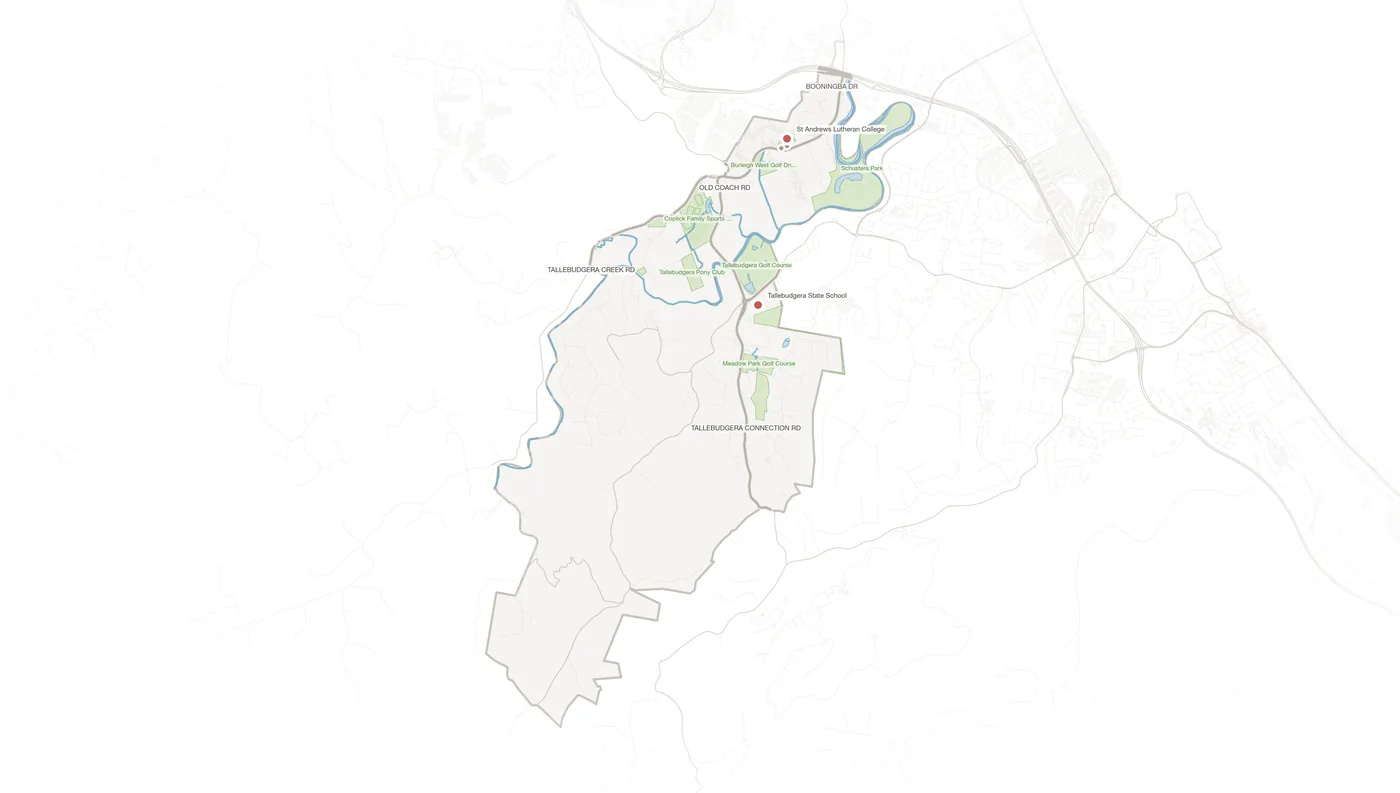
Explore Tallebudgera on the Map
View parcels, zoning overlays, DA applications, schools and more.
Open Interactive Map