Wanguri
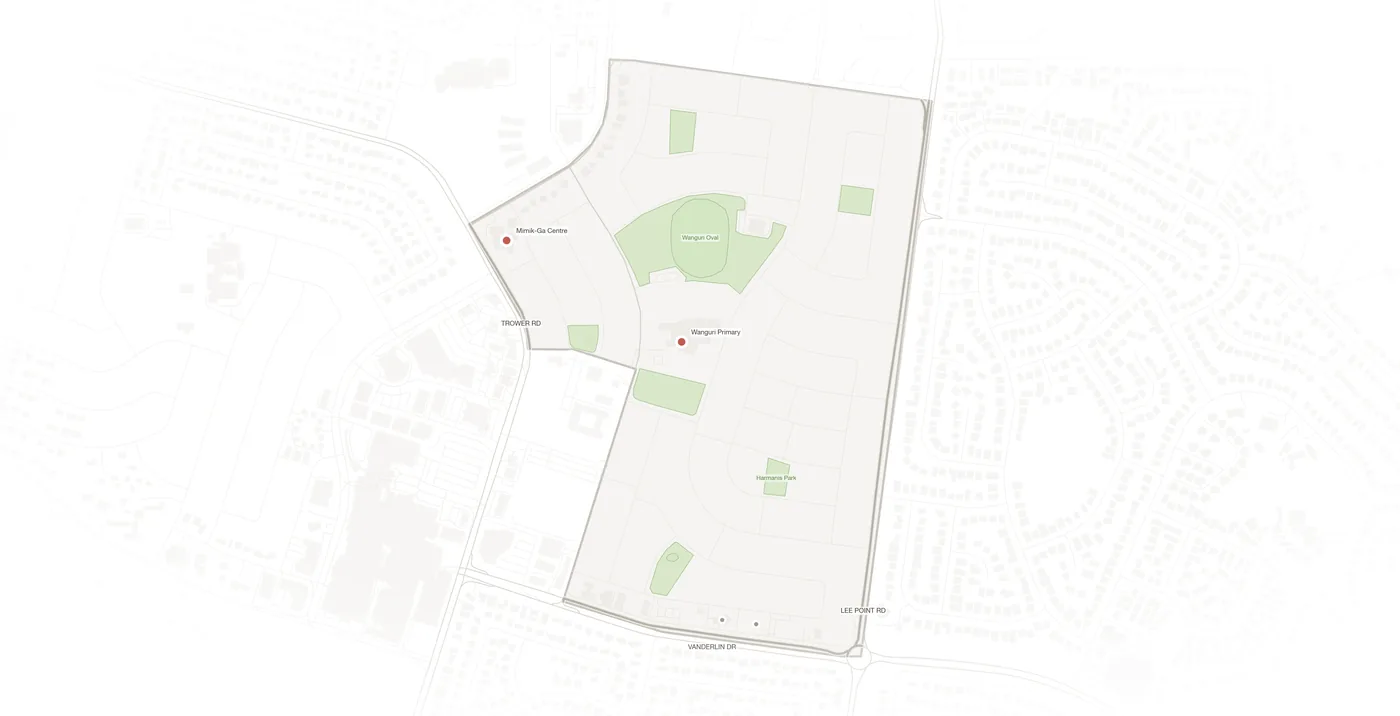
Household income in the 91.5th percentile nationally sets Wanguri apart from most Darwin suburbs, yet the median house price sits at a comparatively modest $480,000, making the income-to-price ratio unusually favourable. The 0.89 km2 suburb holds 1,836 residents at a density of 2,073 per km2. University qualifications reach 36.0%, which is 5.9 points above the national figure, and 30.6% of residents were born overseas, running 9.0 points higher than the national rate. Separate houses dominate at 91.1% of dwellings, and 42.3% of homes have four or more bedrooms, reflecting a family-skewed housing stock. The suburb carries an aging trajectory with senior share rising 3.3 points over the decade.
Population
1,836
Median Age
39.0
Household IncomeiMedian weekly household income (ABS Census)
$2,439/wk
DAs (12 months)iDevelopment Applications lodged in the past year
0
Median House
$480K
Estimated from rent (2025)
The median house price of $480,000 sits at an accessible level given that household income ranks in the 91.5th percentile nationally. Monthly mortgage repayments average $2,167, producing a mortgage-to-income ratio of 20.5%, well below the 30% stress threshold and lower than most capital city equivalents. Separate houses account for 91.1% of the stock, so buyers are largely choosing between detached homes rather than apartments. The bedroom profile leans large: 42.3% of dwellings have four or more bedrooms and 47.7% have three bedrooms, making the suburb well-suited to families. Outright owners represent 27.3% of residents, and 41.2% hold a mortgage, with only 31.5% renting, indicating a predominantly owner-occupier market rather than an investor-dominated one.
For Buyers
The median house price of $480,000 sits at an accessible level given that household income ranks in the 91.5th percentile nationally. Monthly mortgage repayments average $2,167, producing a mortgage-to-income ratio of 20.5%, well below the 30% stress threshold and lower than most capital city equivalents. Separate houses account for 91.1% of the stock, so buyers are largely choosing between detached homes rather than apartments. The bedroom profile leans large: 42.3% of dwellings have four or more bedrooms and 47.7% have three bedrooms, making the suburb well-suited to families. Outright owners represent 27.3% of residents, and 41.2% hold a mortgage, with only 31.5% renting, indicating a predominantly owner-occupier market rather than an investor-dominated one.
For Investors
Renters make up 31.5% of Wanguri households, with weekly rent at $410, which implies a gross yield of approximately 4.4% against the $480,000 median, higher than many comparable Darwin suburbs. The vacancy rate stands at 5.5%, elevated enough to warrant attention when assessing tenant demand. Net overseas migration averages 29 residents per year while internal migration runs at minus 38, so demand fundamentals depend heavily on Territory public sector and defence-related mobility rather than organic growth. Population has been broadly flat, moving from 1,932 in 2023 to 1,836 in 2025. Development activity shows zero applications in the past 12 months, consistent with an established suburb with little new supply pressure and limited speculative risk.
Schools in Wanguri iICSEA: school advantage index. 1000 = national avg, higher = more advantaged
Holy Spirit Catholic Primary School
T-6 · 243 students
Wanguri Primary School
T-6 · 327 students
Demographics
The median age of 39 is 1.0 year below the national figure, though the trajectory is aging, with the senior share rising 3.3 points and young-adult share falling 1.4 points over the decade. Overseas-born residents at 30.6% run 9.0 points above national, with ancestry dominated by English (438), Irish (179) and Scottish (151), while Greek is the most spoken non-English language with 54 speakers. University qualifications at 36.0% exceed the national average by 5.9 points, consistent with a public-sector and professional workforce. Average household size of 3.0 is 0.5 above the national average, and 680 couples with children outnumber 298 couples without, confirming a family-focused composition. Volunteering runs at 20.6%, above typical suburban rates.
Age Distribution
Bedrooms
Dwelling Structure
91.1%
Houses
N/A
Townhouse
8.9%
Apartment
Tenure
Wanguri is overwhelmingly a detached-house suburb, with 91.1% of dwellings being separate houses and just 8.9% apartments. Tenure leans toward ownership: 27.3% own outright, 41.2% carry a mortgage, and 31.5% rent, compared to the national renter share which is typically higher in established urban suburbs. The bedroom mix is family-sized: four-or-more-bedroom homes account for 42.3% and three-bedroom homes for 47.7%, leaving only a small share of smaller dwellings. Mortgage stress is not a feature here, with repayments at $2,167 per month representing just 20.5% of household income, well below stress levels. Rent-to-income sits at 16.8%, equally manageable. The vacancy rate of 5.5% is worth monitoring, as it suggests some slack in the rental market relative to available stock.
Mortgage / mo
$2,167
Rent / wk
$410
HH Size
3.0
Personal Income / wk
$977
Vacancy Ratei% of dwellings unoccupied on Census night (ABS 2021)
5.5%
Unoccupied
33
Rent / IncomeiMedian rent as % of household income. Over 30% = housing stress
16.8%
Mortgage / IncomeiMedian mortgage as % of household income. Over 30% = housing stress
20.5%
Community Profile
Languages Spoken at Home
Ancestry
Household Composition
20.8%
Couples, no children
1,432
Total families
Economy & Employment
Healthcare is the dominant industry at 22.8% of local workers (136 people), followed by Public Administration at 16.6% (99) and Education at 14.8% (88), a public-sector-heavy profile typical of Darwin suburbs near government and hospital precincts. Professional/Tech adds 7.0% and Construction 6.7%. By occupation, Professionals (243) lead, ahead of Clerical/Admin (113) and Managers (112). The unemployment rate is 4.2%, with 69.3% of employed residents working full-time. On SEIFA, the suburb scores decile 6 for relative disadvantage (IRSD) and decile 7 for advantage and disadvantage (IRSAD), placing it in the middle tier nationally. Real incomes fell 1.6% over the decade despite nominal income growth, reflecting Territory cost-of-living dynamics.
Unemployment
4.0%
Labour Force
1,083
Unemployed
43
Quarterly Trend
Source: SALM Dec-25
Socio-Economic Indexes (SEIFA)iABS index ranking suburbs from 1 (most disadvantaged) to 10 (most advantaged)
Full-time
69.3%
Part-time
26.5%
Participation
60.9%
Employed
854
Occupations
Top Industries
University
36.0%
Postgraduate
9.4%
Born Overseas
30.6%
Dwellings
571
Transport to Work
Car dependence is high, with 82.6% of residents commuting by car, while only 2.3% use public transport. Walking and cycling account for 7.0%, reasonable for a low-density suburban form. The IRSAD decile of 7 places Wanguri above the national median for combined advantage and disadvantage, and the IEO decile of 6 reflects the mixed but above-average education and occupation profile. No schools are recorded within the suburb boundary, so families depend on nearby institutions across the broader northern Darwin area. Only 4.8% of residents (80 people) need daily assistance, below what the aging trajectory might suggest. Rent-to-income at 16.8% keeps housing costs comfortable for tenants, and the community has a turnover rate of 28.2%, meaning 71.8% of residents stayed in the same area over five years, indicating reasonable residential stability.
Drive
82.6%
Public Transport
2.3%
Walk / Cycle
7.0%
Work from Home
N/A
Population Forecast
-0.21%/yr
(-4 people/yr)
EstablishedPopulation has edged from 1,932 in 2023 to 1,836 in 2025, a small decline, and the medium forecast projects a continued gentle fall to around 1,907 by 2031. Annual growth runs at minus 0.21%, or roughly minus 4 persons per year. The internal migration balance is negative at minus 38 per year, while overseas migration contributes plus 29, so the Territory's chronic outmigration pattern is the primary headwind. Over the longer 10-year horizon, population grew 3.3%, indicating the suburb is stable rather than declining sharply. Affordability has been steady, with mortgage-to-income holding near 42% across 2011 to 2021 with minimal change. The gentrification score is zero, consistent with an established public-sector suburb that is not undergoing price-driven neighbourhood change.
Historical + Forecast
Hamilton-Perry + Holt smoothing on ERP 2001-2025
Age Cohort Forecast
Primary Driver
Overseas Migration
Net Overseas / yr
+29
Net Internal / yr
-38
National Ranking iPercentile rank among ~15,000 AU suburbs. 90% = higher than 90% of suburbs
How Wanguri compares to ~15,000 Australian suburbs
Frequently Asked Questions
Is Wanguri a good suburb to live in?
Wanguri ranks decile 7 on IRSAD nationally, above the national median for combined advantage and disadvantage. Household income sits in the 91.5th percentile, mortgage stress is low at 20.5% of income, and 71.8% of residents stayed in the area over five years. The main limitation is high car dependence, with only 2.3% using public transport.
What is the median house price in Wanguri?
The median house price is $480,000 based on 2025 estimates derived from rent data. Weekly rent averages $410 and monthly mortgage repayments run $2,167, equating to a mortgage-to-income ratio of 20.5%, well below the 30% stress threshold. The gross rental yield is approximately 4.4%.
What schools are in Wanguri?
No schools are recorded within the 0.89 km2 Wanguri boundary in this dataset. Families rely on schools in surrounding northern Darwin suburbs. Despite no local schools, 36.0% of residents hold university qualifications, which is 5.9 points above the national average, reflecting the professional and public-sector workforce.
Is Wanguri safe?
Detailed crime statistics are not available for Wanguri in this dataset. As an indirect measure, the suburb scores decile 6 on IRSD (relative disadvantage), placing it in the middle tier nationally. Only 4.8% of residents (80 people) need daily assistance, and the unemployment rate is 4.2%, both consistent with a stable, low-disadvantage community.
Is Wanguri good for property investment?
Weekly rent of $410 against a $480,000 median implies a gross yield of around 4.4%, higher than most Sydney or Melbourne equivalents. The vacancy rate of 5.5% is elevated, so tenant demand should be checked carefully. Population is trending slightly down at minus 0.21% per year, with internal migration running negative at minus 38 per year, which limits capital growth expectations.
How is Wanguri's population changing?
Population moved from 1,932 in 2023 to 1,836 in 2025, a slight decline. Annual growth is minus 0.21%, or roughly minus 4 persons per year. Over 10 years the suburb grew 3.3%. Medium forecasts project around 1,907 residents by 2031. Internal migration is negative at minus 38 per year while overseas migration adds 29, a pattern common across Darwin suburbs.
What languages are spoken in Wanguri?
About 30.6% of residents were born overseas, which is 9.0 points above the national figure. English dominates and Greek is the most common non-English language with 54 speakers, followed by Urdu and Malayalam at 11 speakers each. Ancestry is primarily Anglo-Celtic, led by English (438), Irish (179) and Scottish (151).
How to read these comparisons
Phrases like "above the national average" reference the unweighted median across Australian suburbs with more than 1,000 residents, not population-weighted national figures. Suburb-level medians are more useful for ranking suburbs against each other; ABS census headlines are population-weighted (so dominated by Sydney and Melbourne) and can read very differently.
Current baseline (refreshed 2026-05-10): median age 40, university-educated 30.1%, born overseas 21.6%, average household size 2.5 people.
Data sources: ABS 2021 Census (demographics, income, tenure), state Valuer-General (house prices), Department of Jobs SALM (unemployment), ACARA (school ICSEA), state Crime Statistics agencies (offences), council DA portals (development applications). Population forecasts use a Hamilton-Perry cohort model calibrated to ABS ERP.
Explore Wanguri on the Map
View parcels, zoning overlays, DA applications, schools and more.
Open Interactive Map