Wondunna
At 98.6% separate house coverage and 79.2% of dwellings with four or more bedrooms, Wondunna is one of the most family-house-concentrated suburbs in the Fraser Coast region. The median house price sits at $488,000, and household income lands in the 68.2nd income percentile nationally, above average yet without the gentrification premium of coastal suburbs. SEIFA tells a more complex story: the IRSD decile of 2 flags relative disadvantage, while the IER decile of 4 reflects moderate economic resources, a gap explained by high homeownership (83% own or are paying off) combined with lower-income service sector employment. Population grew 43% since 2011, driven by internal migration of 373 people per year.
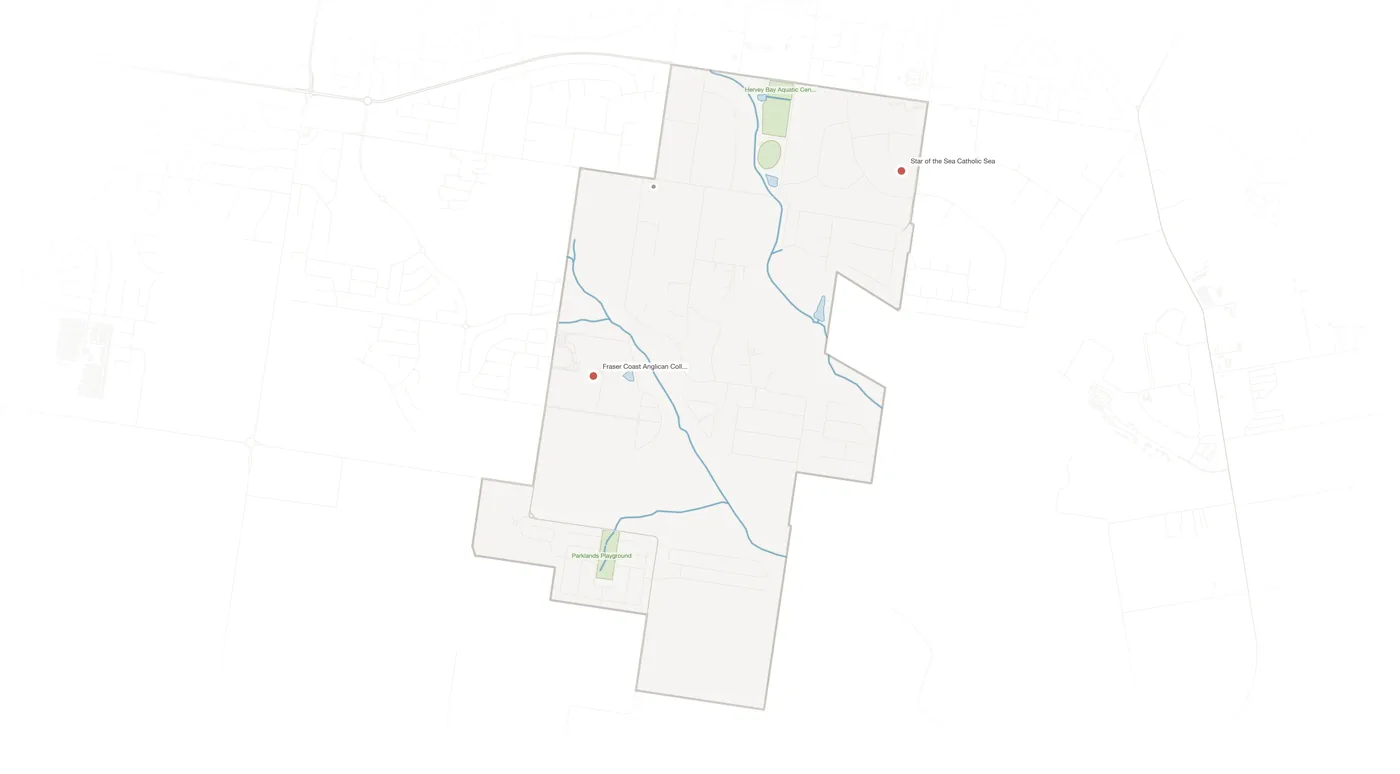
Population
3,315
Median Age
40.0
Household IncomeiMedian weekly household income (ABS Census)
$1,875/wk
DAs (12 months)iDevelopment Applications lodged in the past year
20
Median House
$488K
Estimated from rent (2025)
The median house price of $488,000 is estimated from rent data (2025) and reflects a market where mortgage costs remain manageable. Monthly repayments average $1,733, producing a mortgage-to-income ratio of 21.3%, well below the 30% stress threshold, and rent-to-income sits at 20.8%, both comfortable by national standards. The stock is almost entirely separate houses at 98.6%, with 79.2% having four or more bedrooms, so buyers looking for large family homes will find consistent supply here. Only 16.9% of dwellings are rented, compared to the national average, meaning the market is dominated by owner-occupiers: 37.8% own outright and 45.2% carry a mortgage. Buyers can enter at a price point lower than many QLD coastal suburbs while accessing four-bedroom stock.
For Buyers
The median house price of $488,000 is estimated from rent data (2025) and reflects a market where mortgage costs remain manageable. Monthly repayments average $1,733, producing a mortgage-to-income ratio of 21.3%, well below the 30% stress threshold, and rent-to-income sits at 20.8%, both comfortable by national standards. The stock is almost entirely separate houses at 98.6%, with 79.2% having four or more bedrooms, so buyers looking for large family homes will find consistent supply here. Only 16.9% of dwellings are rented, compared to the national average, meaning the market is dominated by owner-occupiers: 37.8% own outright and 45.2% carry a mortgage. Buyers can enter at a price point lower than many QLD coastal suburbs while accessing four-bedroom stock.
For Investors
A weekly rent of $390 against a $488,000 median produces an estimated gross yield near 4.1%, reasonable for regional QLD. The vacancy rate stands at 4.0%, elevated compared to the tight sub-2% national average, which means tenant competition is softer and landlord pricing power is limited. The renter pool at 16.9% is thin relative to national averages, reducing tenant depth. On the demand side, net internal migration averages 373 residents per year, the primary growth driver, and the medium forecast puts the broader SA2 population at 18,632 by 2031. The gentrification score of 54 puts the area in Active stage, with population up 43% since 2011 and accelerating. Development activity reached 12 applications in the past 12 months, modest but consistent with a low-density residential suburb.
Development Activity
Total DAs
36
Last 12 Months
20
YoY ChangeiYear-over-year change in DA lodgements
+566.7%
Avg DA CostiAverage estimated cost per DA in the past year
N/A
Monthly DA Lodgements
DA Categories
Schools in Wondunna iICSEA: school advantage index. 1000 = national avg, higher = more advantaged
Fraser Coast Anglican College
Prep-12 · 1010 students
Demographics
The median age of 40 matches the national figure exactly, placing Wondunna at the national average rather than above or below. However, the trajectory is aging: the senior share rose 9.4 points over the decade while the working-age share fell 4.6 points, a steeper shift than national trends. Overseas-born residents at 14.2% are 7.4 points below the national figure, and ancestry is predominantly Anglo-Celtic, led by English (1,429), Scottish (351) and Irish (300). University qualifications reach 24.3%, which is 5.8 points below the national rate, consistent with a trade and service economy. The average household size of 2.9 is 0.4 above national, and couples with children account for the largest family type at 1,232 households out of 2,858 total families.
Age Distribution
Bedrooms
Dwelling Structure
98.6%
Houses
1.4%
Townhouse
N/A
Apartment
Tenure
Wondunna's housing stock is unusually uniform: 98.6% are separate houses and 1.4% semi-detached, with effectively no apartments. The bedroom profile reinforces the family-home character, with 79.2% of dwellings having four or more bedrooms, and just 2.8% with two bedrooms. Tenure is homeowner-heavy: 37.8% own outright and 45.2% hold a mortgage, adding up to 83% owner-occupied compared to higher national renter shares. Only 16.9% rent. Monthly mortgage repayments of $1,733 and a mortgage-to-income ratio of 21.3% sit below the national average stress level. Housing stress indicators are both negative, with rent-to-income at 20.8% and mortgage-to-income at 21.3%, below the conventional 30% stress line. The 4.0% vacancy rate is above the tight-market average, suggesting some excess supply.
Mortgage / mo
$1,733
Rent / wk
$390
HH Size
2.9
Personal Income / wk
$765
Vacancy Ratei% of dwellings unoccupied on Census night (ABS 2021)
4.0%
Unoccupied
46
Rent / IncomeiMedian rent as % of household income. Over 30% = housing stress
20.8%
Mortgage / IncomeiMedian mortgage as % of household income. Over 30% = housing stress
21.3%
Community Profile
Ancestry
Household Composition
28.6%
Couples, no children
2,858
Total families
Economy & Employment
Healthcare dominates local employment at 28.1% (283 workers), nearly twice the share of the second sector, Education at 17.8% (179 workers). Construction follows at 11.4%, Public Admin at 8.2% and Retail at 6.0%. By occupation, Professionals lead with 324 workers, followed by Community and Personal Services at 225, Clerical and Admin at 189, Managers at 166 and Sales at 163. Full-time employment accounts for 63.4% of jobs, and the unemployment rate is 5.9%, above the national low-unemployment baseline but within a regional QLD context. The SEIFA IRSD decile of 2 and IRSAD decile of 2 indicate relative disadvantage nationally, driven by the service-heavy industry mix and below-average university education rates of 24.3%. Real income grew 13.5% over the decade, a positive sign despite the low SEIFA score.
Unemployment
4.1%
Labour Force
7,743
Unemployed
321
Quarterly Trend
Source: SALM Dec-25
Socio-Economic Indexes (SEIFA)iABS index ranking suburbs from 1 (most disadvantaged) to 10 (most advantaged)
Full-time
63.4%
Part-time
30.7%
Participation
59.7%
Employed
1,463
Occupations
Top Industries
University
24.3%
Postgraduate
4.0%
Born Overseas
14.2%
Dwellings
1,077
Transport to Work
Car dependency is very high, with 92.1% of residents driving to work, compared to lower rates in urban centres, and only 1.6% walking or cycling. Public transport data is not available for this suburb. No schools are recorded within Wondunna's 6.72 square kilometre boundary, so families depend on nearby Fraser Coast education facilities. Crime data is not available for this suburb at the SA2 level, making direct safety comparisons with the state average impossible. On socioeconomic measures, the IRSAD decile of 2 ranks Wondunna in the lower tier nationally, though mortgage and rent stress remain low at 21.3% and 20.8% respectively. Volunteering reaches 14.5% of residents, and 6.8% of the population (215 people) require daily assistance, a rate consistent with its aging trajectory.
Drive
92.1%
Public Transport
N/A
Walk / Cycle
1.6%
Work from Home
N/A
Population Forecast
+2.19%/yr
(+364 people/yr)
EstablishedPopulation in the broader SA2 grew 29.7% over ten years and is forecast to reach 18,632 by 2031, an annual growth rate of 2.19% or roughly 364 new residents per year. Internal migration drives 373 net arrivals annually, with overseas migration adding 86 more, making this one of the stronger internal migration destinations in the region. The gentrification score of 54 places the area in Active stage, supported by three signals: population up 43% since 2011, net internal migration of 373 per year, and a trajectory accelerating from 10% to 29% growth. Rent grew 35.3% over the period, outpacing real income growth of 13.5%, which has compressed affordability slightly from 62.8% in 2011 to 60.8% in 2021, though the trend reads as Stable. The aging trajectory is a moderate headwind, as the senior share is rising faster than working-age inflows.
Historical + Forecast
Hamilton-Perry + Holt smoothing on ERP 2001-2025
Age Cohort Forecast
Primary Driver
Internal Migration
Net Overseas / yr
+86
Net Internal / yr
+373
Gentrification Signal
Active
Population +43% since 2011, Net internal migration +373/yr, Accelerating: 10% → 29%
National Ranking iPercentile rank among ~15,000 AU suburbs. 90% = higher than 90% of suburbs
How Wondunna compares to ~15,000 Australian suburbs
Frequently Asked Questions
Is Wondunna a good suburb to live in?
Wondunna suits families seeking large separate houses at accessible prices. The median house price is $488,000 with mortgage-to-income at 21.3%, below the 30% stress threshold. The IRSAD decile of 2 reflects relative disadvantage nationally, but housing stress indicators are low and the suburb has grown 43% since 2011, signalling sustained demand.
What is the median house price in Wondunna?
The median house price is $488,000 (2025 estimate derived from rent data). Weekly rent averages $390, implying a gross yield near 4.1%. Monthly mortgage repayments average $1,733, and the mortgage-to-income ratio is 21.3%, well below the national stress benchmark of 30%.
What schools are in Wondunna?
No schools are recorded within Wondunna's 6.72 square kilometre boundary in this dataset. Families rely on schools in surrounding Fraser Coast suburbs. Despite no local schools, 24.3% of residents hold university qualifications, though this is 5.8 points below the national average.
Is Wondunna safe?
Detailed crime statistics are not available for Wondunna at the SA2 level. As a proxy, the suburb has a 6.8% rate of residents needing daily assistance (215 people) and a volunteering rate of 14.5%. The IRSAD decile of 2 indicates below-average socioeconomic advantage compared with the national distribution.
Is Wondunna good for property investment?
Weekly rent of $390 against a $488,000 median gives a gross yield near 4.1%, reasonable by regional QLD standards. The 4.0% vacancy rate is elevated compared to tight-market averages, limiting rent pricing power. Population is growing at 2.19% per year with 373 net internal arrivals annually, supporting long-term demand. The gentrification score of 54 indicates Active stage.
How is Wondunna's population changing?
The broader SA2 population grew 29.7% over the past decade and is forecast at 18,632 by 2031. Annual growth runs at 2.19%, equivalent to 364 new residents each year. Internal migration contributes 373 net arrivals annually, the primary driver. The suburb has an aging trajectory, with the senior share up 9.4 points and working-age share down 4.6 points over the decade.
How to read these comparisons
Phrases like "above the national average" reference the unweighted median across Australian suburbs with more than 1,000 residents, not population-weighted national figures. Suburb-level medians are more useful for ranking suburbs against each other; ABS census headlines are population-weighted (so dominated by Sydney and Melbourne) and can read very differently.
Current baseline (refreshed 2026-05-10): median age 40, university-educated 30.1%, born overseas 21.6%, average household size 2.5 people.
Data sources: ABS 2021 Census (demographics, income, tenure), state Valuer-General (house prices), Department of Jobs SALM (unemployment), ACARA (school ICSEA), state Crime Statistics agencies (offences), council DA portals (development applications). Population forecasts use a Hamilton-Perry cohort model calibrated to ABS ERP.
Explore Wondunna on the Map
View parcels, zoning overlays, DA applications, schools and more.
Open Interactive Map